
When “Growth” Meets Reality: A Shareholder’s Perspective on Q1 2026
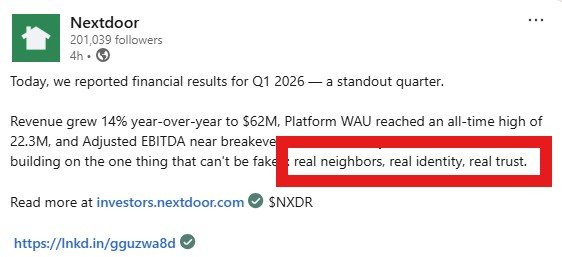
I didn’t tune into yesterday’s Q1 2026 Financial Results call.
Not because I’m uninterested—but because I’ve been here before. The pattern feels familiar: questions go unanswered, voices go unheard, and the narrative rarely shifts. At some point, listening starts to feel less like engagement and more like theater.
The reported numbers sound strong on the surface:
Weekly Active Users at an all-time high of 22.3M
Revenue at $62M, up 14%
EBITDA hovering near breakeven (down $0.2M)
On paper, that’s progress.
But as a shareholder, I’ve been watching something else unfold in parallel—market behavior.
Ahead of the Q4 and full-year 2025 call, the stock saw a lift. Then came the sell-off. Short-term investors didn’t see enough in terms of sustainable growth, stability, or long-term vision. We’re now seeing a similar pattern again: a rise to around $1.66 per share… followed by selling pressure.
The difference this time? The baseline is lower. We’re closer to sub-$1 territory than we were just a few months ago. Volatility remains, but confidence appears thinner.
And here’s the bigger question:
If investors are truly bullish on the company, why the sell-off?
Wouldn’t real confidence in the earnings call drive buying at what many would consider rock-bottom prices? Wouldn’t that conviction increase demand, lift share value, and reinforce belief in leadership’s long-term thesis—especially the vision outlined by Nirav Tolia?
Instead, the market reaction suggests hesitation. The broader market isn’t just listening to the message—it’s voting on whether it believes it.
Then there’s the question of trust in the metrics.
We’re told Weekly Active Users are increasing. Yet across platforms like Reddit and X, users consistently describe experiences that suggest disengagement—frustration with moderation, concerns about fairness, and suspensions that feel inconsistent or opaque. When local moderation begins to feel like a “personal domain” rather than a community service, it raises legitimate concerns about user retention and platform health.
That’s where independent validation becomes critical.
Without third-party auditing of key metrics, it’s difficult to align reported growth with observable user sentiment fully. Trust isn’t built through statements—it’s built through transparency.
Which brings me to the closing message from the company:
“…real neighbors, real identity, real trust.”
Those aren’t just brand pillars—they’re expectations.
“Real trust” means openness to independent verification.
“Real identity” means offering something distinct and defensible in a crowded landscape—not a repackaging of what already exists on platforms like Facebook or Discord.
“Real neighbors” means creating an environment that feels inclusive, not restrictive or arbitrarily controlled.
Because here’s the reality:
If trust has to be stated repeatedly, it’s probably being questioned.
And that’s the gap worth addressing—not just for shareholders but for the platform's long-term viability.
Subscribe to NielFlamm.com.
#Investing #StockMarket #ShareholderPerspective #CorporateGovernance #Transparency #Leadership #DigitalStrategy #UserExperience #Trust #Nextdoor
