
Caring for My Mother Without Running the Show
Yesterday, during meditation, I felt a conscious contact with a Power Greater than myself. I felt grounded and right-sized.
Then, before a conversation with another alcoholic, a few questions came up.
Are my motives pure when it comes to my mother? Am I doing God’s will?
Without a doubt, I want my mother to have the best experiences she can with whatever time she has here on Earth before moving on to the next dimension. I want her to have care, comfort, choices, and things to look forward to.
That part is clear to me.
But another question followed: Am I trying to exert my own will? Am I taking control? Is my ego involved?
Apparently, my ego also attended the meditation and hoped nobody would take attendance.
After prayer and discussion, I could acknowledge it: I am trying to run the show.
That is uncomfortable to admit, especially after writing so openly about my frustrations with my father. But if I’m willing to share my anger, I need to be willing to share my self-reflection, too.
I can deeply love my mother and still get caught up in wanting everything done my way. I can have good intentions and become attached to being the person who makes the decisions.
My concern for her is real. So is my responsibility to examine how I act on that concern.
I’ve written about money and control, and how I’ve experienced my father’s responses. Now I need to look at my own desire for control.
Whether my father is trying to run the show, appease his ego, or act from some other motive is not mine to judge. I don’t know everything going on inside him.
I am responsible for my actions.
That gives me plenty to work on without taking on a second job managing his spiritual condition.
For the moment, I’m going to relent. I’m going to loosen my grip on how this has to happen.
My mother has expressed that she wants assisted living. After that, the plan is Thailand with me for the 6+6. As long as her care and those plans are being funded, who manages the finances or makes the payments does not need to be the thing I fight over.
The resources need to be there. The bills need to be paid. My mother’s wishes need to remain part of the decisions about her life.
I can do my part: show up, listen, help with arrangements, ask questions, and follow through on my responsibilities.
Then I need to let God control the result.
I would love to report that I have mastered this and will never mentally grab the steering wheel again. Unfortunately, I know the driver.
This will take practice. More prayer. More honest conversations. More willingness to pause when I start confusing helping with directing every detail.
My boundaries with my father remain.
I have identified what I will accept in that relationship and what I won’t tolerate. Letting go of an outcome doesn’t erase those boundaries. I am still responsible for how I participate, what I agree to, and when I need to step back.
I won’t let fear of people or economic insecurity make those decisions for me. When fear shows up, I can bring it into prayer and talk about it honestly instead of giving it control over my behavior.
Today, I feel clearer about where my work is.
I love my mother. I want to help her have a life she enjoys. I can act with care and hold my boundaries while leaving room for things to happen without my direction.
I’ll do my part—and keep practicing the part where I let go.
Day 101: Our Data Is a Commodity. Why Are We Giving It Away?
Day 101.
Today I want to strip this Nextdoor discussion down to basic economics.
If I have something of value, another party uses it, and that use generates revenue, why shouldn't I share in the value created?
In this case, the commodity is information.
Reviews are information.
Recommendations are information.
Posts, comments, neighborhood observations, business experiences, and local knowledge are information.
Collectively, that's user-generated content.
And when a platform can aggregate, organize, analyze, and monetize that information, those individual contributions can become economically valuable.
We Call It “Content.” But It's Also an Economic Input.
Suppose I recommend a plumber on Nextdoor.
I supplied the experience. I paid to hire the plumber. I evaluated the work. I spent my time writing the recommendation.
Another neighbor reads it.
The plumber potentially gets business.
Nextdoor gets engagement and another piece of local knowledge stored within its platform.
Now multiply that by millions of neighbors and years of participation.
Suddenly, what looks like individual posts becomes something much more interesting:
An asset.
And with AI making it increasingly possible to organize, summarize, and extract useful information from enormous collections of human-created knowledge, that accumulated information may become even more useful.
I'm Not Saying Nextdoor Shouldn't Profit
Quite the opposite.
I'm a shareholder. I want Nextdoor to make money.
Nextdoor built the technology. It operates the platform. It employs people, develops products, sells advertising, and assumes the financial risk of running the business.
Nextdoor should benefit from the value it creates.
My question is:
Why does that automatically mean the neighbor gets zero?
If my contribution becomes part of something commercially valuable, why couldn't there be a model where:
Nextdoor wins.
Shareholders win.
Businesses win.
And the neighbors supplying the information win too.
I'm not suggesting every post deserves a royalty check.
But reviews, recommendations, local knowledge, research participation, and other user-generated information that contributes to commercial value?
Let's have that conversation.
Until Then, Maybe We Stop Supplying the Commodity
That's the idea behind my Neighbor Value-Sharing Petition.
The petition asks Nextdoor users to voluntarily stop providing new routine data, business reviews, recommendations, and other commercial user-generated content until Nextdoor develops a meaningful way for neighbors to participate in the revenue and value their contributions help generate.
It's not about withholding emergency information, safety alerts, missing-person information or other important community communication.
It's about the commodity.
If our information has value, perhaps we should stop giving that value away for free until there's a conversation about sharing it.
Read and sign the petition:
Then share it with another Nextdoor user.
Nextdoor Built the Container. Neighbors Keep Filling It.
A platform without people is software.
A review platform without reviews is an empty database.
A neighborhood network without neighbors sharing neighborhood knowledge isn't much of a neighborhood network.
Nextdoor built the container.
Neighbors keep filling it.
If what's inside that container can be monetized, I think it's reasonable for the people supplying it to ask:
Where's our share?
Until Nextdoor is willing to have that conversation, I'm asking neighbors to consider something incredibly simple:
Don't provide the commodity.
No new routine reviews.
No new business recommendations.
No additional commercial data.
Then let's see how valuable the commodity becomes when the people producing it decide they want to share in its value.
Our data. Our knowledge. Our time. Our value.
👉 Sign the petition:
https://c.org/GkNWmffgg9
👉 More of my continuing Nextdoor case study:
NielFlamm.com/blog
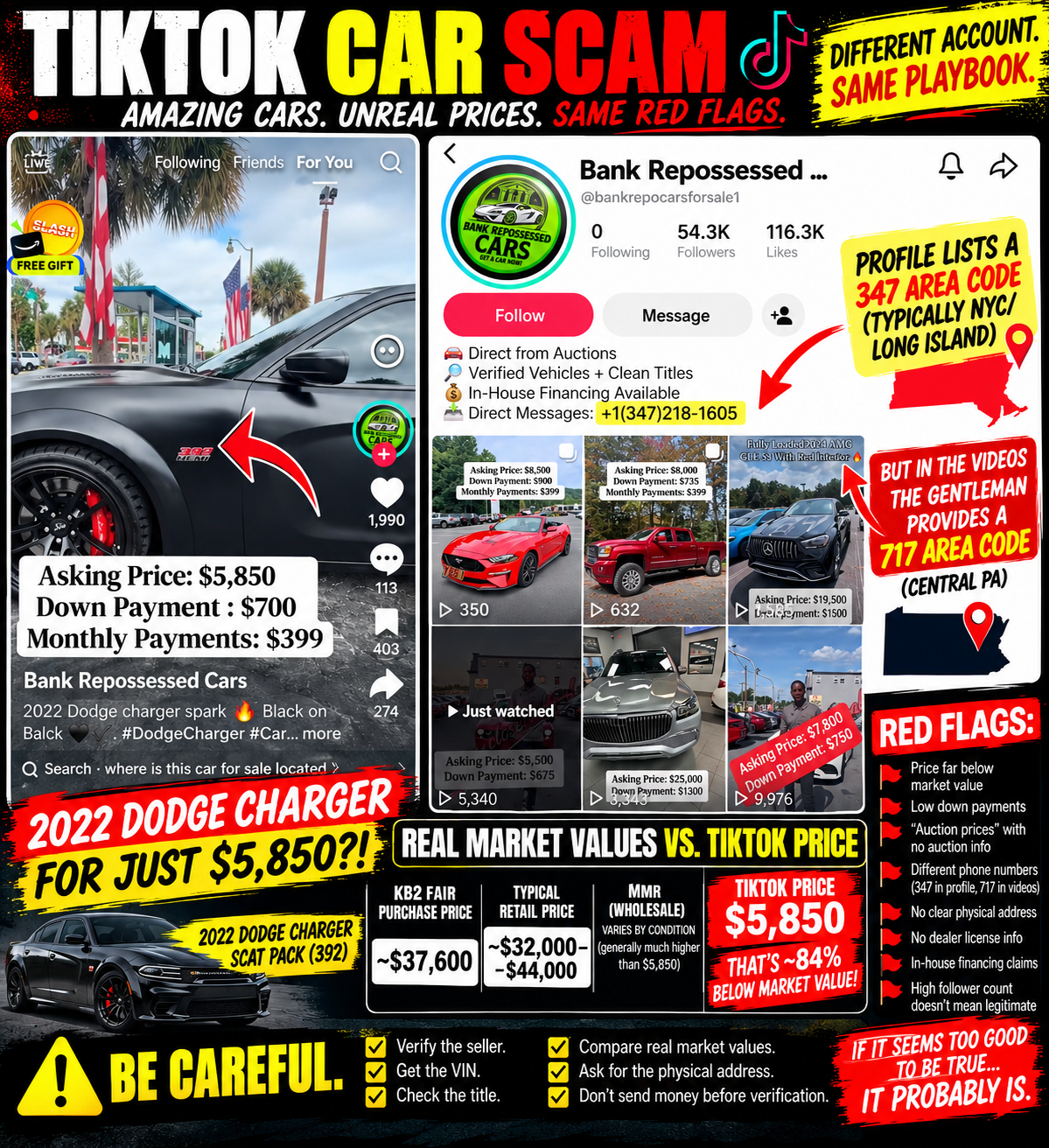
Another “Bank Repossessed” TikTok Car Deal — And the Phone Numbers Don’t Even Match
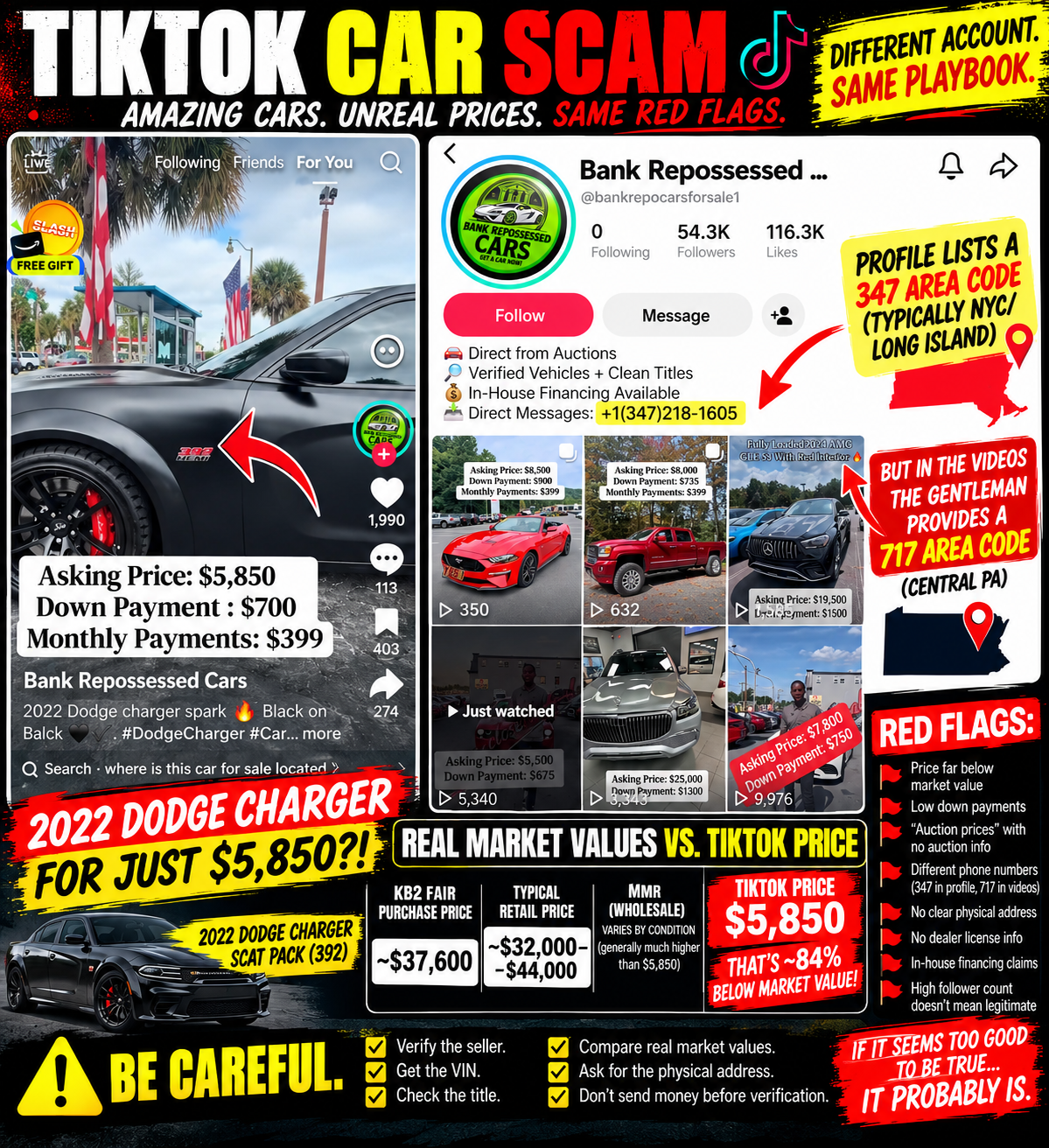
TikTok apparently still thinks I need a ridiculously inexpensive performance car.
The latest account to appear in my feed calls itself “Bank Repossessed Cars” and uses the handle @bankrepocarsforsale1.
At the time of my screenshot, the account had:
54,300 followers.
116,300 likes.
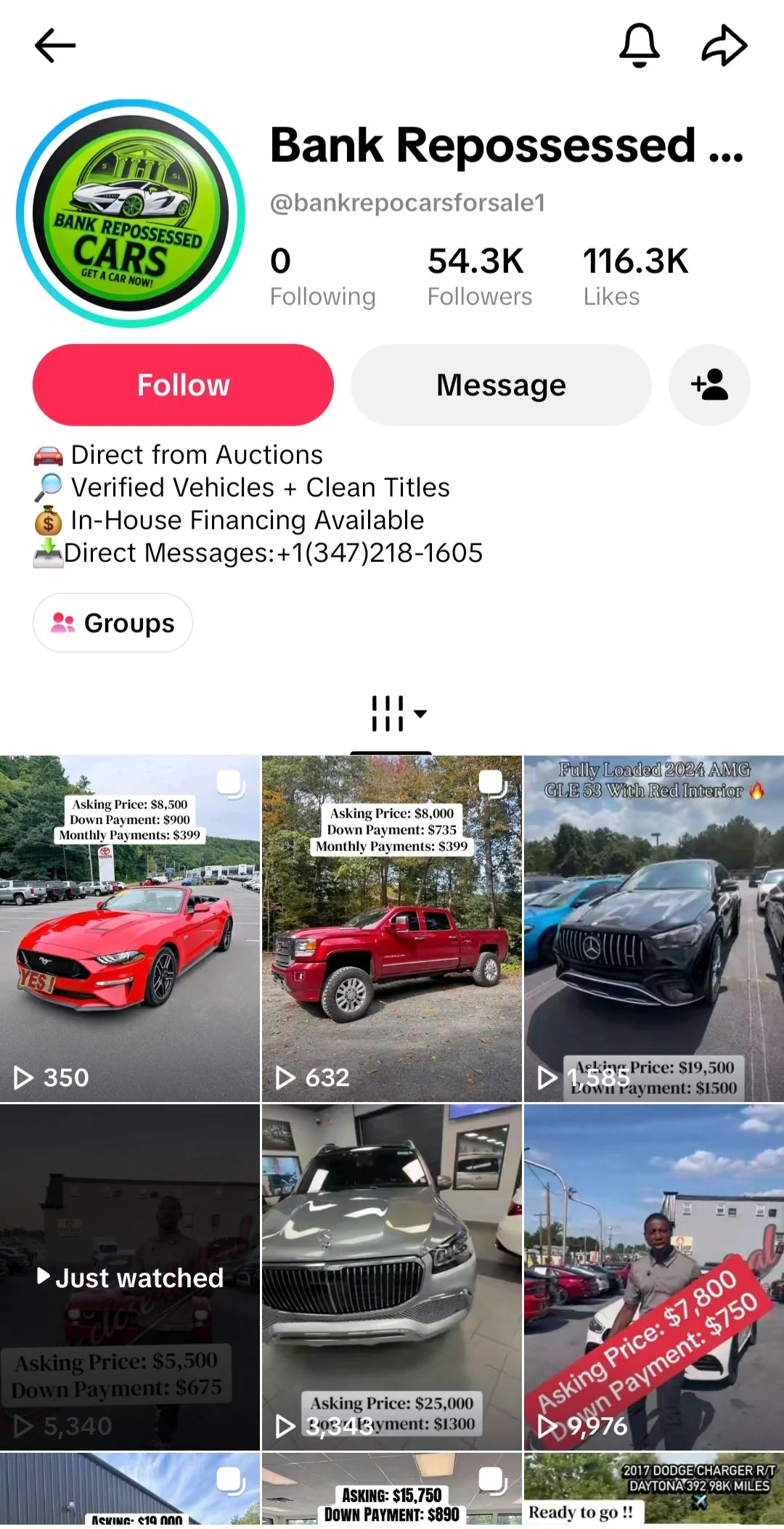
That's substantially larger than several of the questionable car accounts I've written about before.
The profile says:
🚗 Direct from Auctions
🔎 Verified Vehicles + Clean Titles
💰 In-House Financing Available
And then there's a telephone number for direct messages:
+1 (347) 218-1605
Sounds impressive.
Then I started watching the videos.
And once again, I have questions.
🚗 Today's Deal: A 2022 Dodge Charger for $5,850
The video that caught my attention shows what is described as a 2022 Dodge Charger with the following offer:
Asking Price: $5,850
Down Payment: $700
Monthly Payments: $399
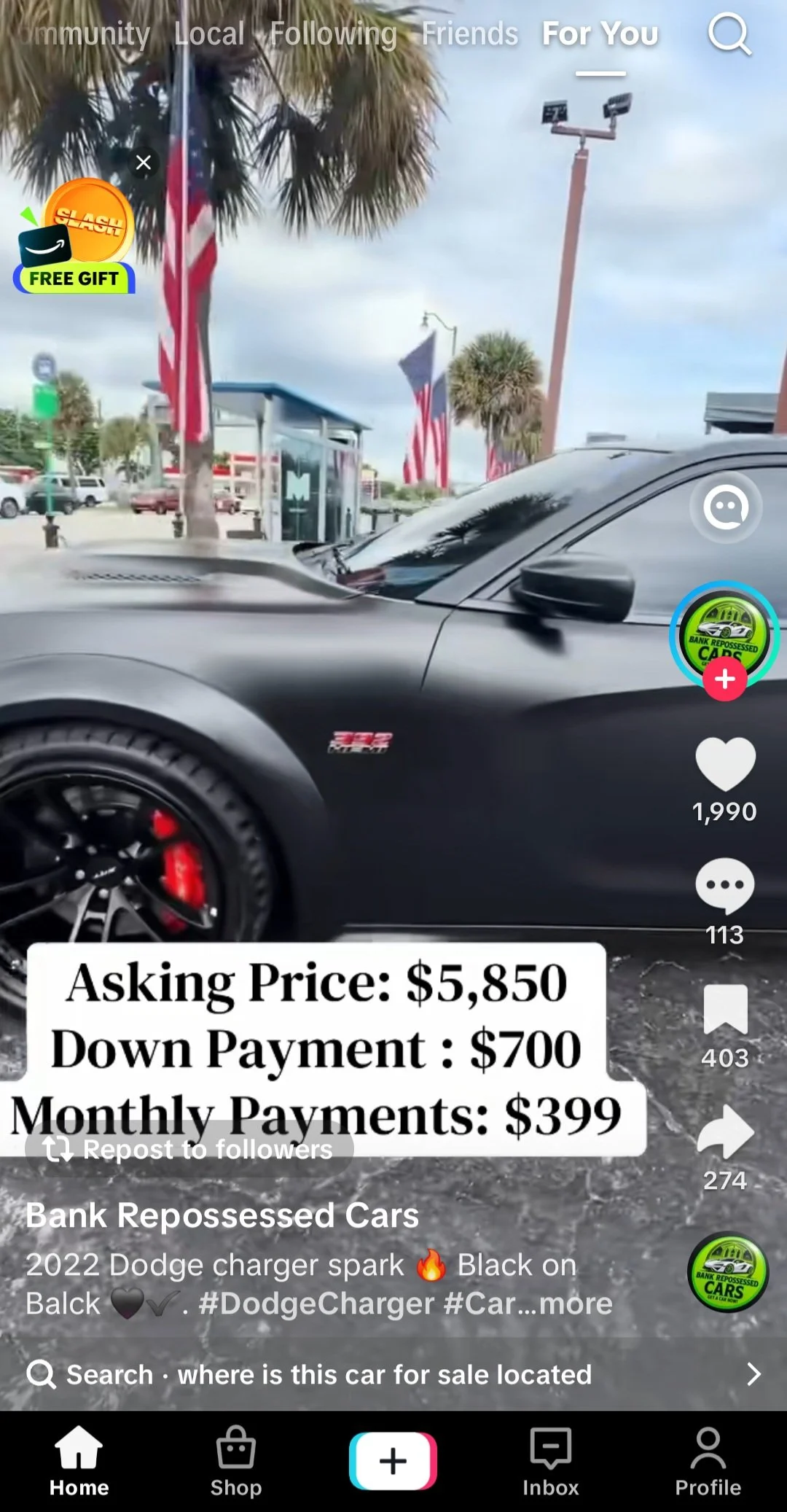
The caption describes it as a “2022 Dodge Charger spark”, although the vehicle shown appears to carry a 392 badge.
If this is actually a 2022 Charger Scat Pack/392, that $5,850 advertised price deserves a very close look.
Why?
Because the market numbers aren't even in the same neighborhood.
💰 Kelley Blue Book Says About $37,000 — Not $5,850
Kelley Blue Book currently puts the national Fair Purchase Price of a 2022 Dodge Charger Scat Pack around $37,600. KBB lists roughly $31,900 trade-in, $34,800 private-party, and $37,600 Fair Purchase Price for a good-condition example, while a Scat Pack Widebody is higher still at about $44,100 Fair Purchase Price. Exact values vary with mileage, condition, options, and location. Kbb.com
Edmunds tells a similar story: its current dealer-retail estimate for a regular 2022 Scat Pack ranges from roughly $32,300 in rough condition to $39,500 in outstanding condition. Edmunds
CARFAX's current listings put 2022 Charger Scat Packs at an average listing price of about $44,347, with its displayed range running roughly $36,747–$52,950. Carfax
TikTok?
$5,850.
That's roughly 84% below KBB's $37,600 Fair Purchase Price.
Maybe there's an explanation.
Fantastic.
I'd like to hear it.
🔨 But What About MMR and “Auction Prices”?
This account specifically promotes the vehicles as coming “Direct from Auctions.”
That's where the Manheim Market Report—or MMR—comes in.
MMR isn't the same thing as KBB retail value. Manheim describes MMR as a wholesale-market valuation based on actual vehicles sold through Manheim, with values that can be adjusted for factors such as odometer reading, selling region, condition grade and even color. Manheim
That's why I'm not going to invent an exact MMR for the Charger in this video.
I don't have its VIN.
I don't have verified mileage.
I don't have its condition report.
I don't have its auction location.
I don't have a current vehicle-specific Manheim report.
Without those things, saying, “The MMR is exactly $XX,XXX,” would be pretending to know something I don't.
But here's what we can compare.
KBB puts the Scat Pack's trade-in value around $31,900. JD Power estimates a trade-in base of around $31,250–$33,250, depending on condition. Those aren't MMR, but they're useful wholesale-side reference points. Kbb.com
So if this really is a clean-title 2022 Scat Pack being sold for $5,850, the question isn't simply:
“Is it cheaper because it came from an auction?”
The question is:
How did someone acquire a vehicle worth tens of thousands of dollars cheaply enough to retail it for $5,850?
“Auction” isn't a magic word that makes vehicle economics disappear.
📞 Then I Noticed the Phone Numbers
Here's where things became even more interesting.
The TikTok profile lists:
+1 (347) 218-1605
The 347 area code is associated with New York City, including the boroughs of Brooklyn, Queens, the Bronx and Staten Island. It's commonly encountered around the broader NYC/Long Island market, although an area code obviously doesn't establish where somebody currently lives or operates a business.
But I watched several of the account's videos.
The gentleman appearing in those videos provides a different telephone number—with a 717 area code.
The 717 area code serves south-central Pennsylvania, including Harrisburg, Lancaster, and York.
Again, people keep phone numbers after moving. Businesses can have multiple telephone numbers. VOIP numbers exist. None of this, by itself, proves anything improper.
But when I'm supposedly dealing with a business selling cars online, it's another question I'd want answered:
Why does the profile give me one phone number while the person in the videos gives me another?
And, more importantly:
What's the actual dealership?
Where is it physically located?
Which number belongs to that dealership?
Those should be remarkably easy questions for a legitimate automobile dealer to answer.
👀 And Look at the Rest of the Inventory
The Charger isn't alone.
The profile shows a Mustang advertised for:
$8,500 — $900 down — $399/month
A GMC pickup:
$8,000 — $735 down — $399/month
A Mercedes-AMG GLE 53 appears to be advertised around:
$19,500 — $1,500 down
Another vehicle:
$5,500 — $500 down
Another:
$7,800 — $750 down
There's even a vehicle shown around $25,000 with $1,300 down.
The scenery changes.
The dealerships and lots visible in the videos appear to change.
The vehicles range from ordinary transportation to expensive luxury and performance models.
Yet the formula remains remarkably familiar.
🚩 “Verified Vehicles + Clean Titles”
Great.
Verified by whom?
That's not sarcasm. That's an actual question I'd ask before buying.
If I'm buying one of these cars, give me the VIN.
Then I can verify the vehicle myself.
If it has a clean title, provide the documentation I need to confirm it independently.
If it came from an auction, tell me which auction.
If you're a licensed dealer, give me the legal business name, physical address, and dealer-license information.
If you're offering in-house financing, give me the written financing terms.
I don't need a green checkmark emoji.
I need documentation.
💳 $700 Down and $399 a Month — What's the Loan?
There's another mathematical problem worth examining.
The Charger is advertised at:
$5,850 purchase price
minus
$700 down
which leaves:
$5,150
If the payments really are $399 per month, $5,150 divided by $399 is only about 12.9 payments, before interest, taxes, fees, or anything else.
So what's the actual term?
What's the APR?
What's the amount financed?
What's the total of payments?
Who's extending the credit?
Are there additional fees?
If the actual vehicle costs $5,850, those should be straightforward questions.
If $5,850 isn't actually the total cash price, then I'd like to know what that number represents.
🚩 54,000 Followers Don't Answer Any of This
This account is bigger than many I've previously documented.
54,300 followers.
That's meaningful social proof.
Someone encountering the account might reasonably think:
They have 54,000 followers. They must be legitimate.
But we've been through this before.
Followers aren't a dealer license.
Likes aren't a title.
Views aren't a VIN.
A green checkmark emoji isn't vehicle verification.
And a real person standing beside a real automobile doesn't establish that the TikTok account displaying the footage owns that automobile or is authorized to sell it under the advertised terms.
🚗 A Real Car Still Doesn't Automatically Make the Offer Real
This has become a recurring theme in this series.
Some of these videos clearly contain actual cars.
Some appear to have been filmed at actual dealerships.
There are real salespeople.
Real parking lots.
Real transporters.
Real dealership signs.
That's persuasive imagery.
But the question isn't:
“Does the car in this video exist?”
It's:
“Does this TikTok account own or have authority to sell this exact vehicle for this exact price under these exact terms?”
Those are very different questions.
I'm not claiming the footage on this account was copied from somewhere else. I haven't established that.
But before sending a $700 deposit, I'd want to establish where the footage came from and whether the seller I'm communicating with is actually connected to that vehicle.
🏡 Be Careful — and Be a Good Neighbor
This is the part that matters most.
Imagine someone who has terrible credit.
Their car just died.
They need transportation Monday morning, or they risk losing their job.
Traditional dealerships have turned them down.
Then TikTok serves them:
2022 Dodge Charger
$5,850
$700 down
$399/month
In-house financing available
That doesn't necessarily look suspicious to someone in that situation.
It looks like hope.
That's why, if somebody you know is considering one of these deals, don't ridicule them.
Help them investigate.
Before sending money, get the VIN. Verify the title. Find the dealership's legal name and physical address independently. Verify the dealer license with the appropriate state regulator. Call a publicly listed number—not simply the number supplied in a TikTok profile. Get the complete financing agreement. Have the vehicle independently inspected. And compare the asking price with retail and realistic wholesale values.
If the seller won't let you do those things before sending a deposit?
Keep your $700.
Different Account. Same Questions.
I'm seeing this pattern often enough that I can practically write the checklist before opening the profile.
Extremely inexpensive desirable car.
Small down payment.
Low monthly payment.
“Direct from auction.”
“Clean title.”
“In-house financing.”
Private messages.
Phone numbers that raise additional questions.
And prices that appear wildly disconnected from ordinary retail values.
Maybe this account has a perfectly reasonable explanation for it all.
I'd be interested in hearing it.
Because based on the screenshot, a $5,850 2022 Charger that appears to be a 392, compared with a KBB Fair Purchase Price around $37,600 for a Scat Pack, is one heck of an explanation. Kbb.com
Until then:
Be careful. Verify everything. And don't let a $700 down payment make a $30,000 question disappear.
Follow the continuing series at NielFlamm.com/blog.
Coffee Chats with Donna: I Should Have Brought a Notebook
Today’s coffee delivery was a small Dutch Bros Americano with vanilla and cream.
And I have an update: my friend has a name.
Donna Woods.
She’s the woman I’ve been getting to know while visiting my mother at the skilled nursing facility. Our previous conversations have covered burgers, sweet tea, prosthetics, and enough pets to require a separate address book.
Today, the conversation continued. My ability to keep up did not.
I learned that her husband was a trash collector and later built a Toys “R” Us. Before I could get all the details, we had moved on to pecan ice cream, a strawberry shake, coffee and donuts, and Pensacola, Florida.
I believe that was the order. There may have been a connecting flight I missed.
I was still mentally standing in Toys “R” Us while Donna was already ordering dessert.
She had to be talking 200 words a minute. That’s my unofficial estimate. I didn’t have the equipment—or the processing speed—to verify it.
But I was enjoying myself.
I’m learning that I don’t need to capture every detail to enjoy a conversation with Donna. I can listen, follow what I can, and accept that I may leave with questions about how we got from trash collection to a strawberry shake.
Then Donna had things to do.
The 11 a.m. Coffee Chats were coming up, and she was rounding up people. She was meeting new residents, saying hello to nurses, and making sure people knew there was somewhere to go and someone to talk to.
I don’t know whether she has an official role in organizing any of this. From what I saw, she wasn’t waiting for a title.
Donna was working the room.
Watching her, I got to see another side of the friend I’ve been writing about. I’ve talked about the importance of stopping to listen and making time for people. Today, I watched Donna doing her own version of showing up: greeting people, introducing herself, and inviting them into a conversation.
She had a full social schedule, and she appeared ready to help everyone else acquire one.
I came into the facility because my mother is there. Along the way, I’ve found myself looking forward to these conversations, too. Each visit, I learn a little more about Donna—and see a little more of the community around Mom.
Today, that community included an enthusiastic recruiter and an 11 a.m. coffee appointment.
Next time, I may bring a notebook.
Although at Donna’s pace, I should probably learn shorthand first.
Meditation, a Whopper, and Four Words of Wisdom: Make Good Choices
Tonight, I went to a meditation meeting.
It’s a new meeting, and this was my first time attending. I’d heard awesome things about it; I knew the person guiding the group, and after the last few months—and especially the last week—I figured, why not?
I could probably use a little more conscious contact with the Spirit in the Fourth Dimension to help me be of maximum use to all humanity.
Apparently, immediately afterward, humanity was waiting for me at Burger King.
The meeting ended at 8:00 p.m., which was already way past dinner for me. I hadn’t eaten lunch either.
Correction.
I had half of a King Size Kit Kat bar for lunch.
So, nutritionally speaking, I was thriving.
I was going to make my usual Harris Teeter stop, but then I saw Burger King.
The King was calling.
I safely crossed two lanes of traffic to make the left because, at that particular moment, I wanted to have it my way.
I ordered a Whopper Jr., fries, and—of course—a Coke Zero. I also ordered a Rodeo Burger because I love the onion rings and BBQ sauce combo.
I was sitting there waiting for my food when I heard someone yelling.
I looked ahead, and this dude was waving his hands, obviously trying to get my attention.
I don’t remember everything he said before this, but I definitely heard:
“I just got out of the pen, and I’m hungry.”
I assumed by “the pen,” he meant prison.
Well.
Welcome back to society. Apparently, I was his Burger King ambassador.
The timing was also interesting.
I had recently talked with Sam Taylor (https://www.facebook.com/sam.peralta.18041), someone I previously led on a Learning & Development team, about my dating adventures—including the woman who wanted help paying her rent and then, after one date, her phone bill.
Sam and I talked about something we both tend to do: we don’t typically hand people money, but we’re willing to buy something they need.
That has generally been one of my boundaries.
I’ve also had a roommate who frequently said:
“I’m one paycheck from being homeless.”
I’ve never forgotten that.
I get it.
Part of my recovery is trying to be useful to other people while still maintaining boundaries.
So I told the guy I’d buy him something to eat.
I got my meal and tried to get the attention of the Burger King drive-thru dudes, who, by the way, were really nice.
I asked if I could order another meal.
Nope.
Apparently, once I reached the window, the sacred Burger King ordering process couldn't be disturbed.
I had to drive around again.
That seemed ridiculous.
But okay.
I asked the guy what he wanted to drink.
“Sprite.”
I told him:
“Don’t move. I have to drive around again.”
He started thanking me and told me he had a gift for me.
I immediately said:
“It’s all good, sir. No gift.”
Meanwhile, inside my head, several possibilities were being considered as to exactly what kind of “gift” a guy who had just gotten out of the pen might be planning to give me.
I decided I was good.
No gift necessary.
I drove around Burger King again, ordered him a Whopper meal with a Sprite, paid, got the food, and pulled forward to hand it to him.
He thanked me and told me he would “pay me back on the back end.”
I’m pretty sure I’m never going to see this guy again.
And that’s okay.
I didn’t buy him dinner because I expected him to pay me back.
Before I drove away, I left him with four words:
“Make good choices.”
He looked at me and said:
“Those are some words of wisdom. Make good choices.”
I wished him luck and drove away.
Then I ate my fries.
For me, that was the unexpected lesson at the end of tonight’s meditation.
I didn’t solve someone’s life. I didn’t give away everything I had. I didn’t abandon my boundaries.
I just bought a hungry stranger a Whopper and a Sprite.
I don’t know if he’ll remember the meal or those four words. I don’t know what happens next in his life.
I only know that tonight, he wasn’t hungry.
And tonight, I received another reminder that being of service doesn’t always happen where I expect it.
Sometimes I find the Spirit in the Fourth Dimension through meditation.
And sometimes...
I find it in the Burger King drive-thru.
I had it my way.
And hopefully, both of us will make good choices.