
People Don’t Buy Products — They Buy Connection. And That’s Where #Nextdoor Falls Short.
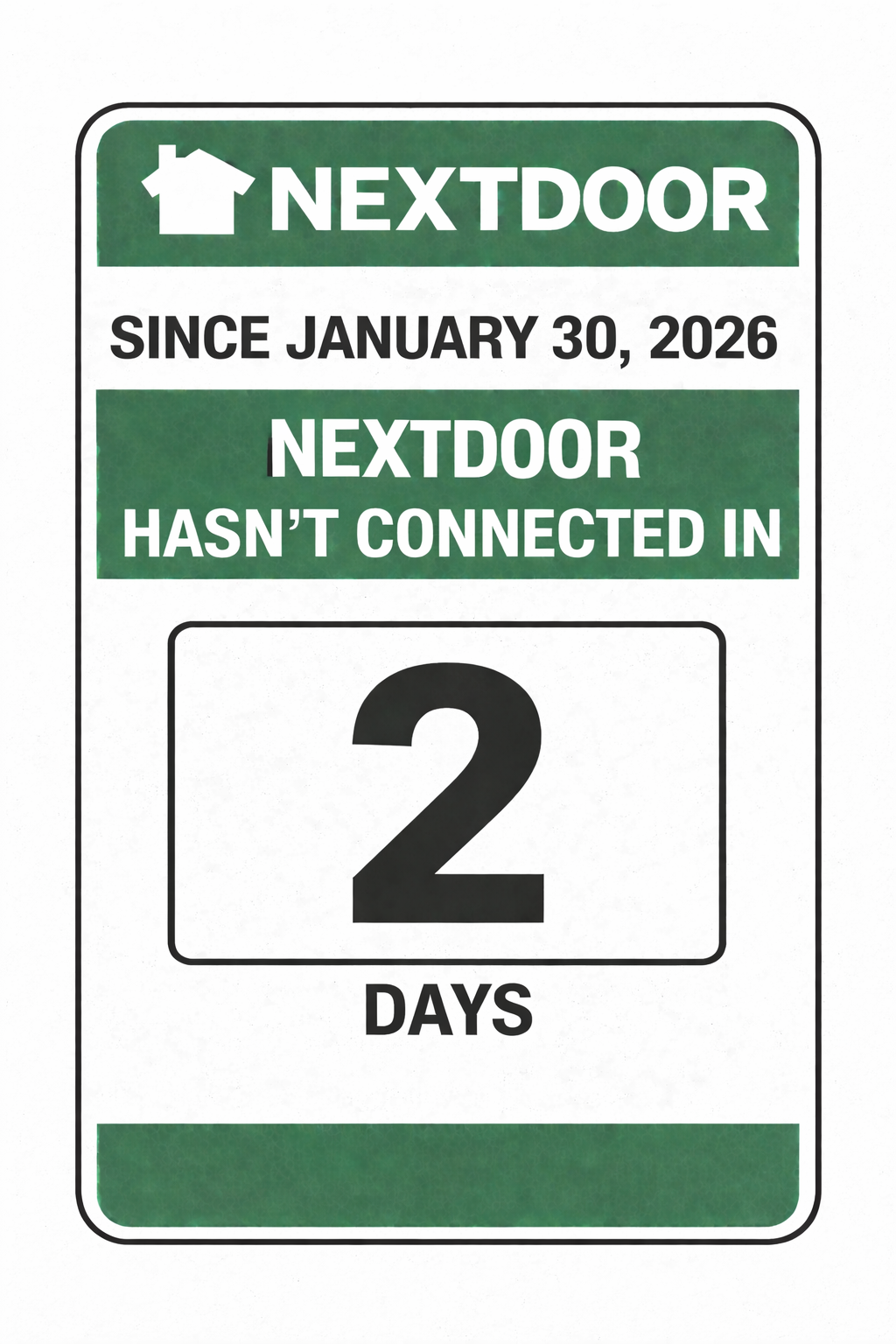
For decades, sales, marketing, and product leaders have understood two fundamental truths:
- People don’t buy products. They buy a connection.
- People buy when the perceived value exceeds the price.
These aren’t slogans. They are the foundation of every durable brand and every successful platform, which brings me to #Nextdoor.
#Nextdoor’s stated mission is to connect neighbors. On paper, that sounds compelling. In practice, when you compare Nextdoor to other social platforms, the value proposition collapses under scrutiny. Connection is the Product — Not the Pitch. Connection is not a marketing message. It’s a lived experience built through:
- Trust
- Transparency
- Consistent engagement
- Fair governance
- Predictable rules
Platforms like #Facebook, #LinkedIn, #X, and even niche community tools understand this. They invest in visible leadership, clear moderation frameworks, appeal processes, and measurable engagement.
#Nextdoor, by contrast, offers connection as a claim, not as a system.
Value vs. Price: The Imbalance
#Nextdoor is “free,” but users still pay a price:
- Time
- Attention
- Trust
- Risk of arbitrary suspension
- Lack of clarity on rules and enforcement
When users are suspended for selling items, asking questions, or criticizing the platform—without clear citations or transparent appeals—the perceived value drops to near zero. At that point, free becomes expensive.
Comparison to Other Platforms
When users evaluate platforms today, they don’t ask:
- “Is this local?”
They ask:
- Does this platform protect me as a user?
- Are the rules clear and consistently applied?
- Can I appeal decisions and get answers?
- Do leaders show up and communicate?
- Is feedback allowed, or punished?
On these dimensions, #Nextdoor consistently underperforms compared to larger, more mature platforms—many of which manage far greater scale and complexity.
Leadership Silence Erodes Value
Connection starts at the top. When a CEO positions himself as the steward of “neighbor connection” yet remains largely absent from public engagement, the signal is unmistakable. Silence is not neutral—it communicates avoidance, not leadership. Tagging #NiravTolia here is not personal. It’s structural. Leadership behavior sets cultural norms. And culture determines whether the connection is real or performative.
Why This Matters
People don’t stay on platforms because they’re told to. They stay because:
- The value is obvious
- The rules are fair
- The leadership is visible
- The connection feels mutual
Right now, #Nextdoor struggles on all four. If connection is truly the product, then governance, transparency, and engagement are not optional features—they are the core offering. Until those fundamentals change, users will continue to ask the same unavoidable question:
Why choose Nextdoor at all?
