

Day 156: Nextdoor Wants Your Contributions, Your Data, and Your Trust — But What Are Users Getting in Return?

Day 156 of asking questions about Nextdoor, its business practices, and the value it places on the people who make the platform what it is.
Today, I came across two LinkedIn posts that Nextdoor commented on. At first glance, they seem like ordinary corporate content: one about healthcare research and another about AI and workplace culture.
But when you look a little closer, both raise questions that fit right into the conversation I've been having about Nextdoor.
Let's start with the research.
Nextdoor Research: Whose Contributions Are Building the Story?
What Matters Most When Choosing a New Doctor? Here's What Nextdoor Research Finds
Nextdoor published a blog post on November 18, 2026, discussing how people choose healthcare providers.
The article reports that 89% of neighbors surveyed had looked for a new healthcare provider in the past year. It also says 72% of neighbors have used Nextdoor for local healthcare information.
There are some interesting findings:
34% used Nextdoor for local doctor recommendations.
34% used it to find nearby health events.
30% used it to find information about vaccines or flu shots.
29% used it to find local urgent care and walk-in clinics.
24% used it to find out whether local providers were accepting new patients.
But here's the part that caught my attention.
Nextdoor says its research combines a survey of 1,000 U.S. adults, conducted November 2–5, 2026, with platform data from U.S. posts and comments between November 2022 and October 2026.
The article also reports that approximately six in ten posts and comments about pediatricians, specialists, primary care doctors, and eye doctors involved neighbors asking for or giving recommendations.
In other words, the conversations happening on the platform helped build the research story.
And that's where I have a question.
What about the people who created those conversations?
The Users Are the Content
I've been talking about this for a while.
Platforms like Nextdoor don't magically produce useful local knowledge. The information comes from people.
People ask questions. They share experiences. They recommend doctors, restaurants, contractors, and businesses. They warn neighbors about problems. They post pictures, respond to comments, and participate in discussions.
That activity creates value.
Nextdoor can take those conversations, analyze patterns, combine them with survey results, and turn the findings into corporate research and marketing content.
And there's nothing inherently wrong with analyzing platform activity, as long as it's done responsibly and in accordance with applicable privacy commitments.
But there's a bigger question about the value exchange.
The users are providing the conversations. They're creating the content. They're building the community. They're supplying the local knowledge that makes the platform useful.
Nextdoor can package those contributions into insights it can use to build its brand, demonstrate its value, and support its business objectives.
What do the people contributing that value receive in return?
I'm not necessarily suggesting that every person who writes a comment should receive a check. That's not a practical model for every online community.
But I do believe platforms should explore ways to compensate creators, posters, and users whose contributions generate measurable commercial value.
That could include creator programs, revenue-sharing opportunities, recognition, rewards, or other meaningful ways of giving something back to the people who make the platform valuable.
The point is simple: the community isn't just the audience. The community is part of the product.

Where Is Jacob Chavis?
Another detail worth pointing out: Jacob Chavis isn't mentioned in this article.
That's notable given my previous request for the full research study and methodology behind Nextdoor’s research.
This particular article is credited to Team Nextdoor. It describes the survey and the platform data used, but it doesn't identify Jacob as the author or researcher.
I also don’t see a product pitch in this article. It's not an obvious attempt to sell a particular Nextdoor advertising product or service.
That's a distinction worth making.
The article focuses on research findings and how neighbors use the platform when making healthcare decisions.
But the absence of a sales pitch doesn't answer how Nextdoor uses its community’s contributions.
And it doesn't resolve my earlier questions about research transparency and methodology.
Nextdoor and AI: Is It a Threat or an Opportunity?
Now let's look at the second LinkedIn post.
Digiday: KERV.ai, Macmillan Publishers and Chomps Are Among This Year's Work/Life Awards Finalists
Digiday published this announcement on November 17, 2026, highlighting finalists for its Work/Life Awards.
Buried in the list of finalists for Best Use of AI in the Workplace is:
Nextdoor's AI Days: Building an AI-Native Workplace.
To be clear, this is a finalist listing, not an announcement that Nextdoor won the award.
Still, it raises an interesting question about the company's positioning around artificial intelligence.
I've heard Nirav Tolia discuss AI in ways that sometimes emphasize its potential downsides and the challenges it creates. At other times, the conversation shifts toward the opportunities AI presents and how companies should embrace it.
So which is it?
Is AI a threat to the way people communicate, interact, and build communities? Or is it a powerful tool that Nextdoor intends to use to transform its business?
It can certainly be both. AI can create risks while also offering meaningful opportunities.
But leadership needs to explain the strategy.
What exactly does an AI-native workplace mean at Nextdoor?
How is AI being used by employees?
Is it improving productivity or reducing operating costs?
Is it improving the experience for neighbors?
Is it helping advertisers get better results?
Is it improving moderation and reducing spam?
Is it creating new revenue opportunities?
How will shareholders know whether the investment is paying off?
Being nominated for an award is nice. Having an AI strategy is nice, too.
But investors should be looking for measurable business results, not just another corporate headline.
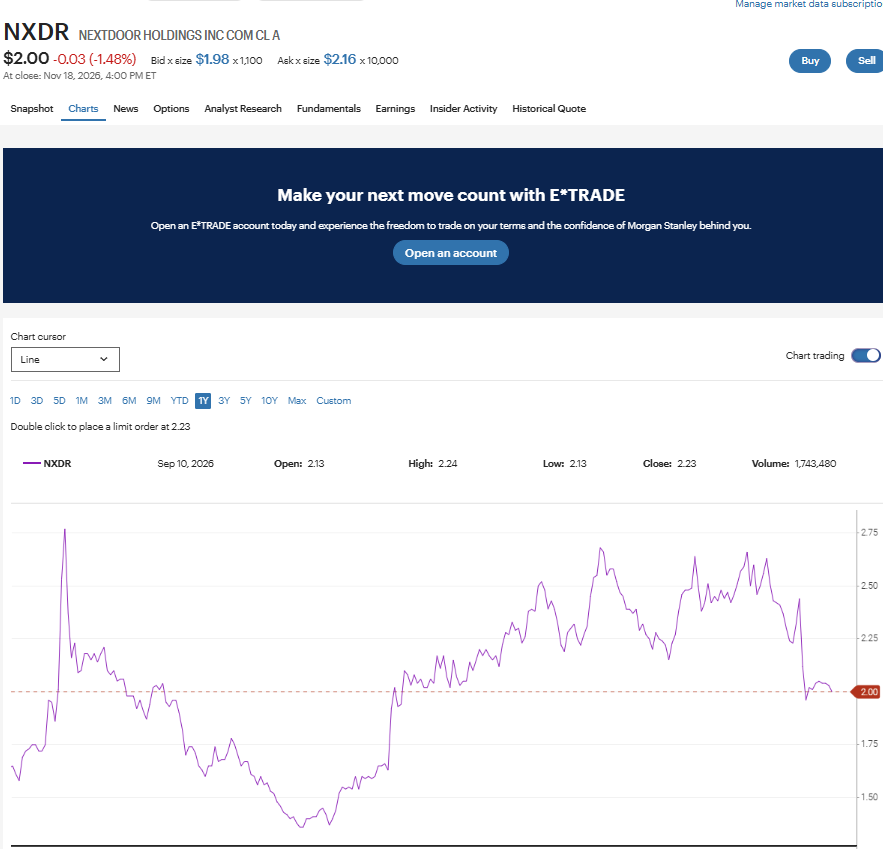
NXDR Is Down to $2—so Much for the Nasdaq Transition.
And then there's the stock.
NXDR is down to approximately $2, based on the latest price I'm looking at.
Remember all the attention surrounding the transition from the New York Stock Exchange to Nasdaq?
There was the ceremony, the celebration, the new chapter, and the suggestion that this move would position the company for the future.
But changing the exchange where a stock trades doesn't automatically change the underlying business.
A new ticker location doesn't fix monetization. It doesn't improve advertiser performance on its own. It doesn't create sustainable profitability. And it doesn't guarantee that investors will suddenly become more enthusiastic.
The Nasdaq transition may have strategic benefits, but those benefits have to translate into something tangible.
At some point, the company has to do the basics right.
Grow revenue. Improve monetization. Deliver value to advertisers. Build a better user experience. Control expenses. Demonstrate a path to profitability.
That's what builds business value.
Not ribbon cuttings. Not LinkedIn announcements. Not award nominations. And not simply moving from one stock exchange to another.
The Bigger Picture: Give Credit to the People Creating the Value
These two posts illustrate something I've been talking about throughout this series.
Nextdoor has a community that generates information, conversations, recommendations, and local knowledge. It also has an opportunity to use AI to improve its operations and business model.
Those are potentially valuable assets.
But the company needs to think carefully about the people behind those assets.
If user conversations help create research, acknowledge the importance of those contributions. If users and creators are generating commercial value, explore ways to share that value. If AI will transform the company, explain how it will benefit neighbors, advertisers, employees, and shareholders.
And if the company wants investors to believe in its future, show them the results.
I continue to want Nextdoor to succeed. I want the platform to be useful. I want neighbors to have a place to exchange information and help one another.
But success requires more than announcements and marketing.
The people create the community. The community creates the content. The content creates value.
Maybe it's time for Nextdoor to think about how some of that value gets shared.
Day 156. The research is published. AI is being celebrated. The Nasdaq transition is complete.
Now let's get back to the basics: build a better platform, reward the people who make it valuable, and deliver results that shareholders can actually see.