

Day 86: Is Nextdoor Laboring? Or Are We Back to Business as Usual?

Labor Day is over.
It's Day 86 of my continuing Nextdoor case study, and after wondering yesterday whether Nextdoor was taking an extended holiday weekend, I checked again today.
I haven't received any communication regarding the two detailed Insights studies I requested.
And NXDR?
As of this writing, it's hovering around the low $2.20s. Market sources were showing roughly $2.24 late this afternoon after Friday's $2.24 close, so the exact number is moving as I write this.
Hey, at least we're talking pennies now.
Is Nextdoor laboring?
I'm still trying to figure that out.
But something Nirav Tolia posted on X on September 3 caught my attention.
“A 2025 Study Found...”
In the post, Nirav wrote:
“A 2025 study found AI-generated fake reviews are now indistinguishable from real ones...”
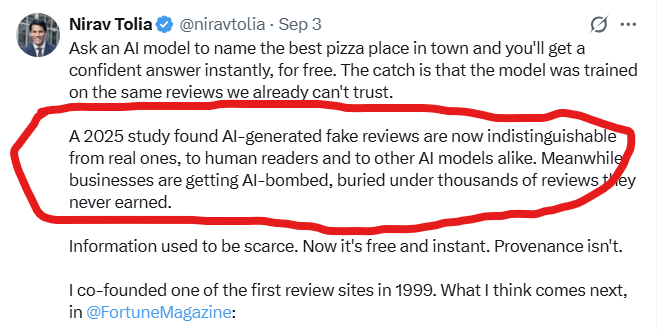
And immediately I thought:
Here we go again.
A study.
Which study?
Who wrote it?
Where was it published?
What was the methodology?
What was the sample size?
What exactly did “indistinguishable” mean?
This probably sounds familiar to anyone who has followed my 86-day adventure in Nextdoor research transparency.
Here's the interesting part: I looked, and there is identifiable research behind Nirav's statement.
In a Fortune piece published the same day, Nirav identified it more specifically as a 2025 study from Nottingham University Business School.
Peer-reviewed 2025 studies examine AI-generated fake reviews, including a Journal of Retailing and Consumer Services study analyzing 714,016 reviews and finding meaningful linguistic differences between AI-generated fake reviews, human-generated fake reviews, and authentic reviews.
So my criticism isn't:
“The study doesn't exist.”
My question is:
Why not cite it in the original post?
If you're going to use research to establish credibility, give readers enough information to evaluate the research themselves.
Study name. Authors. Publication. Link.
Four things.
Done.
Especially when you're the CEO of a company currently promoting the idea that provenance matters.
That's almost too perfect.
Fake Reviews Didn't Arrive With ChatGPT
Another part of this discussion bothers me.
AI didn't invent fake reviews.
AI made them faster, cheaper, and easier to produce at scale.
Humans have been manipulating reputations for a very, very long time.
In fact, the history is pretty entertaining.
1800s: Walt Whitman anonymously published glowing reviews of his own Leaves of Grass. That's essentially the 19th-century version of creating a burner account and giving yourself five stars.
Early 1900s: Newspapers were already dealing with fabricated information, exaggerated claims, and “fakers.” By 1913, the New York World had established a Bureau of Accuracy and Fair Play partly to address complaints and “stamp out fakes and fakers.”
Pre-internet advertising: Businesses used testimonials and endorsements as marketing tools, creating the same fundamental problem we face today: Is this person recommending the product because they genuinely love it—or because somebody benefits from the endorsement?
Early Internet: Message boards, review sites, and eventually e-commerce let businesses and individuals create accounts and manufacture praise—or attack competitors.
Ironically, Nirav himself co-founded Epinions in 1999, one of the early user-generated review platforms. He now acknowledges that the review economy eventually became vulnerable to manipulation.
2010s: Fake-review businesses became an industry. Businesses could purchase positive reviews, competitors could be attacked with negative ones, and reviewers could operate multiple identities.
2020s: Review farms became increasingly sophisticated. Investigators found coordinated reviewers praising unrelated businesses across countries, with identical reviews sometimes appearing under different names.
Today: Generative AI has dramatically changed the economics. Instead of paying humans to crank out hundreds of reviews manually, someone can rapidly generate enormous quantities of convincing text. Research now shows LLMs can produce deceptive reviews with human-level capabilities, even though researchers can still statistically identify some linguistic differences.
Same scam.
Much better machinery.
Which Brings Me Back to Nextdoor
Nextdoor's current pitch is that verified identity and neighborhood accountability can make recommendations more trustworthy.
That's an interesting strategy.
But verification alone doesn't make an opinion truthful.
A real person can exaggerate.
A verified person can have a grudge.
A real neighbor can recommend their friend's company.
A legitimate customer can receive an incentive.
Two verified neighbors can have completely different experiences with the same business.
And, as I've previously documented, I've had my own questions about how robust Nextdoor's verification system actually is.
So “verified” is a trust signal.
It isn't a magical truth serum.
Provenance Matters? I agree.
That's actually what makes Nirav's post so interesting.
His broader argument is essentially:
Where information comes from matters.
I agree.
Completely.
Which is why when the CEO says:
“A 2025 study found...”
I want the provenance.
Name the study.
Name the researchers.
Link to it.
Let readers inspect it.
And that's precisely what I've been asking Nextdoor to provide regarding its own research.
For 86 days.
Nextdoor published Insights findings.
Nextdoor publicly told readers they could request detailed data.
I requested it.
I've emailed.
I've followed up.
I've expanded the distribution.
I sent another request Saturday.
And I'm still waiting for the two detailed studies.
Day 86
Yesterday was Labor Day.
Today I'm asking:
Is Nextdoor laboring?
Because I'm still doing the work.
Waiting for somebody at Nextdoor to answer the questions.
Nirav's post argues that provenance matters.
On that, we agree.
So here's my Day 86 suggestion:
Practice it.
When you cite research, show us the research.
When Nextdoor publishes research, show us the methodology.
When your own blog tells readers they can request detailed data, provide the detailed data—or explain why you won't.
Because whether we're talking about a restaurant review, an AI-generated recommendation, or a corporate Insights report, the principle is the same:
Don't just tell me to trust it. Give me enough information to decide whether to trust it.
Follow the continuing Nextdoor case study at NielFlamm.com/blog.

Nextdoor Has an AI Day. Maybe It Needs a Communication Day.
I came across an interesting HR Brew article about Nextdoor's HR team dedicating one full day every month to AI experimentation.
Full article:
https://www.hr-brew.com/stories/nextdoors-hr-team-halts-people-work-once-a-month-and-dedicates-the-day-to-ai
First, credit where it's due.
As someone with a Learning & Development background, I like this idea.
Nextdoor Head of People Tony Castellanos told HR Brew that the HR team clears its calendars one day each month—no meetings, interviews, or reports—so employees can experiment with AI and build solutions.
That's experiential learning.
That's giving employees permission to experiment, iterate, and learn.
I can get behind that.
But given everything I've been documenting about Nextdoor, another thought immediately crossed my mind:
Could we dedicate one day to communication?
I've spent more than two months trying to obtain a Nextdoor Insights study from Jacob Chavis.

I've contacted Jacob, Nirav Tolia, Sarah Leary, Investor Relations, and Communications.
Then Nextdoor published another Insights report directing readers who want detailed information to—you guessed it—Jacob Chavis.
I followed those instructions again.
Short email. Kinder, gentler reset. Two studies requested.
I'm still waiting.
That's why this article fascinates me.
Nextdoor can pause routine HR work for an entire day each month so employees can explore AI.
Great.
But technology doesn't solve every organizational problem.
Sometimes the solution isn't another AI agent.
Sometimes it's:
"Hey, somebody answer that email."
HR Brew also reports that Nextdoor's "People Brain" reviews content published to public channels to help ensure messaging and policy align with the People team's core content.
Now that makes me curious.
If AI is helping evaluate Nextdoor's public messaging, I'd love to know what it thinks about:
Community without conversation.
Communication posts with comments disabled.
Research advertised as available while requests go unanswered.
A shareholder spending more than two months asking for an answer.
Maybe those aren't AI problems.
Maybe they're leadership and execution problems.
I've repeatedly said I want Nextdoor and NXDR to succeed. I'm a shareholder. Financially, that's in my interest.
AI Days could genuinely improve efficiency.
But innovation shouldn't distract from the basics.
Artificial intelligence is impressive.
Answering an email doesn't require it.
Perhaps alongside AI Day, Nextdoor should try a Communication Day.
I'll volunteer my inbox for the pilot.
Full timeline at NielFlamm.com/blog.

SOULM8TE: AI, Obsession... and a Familiar Story?

SOULM8TE puts a new spin on AI companionship, but while watching it I couldn't shake the feeling that I'd seen this story before.
In my latest movie review, I compare SOULM8TE to Subservience, Her, and especially the 1995 The Outer Limits episode "Valerie 23." Was Blumhouse's latest thriller worth the watch, or did an old TV episode do it better?
🎬 Watch my full SOULM8TE review at:
https://NielFlamm.com/videos/moviereviews
Then check out Valerie 23 and decide for yourself:

Nextdoor’s Identity Question: Community Platform or Data & Advertising Company?

I continue to look more deeply into Nextdoor, not only as a shareholder but also as someone trying to understand its long-term vision, strategy, and execution.
Nextdoor recently released its 2026 Back-to-School Research, which discusses today’s parents, the importance of neighborhoods, local recommendations, and how communities support each other.
On the surface, this aligns with the message CEO Nirav Tolia often shares — building connection, strengthening communities, using AI to improve the neighbor experience, and bringing people together.
I support that mission.
The challenge is that the messaging starts to feel contradictory when compared to other leadership conversations.
In a recent interview, Chief Revenue Officer Michael Kiernan discussed Nextdoor’s future revenue strategy, AI transformation, and new monetization opportunities.
He discussed how Nextdoor has over 110 million people on the platform, and how the company understands neighbors — where they live, their interests, their communities, and how they engage. He also discussed how the “neighborhood graph” could become a monetization asset.
From a business perspective, I understand this.
Nextdoor is a publicly traded company. It has shareholders. It has expenses. It needs sustainable revenue.
Advertising, partnerships, AI efficiency, and new revenue streams are expected parts of running a technology company.
But here is where I continue to ask questions:
Where does the neighbor fit into the equation?
If surveys and neighbor insights are valuable enough to promote to advertisers, partners, and the public, shouldn’t the full research methodology be transparent?
How many people participated?
How were participants selected?
What were the demographics?
What questions were asked?
What was the complete data set?
Today marks Day 22 since I requested the full research information from Jacob Chavis regarding previous Nextdoor studies.
No full study.
No methodology.
No response.
That is where trust becomes difficult.
A company cannot talk about transparency, trust, and an authentic community while also controlling which information neighbors and investors are allowed to see.
The bigger question:
Is Nextdoor a neighborhood platform that creates revenue opportunities by connecting people?
Or is Nextdoor becoming a data and advertising company powered by neighbor activity?
Those are two very different stories.
Maybe the answer is somewhere in the middle — but that requires transparency.
Neighbors deserve clarity.
Advertisers deserve clarity.
Shareholders deserve clarity.
Trust is not created through messaging.
Trust is created through actions.
Join the discussion on NielFlamm.com.

Day 21: AI Talk vs. AI Execution

Today marks 21 days since I requested the report referenced on blog.nextdoor.com, in which Jacob Chavis of Nextdoor (jchavis@nextdoor.com) was listed as the contact for the full study.
Why did I request it?
Simple.
I wanted to understand the details behind the research:
What methodology was used?
What was the sample size?
What demographics were represented?
How was the data collected?
Basically, is this a meaningful research study or more of a FAMILY FEUD survey board?
It’s now been three weeks.
I’ll give some grace—it is Sunday, the weekend, and right after celebrating the 250th birthday of the United States of America.
However, throughout my career, as a manager and even before moving into leadership roles, responsiveness mattered. I monitored communication through company tools and responded when something required attention.
Now, compare that experience with one I recently had.
I use the Dexcom Stelo CGM to monitor my blood glucose levels. Since I’m not insulin dependent, I don’t qualify for a traditional Dexcom CGM under my UnitedHealthcare requirements, but Stelo helps me manage important health information.
Recently, my sensor session ended 8 days early.
That matters because consistent monitoring helps me understand if my glucose is trending too high or too low.
I had just received my regularly scheduled replacement, so I was able to swap sensors—but that meant I would eventually be short.
What happened next?
I used the Stelo chatbot.
It asked questions.
Created the incident.
Guided me through the process.
I filled out the required information.
Less than 24 hours later, a replacement CGM was on the way.
That made me think:
Why isn’t Nextdoor using AI like this?
A real-time AI assistant could help with:
Neighbors experience issues.
Moderation questions.
Suspension appeals.
Advertiser concerns.
Basic customer support.
Nirav Tolia frequently discusses AI as part of Nextdoor’s future.
The question I continue asking is:
Where is the execution that directly improves the user experience?
Talking about AI is easy.
Implementing AI where customers actually feel the impact is the difference.
Read more and join the discussion at NielFlamm.com