
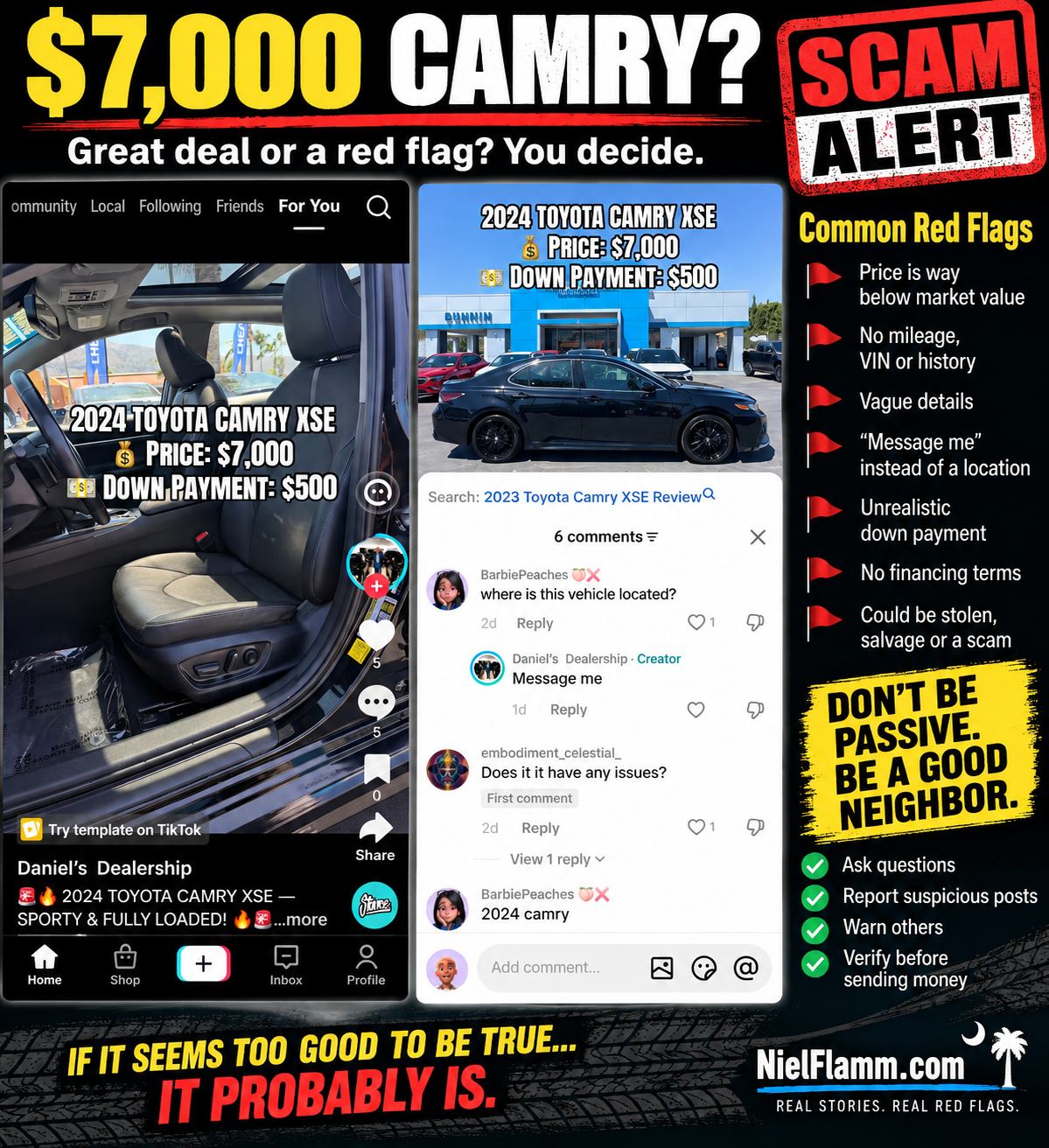
A $7,000 2024 Toyota Camry XSE? TikTok’s $500 Down Car Deal Is Back
At this point, I think TikTok believes I’m shopping for a car.
I’m not.
But the algorithm apparently knows I enjoy looking at vehicle offers that make me stop scrolling and say:
“There is absolutely no way.”
We've already had the $6,800 Camry. Then the $5,000 Honda Accord. Then the brand-new 2026 Toyota RAV4 Plug-In XSE advertised for $8,500.
Now we have another contestant.
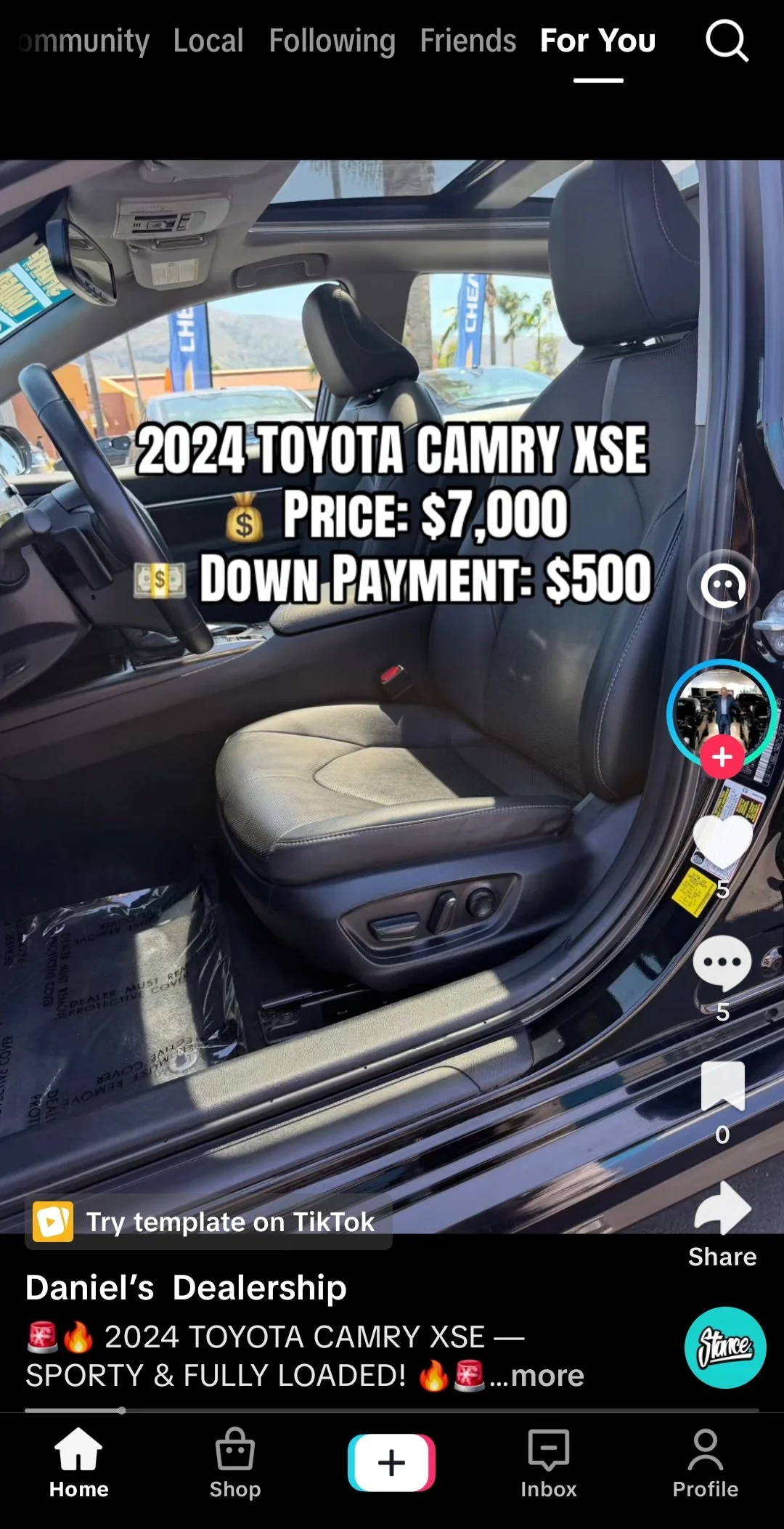
According to a TikTok posted under the name “Daniel’s Dealership,” this is a:
2024 Toyota Camry XSE
Price: $7,000
Down payment: $500
And the caption adds:
“SPORTY & FULLY LOADED!”
Well, fantastic.
Where do I send my $500?
Actually, don't answer that.
🚩 Let's Start With What This Car Is Actually Worth
The advertised price immediately caught my attention, so I checked current values.
Kelley Blue Book currently puts the Fair Purchase Price of a used 2024 Toyota Camry XSE at about $28,000 nationally. Depending on condition, KBB estimates trade-in value around $21,620–$24,920 and private-party value around $23,590–$27,190. Kelley Blue Book
So let's compare:
TikTok: $7,000
KBB Fair Purchase Price: approximately $28,000
That's not a small discount.
That's about 75% below KBB's current Fair Purchase Price.
Even more interesting: Toyota's original base MSRP for a 2024 Camry XSE was $31,720. The XSE AWD started at $33,120 and the XSE V6 at $36,845. Toyota
In other words, we're being presented with a relatively recent Toyota—one of the more desirable Camry trim levels—for less than many dealerships would expect to receive simply by trading one in.
Could a $7,000 Camry exist?
Of course.
Maybe it's wrecked.
Maybe it has a salvage title.
Maybe it has extraordinarily high mileage.
Maybe it has mechanical problems.
Maybe there's some other legitimate explanation.
But those details would be pretty important, wouldn't they?
The TikTok doesn't tell us.
🚩 “Fully Loaded!” Okay. How Many Miles?
This is where these advertisements continue to fascinate me.
We get:
SPORTY!
FULLY LOADED!
🔥🔥🔥
What don't we get?
Mileage.
VIN.
Vehicle history.
Title status.
Accident history.
Financing terms.
APR.
Loan length.
Dealer address.
Those boring little details that might explain why a car worth around $20,000 is supposedly being offered for $7,000.
Maybe there's a perfectly reasonable explanation.
I'd love to hear it.
Preferably publicly.
🚩 And There’s That $500 Again
This is becoming my favorite recurring character.
THE $500 DOWN PAYMENT.
I've now encountered multiple suspiciously cheap vehicle advertisements using essentially the same formula:
Unusually inexpensive vehicle.
Tiny down payment.
Very little financing information.
Then get the interested person into a private conversation.
For this Camry:
$7,000 price.
$500 down.
But what happens to the remaining $6,500?
What's the monthly payment?
How many months?
What's the APR?
Who's financing it?
What credit qualifications apply?
None of that appears in the screenshot.
But don't worry.
We do learn how to get more information.
🚩 “Where Is This Vehicle Located?”
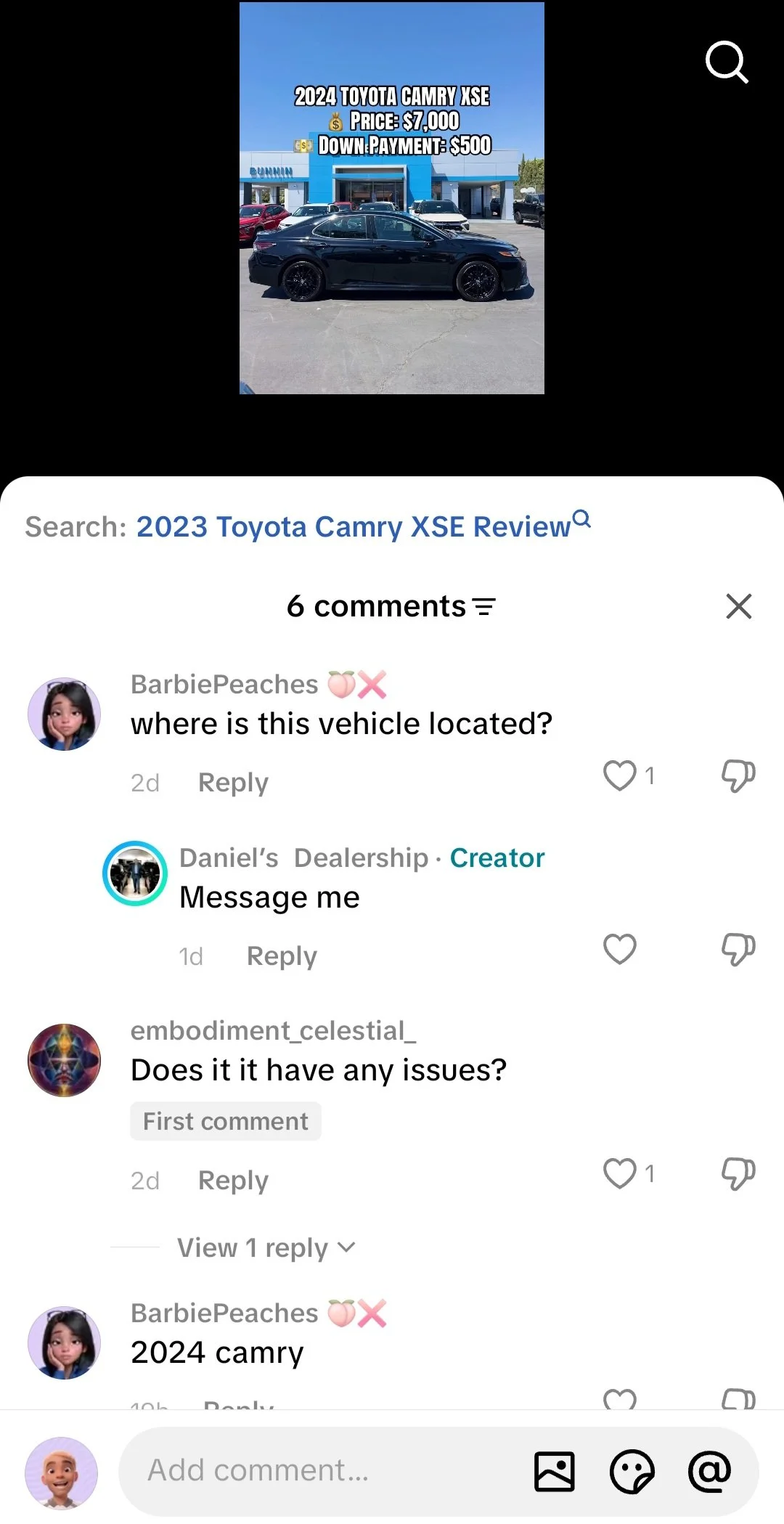
Someone in the comments asks possibly the easiest dealership question imaginable:
“where is this vehicle located?”
That's a fantastic question.
It should also have an extraordinarily simple answer.
Charleston.
Charlotte.
Atlanta.
Chicago.
123 Main Street.
Whatever.
Instead, the account responds:
“Message me”
There it is again.
Why does the location of the vehicle need to be a secret?
If you're a dealership advertising a vehicle for sale, wouldn't you generally want customers to know where the dealership is?
Another commenter asks:
“Does it it have any issues?”
Also a very reasonable question considering the price.
That question is even more important when KBB indicates a typical 2024 XSE is worth several times the advertised $7,000 price. Kelley Blue Book
🚩 The DM Pattern Keeps Appearing
This is now one of the biggest recurring themes I've noticed in these social-media vehicle offers.
The advertisement gets your attention publicly.
The incredibly low price creates interest.
The small down payment makes the vehicle seem obtainable.
Then, when someone asks for basic information:
DM me.
Message us.
Message me.
I have not messaged this account, so I cannot tell you what happens after someone enters the private conversation.
Maybe they provide legitimate dealership information.
Maybe they provide the VIN.
Maybe they explain why the car is $7,000.
I don't know.
And that's an important distinction.
But if that private conversation eventually turns into:
“Send the $500 so we can hold the vehicle,”
I'd stop.
Especially if they ask for payment through a peer-to-peer payment service or another method that makes recovering the money difficult.
Before sending anything, independently verify the dealership, physical location, VIN, title, vehicle history, and that the person you're communicating with actually has authority to sell that vehicle.
🚩 There's Something Else Interesting in the Picture
Look closely at the exterior photo.
A dealership building sits behind the Camry.
There's signage.
There are other vehicles.
It certainly looks like a dealership photograph.
But a picture taken at a legitimate dealership doesn't automatically prove that the social-media account posting it represents that dealership.
That's an important distinction with online vehicle shopping.
Photos can be copied.
Listings can be copied.
Dealer inventory photographs can be copied.
Even entire descriptions can be copied.
So I'd want to identify the dealership visible in the photograph and independently contact that business—not using information supplied by the social-media account—to ask:
“Do you have this 2024 Camry XSE, and are you selling it for $7,000?”
That one phone call could answer quite a few questions.
Let's Do the Reality Check
The TikTok advertisement:
2024 Toyota Camry XSE — $7,000
Kelley Blue Book:
Approximately $28,000 Fair Purchase Price. Kelley Blue Book
Toyota's original XSE base MSRP:
$31,720. Toyota
TikTok down payment:
$500
Someone asks where the vehicle is located.
Response:
“Message me.”
Someone asks whether the vehicle has issues.
And here I am asking:
Why does a car potentially worth four times the advertised price cost only $7,000?
That's the question I'd want answered before worrying about the $500 down payment.
🏡 Don't Just Scroll Past It—Be a Good Neighbor
Another reason I keep writing about these posts is this:
Someone commented asking where the car is located.
Someone else asked whether it has problems.
Those aren't abstract numbers on a screen.
Those are people who may genuinely need transportation.
A $28,000 Camry may be completely outside someone's budget.
A $7,000 Camry with only $500 down may suddenly feel possible.
That's precisely why an extraordinary offer deserves extraordinary scrutiny.
And if you recognize the warning signs, don't be passive.
Say something.
Report suspicious listings.
Tell a friend.
Warn someone in the comments without harassing anyone.
Help somebody independently verify the seller before they send money.
Being a good neighbor online isn't much different from being one offline.
Sometimes it means seeing someone about to make a $500 mistake and saying:
“Before you send that money, let's make sure this car—and this seller—are real.”
Because the best scam prevention tool isn't always sophisticated technology.
Sometimes it's simply another person paying attention.
More scam emails, suspicious recruiters, questionable vehicle deals, and whatever else the internet sends my way at:
NielFlamm.com/blog
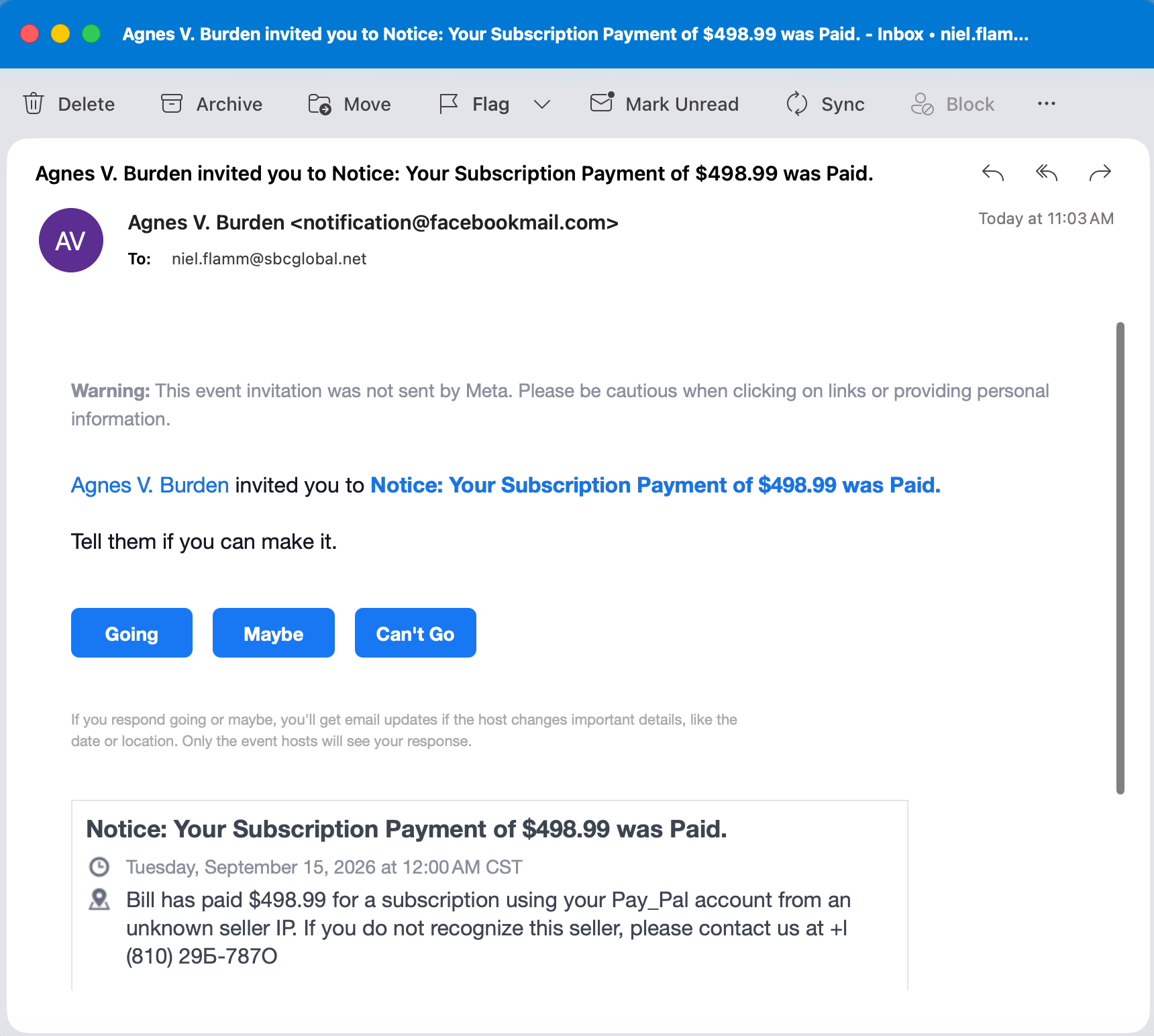
Apparently My $498.99 PayPal Subscription Is Now a Facebook Event
The scammers are getting creative.
Today I received an email with this wonderfully alarming subject line:
“Agnes V. Burden invited you to Notice: Your Subscription Payment of $498.99 was Paid.”
Wait.
I bought a subscription?
For $498.99?
And Agnes is throwing an event to tell me about it?
I appreciate the invitation, Agnes, but I think I'm busy that day.
🚩 The First Red Flag Is Actually a Giant Warning
This one gets interesting because the email appears to be generated through Facebook's event system rather than simply pretending to be a normal PayPal notification.
And Facebook practically puts a warning label on it for us:
“This event invitation was not sent by Meta. Please be cautious when clicking on links or providing personal information.”
That's not exactly subtle.
The apparent sender address is notification@facebookmail.com, which could make someone think, Well, it came through Facebook, so it must be legitimate.
But that's the trick.
The screenshot indicates that Agnes V. Burden created the event. The event itself appears to carry the scam message.
That's an important distinction: a legitimate platform can be used to deliver content created by someone else.
🎉 You're Invited! Your Money Is Gone!
The event title reads:
“Notice: Your Subscription Payment of $498.99 was Paid.”
Then we get the usual Facebook invitation:
Going | Maybe | Can't Go
I'm struggling to choose the right RSVP.
Going: Yes, I definitely want to attend the disappearance of $498.99.
Maybe: Depends. Will there be food?
Can't Go: Sorry, I have another fraudulent transaction at 1:00.
But then we get to the actual event description:
“Bill has paid $498.99 for a subscription using your Pay_Pal account from an unknown seller IP.”
There are so many questions.
Who is Bill?
Why is Bill spending my money?
Why is PayPal suddenly “Pay_Pal”?
And what exactly is an “unknown seller IP” supposed to mean?
But don't worry.
They've conveniently provided a phone number.
🚩 And THAT Is the Point
The message says that if I don't recognize the seller, I should call the number shown in the invitation.
There's the hook.
The $498.99 isn't necessarily the objective.
The objective may be to make me panic about the $498.99 and call the number.
The FTC specifically warns about this type of subscription-renewal scam. Victims receive notices claiming they've been charged hundreds of dollars for a subscription and are instructed to call a number to dispute it. Once they call, scammers may try to get financial information, persuade the victim to grant remote computer access, or create a fake “refund” problem that ultimately leads the victim to send money. Consumer Advice
In other words:
The fake charge creates the panic.
The phone number gives the scammer a path in.
🚩 This Facebook-Event Version Isn't Unique
Here's what really caught my attention.
I found a strikingly similar report in the Better Business Bureau's Scam Tracker from July 2026.
That report described a Facebook/Meta event invitation claiming a $749.49 MetaPay payment, complete with the same warning that the event invitation wasn't sent by Meta. The event then instructed the recipient to call a phone number if the payment was unauthorized. BBB categorized that report as phishing. Better Business Bureau
Different amount.
Different supposed transaction.
Different phone number.
Very similar playbook.
That's a useful reminder that scammers don't always need to spoof an entire company's email system. Sometimes they can abuse legitimate features—event invitations, calendar invites, shared documents, comments or other notifications—to get their message delivered.
💰 So What Should I Do About My $498.99?
First, I'm not calling the number in the invitation.
I'm also not clicking anything in the event to “resolve” the supposed charge.
If I were genuinely concerned that $498.99 had been charged through PayPal, I'd independently open the real PayPal app or website and inspect my transactions.
I'd also check the bank or credit-card account connected to it.
The FTC recommends that same approach for suspicious subscription notices: check your actual financial accounts, and if you need to contact the company, use contact information you know is legitimate—not the phone number supplied in the suspicious message. Consumer Advice
If the $498.99 transaction isn't there?
Then there's nothing to refund.
And there's certainly no reason to call Agnes.
🧠 The Psychology Is Better Than the Grammar
What makes this scam potentially effective isn't perfect spelling or a sophisticated story.
It's the number:
$498.99
That's large enough to make someone panic.
You don't stop to analyze “Pay_Pal.”
You don't wonder why a financial transaction has become a Facebook event.
You don't ask who Bill is.
You see:
YOU JUST LOST $498.99.
Then:
CALL THIS NUMBER.
That's social engineering.
The scammer doesn't need you to believe the entire story.
They just need you to become concerned enough to take the next action.
🏡 Be a Good Neighbor
I've said this before, and I'll keep saying it.
If you see something like this, don't be passive.
Tell your parents.
Tell your grandparents.
Tell your friends.
Tell the neighbor who isn't particularly comfortable with technology.
Share screenshots.
Report suspicious messages.
The FTC even recommends talking to someone you trust—a friend, family member, or neighbor—when you're unsure whether something is a scam. That second set of eyes can interrupt the panic that these schemes depend upon. Consumer Advice
You might recognize it as suspicious right away.
Someone else may see $498.99 and think their money is disappearing.
Sometimes being a good neighbor is simply saying:
“Don't call that number. Let's check your actual account first.”
Agnes, I'm Going to Have to Decline
So, Agnes V. Burden, thank you for inviting me to the celebration of my imaginary $498.99 subscription.
Unfortunately:
Going? No.
Maybe? No.
Can't Go? Absolutely.
And I'm definitely not calling your phone number.
Follow along at NielFlamm.com/blog for more scam emails, questionable TikTok car deals, suspicious recruiters, and whatever creative nonsense lands in my inbox next.