

Day 62: What Do Nextdoor’s Partners Think?

It's Day 62.
I'm not surprised.
And somehow, I'm still surprised.
Sixty-two days since I requested a study from Jacob Chavis without receiving the study—or a response.
62 days. Unbelievable.
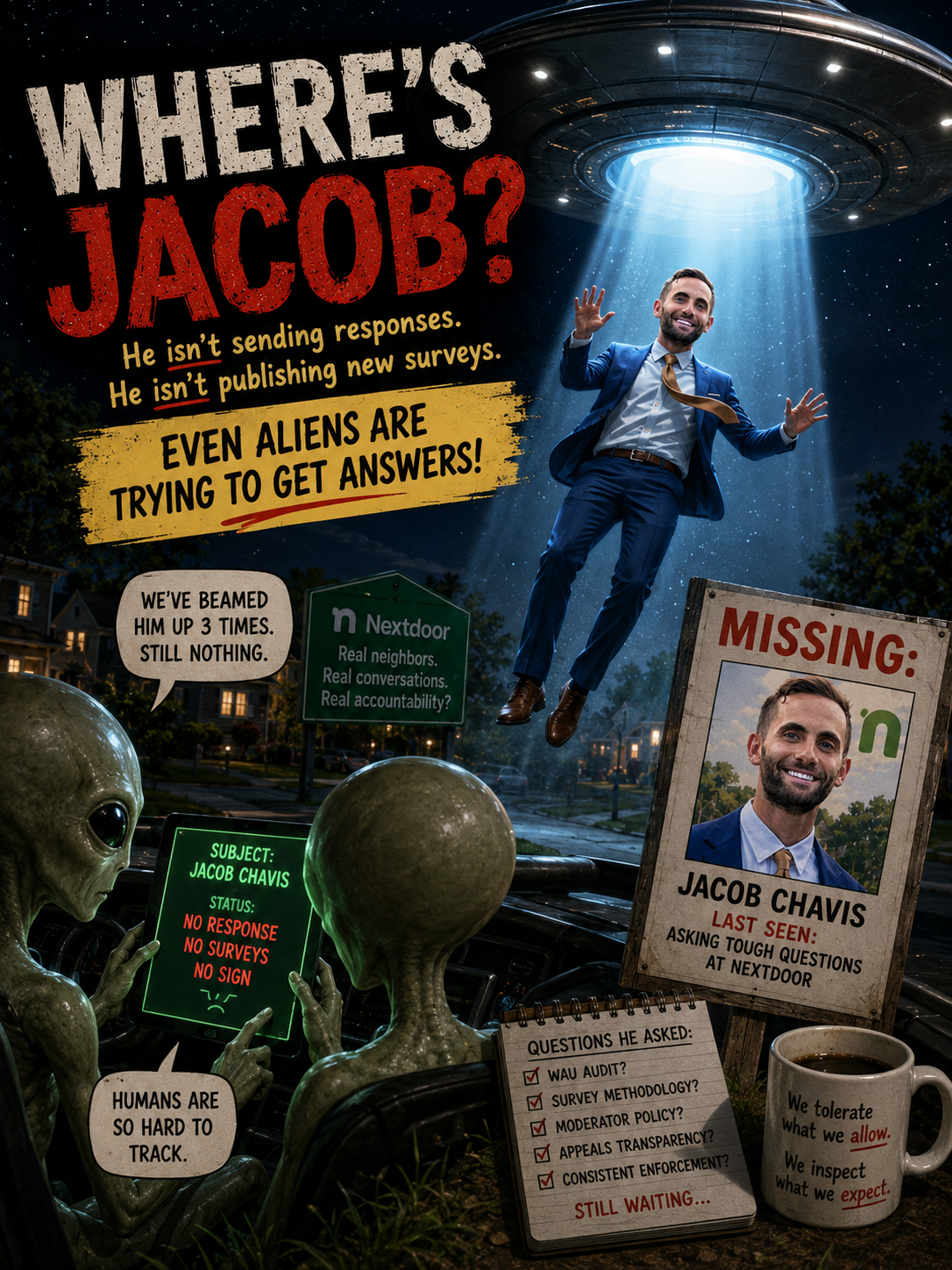
Yesterday I wrote about Nextdoor reposting content from Groundworks Commercial. Since Jacob seems to have vanished from the Insights landscape—perhaps abducted by aliens 👽—I've started watching what Nextdoor is publishing.
Something is interesting about reposts.
When Nextdoor publishes its own LinkedIn content, comments are typically disabled.
When Nextdoor reposts someone else's content, the original post's comments may remain available.
And, well...
I do what I do.
I commented on the Groundworks Commercial post about my experience with Nextdoor.
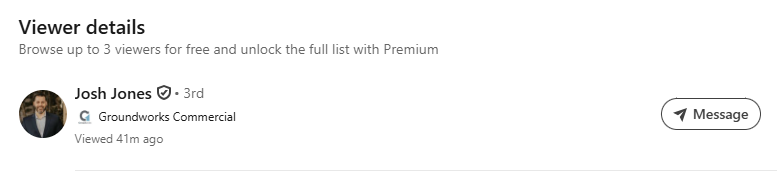
Then last night, I noticed Josh Jones from Groundworks Commercial viewed my LinkedIn profile.
Hello, Josh. 👋
I'm genuinely curious:
What do you think about all of this?
Not just Josh, either.
That has me thinking about Nextdoor's broader network of partners.
Nextdoor works with businesses, advertisers, local organizations, news outlets, government agencies, and other companies.
Those organizations lend something besides money or content.
They lend their names.
So what are decision-makers at these organizations seeing?
Do they look only at Nextdoor's WAU, advertising opportunities and neighborhood reach?
Do they examine the moderation controversies?
Do they look at how critical feedback is handled?
Do they notice comments are disabled on corporate posts?
Do they examine how small businesses experience the platform?
Do they care how shareholders are treated?
And does corporate culture factor into deciding whether another organization wants its brand associated with Nextdoor?
I'm not suggesting Groundworks Commercial—or any Nextdoor partner—agrees with my views.
I have no idea what Josh thinks.
That's why I'm asking.
But partnerships work both ways.
When two brands associate publicly, each company's reputation becomes part of the other's equation.
I've spent 62 days asking questions on Nextdoor.
Maybe there's another group worth asking:
What do Nextdoor's partners think?
Local news organizations.
Small businesses.
Advertisers.
Corporate partners.
Public agencies.
What are their experiences behind the scenes?
After 62 days, I'm increasingly interested not only in what Nextdoor says about itself...
but what organizations doing business with Nextdoor say about Nextdoor.
Josh, since you stopped by my profile, I'd welcome your perspective.
And if anyone from another Nextdoor partner is reading this, yours too.
Day 62. The conversation keeps getting bigger, even if Nextdoor isn't participating.
Join the discussion at NielFlamm.com/blog.
Leave some feedback—I'd love to hear your perspective.
Leadership Is More Than Looking Back
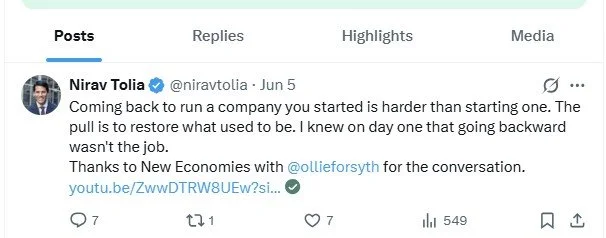
I came across a recent post on X from Nextdoor CEO Nirav Tolia reflecting on the challenges of returning to lead a company he founded. My reaction? It reads more as frustration than inspiration.
Running a public company is difficult, and every CEO faces pressure. But leadership is about setting the tone for employees, shareholders, customers, and the broader community. Looking backward can be part of the journey, but people also want to hear a vision for moving forward.
I've also seen current and former employees post online about what they describe as a difficult workplace culture. Those are their opinions and experiences, not mine, but they reinforce the importance of leadership messaging.
In a previous blog, I also commented on a March 3, 2026 X post that began with the phrase, "I'll be honest…" I believe communicators should avoid that expression because it can unintentionally invite readers to question whether previous statements were equally candid.
Which brings me to another question: Does Nextdoor have a public relations strategy that helps shape these messages? The company has a Media Relations team, but strong executive communications require more than media outreach.
If you need additional communications expertise, firms like JMac PR, led by John McCartney and known for technology and media campaigns, can provide strategic messaging support to help organizations better connect with stakeholders.
Leadership isn't just about what you say—it's about the confidence and clarity people take away after hearing it.
Subscribe to NielFlamm.com.