

Day 38: Context Matters

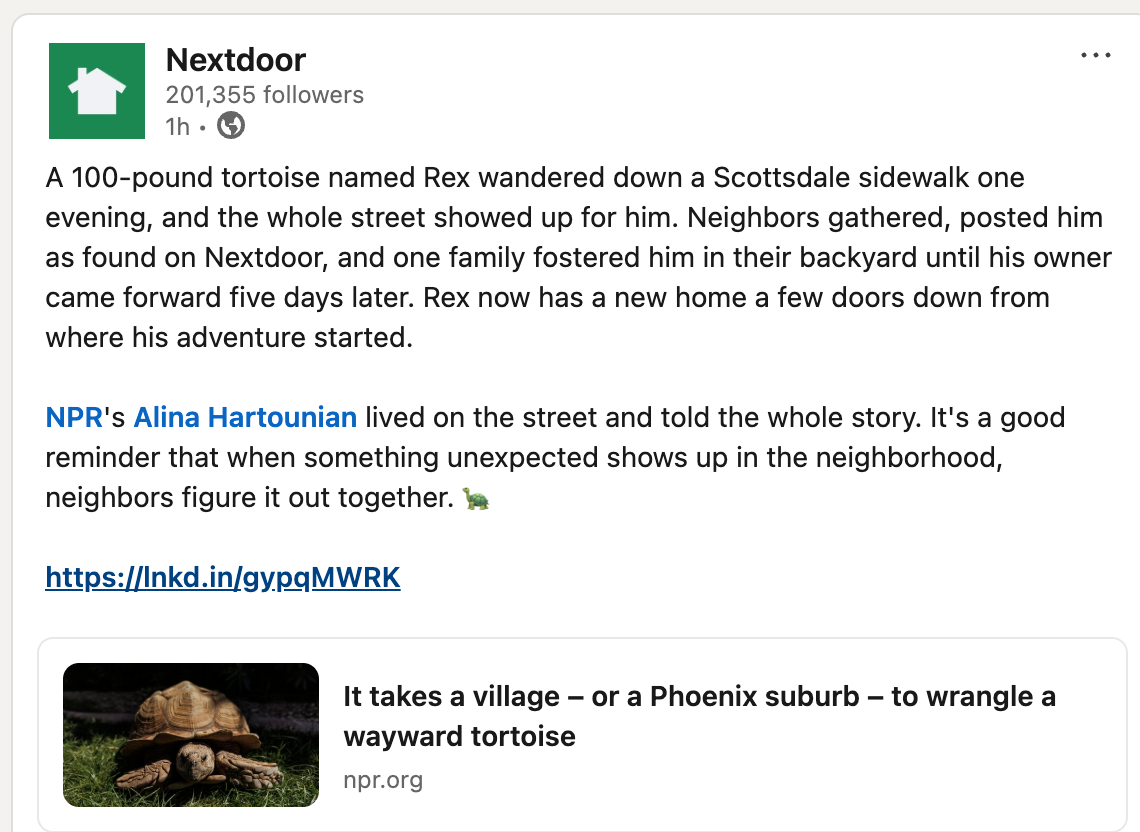

Nextdoor recently shared another feel-good story on LinkedIn about a lost tortoise and a neighborhood coming together to help.
It's a great story.
What caught my attention, however, was what wasn't included in the LinkedIn post.
In the accompanying NPR article by Alina Hartounian, the story notes that both Facebook and Nextdoor were used to help spread the word—with Facebook mentioned first. The LinkedIn post, by contrast, highlights only Nextdoor's role. To me, that leaves out important context about how the community effort came together.
It also raised a few questions.
I wonder whether Alina Hartounian is aware of the criticism some users have raised regarding Nextdoor's moderation and communication practices. NPR has a long history of reporting on issues involving free expression, transparency, and the role of the First Amendment in public discourse. While the First Amendment limits government restrictions on speech rather than private companies' moderation decisions, NPR has frequently covered debates about censorship, platform moderation, and the importance of open dialogue. That made me curious how those broader conversations intersect with reporting on social media platforms.
At the same time, Nextdoor's CEO, Nirav Tolia, continues to lead a company whose LinkedIn posts do not permit public comments. As someone who values feedback and discussion, I find that contrast noteworthy.
Today is also Day 38 since I requested a Nextdoor study. I still have not received the study or a response. At this point, I continue to wonder whether the document is intended primarily as a marketing or lead-generation asset rather than research distributed broadly upon request. I don't know the answer, but the continued silence naturally raises the question.
Transparency isn't just about the stories we tell.
It's also about the context we provide, the conversations we allow, and the questions we're willing to answer.
What are your thoughts?
Join the discussion on NielFlamm.com.
Why the Silence? Reflections on Day 36
It's very late at night...or very early in the morning, depending on your perspective.
A thought crossed my mind as I reflected on the past 36 days of waiting for a response to a simple request.
Why the silence?
To be transparent, there have been a few responses along the way. Nextdoor Support initially communicated with me until I asked follow-up questions. @John T. Williams from Investor Relations responded after I mentioned filing complaints with the Federal Trade Commission and U.S. Securities and Exchange Commission, although I believe he is no longer with the company following an unrelated email mistake. NextDoor Service has also interacted through comments on LinkedIn.
But from others, including Jacob Chavis, the press team, and CEO Nirav Tolia, there has been no direct response.
That led me to ask myself a question—not because I know the answer, but because it's one possible explanation among many.
Do they see someone like me as simply not worth responding to?
Or is it something else?
Perhaps they're following company policy.
Perhaps they've been advised not to engage.
Perhaps they're overwhelmed with other priorities.
Perhaps they don't believe a response would change anything.
Perhaps they view me as a disruptor.
Or perhaps they simply don't know how to respond.
I don't know.
What I do know is the lesson I learned early in my career:
Treat the environmental engineer with the same respect you would give the Chief Executive Officer.
Titles change. Job descriptions change. Companies come and go. Respect shouldn't.
One of the best leaders I ever worked with told me that every interaction is an opportunity to reinforce a culture—or weaken it. Sometimes, a simple acknowledgment is all someone is looking for.
This post isn't about assuming motives. It's about asking whether responsiveness and respect should be part of a company's culture, regardless of who asks.
What do you think? When someone reaches out professionally, does every inquiry deserve at least an acknowledgment?
Join the discussion on NielFlamm.com.
Whistleblowers Welcome: Help Shine a Light on Leadership and Workplace Culture
Every organization has room to improve. Some embrace feedback. Others silence it.
If you are a current or former employee who is concerned about workplace culture, leadership, management practices, accountability, or organizational performance, I’d like to hear your perspective.
If you choose to reach out, I will take reasonable steps to redact identifying information before discussing your experience publicly. Please do not send confidential, proprietary, or legally protected information. I’m interested in your experiences, observations, and opinions—not trade secrets.
Poor performance should not be rewarded.
Ineffective leadership should be examined, not ignored.
A toxic culture rarely appears overnight. It often starts at the top and spreads throughout an organization until someone has the courage to confront it.
One of my favorite leadership principles is simple:
You tolerate what you allow.
If leaders allow dysfunction, it becomes the culture.
If employees remain silent out of fear, meaningful change becomes even more difficult.
Constructive transparency and accountability make organizations stronger—not weaker.
If there are stories that deserve to be heard, let’s have that conversation.