
Rhetoric vs. Results: Which Creates Long-Term Shareholder Value?
Driving home from dialysis today, I found myself thinking about rhetoric.
Not rhetoric in politics, but in corporate leadership.
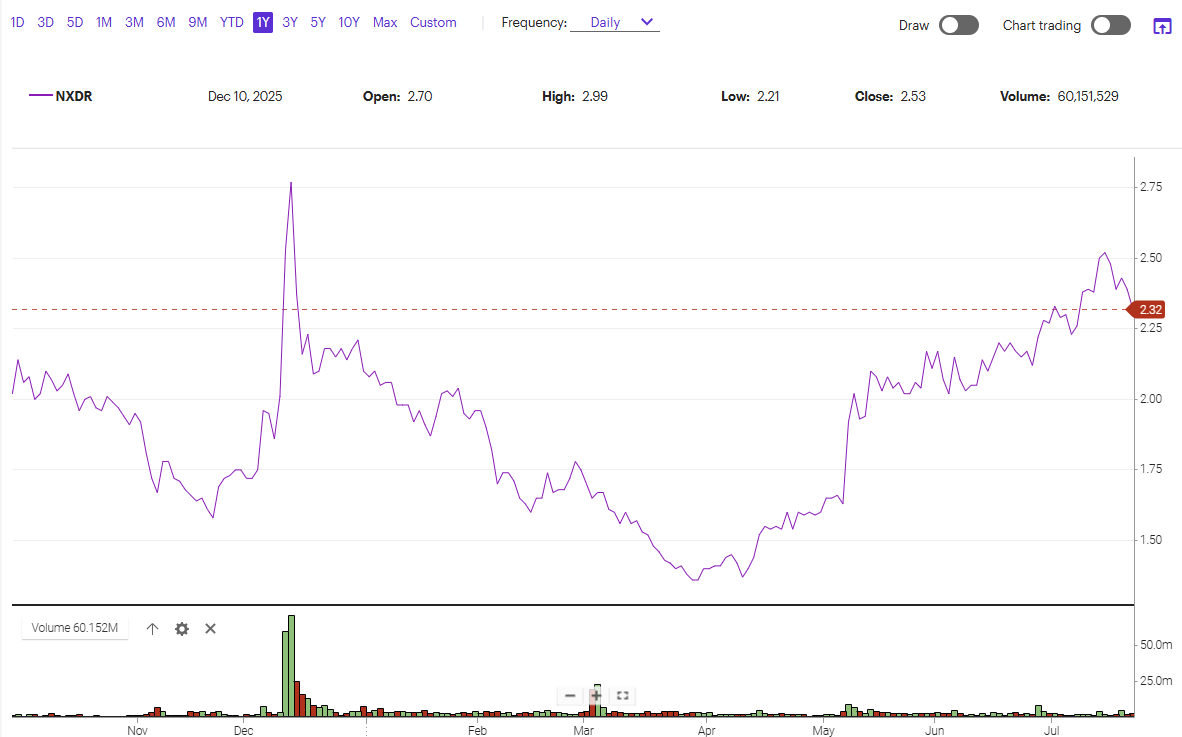
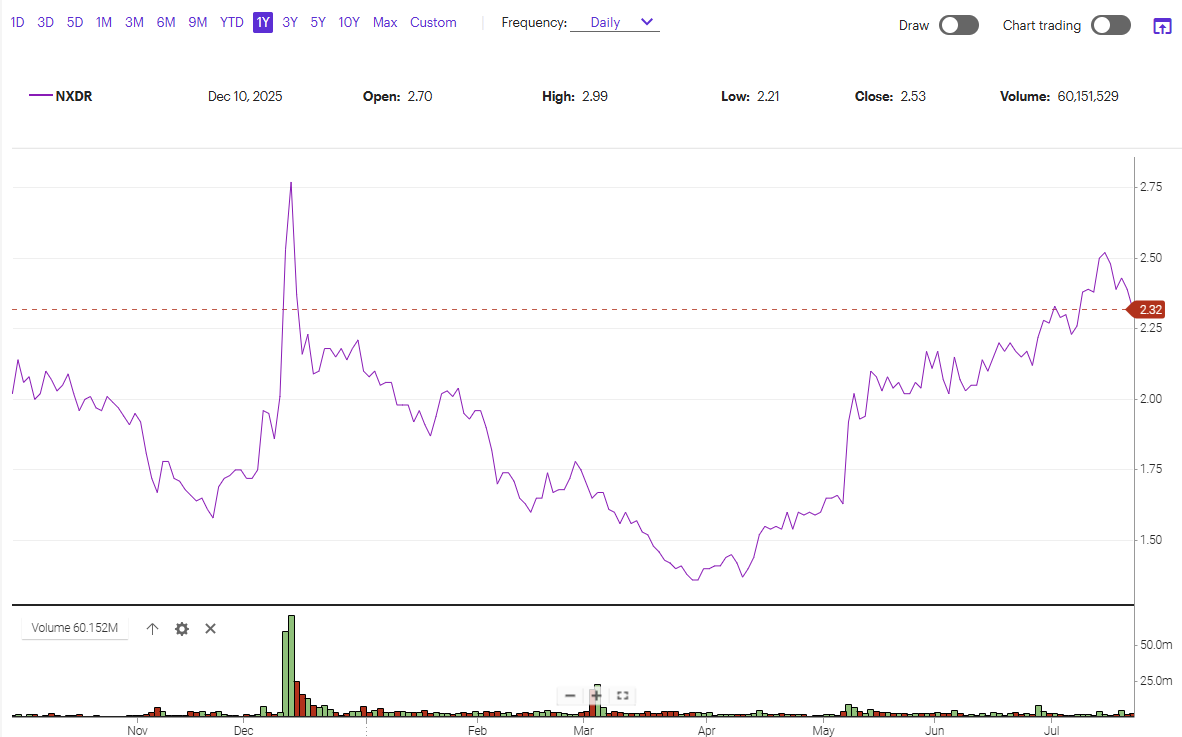
Nextdoor's stock reached a two-year high of $2.77 on December 11, 2025, and another notable high of $2.52 on July 15, 2026. Since then, I've been asking myself a simple question:
How low will this slide go?
I've shared before that I'm currently bearish on NXDR. From my perspective, the company hasn't yet demonstrated the value proposition, communication, or user experience improvements that would change my outlook.
That brings me back to rhetoric.
I have no issue with a CEO giving interviews, appearing on podcasts, speaking at conferences, or communicating with investors. Those are all legitimate responsibilities of executive leadership.
The question is one of balance.
At what point does the effort spent crafting the narrative begin to outweigh the effort spent improving the reality behind that narrative?
Throughout my career, I've had the opportunity to work for organizations ranging from small businesses to global corporations. I've met several CEOs along the way.
What impressed me wasn't how often they were in front of a microphone.
It was the results.
When products improved, customers noticed.
When service improved, customers talked about it.
When execution improved, the financials eventually reflected it.
The rhetoric became believable because it was supported by measurable outcomes.
As a shareholder, I don't invest in presentations.
I invest in execution.
I don't invest in carefully crafted messaging.
I invest in products that customers value, cultures that encourage accountability, and leadership teams that allow results to speak louder than interviews.
In my opinion, rhetoric should amplify success—not attempt to substitute for it.
That's why I continue to ask questions about transparency, communication, and the customer experience at Nextdoor.
What does the global corporate workforce think?
When a company's rhetoric and its results appear to diverge, which one ultimately determines long-term value?
Join the discussion on NielFlamm.com.
Leadership Disconnect: The Rules You Promote Should Start With You
I’m on a roll tonight.
Maybe it’s because after dialysis, once the “dialysis hangover” feeling starts to fade — a feeling I remember from another lifetime over 17 years ago — I start connecting dots.
Tonight, something stood out.
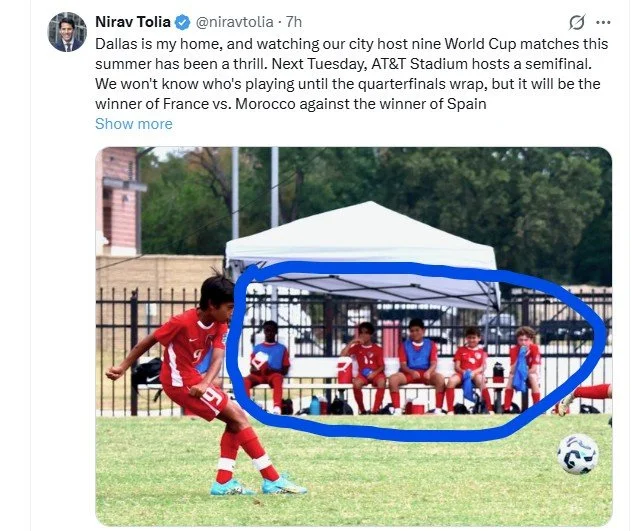
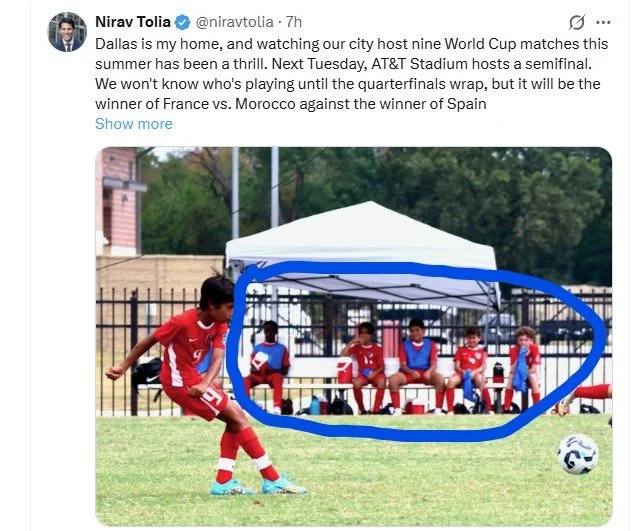
Nirav Tolia posted on X about the World Cup, his family, and how important soccer is to them—a proud parent moment.
I understand that.
However, the picture appeared to include his child during a game with other children and teammates clearly visible in the background.
Is posting a photo from a public event automatically illegal?
No.
That is not the point.
The point is awareness, judgment, and understanding of the community you lead.
The CEO of Nextdoor runs a platform where neighbors regularly discuss safety, privacy, strangers taking photos, and concerns about their children’s images and likeness being shared online without permission.
Parents ask:
“Who took this picture?”
“Why is my child online?”
“Did anyone ask before posting this?”
These are conversations happening on his own platform.
However, the person leading that platform seems comfortable sharing a moment in which other children may be included in a public post without their parents' consent.
That disconnect matters.
Leadership is not just what you say on a podcast.
Leadership is not just about kindness, trust, neighbors, and community.
Leadership is demonstrating an understanding of the concerns of the people using your product.
This is bigger than one picture.
It is about being connected to your customers' reality.
A CEO sets the example.
If your platform promotes trust, safety, respect, and community awareness — those principles should not stop when you log off the app.
You cannot build trust while appearing disconnected from what your own users are concerned about.
The community is speaking.
The question is:
Is leadership listening?
Join the discussion on NielFlamm.com.

CEO Accountability: The Culture You Allow Becomes the Culture You Build

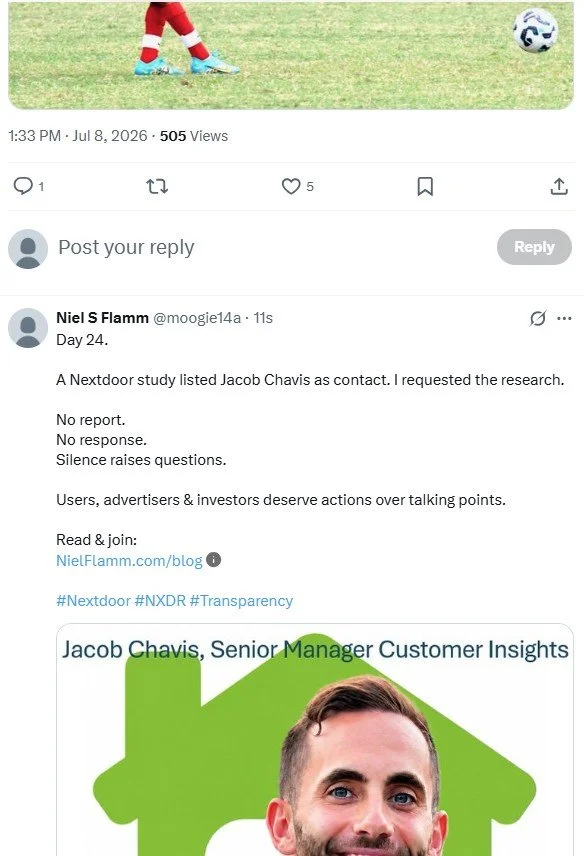
As part of my process, I continue sharing my documented experience with Nextdoor, Nirav Tolia, and, currently, Jacob Chavis.
Today is Day 24.
A simple request was made for the full study information from research published by the Nextdoor Communications team, listing Jacob as the contact.
No study.
No methodology.
No response.
While posting updates, I noticed Nirav sharing a message about the World Cup, neighbors connecting, and finding common ground.
That is a great message.
But leadership is not only about the message you deliver externally.
It is about the experience people receive internally and externally when nobody is watching.
I commented on the post with my experience, an infographic, and directed people to the full story.
It was the first comment.
Nirav has responded to other commenters. My experience remains unacknowledged.
This is where CEO accountability matters.
Every organization has issues. Every company makes mistakes. The difference is how leadership responds when something is brought forward.
Feedback is not automatically “noise.”
Feedback can be data.
Feedback can identify gaps between what the company leaders believe they are building and the experience customers, users, employees, and shareholders are actually having.
A CEO sets the standard.
If communication gaps are accepted, they become normal.
If accountability is optional, it becomes culture.
If silence is tolerated, it becomes the process.
“I tolerate what I allow.”
The question isn’t whether every piece of feedback is comfortable.
The question is whether leadership is willing to listen, evaluate, and improve.
That is how trust is built.
Join the discussion on NielFlamm.com.
When Words Reveal More Than They Intend - A Closer Look at Nextdoor's Sales Summit Video
On May 15, 2026, #NiravTolia posted a 55-second video from Nextdoor's sales summit in Dallas. For a company that has repeatedly emphasized being mindful of spending, the optics of a travel-intensive sales summit are worth noting — but it's the words in the video that deserve closer examination.
The video is titled: "Why I'm Super Bullish About Nextdoor In 2026."
Let's start there.
Tolia opens with "honestly" and later uses "genuinely." These words are meant to signal authenticity — but they often do the opposite. When a leader prefaces a statement with "honestly," it raises an uncomfortable question: Does that imply the preceding statements weren't? Words carry weight, especially when a CEO speaks to investors, employees, and the market.
He says he hasn't been more "excited about the upside potential of Nextdoor."
Let's unpack that for a moment.
No CEO is going to step in front of a camera and say:
- "We're probably going to fail."
- "We have the wrong people in the wrong seats."
- "Our strategy isn't working, and I'm not sure what to do next."
- "Frankly, our competitors are outexecuting us."
- "Investors should be deeply concerned."
Of course not. Optimism is the job. Enthusiasm is the costume. But enthusiasm is not a turnaround plan.
And yes — of course there's upside. #NXDR is trading roughly 90% below its all-time high. At that level, the only directions are up, sideways, or toward penny stock territory and eventual delisting. Citing "upside potential" when a stock has already lost nearly all of its value isn't bullishness — it's arithmetic.
Then there's this: "We're just getting started."
Just getting started — in year two of a tenure that was itself a return engagement. What exactly has been happening for the past 24 months? Were those months a rehearsal? A warm-up? A prelude to the actual work?
Words have meaning. And when the words chosen by a CEO in a produced, intentional video are "honestly," "genuinely," "excited," "upside," and "just getting started," the cumulative message isn't confidence.
It's a script.
Investors, board members, and employees deserve more than polished optimism delivered from a sales stage. They deserve metrics, milestones, and accountability.
Excitement doesn't move a stock. Execution does.
Subscribe to NielFlamm.com.
#Nextdoor #NXDR #Leadership #CEO #InvestorRelations #CorporateAccountability #WordsMatter #TurnaroundManagement #BoardGovernance #TechIndustry #NiravTolia
Triage, Transformation & The Missing Turnaround at Nextdoor
When #NiravTolia returned as CEO of Nextdoor in March 2024, the mandate was straightforward: stabilize the business, restore confidence, and create durable shareholder value.
Turnarounds follow a predictable playbook. Triage before transformation. That means:
- Shedding or restructuring underperforming segments
- Reallocating capital toward profitable, scalable initiatives
- Streamlining operations and clarifying accountability
- Consistently meeting financial expectations
- Communicating transparently with investors and employees
- Tying executive compensation to measurable outcomes
More than two years in, the question that deserves a serious answer is: Where is the evidence of transformation?
What has largely filled that void is AI.
That's not inherently a problem. AI is a legitimate strategic lever. But AI is a capability, not a strategy. Wrapping operational drift in the language of innovation does not fix the underlying business. And dismissing outside criticism doesn't change what the metrics show — it simply signals that the gap between narrative and reality hasn't closed.
The numbers are no longer forgiving. The stock's all-time high was $13.50 in November 2021. It now trades around $1.50 — a collapse of nearly 90% from its peak. Market cap has fallen to roughly $630 million. Weekly active users grew just 1% year-over-year in Q1 2026, even as the company posted an $11 million net loss.
This raises a question that can no longer be deferred: What are the fiduciaries doing?
The board includes Bill Gurley of Benchmark, David S. of Greylock, and directors Dana Evan, Robert Hohman, Jason Pressman, Niraj Shah, Elisa Steele, and Chris Varelas. BlackRock holds a 5%-or-greater institutional stake. These are not passive observers — they are experienced investors who know what a real turnaround looks like.
At what point does continued patience become complicity? Gurley built his reputation by holding management accountable. Sze backed LinkedIn, Facebook, and Pandora — he knows what genuine growth inflection looks like. BlackRock's fiduciary obligation to its own investors is explicit.
Two-plus years in, with the stock near historic lows and user growth nearly flat, the board's silence is itself a signal.
Outcomes measure leadership. The board is measured by whether it demands them.
At some point, loyalty to a founder and accountability to shareholders become mutually exclusive. That point may already have passed.
Subscribe to NielFlamm.com
#Nextdoor #NXDR #Leadership #InvestorRelations #CorporateStrategy #TurnaroundManagement #BoardAccountability #TechIndustry #CEO #Benchmark #Greylock #BlackRock