

Day 93: Nextdoor Turned the Comments Off Again. So Much for Progress.

Well, that didn't last long.
A few days ago, I actually did something that might surprise people who only see my Nextdoor posts occasionally:
I applauded Nextdoor.
I had previously provided feedback about Nextdoor disabling comments on some of its LinkedIn posts. Then I noticed newer posts where commenting was available again.
I said that was progress.
I said companies should be willing to change course.
I even wrote:
“Nice move, Nextdoor. Keep going.”
Apparently, I should have added:
“…but please don't put it in reverse.”
Because here we are.
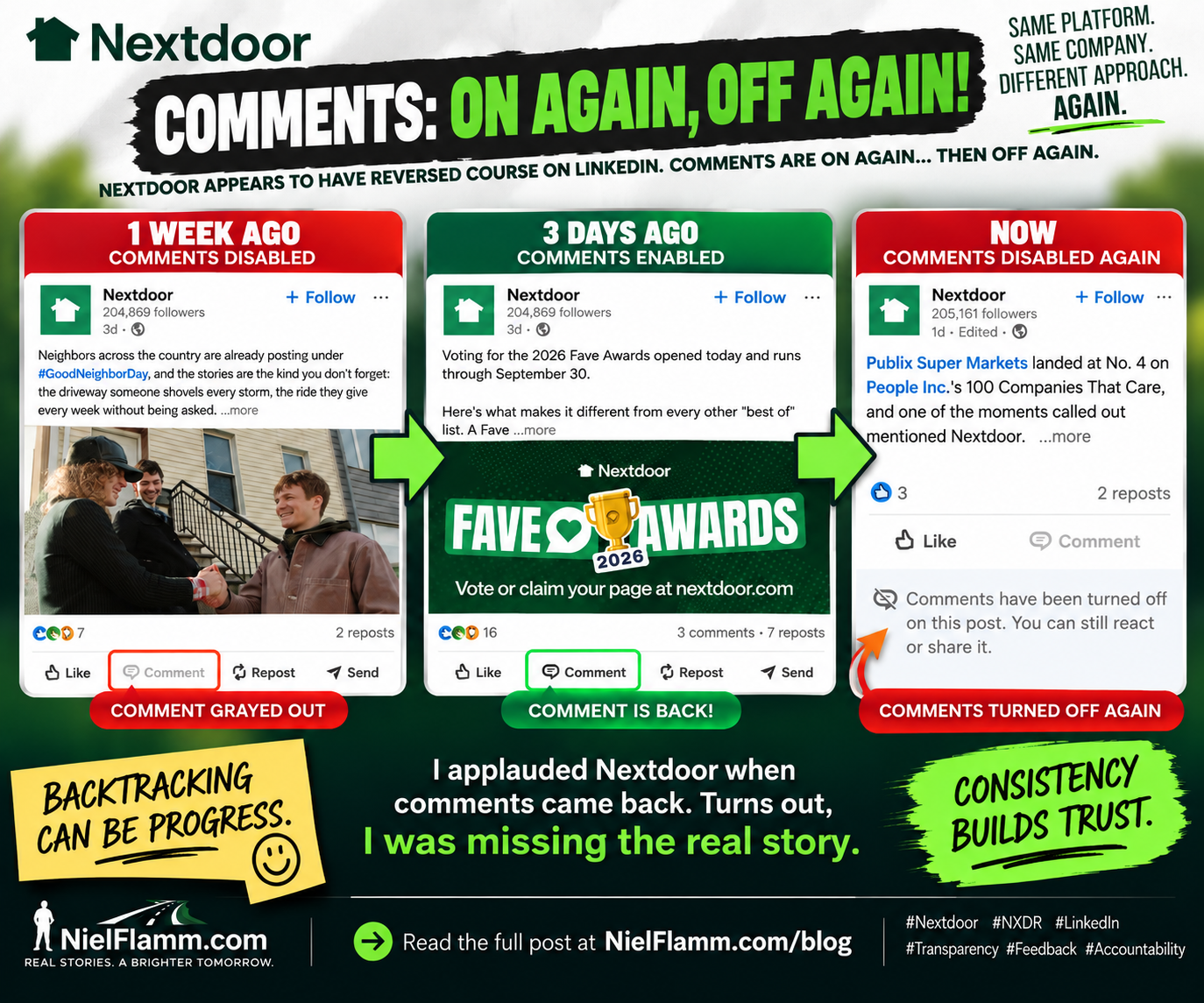
It's Day 93 of my ongoing Nextdoor case study, and they've once again turned off comments on a Nextdoor LinkedIn post.
And the post they chose makes this particularly interesting.
The Publix Post Has Comments Turned Off
Nextdoor's recent LinkedIn post celebrates Publix Super Markets ranking No. 4 on PEOPLE's 100 Companies That Care list.
Nextdoor's connection to the story is that a Publix associate used the Nextdoor app while helping neighbors before Hurricane Milton. Nextdoor's post says this demonstrates what can happen when a network is built around real local neighborhoods. LinkedIn
I've already written about why I think there's another, more interesting story here:
Nextdoor didn't make the Top 100.
But now there's another layer.
Look at the screenshot.
The Comment button is grayed out, and LinkedIn states:
“Comments have been turned off on this post.”
LinkedIn lets Page administrators turn comments on or off, even after a post has been published. LinkedIn
So once again, Nextdoor is publishing something publicly on a social network while choosing not to allow the public to respond beneath that particular post.
Wait… Weren't We Moving Forward?
That's what makes this frustrating.
I had just praised Nextdoor for what seemed like a change in direction.
Comments had been disabled.
Then newer posts allowed comments.
I noticed.
And instead of finding another reason to complain, I did exactly what I think someone providing fair feedback should do:
I acknowledged the improvement.
That's important.
If I'm going to point out things I believe Nextdoor gets wrong, then I should be equally willing to acknowledge when I think it gets something right.
I did.
Now we're apparently going backward again.
This Is Exactly Why Communication Matters
Nextdoor describes itself as “the essential neighborhood network” and says it connects neighbors to conversations that matter locally. LinkedIn
Conversation.
That's the interesting word.
Because conversation generally requires more than one participant.
Posting a corporate message and disabling responses isn't really a conversation.
It's a broadcast.
Broadcasting information isn't inherently wrong. Companies do it every day.
But for a company whose entire product is built around people talking to one another, repeatedly switching comments on and off creates an odd contradiction.
A social network should probably be social.
And Why This Post?
That's the question I'm especially curious about.
Why disable comments on this post?
I don't know.
Maybe it was intentional.
Maybe there's a communications strategy behind it.
Maybe Nextdoor anticipated comments it didn't want.
Maybe it has absolutely nothing to do with criticism.
I don't have access to Nextdoor's internal decision-making, so I won't invent a motive.
But I can certainly observe the result:
Nextdoor published a post celebrating another company's recognition for caring about people and communities—and didn't allow people to comment on it.
That's… interesting.
Especially after I realized I had initially been missing the real story.
I Was Missing the Real Story
At first, my reaction to the Publix post was basically:
Nextdoor is playing Six Degrees of Kevin Bacon.
A Publix employee did something wonderful.
The employee happened to use Nextdoor.
Publix made PEOPLE's list.
Nextdoor then highlighted its connection to the story.
I thought that was the story.
It wasn't.
The more interesting question was:
Why wasn't Nextdoor itself on the list?
Technology companies including Salesforce, NVIDIA, Intuit, Adobe, ServiceNow and Hewlett Packard Enterprise made the 2026 Companies That Care list.
These aren't organizations that decided they had to choose between corporate responsibility and running successful businesses.
They demonstrate that companies can pursue their missions, invest in employees and communities, make money, and create value for shareholders.
That's the standard I want Nextdoor to pursue.
Don't borrow someone else's spotlight.
Earn your own.
And Comments Are Part of the Bigger Picture
This isn't really about one LinkedIn button.
It's about something I've been discussing throughout this case study:
Does Nextdoor's behavior match Nextdoor's message?
Nextdoor talks about connection.
Community.
Trust.
Neighbors.
Conversation.
Local businesses.
Good neighbors.
But I've also provided feedback about what I see as problems with its volunteer moderator model, its approach to monetizing small businesses, communication and transparency, shareholder value, and the platform's long-running “Karen” reputation.
And now we're back to comments being disabled on a corporate LinkedIn post.
Again.
None of these things alone define Nextdoor.
But collectively they raise a question I've asked repeatedly:
Does the experience match the mission, vision and values?
Day 93—and the Other Question Still Hasn't Been Answered
And yes, there's another reason today is Day 93.
I'm still waiting for the detailed data referenced in Nextdoor's Home Insurance Insights research.
I've also requested the detailed data referenced in its Financial Advising and Investing research.
I'm not asking for the public blog summaries.
I'm asking for the detailed data Nextdoor told readers they could request.
It's been 93 days.
I've emailed.
I've clarified the request.
I've offered phone.
Video conference.
Virtual coffee.
A simple answer would still resolve it:
Yes, we can provide it.
No, we can't provide it.
It's restricted.
Here are the requirements.
Someone else handles it.
Those are answers.
Silence isn't.
Hearing vs. Listening—Again
Maybe this is why I keep returning to my Learning & Development background.
There is a difference between hearing feedback and listening to feedback.
Listening doesn't mean agreeing.
It doesn't mean giving me what I want.
It doesn't mean leaving every LinkedIn comment section open forever.
And it certainly doesn't mean a company has to implement every suggestion somebody posts online.
Listening means considering the information, making a decision, and communicating.
That's why I was willing to applaud Nextdoor when comments came back.
I thought perhaps the company had reconsidered.
Maybe it had.
Now comments are off again.
So I'll provide feedback about that too.
Nextdoor, Pick a Direction
If comments are going to be open, open them.
Moderate them.
Respond when appropriate.
Ignore ridiculous comments when appropriate.
Let people disagree.
That's what social networks do.
If comments are going to be disabled, that's Nextdoor's decision too.
But then let's acknowledge the irony of the neighborhood conversation company limiting conversation on its own corporate social media.
You can't build a brand around community dialogue and then appear uncomfortable when the dialogue isn't completely controlled.
Moderating conversation and preventing conversation are two very different things.
I applauded Nextdoor when I thought it was moving forward.
Today, I'm pointing out that it appears to have taken a step backward.
That's not negativity.
That's consistency.
When I see improvement, I'll acknowledge it.
When I see something I think deserves feedback, I'll provide it.
And when Nextdoor finally answers my 93-day-old research request?
I'll acknowledge that too.
Until then:
Day 93.
The detailed data still hasn't arrived.
And apparently, the comments haven't either.
Follow the continuing case study at NielFlamm.com/blog.
Nextdoor Is Playing Six Degrees of Kevin Bacon With Publix
I saw an interesting Nextdoor post on LinkedIn.
Nextdoor highlighted that Publix Super Markets landed at No. 4 on PEOPLE's 100 Companies That Care list.
The story itself is absolutely worth recognizing.
As Hurricane Milton approached Florida, a Publix associate reportedly checked Nextdoor, discovered an elderly neighbor who needed distilled water for her nebulizer, delivered it, secured her patio furniture, cleared debris, and then helped another neighbor with sandbags.
That's a great story.
And congratulations to the Publix associate who did all that.
But then Nextdoor connected the story to itself:
“This is the kind of thing that happens when a network is built around real, local neighborhoods.”
Hold on.
Are we playing Six Degrees of Kevin Bacon now?
If Someone Uses Your App, Do You Get Credit for What They Do?
The Publix employee deserves the praise.
Publix deserves recognition for employing someone who apparently demonstrated exactly the kind of community spirit that earned the company a place on the list.
But Nextdoor?
The employee opened an app.
The app was a tool.
There's a difference between providing a tool and performing the good deed.
I shop at Publix.
I buy groceries there.
Their subs have practically developed their own fan club, and don't even get me started on the carrot cake.
So, using this logic, every time I buy a Publix sub, I'm helping generate revenue that helps Publix employ people.
One of those employees might help a neighbor.
Therefore...
Where's my PEOPLE award?
I'll wait.
Speaking of That Top 100...
Another part of this caught my attention.
Publix came in at an impressive No. 4.
Nextdoor's post celebrates that accomplishment and its own small connection to one of the stories highlighted.
But there's one company I don't see in the Top 100:
Nextdoor.
Now that makes me curious.
If Nextdoor wants to connect itself to a company recognized as one of the 100 Companies That Care, I'd be interested to know where Nextdoor would land if the list continued.
No. 101?
No. 247?
No. 1,382?
I genuinely don't know.
Maybe Nextdoor would be right outside the Top 100. Maybe it wouldn't be anywhere close.
But that's the more interesting question to me.
Instead of borrowing a little glow from a company that did make the list, what would Nextdoor need to do as an organization to earn a spot of its own?
The Hammer Doesn't Get Credit for Building the House
If someone uses Google Maps to find a food bank and then volunteers there, does Google get credit for feeding people?
If someone drives a Ford to donate blood, does Ford get credit for the donation?
If someone texts a neighbor using an iPhone and then helps clean up their yard, does Apple get the community-service award?
Technology can enable something without being responsible for what happened.
That's an important distinction.
Nextdoor gave this Publix employee a way to discover that a neighbor needed help.
That's valuable.
Say that.
Celebrate that.
But don't climb onto the employee's shoulders and start waving from the parade float.
Nextdoor Actually Has Something Worth Celebrating Here
That's what makes this frustrating.
Nextdoor doesn't need to ride anyone's coattails.
This story demonstrates a legitimate use case for the platform:
A neighbor needed help.
Another neighbor discovered that need through Nextdoor.
The neighbor acted.
That's enough.
Nextdoor could have said:
“We're proud that our platform helped connect neighbors during a hurricane.”
Great.
I'd applaud that.
Instead, the post reads to me like Nextdoor is stretching someone else's act of kindness into evidence supporting its own corporate narrative.
And after all the feedback I've provided about communication, trust, and authenticity, I think Nextdoor should be more careful about that distinction.
Give the Credit to the Person Who Earned It
This isn't complicated.
Publix associate: Helped neighbors prepare for a hurricane. 👏
Publix: Recognized as one of PEOPLE's Companies That Care. 👏
Nextdoor: Provided a platform that helped one neighbor discover another neighbor needed assistance. 👍
Those are three different things.
You can acknowledge all three without pretending they're the same accomplishment.
Nextdoor talks frequently about real people, real neighborhoods, and authentic connections.
Great.
Then put the real person who performed the act at the center of the story.
Don't make someone else's good deed your corporate victory lap.
Celebrate the employee.
Celebrate Publix.
Be proud that your technology played a small role in connecting neighbors.
Then stop.
Nextdoor doesn't need Six Degrees of Kevin Bacon to demonstrate its value.
It needs to demonstrate its own value.
Do better. Stop riding coattails—and let the people who actually did the work receive the applause.
Read more of my continuing Nextdoor case study at NielFlamm.com/blog.
Nextdoor Changed Course—and I’m Going to Applaud Them for It
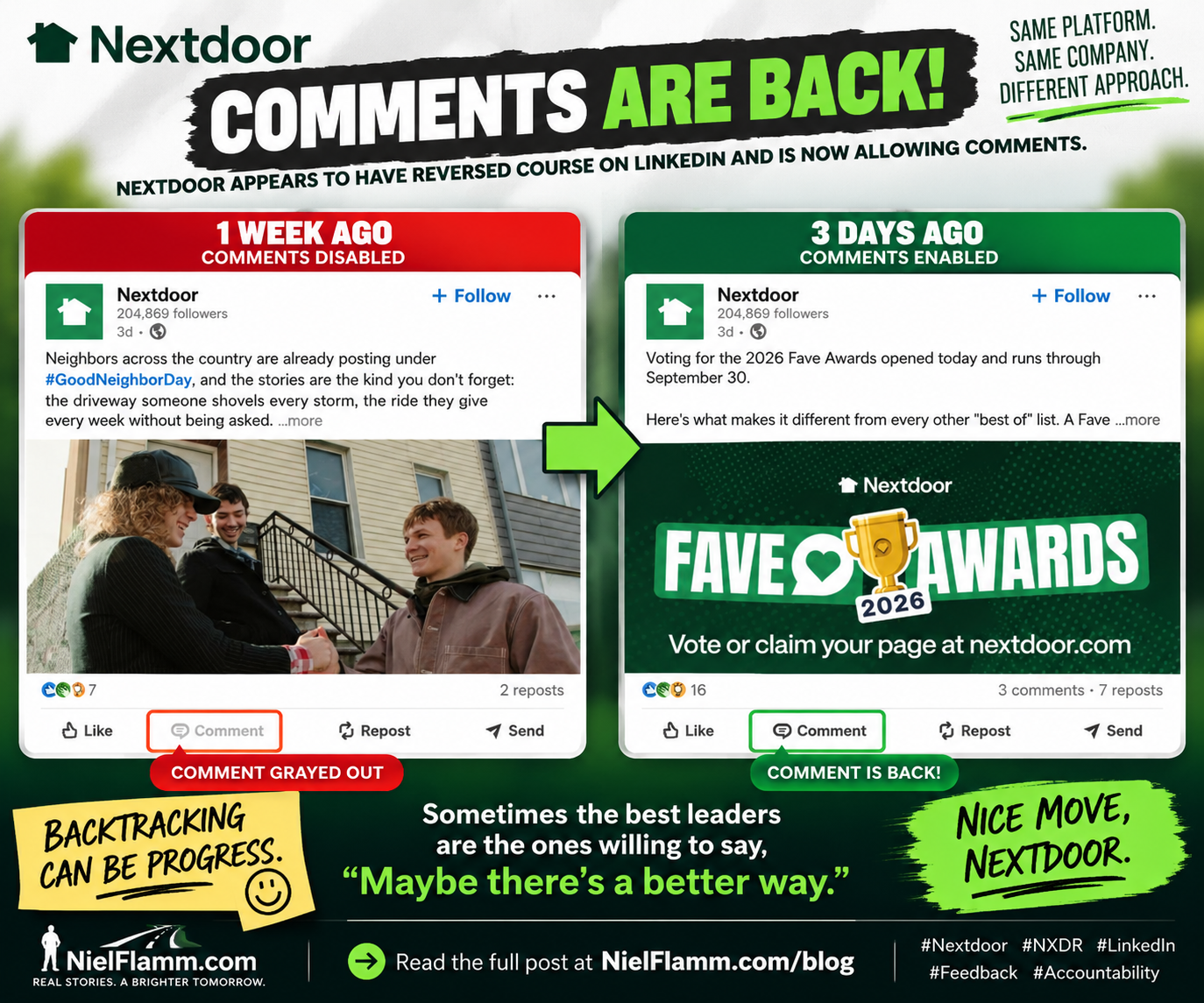
If I'm going to spend time providing feedback to Nextdoor, I should also acknowledge when I see the company do something positive.
And today, I noticed something:
Nextdoor appears to have turned LinkedIn comments back on.
Yes, I'm complimenting Nextdoor.
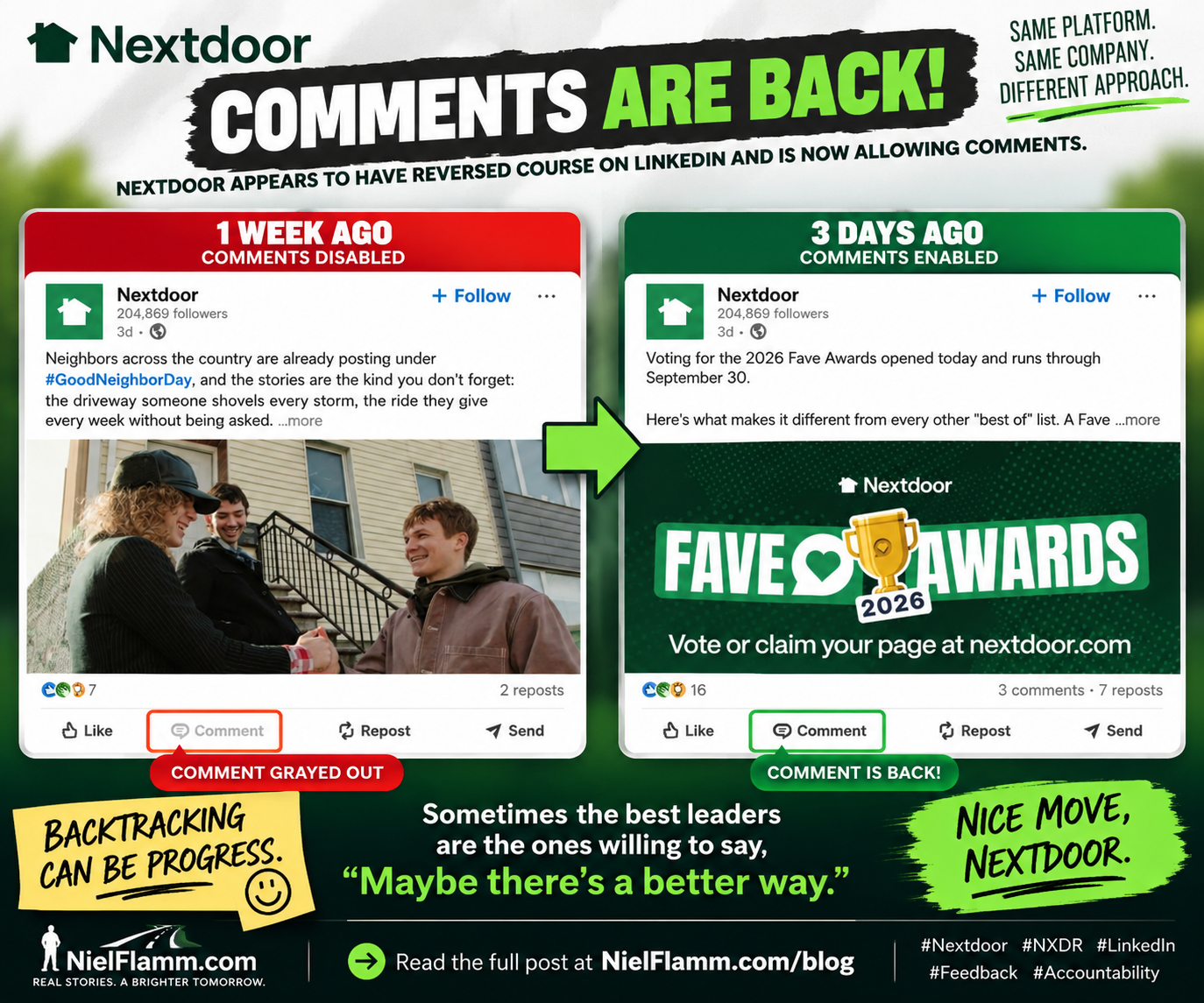
A Week Ago: No Comments
A Nextdoor LinkedIn post from about a week ago promoting #GoodNeighborDay had commenting disabled. Like, Repost, and Send were available, but Comment was grayed out.
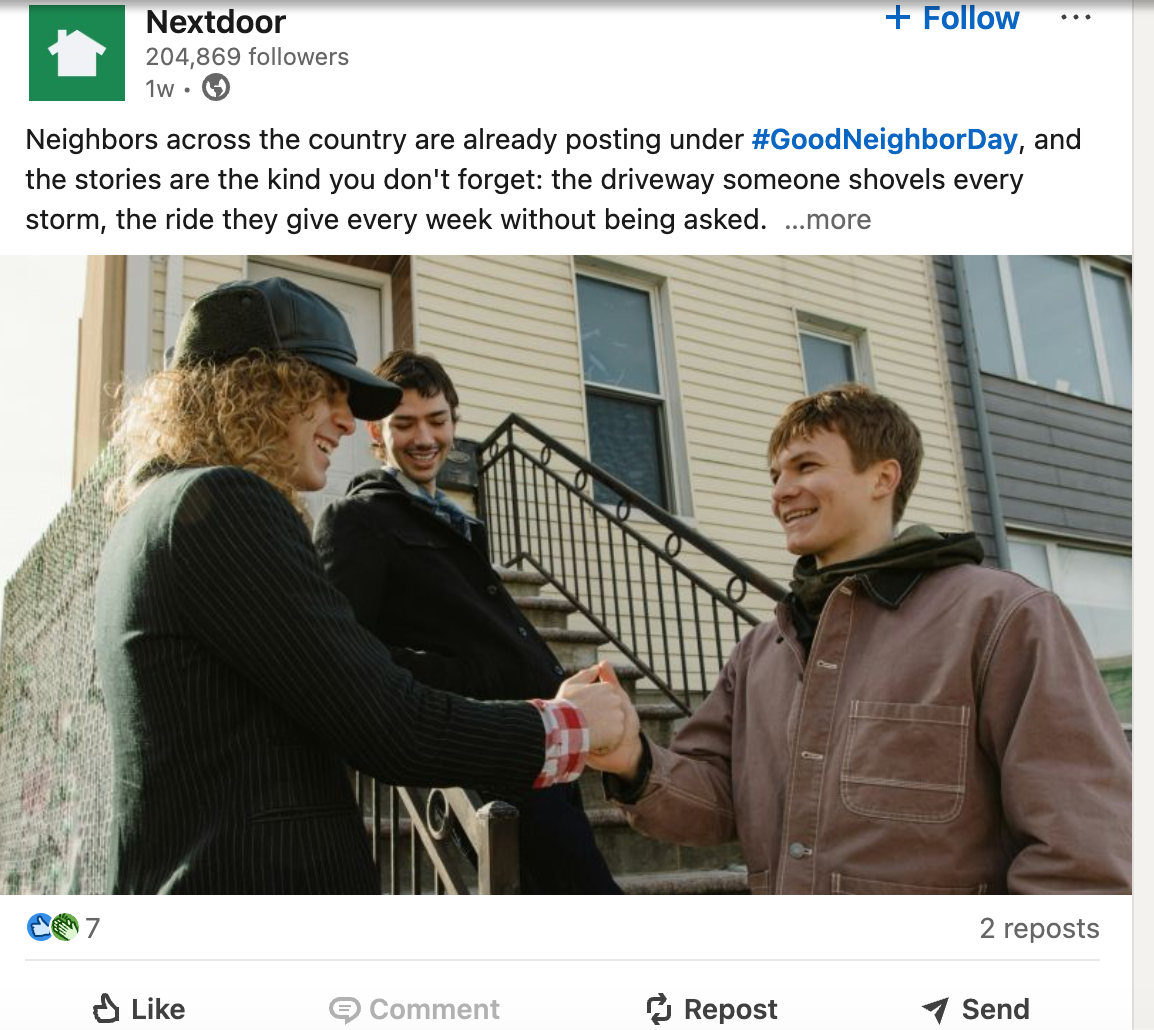
I previously provided feedback about this. For a company built around neighborhood conversations, limiting conversation on its own corporate social media seemed like an odd choice.
But something changed.
Comments Are Back
A more recent post promoting the 2026 Fave Awards allows comments.
There's also another Nextdoor post between these two where commenting is available.
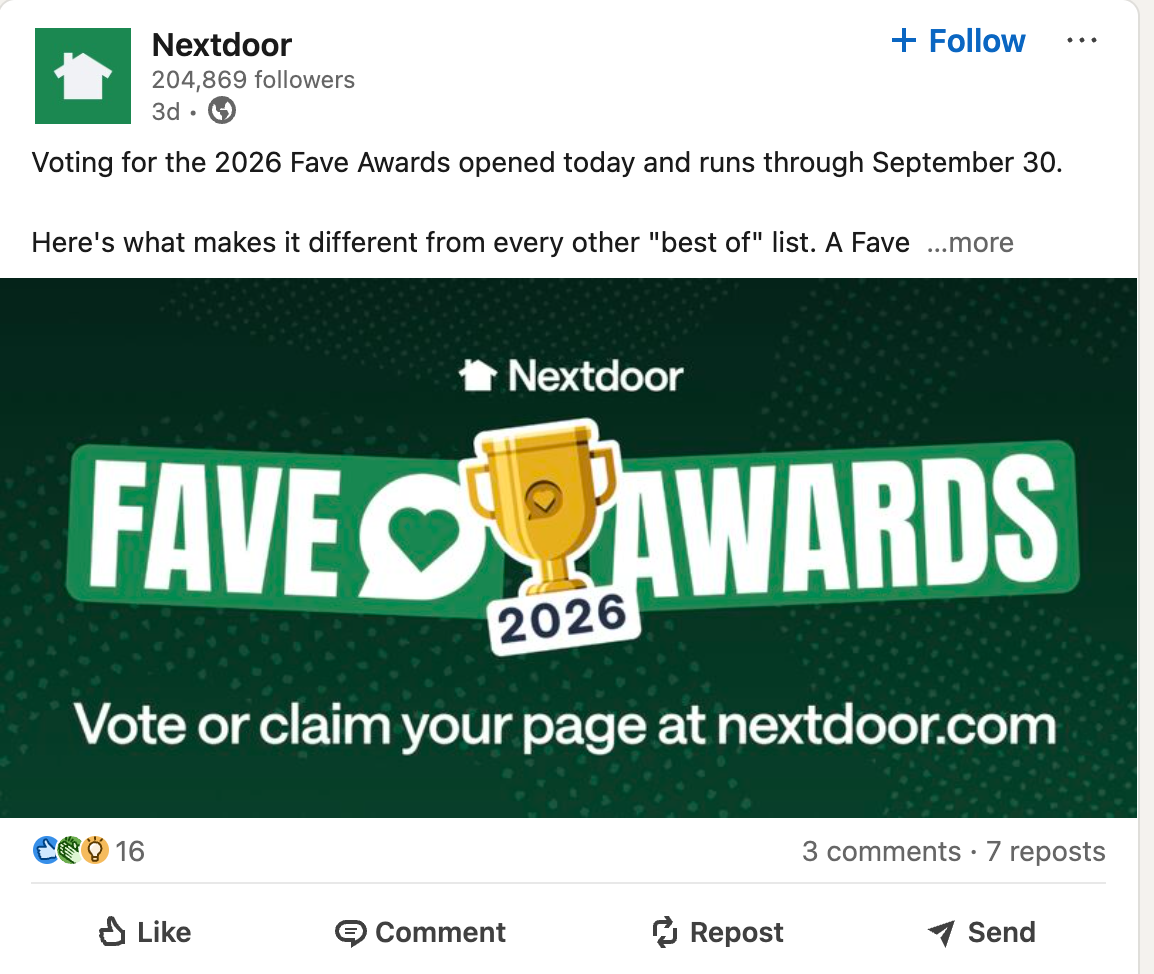
So, whatever the reason, comments appear to be back.
And you know what?
Good. I applaud the decision.
I don't know who made the change or why. I don't know whether Communications reconsidered the approach, whether this is temporary, or whether there's another explanation.
And I'm certainly not claiming my feedback had anything to do with it.
I can only document what I see:
Comments were disabled. Now multiple newer posts allow them.
That's movement in the right direction.
Backtracking Can Be Progress
Companies shouldn't be afraid to reconsider a decision.
If I’m driving somewhere and realize I've made a wrong turn, I don't continue another 40 miles just to prove I was committed to the route.
I turn around.
Changing course isn't necessarily weakness.
Sometimes it's good leadership.
A Social Network Should Be Social
Nextdoor is built around people communicating.
That doesn't mean its LinkedIn page should tolerate spam, abuse, or inappropriate behavior. Moderation has a purpose.
But there's an important difference between:
Moderating the conversation
and
preventing the conversation.
If Nextdoor has decided to allow that conversation again, I think that's a good move.
Credit Where Credit Is Due
I've provided plenty of feedback about Nextdoor's communication, leadership, research transparency, moderation, monetization and shareholder value.
And yes, I'm still waiting for the detailed Insights data I've requested.
But accountability works both ways.
If I'm willing to publicly point out where I think Nextdoor can improve, I should publicly acknowledge when I think Nextdoor gets something right.
This case study isn't about finding something wrong every day.
It's about observing, asking questions, providing feedback, and documenting what happens.
So today:
Nice move, Nextdoor. Keep going.
Now, about that Insights data...
Follow my continuing Nextdoor case study at NielFlamm.com/blog.
Day 91: Another Email Sent. The Question Hasn’t Changed.
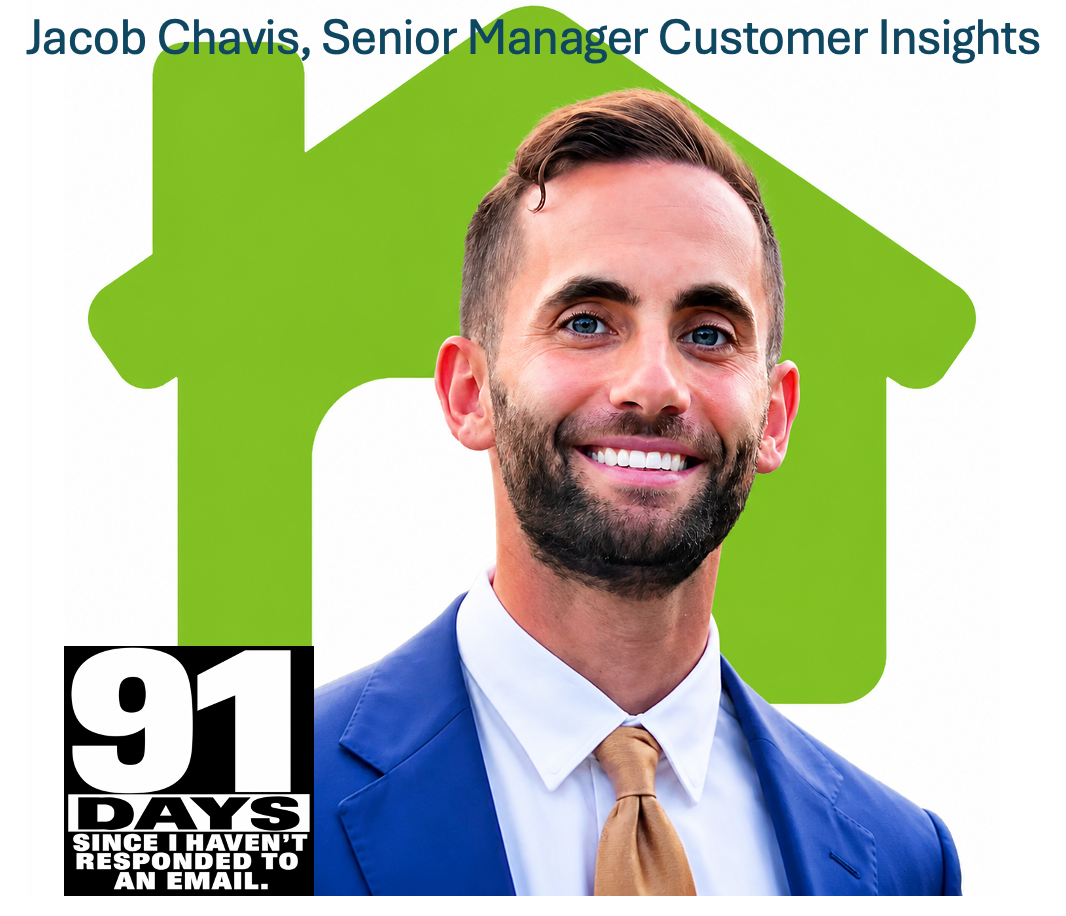
Day 91.
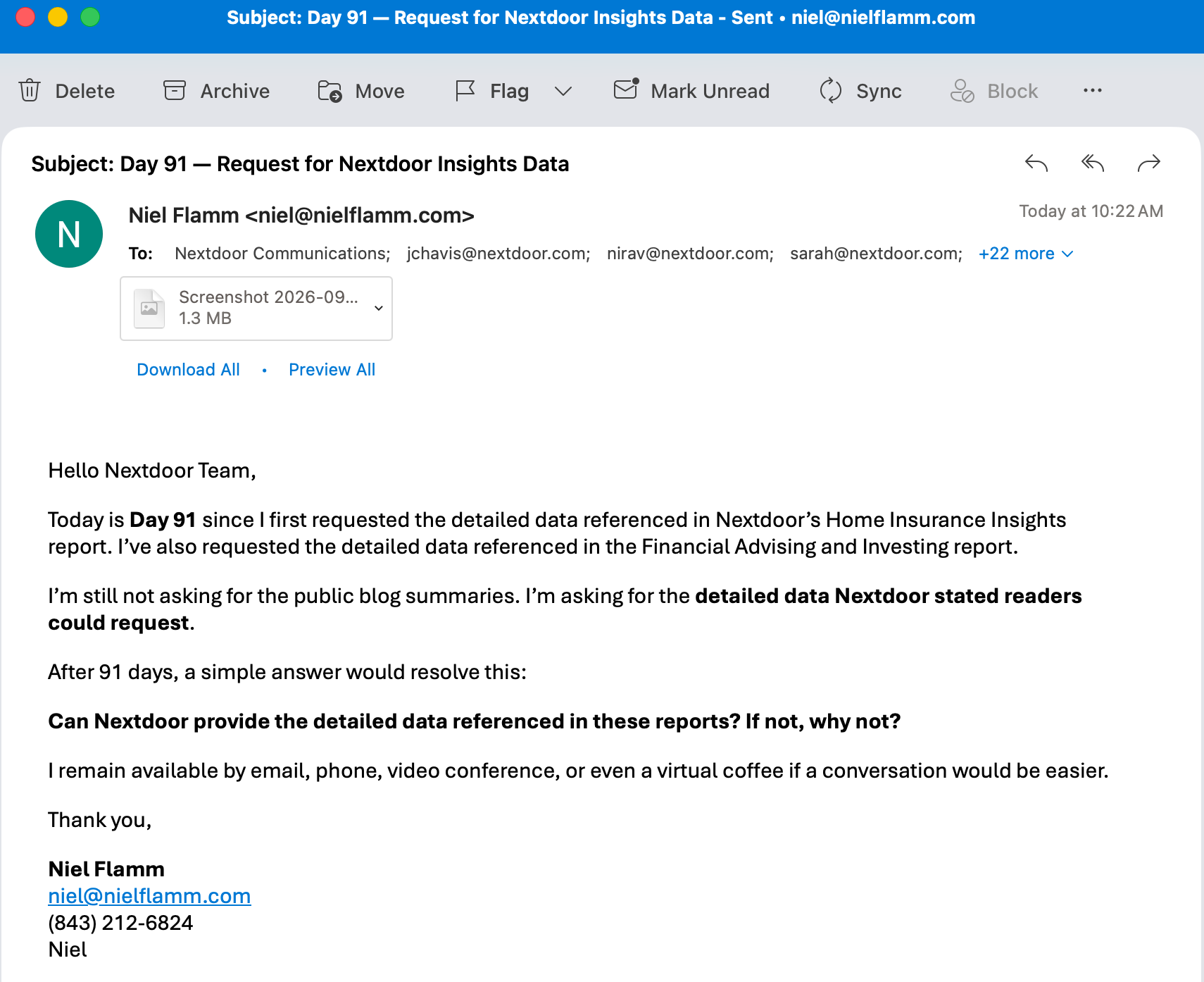
I've officially sent another email to the Nextdoor team.
And after 91 days, I have managed to make the request even shorter.
Not because the issue has become less important.
Because I'm running out of ways to make the question clearer.
The Request Is Still Incredibly Simple
Nextdoor published an Insights report about home insurance that told readers they could reach out for “detailed data, additional audience segments, and strategic recommendations.”
Another Nextdoor Insights report about financial advising and investing made a similar offer.
So I did something apparently radical.
I asked for the detailed data.
Not the blog posts.
Not links to the summaries I've already read.
Not an explanation of where the information appears on Nextdoor's website.
The detailed data referenced in the posts.
And today, on Day 91, I sent another email.
This Time, I Made the Choices Pretty Easy
My email essentially asks one question:
Can Nextdoor provide the detailed data referenced in these reports? If not, why not?
That's it.
At this point, I'm not even asking for a yes.
A no is an answer.
“The data isn't available” is an answer.
“The data is restricted to advertisers” is an answer.
“You need to meet certain requirements” is an answer.
“Someone else handles these requests” is an answer.
Silence isn't much of an answer.
91 Days Is a Long Time to Ask One Question
What started as a research request has gradually become something much more interesting to me.
It's become a case study in corporate communication.
If your company publicly tells people to contact someone for more information, what happens when somebody actually does?
Apparently, in my case, you get enough material for 91 days of writing.
I don't think that was the intended content-marketing strategy.
But here we are.
I'm Still Offering an Easier Option
I've repeatedly said that I'm willing to talk.
Email me.
Call me.
Video conference.
Virtual coffee.
I'm not interested in turning this into some endless game of corporate email Ping-Pong.
I'd rather talk than type.
And I'm certainly not hiding.
I included the same contact information I provided before.
Day 91: Another Email Is in the Inbox
Maybe today is the day.
Maybe someone at Nextdoor reads the email and says:
“Wait...has nobody answered this yet?”
Maybe the detailed data arrives.
Maybe somebody explains why it can't be provided.
Either one moves the story forward.
Until then, Day 91 gets added to the case study.
Another email sent.
Same question.
Still waiting for the answer.
Follow the continuing Nextdoor case study at NielFlamm.com/blog.

Day 86: Is Nextdoor Laboring? Or Are We Back to Business as Usual?

Labor Day is over.
It's Day 86 of my continuing Nextdoor case study, and after wondering yesterday whether Nextdoor was taking an extended holiday weekend, I checked again today.
I haven't received any communication regarding the two detailed Insights studies I requested.
And NXDR?
As of this writing, it's hovering around the low $2.20s. Market sources were showing roughly $2.24 late this afternoon after Friday's $2.24 close, so the exact number is moving as I write this.
Hey, at least we're talking pennies now.
Is Nextdoor laboring?
I'm still trying to figure that out.
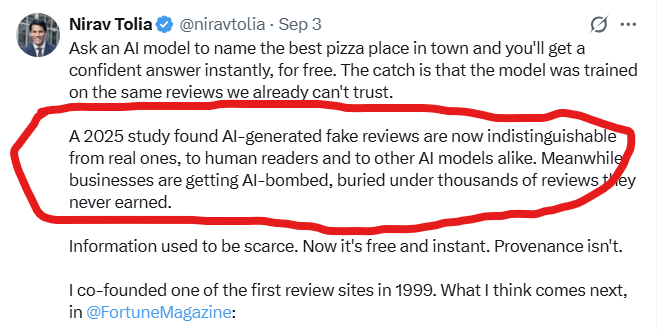
But something Nirav Tolia posted on X on September 3 caught my attention.
“A 2025 Study Found...”
In the post, Nirav wrote:
“A 2025 study found AI-generated fake reviews are now indistinguishable from real ones...”
And immediately I thought:
Here we go again.
A study.
Which study?
Who wrote it?
Where was it published?
What was the methodology?
What was the sample size?
What exactly did “indistinguishable” mean?
This probably sounds familiar to anyone who has followed my 86-day adventure in Nextdoor research transparency.
Here's the interesting part: I looked, and there is identifiable research behind Nirav's statement.
In a Fortune piece published the same day, Nirav identified it more specifically as a 2025 study from Nottingham University Business School.
Peer-reviewed 2025 studies examine AI-generated fake reviews, including a Journal of Retailing and Consumer Services study analyzing 714,016 reviews and finding meaningful linguistic differences between AI-generated fake reviews, human-generated fake reviews, and authentic reviews.
So my criticism isn't:
“The study doesn't exist.”
My question is:
Why not cite it in the original post?
If you're going to use research to establish credibility, give readers enough information to evaluate the research themselves.
Study name. Authors. Publication. Link.
Four things.
Done.
Especially when you're the CEO of a company currently promoting the idea that provenance matters.
That's almost too perfect.
Fake Reviews Didn't Arrive With ChatGPT
Another part of this discussion bothers me.
AI didn't invent fake reviews.
AI made them faster, cheaper, and easier to produce at scale.
Humans have been manipulating reputations for a very, very long time.
In fact, the history is pretty entertaining.
1800s: Walt Whitman anonymously published glowing reviews of his own Leaves of Grass. That's essentially the 19th-century version of creating a burner account and giving yourself five stars.
Early 1900s: Newspapers were already dealing with fabricated information, exaggerated claims, and “fakers.” By 1913, the New York World had established a Bureau of Accuracy and Fair Play partly to address complaints and “stamp out fakes and fakers.”
Pre-internet advertising: Businesses used testimonials and endorsements as marketing tools, creating the same fundamental problem we face today: Is this person recommending the product because they genuinely love it—or because somebody benefits from the endorsement?
Early Internet: Message boards, review sites, and eventually e-commerce let businesses and individuals create accounts and manufacture praise—or attack competitors.
Ironically, Nirav himself co-founded Epinions in 1999, one of the early user-generated review platforms. He now acknowledges that the review economy eventually became vulnerable to manipulation.
2010s: Fake-review businesses became an industry. Businesses could purchase positive reviews, competitors could be attacked with negative ones, and reviewers could operate multiple identities.
2020s: Review farms became increasingly sophisticated. Investigators found coordinated reviewers praising unrelated businesses across countries, with identical reviews sometimes appearing under different names.
Today: Generative AI has dramatically changed the economics. Instead of paying humans to crank out hundreds of reviews manually, someone can rapidly generate enormous quantities of convincing text. Research now shows LLMs can produce deceptive reviews with human-level capabilities, even though researchers can still statistically identify some linguistic differences.
Same scam.
Much better machinery.
Which Brings Me Back to Nextdoor
Nextdoor's current pitch is that verified identity and neighborhood accountability can make recommendations more trustworthy.
That's an interesting strategy.
But verification alone doesn't make an opinion truthful.
A real person can exaggerate.
A verified person can have a grudge.
A real neighbor can recommend their friend's company.
A legitimate customer can receive an incentive.
Two verified neighbors can have completely different experiences with the same business.
And, as I've previously documented, I've had my own questions about how robust Nextdoor's verification system actually is.
So “verified” is a trust signal.
It isn't a magical truth serum.
Provenance Matters? I agree.
That's actually what makes Nirav's post so interesting.
His broader argument is essentially:
Where information comes from matters.
I agree.
Completely.
Which is why when the CEO says:
“A 2025 study found...”
I want the provenance.
Name the study.
Name the researchers.
Link to it.
Let readers inspect it.
And that's precisely what I've been asking Nextdoor to provide regarding its own research.
For 86 days.
Nextdoor published Insights findings.
Nextdoor publicly told readers they could request detailed data.
I requested it.
I've emailed.
I've followed up.
I've expanded the distribution.
I sent another request Saturday.
And I'm still waiting for the two detailed studies.
Day 86
Yesterday was Labor Day.
Today I'm asking:
Is Nextdoor laboring?
Because I'm still doing the work.
Waiting for somebody at Nextdoor to answer the questions.
Nirav's post argues that provenance matters.
On that, we agree.
So here's my Day 86 suggestion:
Practice it.
When you cite research, show us the research.
When Nextdoor publishes research, show us the methodology.
When your own blog tells readers they can request detailed data, provide the detailed data—or explain why you won't.
Because whether we're talking about a restaurant review, an AI-generated recommendation, or a corporate Insights report, the principle is the same:
Don't just tell me to trust it. Give me enough information to decide whether to trust it.
Follow the continuing Nextdoor case study at NielFlamm.com/blog.