
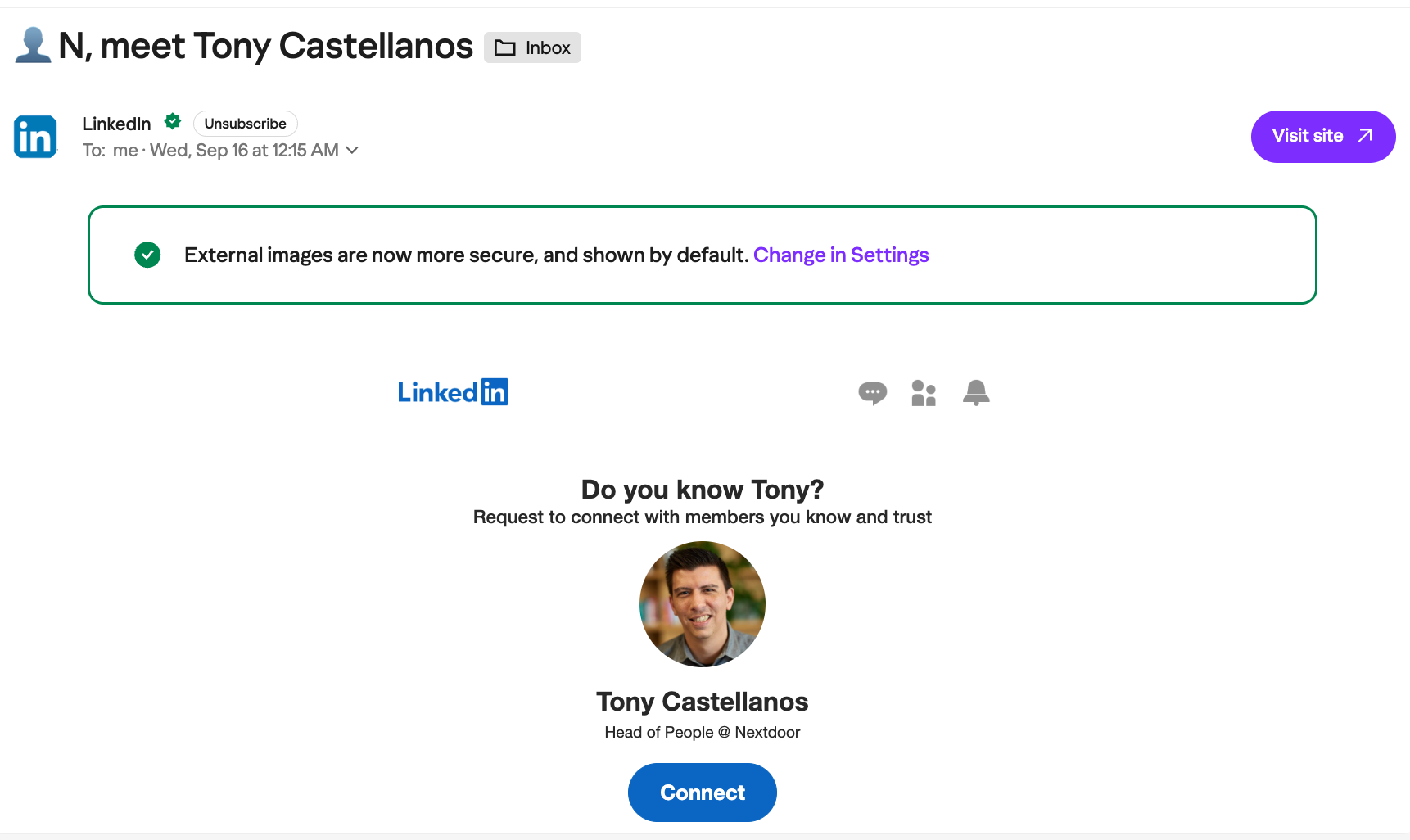
Day 94: LinkedIn Thinks I Should Meet Nextdoor’s Head of People. I Agree.
Sometimes an algorithm has impeccable timing.
At 12:15 this morning, I received an email from LinkedIn with the subject line:
“N, meet Tony Castellanos.”
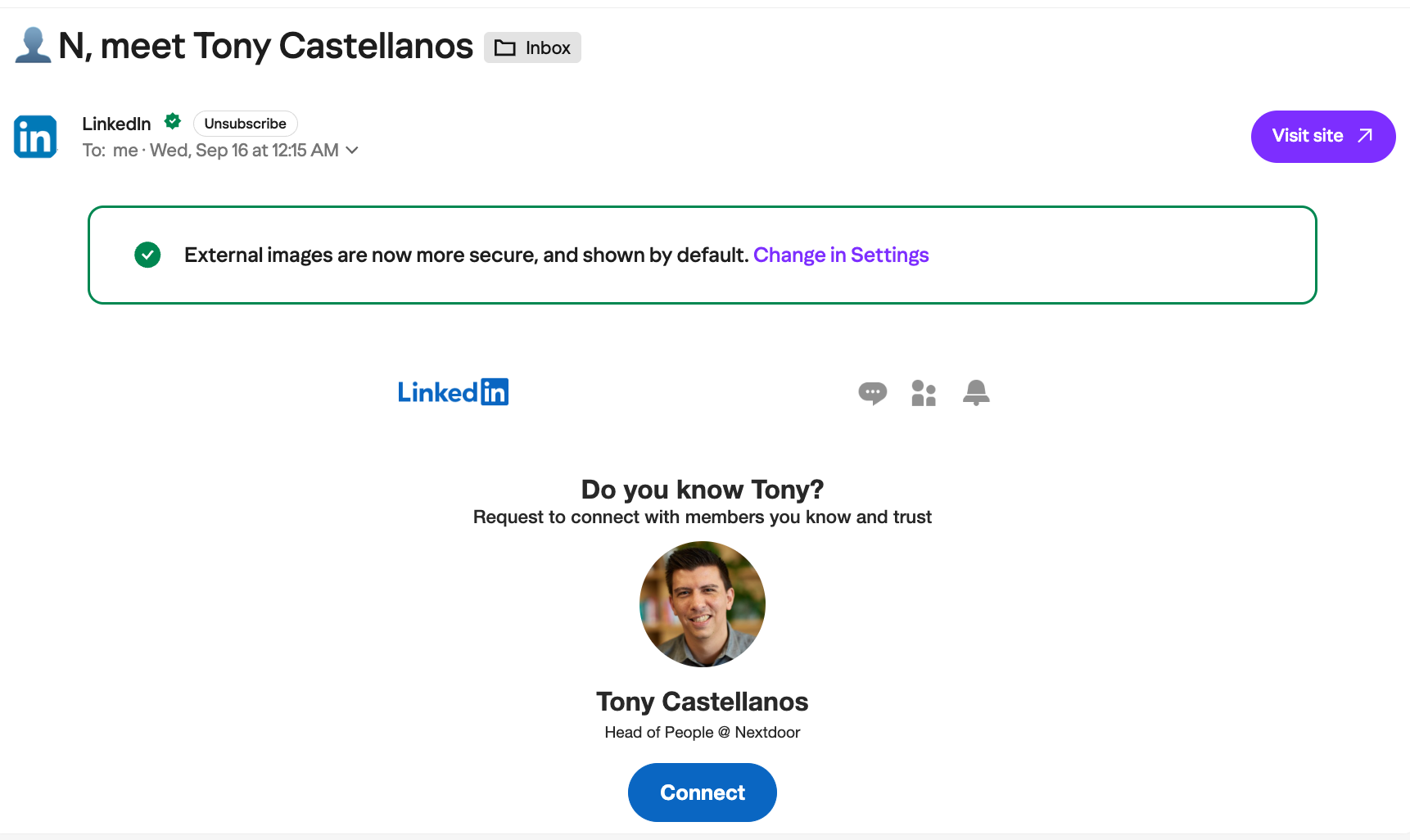
LinkedIn asked:
“Do you know Tony?”
Well, LinkedIn, not exactly.
But after 94 days, I would absolutely love to get to know him.
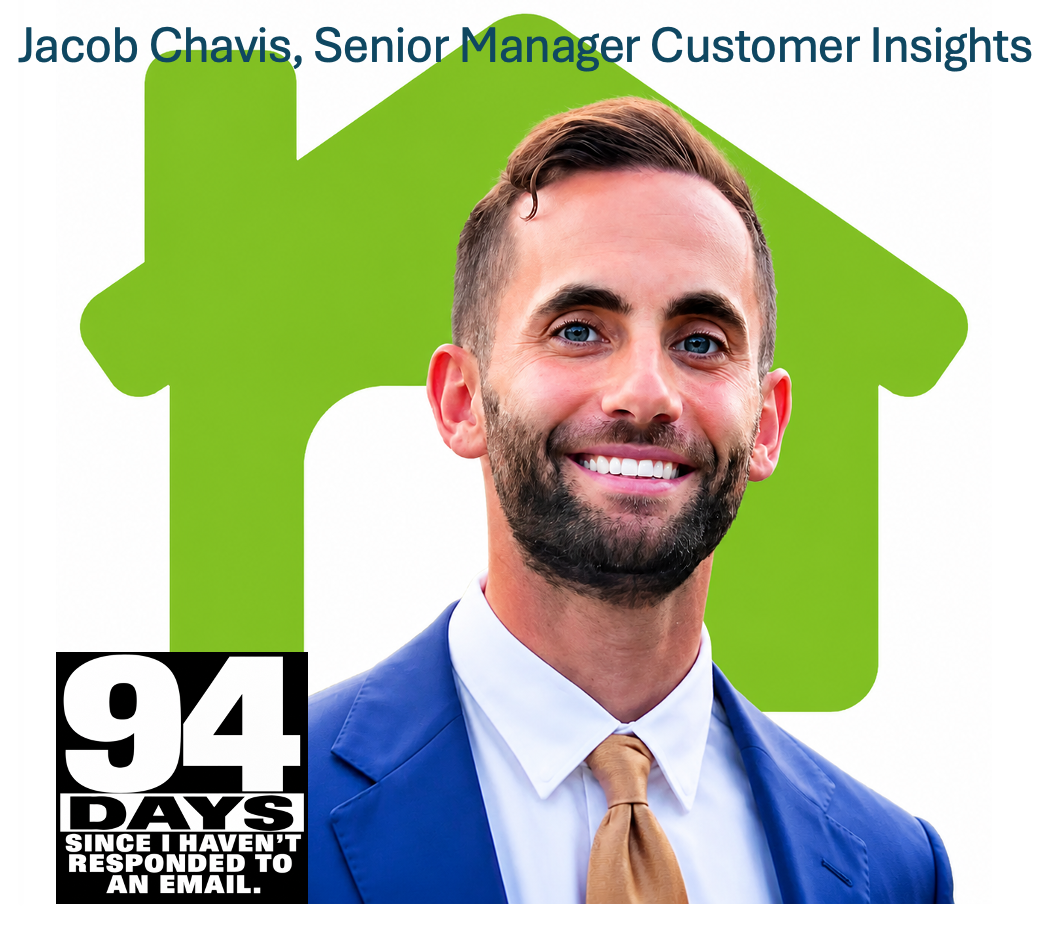
Tony Castellanos is Nextdoor’s Executive Vice President, People. Nextdoor promoted him to that position in March, giving him responsibility for its People organization, including talent acquisition, compensation, HR business partnering, and benefits. Nextdoor also describes the People function under his leadership as a strategic advisory organization that partners with senior leaders on important talent and organizational decisions. Nextdoor
So LinkedIn, your recommendation got me thinking.
Tony, Want to Have a Virtual Coffee?
I've tagged Tony a few times during this ongoing Nextdoor case study.
I may have even included him on an email or two. After 94 days, the distribution list has gotten a little crowded.
But this isn't about blaming Tony for my unanswered request.
He's not running Nextdoor Insights.
He didn't publish the Home Insurance research.
He's not responsible for sending me the data.
And I wouldn't expect the Head of People to suddenly open a spreadsheet and say:
“Niel, good news. I found your missing insurance study!”
That's not his job.
But the email made me think about something bigger.
What Does the Head of People Think?
My original request remains remarkably simple.
Nextdoor published an Insights article telling readers that they could reach out for detailed data, additional audience segments, and strategic recommendations.
I reached out.
And today is Day 94.
So I'd genuinely be interested in Tony's perspective—not necessarily on where the spreadsheet is, but on what happens organizationally when something like this continues for more than three months.
What does Nextdoor's Head of People think when a shareholder responds to a publicly advertised invitation for information and, 94 days later, still hasn't received the requested material or a definitive explanation that it isn't available?
Does he see a communication problem?
A process problem?
An ownership problem?
An escalation problem?
A training problem?
Or does he look at the situation and think Nextdoor has handled it appropriately?
I'd actually like to know.
And Then There’s Risk
This is where the People perspective becomes especially interesting.
I'm not suggesting that Tony is Nextdoor's chief risk officer, general counsel, or head of investor relations. He's not.
But senior People leaders often have a broad view of organizational behavior, leadership practices, and how internal decisions can affect employees and the business.
Nextdoor itself says Tony's People organization is designed to operate as a strategic advisor to the business. Nextdoor
So from that perspective, I'd be curious about his thoughts on organizational risk.
Not because I am declaring that Nextdoor has created some specific legal liability. That's a different question for lawyers.
I'm talking about something much more basic.
What happens when a small problem is allowed to become a 94-day problem?
The original request could have been resolved with a few sentences:
Yes, here's the data.
No, we can't provide it.
It's restricted, and here are the requirements.
That language in the article was incorrect.
Someone else handles these requests.
Any one of those would have provided closure.
Instead, we're on Day 94.
This Is Becoming a Case Study in Organizational Behavior
That's one of the reasons I've remained fascinated by this.
The longer it goes, the less interesting the actual research data becomes.
The organizational response becomes the story.
Who owns the question?
Who notices when something falls through the cracks?
Who has the authority to resolve it?
When does somebody say, “Why are we still dealing with this?”
How does feedback move through the organization?
Does escalation produce resolution—or another layer of silence?
Those are People questions.
They're also leadership questions.
And they're exactly the kinds of questions that fascinate me after more than two decades working in Learning & Development.
Sometimes what looks like a knowledge problem is really a performance problem.
Sometimes what looks like a communication problem is really an ownership problem.
And sometimes an issue survives for 94 days because nobody has decided it's their job to end it.
Tony Has Talked About Human Judgment
There's another reason LinkedIn's recommendation made me smile.
Nextdoor has recently highlighted Tony's work bringing AI into its People organization. The company says the goal is to use technology for transactional work while letting people spend more time on work that requires human judgment. Nextdoor
I actually like that philosophy.
And this seems like a pretty good opportunity for some human judgment.
Forget AI.
Forget another automated workflow.
Forget another corporate process.
A human being could probably resolve this.
Maybe over coffee.
So Yes, LinkedIn. I’d Like to Meet Tony.
LinkedIn apparently thinks Tony Castellanos and I should know each other.
I'm willing.
Tony, if you happen to see this, the invitation is sincere.
Phone.
Video.
Virtual coffee.
I'll even buy my own coffee.
I don't expect you to personally produce the Insights data. I'd simply be fascinated to hear how someone responsible for Nextdoor's People organization views what has now become a 94-day customer/shareholder communication journey.
What worked?
What didn't?
Where should ownership have existed?
What organizational risks can emerge when relatively simple questions remain unresolved?
And perhaps most importantly:
How would you prevent Day 94 from becoming Day 100?
Because tomorrow, unless something changes, there will be a Day 95.
Thanks for the introduction, LinkedIn.
Tony, the coffee invitation is open.
Follow the continuing case study at NielFlamm.com/blog.
Nextdoor Didn’t Make the Top 100. Why Not?
The more I thought about Nextdoor’s LinkedIn post celebrating Publix making PEOPLE’s 100 Companies That Care, the more I realized I was focused on the wrong part of the story.
Yes, Publix ranked No. 4.
Yes, Nextdoor highlighted a Publix associate who used the Nextdoor app to discover an elderly neighbor needed help before Hurricane Milton.
It's a great story, and the employee deserves recognition.
But there's another question that I find much more interesting:
Where was Nextdoor?
Nextdoor didn't make the Top 100.
For a company whose identity revolves around neighbors, community, connection, trust and helping people locally, that's something worth examining.
Technology Companies Made the List
This wasn't a ranking limited to grocery stores, hospitals and nonprofits.
Technology companies made it.
Companies including Salesforce, Intuit, Hewlett Packard Enterprise, Adobe, ServiceNow and NVIDIA were recognized.
Salesforce ranked an impressive No. 5.
So technology isn't the barrier.
And that makes me wonder:
For a company that promotes itself as a platform for connection and community, why wasn't Nextdoor there?
We Don't Know Why—and That's Important
I don't know whether Nextdoor applied.
I don't know whether it was evaluated.
I don't know whether it qualified but didn't score high enough.
And because the published ranking ends at 100, I don't know whether Nextdoor would have been No. 101 or No. 1,001.
I'm not going to manufacture an explanation.
But I can look at some of the issues I've documented and ask whether they provide opportunities for Nextdoor to improve.
Because that's what feedback should ultimately accomplish.
Start With Small Businesses
Nextdoor talks frequently about supporting local businesses.
I've also provided feedback about what I see as an increasingly aggressive effort to monetize those businesses.
Business Pages.
Advertising.
Paid products.
Opportunity Alerts.
Nextdoor needs to make money.
Let me emphasize that because I'm a shareholder:
I WANT NEXTDOOR TO MAKE MONEY.
My concern is where intelligent monetization ends and what I've described as a money grab begins.
If you're going to position yourself as the champion of neighborhood businesses, those businesses should feel like valued members of the ecosystem—not simply another opportunity to extract revenue.
Nextdoor needs to make money with small businesses, not merely from them.
There's a difference.
Then There’s the Moderator Model
I've also repeatedly provided feedback about what I believe is a flawed volunteer moderator model.
I've questioned consistency.
Training.
Accountability.
Quality assurance.
Centralized oversight.
And what happens when personal neighborhood disputes collide with moderation authority.
When moderation works, most people probably never notice it.
When it doesn't, moderation can become the entire Nextdoor experience.
If Nextdoor wants to sell trust, its moderation system needs to consistently create trust.
That requires more than asking unpaid neighbors to police other neighbors.
And Then There’s the “Karen” Problem
Let's address the person demanding to speak with the neighborhood manager.
Nextdoor has faced a long-running public reputation in commentary as something of the “Karen” of social-media platforms.
Fair or unfair, the reputation exists.
Suspicious-neighbor posts.
Parking complaints.
Garbage-can disputes.
Political arguments.
Dog-poop investigations worthy of CSI: Suburbia.
And the classic:
“Did anyone else hear that boom?”
Nextdoor can't control every ridiculous thing someone posts.
But Nextdoor can influence the experience surrounding those posts.
Moderation.
Product design.
Algorithms.
Enforcement.
Community standards.
Leadership.
If a platform develops a cultural reputation for complaining, suspicion and neighborhood conflict, marketing alone isn't going to change it.
You have to change the experience that created the reputation.
But Here’s What Really Got My Attention About Those Tech Companies
Companies such as Salesforce, NVIDIA, Intuit, Adobe, ServiceNow, and HPE aren't charities.
They're businesses.
And some of them are extraordinarily profitable businesses.
That's important because sometimes conversations about corporate responsibility create a false choice:
Make money
or
do good.
The companies appearing on this list demonstrate that it doesn't have to work that way.
Caring and Making Money Aren’t Opposites
Take Salesforce.
Salesforce ranked No. 5 on the Companies That Care list.
In fiscal 2026, Salesforce reported a 20.1% GAAP operating margin, generated approximately $14.4 billion in free cash flow, and returned approximately $14.3 billion to shareholders through stock repurchases and dividends.
At the same time, its community efforts included its AI for Impact initiative and millions of dollars in funding, technology, and expertise for nonprofits.
Then there's NVIDIA.
NVIDIA made the Companies That Care list while also returning enormous amounts of capital to shareholders. During fiscal 2026, NVIDIA reported approximately $40.4 billion in share repurchases and $974 million in dividends.
Intuit made the list while continuing to operate a profitable technology business and connecting its community initiatives directly to its mission of “powering prosperity.”
See the pattern?
These companies didn't have to choose.
They could make money.
They could return money to shareholders.
They could invest in employees.
They could support communities.
And they could still work toward fulfilling their stated missions, visions and values.
Mission Shouldn’t Be a Substitute for Results
This is where I think the comparison becomes particularly relevant to Nextdoor.
Mission statements are wonderful.
Values are wonderful.
Community is wonderful.
But shareholders can't deposit a mission statement.
And customers can't experience corporate values that exist only on a website.
Mission, vision, and values shouldn't substitute for business results.
But the reverse is equally important:
Business results shouldn't require abandoning mission, vision and values.
Great companies figure out how to do both.
That's the standard.
And That’s Why Nextdoor’s Absence Interests Me
Think about the proposition Nextdoor is trying to sell.
It's the neighborhood platform.
The connection platform.
The place where real people connect with real neighbors.
The place where local businesses connect with customers.
The place where communities supposedly become stronger.
If I were designing a company specifically to compete for something called “100 Companies That Care,” that sounds like a pretty good starting point.
Yet Nextdoor didn't make the Top 100.
Meanwhile, companies that don't have “neighborhood connection” at the center of their entire identity did.
That's fascinating.
Maybe Connection Needs to Start at Home
Here's the question I'd ask Nextdoor:
Does the experience inside and around Nextdoor match the values Nextdoor markets outside?
Do employees feel connected?
Do neighbors trust the platform?
Do small businesses feel supported—or monetized?
Do volunteer moderators have the training, oversight, and accountability they need?
Does leadership welcome difficult feedback?
Does the platform's actual reputation resemble the brand Nextdoor wants people to see?
Is the company building sustainable profitability?
And are shareholders seeing the value created by all of it?
Those aren't accusations.
They're questions.
But they're questions I think any company built around connection should be willing to ask.
Profitability Is Part of Caring Too
This may sound strange, but I believe it.
A company that can't sustain itself can't fulfill its mission for very long.
Profit matters.
Cash flow matters.
Shareholder returns matter.
Capital allocation matters.
Employees need a financially healthy employer.
Customers need a financially sustainable product.
Communities benefit when companies can continue investing in them.
And shareholders provided capital with the expectation that management would create value.
Profit isn't the enemy of purpose.
Done correctly, profit helps fund purpose.
That's why I'm impressed when a company can simultaneously generate profits, reward shareholders, invest in employees and communities, and remain aligned with its stated values.
Imagine the Better LinkedIn Post
Rather than Nextdoor posting:
“Publix made the list, and somebody from Publix used Nextdoor!”
Imagine next year:
“Nextdoor Named One of PEOPLE’s 100 Companies That Care.”
Now we're talking.
No Six Degrees of Kevin Bacon.
No connection through Publix.
No borrowed spotlight.
Nextdoor's accomplishment.
Then imagine being able to add:
Revenue growing.
Profitable.
Employees engaged.
Small businesses succeeding.
Moderation improving.
Neighbors finding genuine value.
Shareholders receiving returns.
Community mission intact.
That's the story I'd love to write.
Here’s My Challenge to Nextdoor
Don't dismiss the Top 100 list.
Study it.
Look at the technology companies that made it.
Look at how they treat employees.
Look at their philanthropy.
Look at their community investment.
Look at their corporate cultures.
And importantly, look at how some of them simultaneously make money and create shareholder value.
Then look inward.
Fix what needs fixing.
Improve the moderator model.
Make small businesses feel like partners rather than ATMs.
Continue improving communication.
Address the platform's “Karen” reputation by improving the actual experience.
Listen to feedback—even when it's uncomfortable.
Build sustainable profitability.
Create shareholder value.
And make sure the company's actions reflect the mission, vision and values it talks about publicly.
Because you don't have to choose between:
Caring about communities
and
caring about shareholders.
The best companies can do both.
Nextdoor's mission should actually give it an advantage.
Now it needs to prove it.
Don't just connect yourself to Companies That Care.
Become a profitable Company That Cares.
And give the neighbors, employees, small businesses and shareholders something worth celebrating.
If Nextdoor makes that list someday?
I'll happily applaud them.
Read my continuing Nextdoor case study at NielFlamm.com/blog.
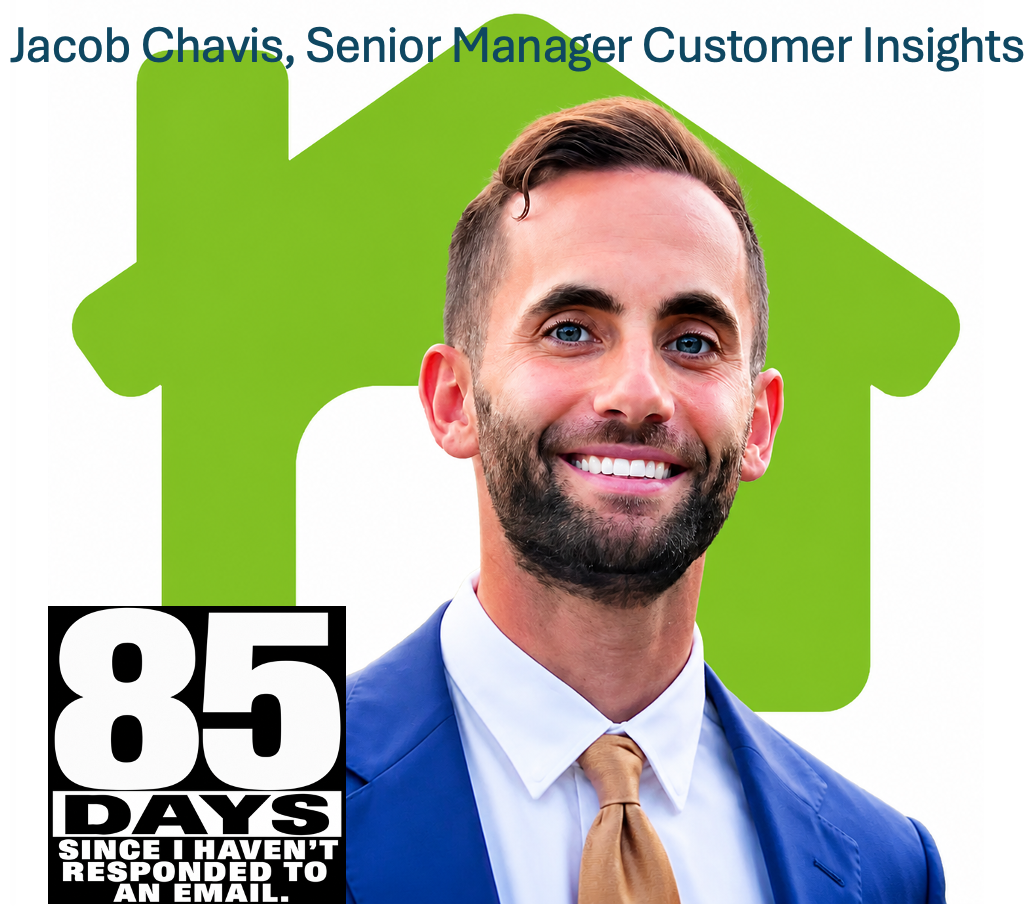
Happy Labor Day — Day 85: Nextdoor, Did You Forget the People Who Do the Work?
Happy Labor Day! 🇺🇸
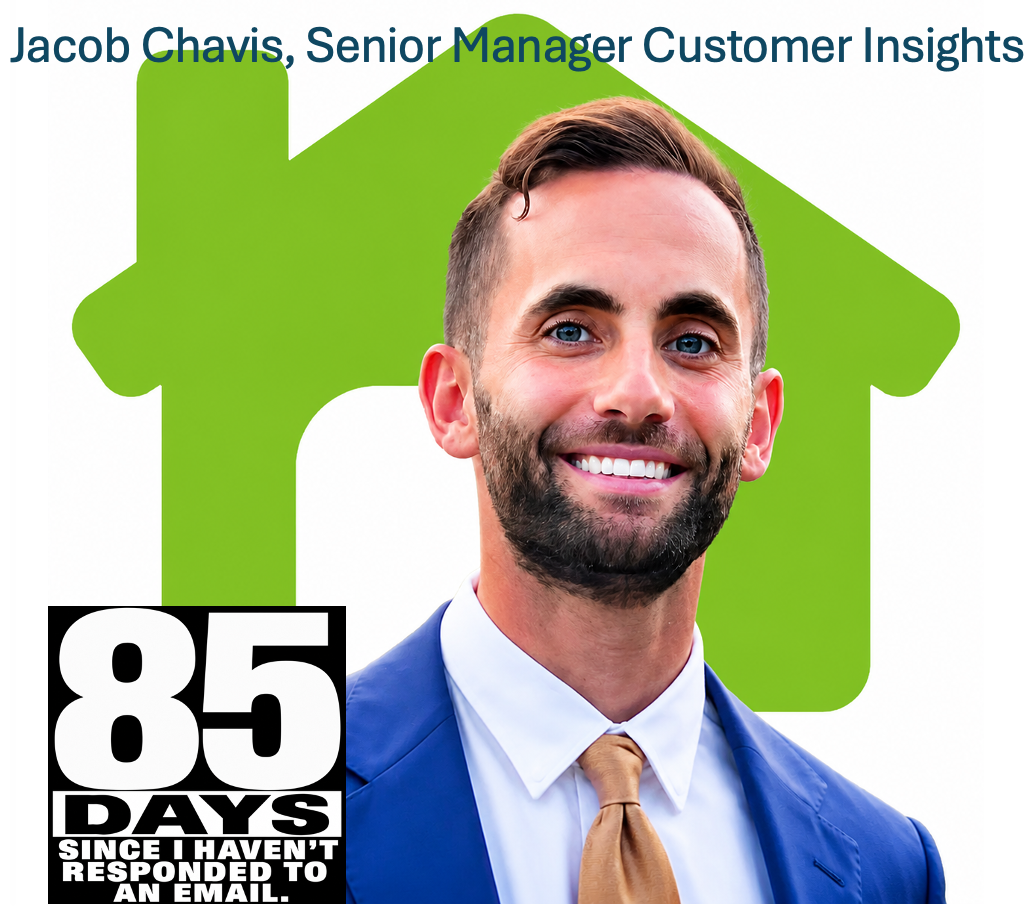
Today is Day 85 of my continuing Nextdoor case study.
Before I get to Nextdoor, it's worth remembering what today actually represents.
Labor Day isn't simply the unofficial end of summer, a three-day weekend, mattress sales, barbecues or one last trip to the beach.
Labor Day recognizes the contributions and achievements of American workers and the labor movement that fought for better working conditions, reasonable hours, fair wages, and greater protections for working people.
It became a federal holiday in 1894, and more than 130 years later, it's still an opportunity to recognize the people whose work keeps businesses, communities, and this country moving.
Which brings me to Nextdoor.
Hello? Anybody Home?
As of this writing, I haven't seen a Labor Day post on Nextdoor.
Nothing from CEO Nirav Tolia either.
Maybe something will appear later today.
If it does, I'll happily update this post.
But right now?
Crickets. 🦗
And I find that remarkable.
This is a company whose entire identity revolves around neighborhoods, communities, local businesses, and the people who make those communities work.
Teachers.
Nurses.
First responders.
Restaurant workers.
Retail employees.
Construction workers.
Delivery drivers.
Small-business owners.
Landscapers.
Electricians.
Plumbers.
Mechanics.
And, yes, the employees who actually keep Nextdoor operating.
If there were ever a holiday that practically writes itself for a company claiming to be the “essential neighborhood network,” wouldn't Labor Day be it?
Talk About Out of Touch
This isn't about whether every corporation is required to publish a social-media post for every holiday.
Of course not.
It's about awareness and consistency with your own brand.
Nextdoor has plenty to say when there's an opportunity to talk about advertisers.
It has plenty to say about businesses building brand recognition.
It has plenty to say about reaching verified neighbors.
It has plenty to say when there's a new product, advertising opportunity, or monetization strategy to promote.
But Labor Day?
A day specifically recognizing the people who actually do the work in those neighborhoods?
Nothing so far.
From my perspective, that's another example of how out of touch Nextdoor's corporate communications can appear.
And this isn't exactly a surprise holiday.
Labor Day has been on the calendar for a while.
You can even schedule a post.
Nobody needed to abandon the barbecue this morning to log into LinkedIn.
Meanwhile, I Worked Saturday
While Nextdoor was apparently enjoying the holiday weekend, I sent another email on Saturday.
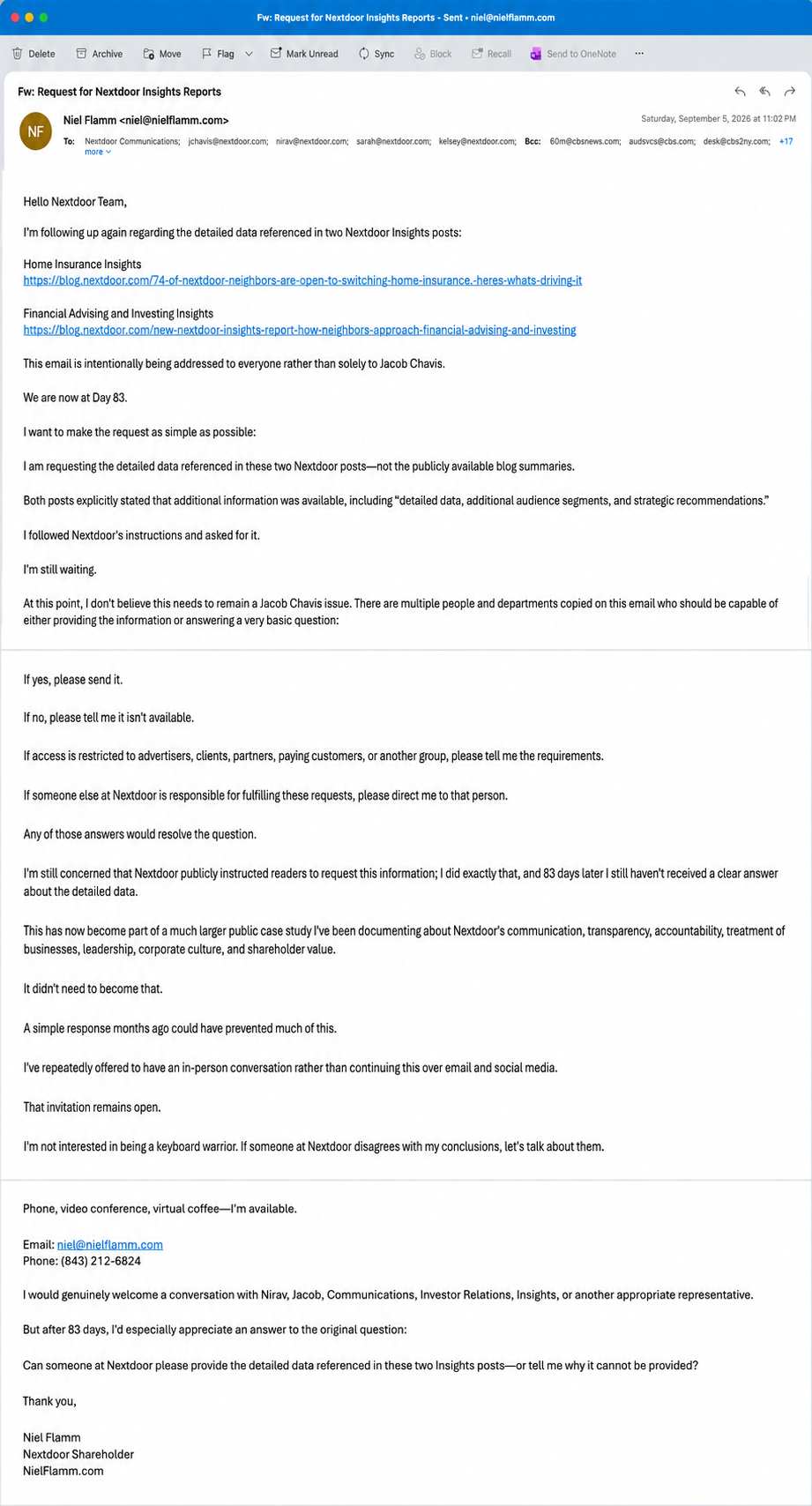
Yes.
Another one.
The subject remains the same issue I've been documenting for nearly three months:
Where are the two detailed Insights studies?
These are the two studies where Nextdoor's own published material told readers they could reach out for additional information, including detailed data, additional audience segments, and strategic recommendations.
I followed the instructions.
I've followed up.
I've clarified that I'm requesting the detailed data—not links to the summaries I've already read.
I've expanded the email beyond Jacob Chavis to include others at Nextdoor who can answer the question.
And now we're at:
Day 85.
At this point, the answer doesn't even need to be complicated.
Yes, Niel, here's the information.
Or:
No, Niel, we're not providing it.
Or:
It's only available to certain customers, advertisers, or partners.
Pick one.
I'll take clarity over silence.
The Irony of Labor Day
Maybe that's what makes today's silence particularly interesting to me.
Labor Day is partly about recognizing the value of people's work.
And one of the themes I've repeatedly raised throughout this case study is whether Nextdoor adequately recognizes the value created by the different people surrounding its platform.
Neighbors create the conversations.
Neighbors provide the recommendations.
Small businesses provide the services.
Employees build and operate the platform.
Advertisers provide revenue.
Investors provide capital.
Every one of those groups contributes something.
A healthy organization understands that relationships with those stakeholders require more than polished marketing language.
They require communication.
Listening.
Trust.
Transparency.
And accountability.
Day 85
So, Happy Labor Day to everyone working today.
Happy Labor Day to everyone fortunate enough to have today off.
Happy Labor Day to the small-business owners who don't really get holidays.
And Happy Labor Day to Nextdoor's employees too.
As for Nextdoor and Nirav Tolia:
Maybe the Labor Day message is coming.
Maybe somebody will answer tomorrow's email.
Maybe I'll finally receive those two detailed studies.
We'll see.
But as of this writing, Day 85 looks remarkably similar to many of the previous 84 days.
.I'm still waiting for somebody at Nextdoor to demonstrate that communication and accountability aren't just words used when they're convenient for the brand.
Happy Labor Day. 🇺🇸
Follow the continuing Nextdoor case study at NielFlamm.com/blog.
Day 82: Is Nextdoor Taking Another Four-Day Weekend?
It’s Day 82.
I’m still here.
Still reaching users.
Still talking to businesses.
Still raising questions for investors.
Still documenting my disappointment with Nextdoor.
And Nextdoor?
Well, from where I’m sitting, it looks like the company may be sticking to a familiar communications playbook:
It’s Friday before Labor Day weekend. Things have gotten very quiet.
No new post today that I’ve seen from Nextdoor’s corporate communications channels.
Nothing new from CEO Nirav Tolia.
And those two detailed Insights studies I’ve been requesting?
Still nothing.
But I do have some exciting news.
NXDR Is Up a Penny! 🎉
As I write this, NXDR is up approximately $0.01.
Hey, at least it isn’t down.
After 82 days, I’ve learned to appreciate the little things.
One penny at a time, people.
Of course, a penny on one trading day doesn't tell us much about the company's long-term value or investor confidence. What matters is sustained performance and whether management's decisions ultimately create shareholder value.
Will We Hear From Nextdoor on Labor Day?
My guess?
Probably not.
We'll see Monday.
But I have to wonder: how difficult is it for a corporate communications organization to schedule a Labor Day post in advance?
You don't exactly need someone sitting at a desk Monday morning typing:
“Happy Labor Day!”
Schedule it.
Go enjoy the barbecue.
Problem solved.
Then Tuesday arrives.
Maybe we'll get another beautifully polished message about verified neighbors, trusted recommendations, local businesses building brand recognition, and how Nextdoor is strengthening communities.
That's the messaging.
I'm interested in what happens underneath it.
Because the Bigger Questions Are Still Sitting There
How is Nextdoor's increasing monetization of small-business interactions going to affect the businesses that helped create the platform's local value?
Where are the two detailed Insights studies that Nextdoor's own previous blog posts invited readers to request?
How does executive compensation align with sustained shareholder value creation?
When does Nextdoor move from improving its losses to delivering the consistent profitability and value shareholders ultimately expect?
And when does somebody simply say:
“Niel, let's talk.”
That's the part that continues to amaze me.
This Could Have Been Very Different
I've said this before, but it becomes more relevant with every passing day.
If someone from Nextdoor had simply reached out to me almost a year ago, I doubt I would be this invested in documenting accountability today.
Not because they needed to agree with me.
Not because I expected special treatment.
Not because one phone call magically solves every disagreement.
Because somebody would have demonstrated something incredibly basic:
Accountability.
“We hear you.”
“We disagree.”
“Here's why.”
“Here's what we can do.”
“Here's what we can't do.”
That's communication.
Instead, I've spent months documenting what happens when questions linger, communication breaks down and a dissatisfied shareholder becomes increasingly interested in understanding why.
And here we are.
Day 82.
And No, I'm Not Interested in Being a Keyboard Warrior
Somebody reading all of these posts might think:
This guy just likes fighting with people online.
Actually, I'd much rather have a conversation.
In person.
By phone.
By web conference.
I'll even make it pleasant.
Let's Have a Virtual Coffee Date ☕
Anyone from Nextdoor who wants to discuss what I've been documenting is welcome to contact me.
I've provided this information before, and it's available on my website.
Email: niel@nielflamm.com
Phone: (843) 212-6824
Nirav, Communications, Investor Relations, Insights—or someone else at Nextdoor:
Pick up the phone. Send an email. Schedule a video call.
Coffee is on me.
Well, technically, my coffee is on me. Yours is on you.
Enjoy the Weekend
Maybe Nextdoor surprises me Monday.
Maybe there's a Labor Day post.
Maybe someone sends the studies.
Maybe my phone rings.
Maybe NXDR goes up another penny.
At this point, anything is possible.
Because almost a year ago, a conversation might have been enough.
Now we're on Day 82.
The invitation remains open.
Let's talk.
Blocked by a CEO: What Does the Block Actually Say?
I recently wrote about being blocked on X by Nextdoor co-founder and CEO Nirav Tolia.
And after looking at that screen again, I started thinking about the psychology of the block itself.
Not diagnosing Nirav.
Not pretending I know what he's thinking.
Not claiming I've somehow crawled inside his head.
Because I haven't.
But I do find the behavior fascinating.
Why Does Someone Block a Critic?
There could be a dozen explanations.
Maybe Nirav thinks I'm repetitive.
Maybe he doesn't like my approach.
Maybe he doesn't want criticism appearing underneath his posts.
Maybe it's reputation management.
Maybe he considers my comments disruptive.
Maybe he simply decided, I don't want to deal with this guy anymore.
And you know what?
That's his right.
It's his X account. He can block me.
But here's what makes it interesting:
I'm not some random person yelling insults at him. I'm a shareholder asking questions about the company I own shares in.
I've questioned Nextdoor's leadership.
I've questioned executive compensation.
I've questioned the company's communication.
I've questioned moderation and verification.
I've questioned its treatment and monetization of small businesses.
I've questioned its research transparency.
I've questioned whether the strategy is creating sufficient shareholder value.
Those questions aren't disappearing because my account disappeared from Nirav's X feed.
Psychologically, What Does a Block Accomplish?
This is where the subject gets interesting without playing amateur psychologist.
Blocking someone creates a boundary.
It removes an unwanted interaction.
It gives someone greater control over what appears in their social-media environment.
It can reduce exposure to criticism.
It can end an interaction someone no longer considers productive.
And yes, in some circumstances, avoidance can also be a response to uncomfortable information.
Which one applies here?
I have absolutely no idea.
And unless Nirav tells me, no one else does.
That's precisely why I'm not going to call him psychologically insecure, diagnose him as a narcissist, or claim I've discovered some deep emotional wound.
That would be speculation masquerading as analysis.
Instead, I'll stick with something I can actually document:
He blocked me.
And I'll ask what I think is the much more interesting question.
Why?
The Power Dynamic Is Fascinating
Think about the people involved here.
On one side is Nirav Tolia.
Co-founder and CEO of Nextdoor.
Entrepreneur.
Guest Shark on Shark Tank.
Podcast guest.
Public-company executive.
A person with access to corporate communications professionals, investor relations, attorneys, media opportunities and a significant public platform.
On the other side:
Me.
One shareholder.
One blog.
No communications department.
No investor-relations team.
No Business Wire distribution strategy.
Just questions, screenshots, publicly available information, and apparently an impressive amount of persistence.
Yet I'm the one who needed to be removed from the conversation.
I find that fascinating.
Maybe It's Just Reputation Management
There's also an explanation that requires virtually no psychology.
Maybe Nirav simply doesn't want a persistent critic leaving negative comments beneath his public posts.
That's not necessarily insecurity.
It could simply be reputation management.
If that's the explanation, though, it creates another interesting question for me.
Nextdoor is a company whose entire business is supposedly centered around conversation, community, and connection.
The company wants neighbors talking to neighbors.
It wants neighbors recommending businesses.
It wants businesses interacting with communities.
It wants people exchanging opinions.
But what happens when the conversation becomes uncomfortable for the person running the company?
Apparently, at least in my case:
Block.
There's some irony there.
Here's What the Block Doesn't Accomplish
It doesn't change Nextdoor's financial results.
It doesn't increase NXDR's stock price.
It doesn't answer my questions about executive compensation.
It doesn't explain Nextdoor's strategy.
It doesn't resolve my concerns about small-business monetization.
It doesn't provide the detailed Insights data I've been requesting.
It doesn't address my concerns about communication, transparency, or accountability.
And it certainly doesn't increase my confidence in Nextdoor's leadership.
It accomplishes exactly one thing:
I can't interact with Nirav's X account.
Okay.
I'll survive.
The Questions Are Bigger Than an X Account
This is where I think CEOs—and really any leader—face an interesting choice when dealing with persistent criticism.
You can answer it.
You can ignore it.
You can dispute it.
You can explain why it's wrong.
You can provide evidence that contradicts it.
You can even decide that the critic isn't worth your time.
All legitimate options.
But blocking the person doesn't refute the criticism.
And that's why I'm not particularly interested in trying to determine whether Nirav is “thin-skinned.”
I'm interested in whether I'm wrong.
Show me.
If Nextdoor's leadership strategy is working, show shareholders the results.
If the monetization strategy is strengthening the neighborhood experience, show us.
If executive compensation is appropriately aligned with shareholder value creation, explain it.
If my interpretation of Nextdoor's corporate culture is completely wrong, demonstrate why.
If the detailed research I've spent more than 80 days requesting isn't available, just say so.
Those are substantive responses.
A block isn't.
Maybe I Hit a Nerve. Maybe I Didn't.
Could my criticism have annoyed Nirav?
Sure.
Could he simply be tired of seeing my name?
Absolutely.
Could somebody handling his social media presence have decided that blocking me was the easiest solution?
Possible.
Could it be nothing more complicated than “I don't want this guy commenting here anymore”?
Yep.
That's the point.
I don't know why Nirav Tolia blocked me.
But I find the decision fascinating.
I'm a shareholder repeatedly asking uncomfortable questions about leadership, executive compensation, company performance, and shareholder value.
Whether the block represents frustration, reputation management, a personal boundary or simply a desire not to see my criticism, only Nirav knows.
What it doesn't do is answer the questions.
And that's the part that matters to me.
Block away.