Day 111: Nextdoor Congratulates Elisa Steele on Governance Excellence. I Have a Governance Question.

Today I saw a Nextdoor post congratulating Elisa Steele on being named to the 2026 NACD Directorship 100 by the National Association of Corporate Directors.
My first reaction was: Congratulations.
My second reaction was: What exactly does someone have to do to make the NACD Directorship 100?
So, naturally, I looked it up.
And this is where things got interesting.
First, Credit to NACD: They Actually Show Their Work
One thing immediately stood out.
While I keep asking how Nextdoor selects its Good Neighbor Award recipients, NACD publishes substantial information about what the award represents, its criteria, and its selection process.
The 2026 Directorship 100 recognizes 100 directors and governance professionals who, according to NACD, exemplify the knowledge, leadership, and excellence it promotes. Elisa Steele is indeed listed among the 2026 director honorees.
Even better, NACD publishes a nomination guide.
Imagine that.
Criteria. In writing. Available to the public.
As someone who has repeatedly asked Nextdoor for greater transparency around its own awards and research, I appreciate being able to see how the sausage is made.
Read NACD's 2026 nomination criteria.
Then I Read the Criteria
This is where my eyebrows went up.
For directors, NACD looks for recent board-level contributions that materially strengthen governance oversight, strategy, or organizational resilience. It also evaluates governance influence, modernization, ethical leadership, judgment, and credibility.
Among the examples NACD provides are directors who demonstrate:
“courage and leadership under duress”
while doing what's best for the corporation and shareholders when facing pressures inside or outside the boardroom.
There's more.
NACD points to directors who contribute to consistent long-term profitability, pursue important business opportunities, improve shareholder returns, or navigate crises and major changes effectively.
And then there's this one:
“Valuing board and team performance over individual performance, keeping ego in check.”
Oh boy.
You knew where I was going with this.
😂

Elisa, I Think We Need to Talk About Nirav
Here's why this caught my attention.
Elisa isn't just someone on Nextdoor's board.
Nextdoor's own governance page currently identifies her as its Lead Independent Director. She also serves on the Audit and Risk Committee and chairs the Nominating, Corporate Governance and Corporate Responsibility Committee.
In other words:
Governance is quite literally part of the job.
That's why I'm having difficulty separating this recognition from the case study I've now been documenting for 111 days.
For months, I've been asking questions about Nextdoor.
I've questioned research transparency.
I've questioned communication.
I've questioned the company's Good Neighbor Award selection process.
I've questioned how Nextdoor responds to feedback.
I've questioned whether neighbors should participate economically when their information and contributions become valuable commercial assets.
I’ve repeatedly offered to have a conversation rather than keep typing about it.
Then Nextdoor CEO Nirav Tolia blocked me on X.
Again.
Let Me Be Fair About the Block
Nirav is entitled to block me.
Being CEO of a public company doesn't mean he has to follow me, answer every post I make, or spend Saturday night debating a shareholder on social media.
I also cannot tell you why he blocked me.
Only Nirav knows that.
So I'm not going to say he blocked me because he “felt pressure.” I can't know that.
I can discuss what leadership should look like when pressure, criticism, or uncomfortable questions arrive.
And, conveniently, NACD just gave me some vocabulary.
Courage under duress.
Doing what's best for the corporation and its shareholders despite pressure.
Keeping ego in check.
Those aren't my standards.
Those are examples contained in NACD's 2026 director nomination criteria.
Elisa, Here's My Challenge
Congratulations on the recognition.
Seriously.
NACD says its Directorship 100 is intended to recognize people shaping the boardroom agenda and demonstrating governance leadership. Being selected is something worth celebrating.
But recognition also creates an opportunity.
Use it.
Have a conversation with Nirav.
Not specifically because I'm special. I'm not.
And not because a CEO must personally respond to every shareholder complaint.
But because how leadership responds to uncomfortable feedback is a governance question.
If the CEO disagrees with someone, disagree.
If the criticism is wrong, explain why it's wrong.
If a question belongs with another executive, delegate it.
If information won’t be provided, say so.
If someone becomes abusive, threatening, or crosses a reasonable boundary, absolutely establish boundaries.
But when the issue is simply persistent questioning, I'd much rather see leadership demonstrate the kind of confidence that says:
Ask the question. Let's deal with it.
That's leadership I can respect even when the answer isn't the one I wanted.
Governance Isn't Just What Happens at a Board Meeting
This may be the biggest lesson I took from reading NACD's criteria.
Governance isn't simply approving minutes, sitting on committees, and attending quarterly meetings.
NACD's criteria cover oversight, resilience, emerging risks, executive compensation, CEO succession, board culture, strategic transformation, shareholder returns, and decision-making.
It even talks about directors demonstrating courage when pressures exist outside the boardroom.
That's important.
Because customers, neighbors, and shareholders aren't sitting inside the boardroom.
We're outside it.
Sometimes we're the pressure.
Sometimes we're annoying.
Sometimes we're wrong.
Sometimes we identify something worth examining.
A strong governance structure should be able to figure out which is which.

And This Is Why I Like Published Criteria
There's also a lesson here for Nextdoor's Good Neighbor Awards.
I can look at NACD's website and see what the organization says it values.
I can read its nomination criteria.
I can understand eligibility.
I want to learn about how candidates are evaluated.
NACD says candidates are vetted and scored using qualitative and quantitative criteria, escalated through senior leadership, and selected honorees ultimately go to the NACD board for final review.
That doesn't mean I know everything about every selection.
I don't.
But transparency gives me something to evaluate the process against.
That's precisely why I've asked Nextdoor to provide greater transparency around its own Good Neighbor Awards.
Don't just tell me the winners are wonderful people.
Show me the process.
NACD does.
Congratulations, Elisa. Now Comes the Fun Part.
So I'll finish where I started.
Congratulations to Elisa Steele.
Being included in the NACD Directorship 100 is a significant professional recognition.
But after reading NACD's own criteria, I don't think the appropriate shareholder response is merely applause.
It's also accountability.
NACD talks about courage.
It talks about leadership under pressure.
It talks about shareholders.
It talks about governance credibility.
It talks about keeping ego in check.
Those are excellent standards.
Let's apply them.
Elisa, have the conversation with Nirav.
Encourage a leadership culture that doesn't shy away from uncomfortable questions.
Encourage people inside Nextdoor to answer them—even when the answer is no.
Please let the CEO know that when a shareholder with too much time on his hands keeps asking questions, the block button doesn't make them disappear.
😂
Because after 111 days, I'm still here.
I'm still a shareholder.
I still want Nextdoor to succeed.
And I'm still asking questions.
Congratulations on the governance award.
Now let's see the governance.
👉 NielFlamm.com/blog
Day 107: NXDR Ends at $2.43 — What Is the Market Telling Us?

Day 107.
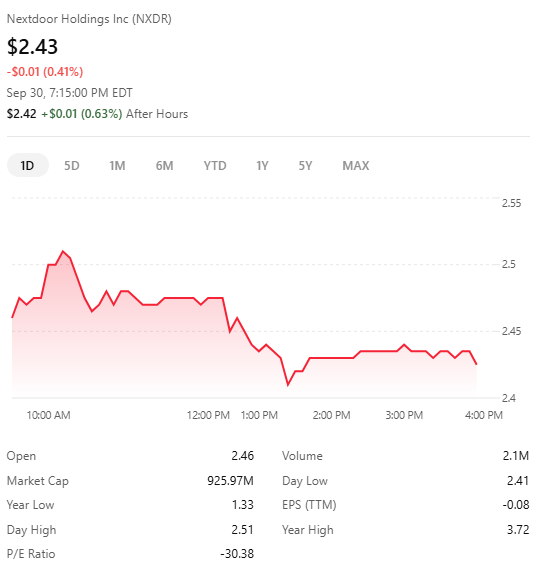
Today, Nextdoor Holdings (NXDR) finished at $2.43 per share, down slightly from Tuesday's $2.45 close. The stock traded between $2.41 and $2.52 during the session, with roughly 2.14 million shares changing hands.
One day doesn't tell the whole story.
The longer-term picture in the chart I've been watching is considerably more interesting.
A Year of Ups, Downs and Plenty in Between
Look at the one-year chart I included with this post.
NXDR has spent portions of the period down around the $2 range, while at other points it approached the upper $2.60s.
More recently, the movement has been just as interesting.
NXDR closed at $2.15 on September 9. By September 21, it had climbed to $2.64. It then fell to $2.38 on September 23, recovered to $2.51 on September 25, and finished September at $2.43.
That's quite a ride for a stock trading for less than $3.
And as a shareholder, it raises a question I've been asking throughout this Nextdoor case study:
What ultimately moves confidence in a company?
A Stock Price Isn't a Corporate Report Card
I want to be careful here.
A stock going up doesn't automatically mean management is doing everything right.
A stock going down doesn't automatically mean management is doing everything wrong.
And I'm certainly not going to look at today's two-cent decline and announce:
“The market has spoken about Nirav Tolia!”
😂
That's not how markets work.
Stock prices can move because of company financial results, expectations about future results, analyst opinions, broader market conditions, trading activity, liquidity, news, investor sentiment, and countless other factors.
NXDR itself demonstrates how quickly those expectations can change. In August, following its second-quarter results, analysts changed their views and price targets. More recently, NXDR has continued moving around considerably from session to session.
I can't attribute a specific Nextdoor decision to a particular movement on this chart.
No one else can either without evidence connecting the two.
But Confidence Still Matters
The chart still matters for my longer-term case study.
Markets ultimately involve people deciding what they believe something is worth.
And those decisions can include much more than yesterday's closing price.
Investors can consider:
Results. Strategy. Growth. Profitability. Execution. Leadership. Communication. Governance. Risk. And expectations about what happens next.
That's where confidence comes in.
A company can announce a brilliant strategy, but eventually investors can look for evidence that it worked.
A CEO can communicate a compelling vision, but eventually shareholders can compare that vision with results.
Management can make decisions that look strange today and brilliant two years from now.
Or the reverse.
Time has an interesting way of grading decisions.

That's Why I Keep Coming Back to Results
I've spent 107 days documenting my experience with Nextdoor.
I've asked about the detailed Insights data.
I've written about communication.
I've questioned transparency.
I've discussed moderation.
I've written about small businesses.
I've questioned how awards are judged.
I've discussed the economic value of neighbor-generated information.
I've praised Nextdoor when I thought it deserved praise.
I've provided feedback when I saw room for improvement.
That doesn’t mean today's $2.43 closing price validates my opinions.
It doesn't.
Likewise, if NXDR jumps to $3 tomorrow, that wouldn't suddenly invalidate the questions I've been asking.
What matters to me as a shareholder is what happens over time.
Decisions → Results → Confidence
Maybe that's the simplest way I can describe what I'm watching.
Leadership makes decisions.
Those decisions eventually produce results.
Those results can influence expectations.
And expectations can affect how investors value the company.
Not necessarily today.
Not necessarily tomorrow.
And certainly not because of one blog post, one executive interview, one Insights report, or one awkward email exchange.
But over time, execution has consequences.
That's why I'm interested in more than whether NXDR is green or red when I open the chart.
I'm interested in the decisions underneath it.
$2.43 Is Just Today's Number
Tomorrow it could be $2.35.
It could be $2.55.
Eventually it could be considerably higher—or considerably lower.
I don't know.
What I do know is that today's number becomes another point on that purple line.
$2.43.
Another trading day.
Another data point.
And another opportunity to remember that the market doesn't permanently value a company based on what leadership says it intends to accomplish.
Over the long run, investors also get to examine what actually happened.
That's the part of the chart I'll continue watching.
Day 107.
NXDR closes September at $2.43.
Let's see where the decisions, results, and confidence take it next.
👉 NielFlamm.com/blog

Nextdoor’s Good Neighbor Awards Get the Spirit Right. I Still Have Questions About the Selection Process.

Nextdoor is highlighting the honorees from its 2026 Good Neighbor Day program, and I want to start somewhere that may surprise people who have followed my ongoing Nextdoor posts:
Bravo. Seriously.
Nextdoor says it received more than 1,300 nominations and ultimately selected five honorees from different regions of the country. The stories are exactly the kinds of things I think deserve recognition: cooking meals for neighbors, helping someone recover after hospitalization, maintaining a neighbor's property during a difficult time, and years of service to a community. Nextdoor Blog
I love this stuff.
Being of Service Matters to Me
Being of service is an important part of my own recovery program.
Help somebody.
Extend my hand.
Be available when somebody needs me.
Do something for another person without constantly calculating what I'll get in return.
That's why I genuinely enjoy reading about these neighbors.
And I'll give Nextdoor additional credit for something else: the stories largely allow the neighbors' actions to stand on their own.
They're not simply commercials screaming, LOOK WHAT NEXTDOOR DID!
The people did these things.
The people deserve the recognition.
That's how it should be.
But Here Comes Niel With Another Question
I know. Shocking. 😂
Nextdoor has provided more information about the process than it did when I first started asking about the program.
The original nomination announcement said a committee of Nextdoor employees would select winners, with one winner per region. It said a panel would review the strongest nominations and score them based on how specific, sustained, and impactful the stories were. Nextdoor Blog
The final announcement provides a little more detail. Nextdoor says it scored nominations using a consistent rubric and reviewed them with Nextdoor employees. They selected the five honorees based on how specific and lasting the acts were and the difference they made. Nextdoor Blog
That's useful information.
But I still have questions.
Who was on the committee?
What roles did they hold at Nextdoor?
How were committee members selected?
What qualifications or experience did they bring to evaluating the nominations?
What did the scoring rubric actually look like?
Were nominations scored independently by multiple people?
Were scores averaged?
Did committee members discuss finalists and reach consensus?
Could someone recuse themselves if they knew a nominee?
Were there conflict-of-interest rules?
How did Nextdoor get from 1,300+ nominations to five people?
Those aren't accusations.
They're questions about process.
Even Reality Television Shows Us the Judges
Think about it.
American Idol doesn't tell viewers, “A committee listened to everybody. Trust us.”
We know who the judges are.
Dancing With the Stars doesn't hide the judging panel behind the ballroom curtain.
We see the judges. We see scores. We understand that there is a process.
Even competition programs built primarily for entertainment recognize that when people are being evaluated, the credibility of the process matters alongside the outcome.
I'm not suggesting Nextdoor needs Ryan Seacrest standing next to a giant scoreboard while an employee holds up a 9.5 for snow shoveling.
Although I'd probably watch that. 😂
I'm saying transparency makes recognition more credible.
Who Judges the Judges?
Here's the uncomfortable hypothetical.
Suppose someone selecting recipients of a community-service award had previously been convicted of embezzling money from a charity or employer.
Would that automatically mean that person couldn't recognize a good deed?
No.
But wouldn't people reasonably want to know who was making the decision?
I'd certainly want to know.
That's why an awards committee's identities, relevant qualifications, and conflict-of-interest standards can matter.
I'm not suggesting anyone on Nextdoor's committee has that kind of history. I don't know who the committee members were—that's precisely the point.
If Nextdoor wants people to trust a selection process, giving people enough information to understand that process would strengthen it.
Nextdoor Is Actually Close Here
This may be one of the stranger conclusions in my continuing Nextdoor case study:
I think Nextdoor got a lot right.
More than 1,300 neighbors apparently took the time to recognize someone else. Nextdoor Blog
Nextdoor established criteria.
It divided recognition geographically.
It published descriptions of how the honorees helped others.
It disclosed that employees participated in the selection.
And, most importantly to me, it largely kept the spotlight on the people actually doing the work.
That's good.
My issue is that Nextdoor stops just short of the transparency I'd like to see.
It tells us there was a committee.
Great. Who was on it?
It tells us there was a rubric.
Great. Show us the rubric.
It tells us nominations were scored.
Great. Explain how.
It tells us five people emerged from more than 1,300 nominations.
Great. Show us how the process got from Point A to Point B.
This Is Becoming a Familiar Theme
That question fits rather neatly into what I've been writing about Nextdoor under CEO Nirav Tolia for months.
Research methodology.
Detailed Insights data.
Communication.
Moderation.
Metrics.
Awards.
Again and again, I find myself arriving at essentially the same place:
Show us the process.
That's where I think Nextdoor's leadership continues to leave an opportunity on the table.
Transparency doesn't diminish these awards.
It could make them stronger.
Publish the committee.
Publish the rubric.
Explain the scoring and consensus process.
Explain conflict-of-interest safeguards.
Then get out of the way and let these neighbors enjoy the recognition they've earned.
Because on the most important part of this story, I have no complaints at all.
People helping other people deserve a spotlight.
As someone whose own recovery reminds me of the importance of extending a hand and serving others, I celebrate every one of them.
Bravo to the neighbors.
Now, Nextdoor, show us how you chose them.
👉 Read my continuing Nextdoor case study at NielFlamm.com/blog

Day 104: The Emails Made It. Now We Wait.

Day 104.
Yesterday, I expanded the audience for my ongoing request for Nextdoor’s detailed Insights reports.
Today, I have a little more clarity about what actually made it through.
Every Board email I attempted was returned as undeliverable.
I couldn’t reach the Nextdoor Board through those addresses. I used what seemed like a reasonable first-name@nextdoor.com format. It didn't work.
The Executive Team was different.
None of those emails bounced back.
That doesn't prove anyone read my email. It doesn't prove it reached a particular executive's inbox instead of getting filtered somewhere along the way.
But unlike my attempted Board emails, I received no delivery-failure messages.
So now?
I wait.
Will Anyone Answer?
My guess?
No.
But that's only a prediction based on my experience over the previous 103 days—not a fact. I'd actually be delighted to be wrong.
The request remains remarkably simple.
Nextdoor previously published Insights posts telling readers that additional findings and detailed data were available if they contacted the company.
I've been asking for that material.
Communications eventually responded, but the materials I received weren't the complete, detailed set I requested.
Yesterday, I put the question in front of a broader group of Nextdoor executives:
Can you provide the detailed reports/data—or tell me they aren't available?
That's it.
No 50-page shareholder proposal.
No demand for a seat in the boardroom.
No decoder ring required.
Send it, say no, explain the restrictions, or tell me who owns the request.
Any of those answers works.
Day 104 Is Now About the Response
The email appears to have reached the Executive Team addresses.
My attempted Board emails didn't.
I've documented both.
Now there's nothing more to add until Nextdoor decides what it wants to do with the question.
Maybe someone responds tomorrow.
Maybe someone responds next week.
Maybe nobody responds at all.
If they answer, I'll publish that too.
For now, the ball is in Nextdoor's court.
Day 104.
The email was sent.
The Executive Team addresses didn't bounce.
Now we find out whether delivery leads to communication.
👉 Follow the continuing case study at NielFlamm.com/blog

Day 103: I Expanded the Email List. The Board Emails Didn’t Cooperate.

Day 103.
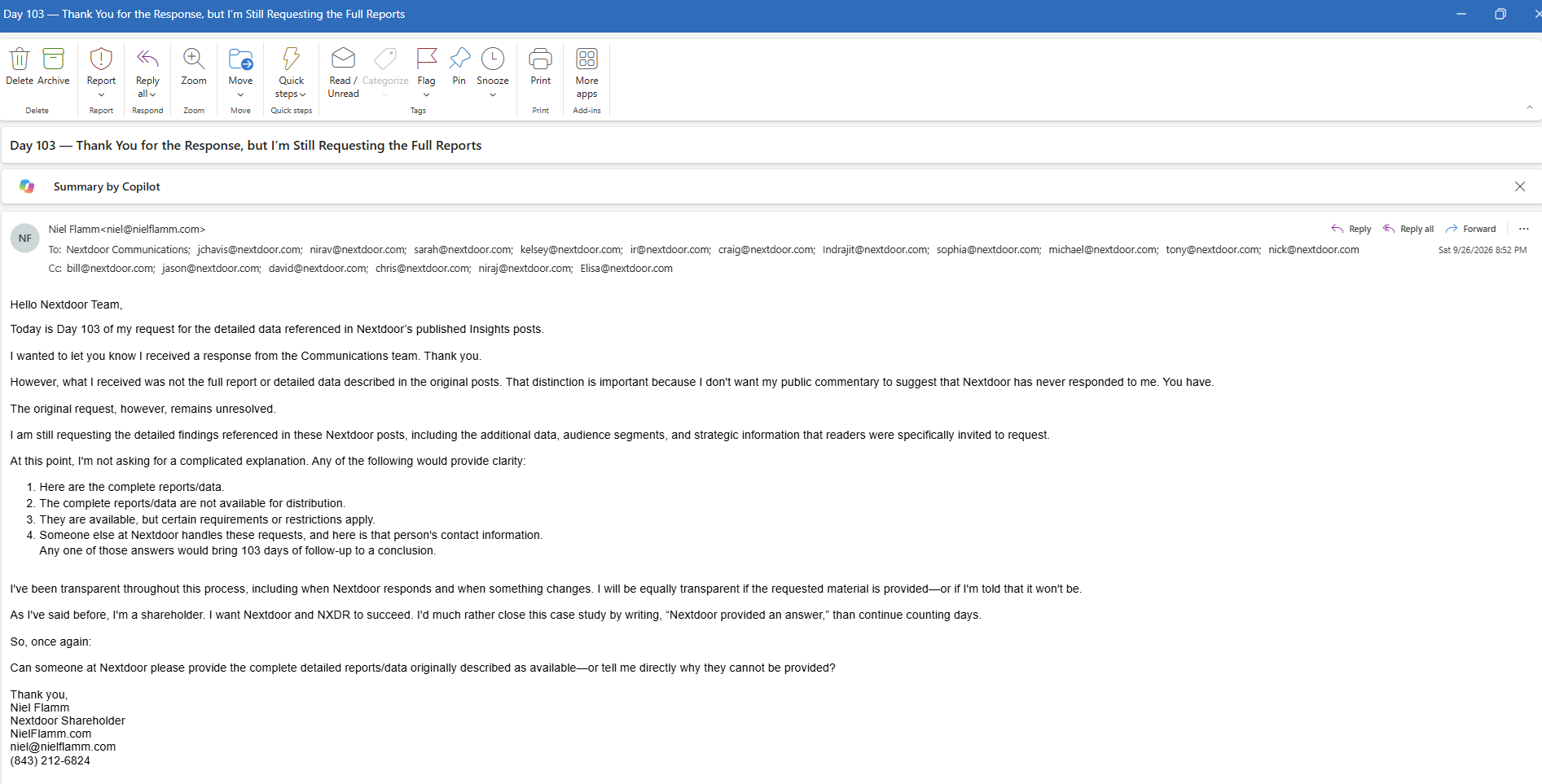
Today, I sent another email to Nextdoor.
After 103 days, I decided to expand the audience.
I put the Nextdoor Executive Team in the “To” field, along with the people who have already been part of this conversation.
I also attempted to include members of the Nextdoor Board of Directors in the CC field.
There was just one problem.
Apparently, my attempt at figuring out the board members' Nextdoor email addresses wasn't particularly successful. 😂
The Board Emails Bounced
I tried the fairly obvious formula: first name@nextdoor.com.
No such luck.
I received failed-delivery notices for the addresses I attempted for:
Michael Kiernan, Jason Pressman, Tony Castellanos, Niraj Shah, Chris Varelas, Elisa Steele, David Sze, and Bill Gurley.
I don’t have confirmation that the board members received today's email.
They apparently didn't.
I’ll research whether there are publicly available professional contact addresses through the companies or organizations they represent.
Interestingly, I haven't received bounce-back notices for the Executive Team addresses included in the “To” field so far. That doesn't prove anyone personally read the email, but at least I haven't received a delivery-failure notification.
What Did I Ask This Time?
The email itself is published in full on this blog, but the short version is remarkably simple.
I acknowledged that Nextdoor Communications did respond to me. I want to be fair and accurate.
The problem is that what I received wasn't the complete report or detailed data described in the original Nextdoor Insights posts.
So I asked again.
Send the complete reports.
Please let me know if they aren't available for distribution.
Tell me what restrictions or requirements apply.
Could you tell me who at Nextdoor is responsible for providing them?
Any of those answers creates closure.
That's really it.
This Shouldn't Require 103 Days
That's what continues to fascinate me about this entire experience.
The request hasn't become more complicated.
The distribution list has.
This started as a request for research referenced as available and has now moved through Communications, members of the Executive Team, and—once I have the working contact information—potentially the Board.
I'm not trying to make it look like people received something when they didn't.
That's why I'm publishing the bounce-backs too.
Transparency works both ways.
If Nextdoor responds, I'll say it responded.
If the response doesn't contain what I requested, I'll say that too.
If my emails to the Board don't work, I'll tell you that.
And if tomorrow Nextdoor sends me the complete reports—or says, “Niel, we're not giving them to you”—I'll publish that, too.
At least we'd finally have an answer.
For now:
Day 103.
The Executive Team email appears to have gone through.
My first attempt at reaching the Board?
Not so much. 😂
The full email I sent is included below,
👉 NielFlamm.com/blog