
When the Process Fails, Don’t Forget There Are People on the Plane
I came across this Facebook Reel, and I genuinely feel for this parent trying to do the best she can for her family:
https://www.facebook.com/share/v/1GUxjuMGvT/
Watching it reminded me of something that companies sometimes forget when operations go sideways: a process failure is rarely just a process failure to the customer.
I’ve been in the situation where my flight has been canceled. It’s no fun.
You’re standing in an airport trying to figure out what happens next. Where am I sleeping? When am I getting home? What happens to my luggage? What about the hotel, rental car, work, kids, medications, connections, or whatever else was waiting for me at the other end?
Now imagine trying to manage all of that while also taking care of your family.
That’s where I think JetBlue missed something important.
Airlines have incredibly complicated operations. Weather happens. Mechanical problems happen. Crews time out. Aircraft end up in the wrong cities. Sometimes a flight cannot operate.
I understand that.
But the operational problem and the customer experience are two different things.
JetBlue may transport cargo in the belly of an aircraft, but the people sitting above it aren't cargo.
They have feelings.
They have emotions.
They have families.
They have somewhere they were expecting to be.
And when the process fails, that is when customer experience matters the most.
A great customer experience isn't demonstrated when everything works perfectly. That's the easy part.
It's demonstrated when something goes completely wrong, and the company says:
“We know this disrupted your life. Let us help you figure out what happens next.”
Policies are necessary. Procedures are necessary. Systems are necessary.
But there has to be enough flexibility—or enough humanity built into those systems—to recognize when somebody needs more than a scripted answer.
Because the passenger standing at the counter isn't thinking about aircraft utilization, crew scheduling, or operational efficiency.
They're thinking:
“How am I going to get my family home?”
Sometimes fixing the customer experience doesn't mean fixing the airplane.
It means remembering the people who were supposed to be sitting inside it.
For more of my thoughts on customer experience, the good, the bad, and sometimes the completely ridiculous, follow along on my blog:
https://NielFlamm.com/blog
Expectations Matter: Why I Share Feedback
If you think I'm being a Karen or a Keith (my apologies to everyone with those names, especially my friend Karen Romero), that isn't my intent.
I believe people and companies can't fix what they don't know.
I look for feedback all the time. Sometimes it's a bitter pill to swallow, but I know it's one of the best ways for me to improve, grow, and become better.
On my way to bring a recovery meeting to a detox behavioral health facility, I stopped at my local SONIC in Mount Pleasant. A fresh burger with pickles, onions, lettuce, and tomato (no cheese, please—I'm lactose intolerant... probably TMI 😄), a large order of tater tots, and an extra-large The Coca-Cola Company Zero—my favorite—sounded perfect for the 30-minute drive.
To make things quick and easy, I ordered through the app.
When I pulled into the drive-in stall, the carhop told me, "We're out of Coke Zero. Would you like Diet Coke instead?"
My real answer was no—I didn't want Diet Coke. I accepted it because I wasn't going to make an issue out of it. I also tipped the carhop, as I always do. The carhop didn't create the problem.
Later, I filled out the customer survey.
I wasn't looking for a free meal, a coupon, or any compensation. I shared an observation. At another fast-food chain, if a location runs out of a drink or food item, it disappears from the app. That means I know before I order that the item isn't available. It sets the right expectation from the beginning and prevents disappointment.
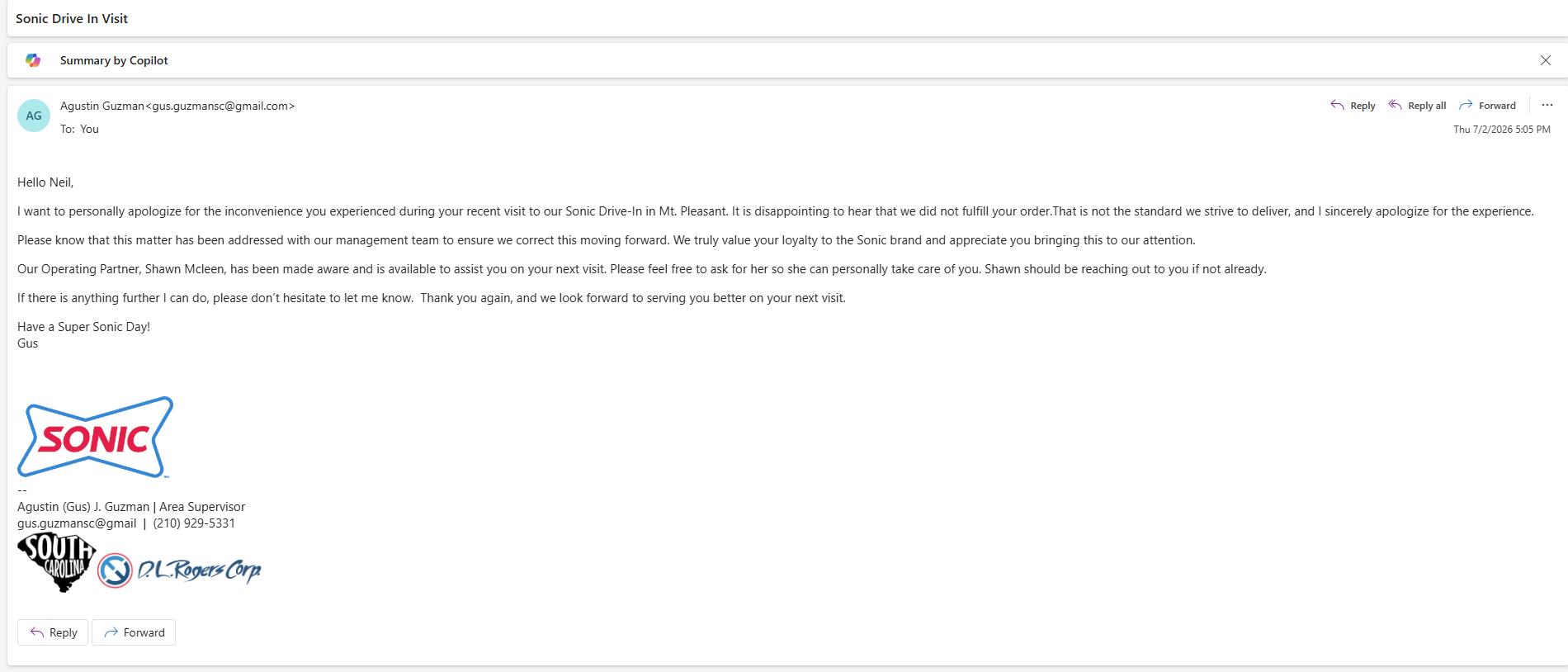
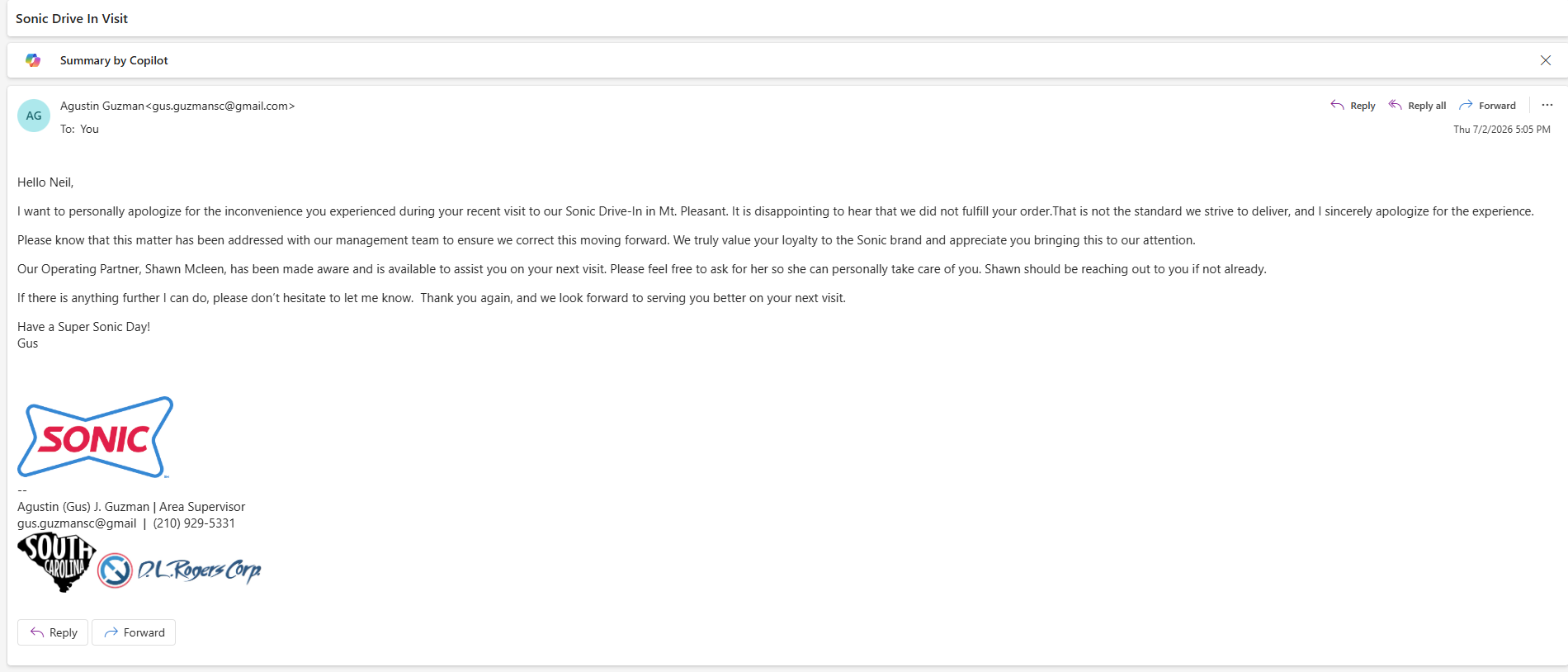
After submitting my feedback, I received a response telling me that "Shawn McLean" would be reaching out to me.
Guess what didn't happen?
Shawn McLean never contacted me.
From my perspective, that created two customer experience misses.
First, the app told me Coke Zero was available when it wasn't.
Second, I was told someone would contact me, but I haven't heard from anyone.
Neither issue was a major problem on its own. Together, though, they reminded me how important expectations are.
They also reminded me of Natalie Beckerman's book, When Did You Stop Caring?
I love technology. I appreciate mobile ordering. I enjoyed the burger. The pickles were outstanding.
But I value companies that do what they say they're going to do even more.
That's why I share feedback—not to complain, but because I genuinely believe companies can't improve what they don't know exists. Every piece of feedback is an opportunity to make the experience better for the next guest.
Join the discussion: what company has impressed you by setting the right expectations and then exceeding them?
NielFlamm.com/blog
When Did You Stop Caring? The Little Things Are the Big Things
Over the past few days, I’ve been getting food to go for Mom and me while she’s been at Novant Health (formerly East Cooper Medical Center).
Why?
Because hospital food is… well… hospital food. 😬
I used to tell my parents this when they visited me during my hospital stays in 2023 and 2024. Now Mom understands.
My brothers and I have been bringing her things she actually wants to eat — breakfast, sushi, snacks, seltzer, and anything that makes a hospital stay a little more comfortable.
I’m a big believer in ordering ahead. Use the app, time the drive, walk in, grab the order, and get back.
I’m also a believer in tipping.
Food service and hospitality workers work hard. They deal with people all day. Many are underpaid. If the service is great — tip. If the service is average, I still tip.
But tipping before receiving the service? I’m starting to rethink that.
Here’s why.
Thursday 7/2/26 — Big Bad Breakfast, Mount Pleasant
I ordered Mom an omelet and pancakes for myself. I picked it up, asked the person handing me the bag:
“Are utensils in the bag?”
Answer: “Yes.”
I get back to the hospital.
No utensils.
I start searching the hospital, trying to find some. Mom is so hungry that she eats part of the omelet by hand.
Yes — I should have checked. That’s on me.
But I also specifically asked.
Tip: $4.84
I emailed the restaurant’s general manager.
No response.
Today, July 4th — Chipotle Mexican Grill
I ordered two Sofritas bowls. Mom has never had Chipotle Mexican Grill, and I thought the Sofritas would be easier for her to eat.
I ordered ingredients on the side and labeled the bowls so we’d know whose was whose.
I arrive at the hospital:
• Lids weren’t secure, causing spills
• Bowls weren’t labeled
• Black beans were missing
Tip: $3.14
I tried contacting Chipotle Mexican Grill support and met “Pepper,” the chatbot wall that didn’t solve the issue.
So what did I do?
I disputed the tip amounts.
Not the food.
The tips.
Because tipping is supposed to recognize service.
The dollar amount isn’t the point.
The principle is.
I tolerate what I allow — and I’m not allowing this.
Small details matter.
A fork matters when someone is sitting in a hospital room hungry.
A secured lid matters.
Checking an order matters.
Follow-through matters.
So I’ll ask the question from Natalie Beckerman’s best sellerbook:
“When Did You Stop Caring?”
Chipotle?
Because the little things tell customers everything.
Join the discussion on NielFlamm.com