
When the Process Fails, Don’t Forget There Are People on the Plane
I came across this Facebook Reel, and I genuinely feel for this parent trying to do the best she can for her family:
https://www.facebook.com/share/v/1GUxjuMGvT/
Watching it reminded me of something that companies sometimes forget when operations go sideways: a process failure is rarely just a process failure to the customer.
I’ve been in the situation where my flight has been canceled. It’s no fun.
You’re standing in an airport trying to figure out what happens next. Where am I sleeping? When am I getting home? What happens to my luggage? What about the hotel, rental car, work, kids, medications, connections, or whatever else was waiting for me at the other end?
Now imagine trying to manage all of that while also taking care of your family.
That’s where I think JetBlue missed something important.
Airlines have incredibly complicated operations. Weather happens. Mechanical problems happen. Crews time out. Aircraft end up in the wrong cities. Sometimes a flight cannot operate.
I understand that.
But the operational problem and the customer experience are two different things.
JetBlue may transport cargo in the belly of an aircraft, but the people sitting above it aren't cargo.
They have feelings.
They have emotions.
They have families.
They have somewhere they were expecting to be.
And when the process fails, that is when customer experience matters the most.
A great customer experience isn't demonstrated when everything works perfectly. That's the easy part.
It's demonstrated when something goes completely wrong, and the company says:
“We know this disrupted your life. Let us help you figure out what happens next.”
Policies are necessary. Procedures are necessary. Systems are necessary.
But there has to be enough flexibility—or enough humanity built into those systems—to recognize when somebody needs more than a scripted answer.
Because the passenger standing at the counter isn't thinking about aircraft utilization, crew scheduling, or operational efficiency.
They're thinking:
“How am I going to get my family home?”
Sometimes fixing the customer experience doesn't mean fixing the airplane.
It means remembering the people who were supposed to be sitting inside it.
For more of my thoughts on customer experience, the good, the bad, and sometimes the completely ridiculous, follow along on my blog:
https://NielFlamm.com/blog
We Expect What We Inspect
A few weeks ago, I wrote about my experience at a local Starbucks where the music being played didn't exactly sound like it came from the corporate-approved playlist. Think death metal, explicit rap, and enough profanity to make me wonder if someone had hijacked the speakers.
I submitted feedback through the Starbucks website chat because I thought someone should know. My goal wasn't to get anyone in trouble. It was simply to share a customer experience that didn't match what I've come to expect from Starbucks.
Fast forward to today.
As I write this blog post, I'm sitting in that same Starbucks.
Something feels different.
I believe the store manager is here. I could be wrong, but here's why I think so:
The music isn't death metal, trap music, or The Best of "Weird Al" Yankovic. It's what I'd expect to hear in a Starbucks.
She's spent a significant amount of time working on an iPad, which looked like inventory or operational work.
She's now working tableside on a laptop.
I overheard what sounded like a discussion about scheduling with one of the baristas.
None of those things stood out to me the last Sunday I visited.
There's an old saying I've used throughout my career:
We expect what we inspect.
Whether you're leading a coffee shop, a Fortune 500 company, or a small business, it's difficult to know what's really happening if leaders never spend time where the work is being done.
Now, am I the reason she's here today?
Probably not.
Did my feedback play some small role?
Maybe.
I have no way of knowing, and I'm not going to pretend otherwise.
What I do know is this: today's customer experience feels noticeably different from the one I wrote about a few weeks ago. The atmosphere is calmer, the music fits the environment, and it feels more like the Starbucks experience I expected in the first place.
Sometimes customers don't expect perfection.
They simply want to know someone is paying attention.
What do you think? Have you ever noticed a business improve after you provided respectful, constructive feedback? I'd love to hear your experience.
Join the discussion on NielFlamm.com.
Expectations Matter: Why I Share Feedback
If you think I'm being a Karen or a Keith (my apologies to everyone with those names, especially my friend Karen Romero), that isn't my intent.
I believe people and companies can't fix what they don't know.
I look for feedback all the time. Sometimes it's a bitter pill to swallow, but I know it's one of the best ways for me to improve, grow, and become better.
On my way to bring a recovery meeting to a detox behavioral health facility, I stopped at my local SONIC in Mount Pleasant. A fresh burger with pickles, onions, lettuce, and tomato (no cheese, please—I'm lactose intolerant... probably TMI 😄), a large order of tater tots, and an extra-large The Coca-Cola Company Zero—my favorite—sounded perfect for the 30-minute drive.
To make things quick and easy, I ordered through the app.
When I pulled into the drive-in stall, the carhop told me, "We're out of Coke Zero. Would you like Diet Coke instead?"
My real answer was no—I didn't want Diet Coke. I accepted it because I wasn't going to make an issue out of it. I also tipped the carhop, as I always do. The carhop didn't create the problem.
Later, I filled out the customer survey.
I wasn't looking for a free meal, a coupon, or any compensation. I shared an observation. At another fast-food chain, if a location runs out of a drink or food item, it disappears from the app. That means I know before I order that the item isn't available. It sets the right expectation from the beginning and prevents disappointment.
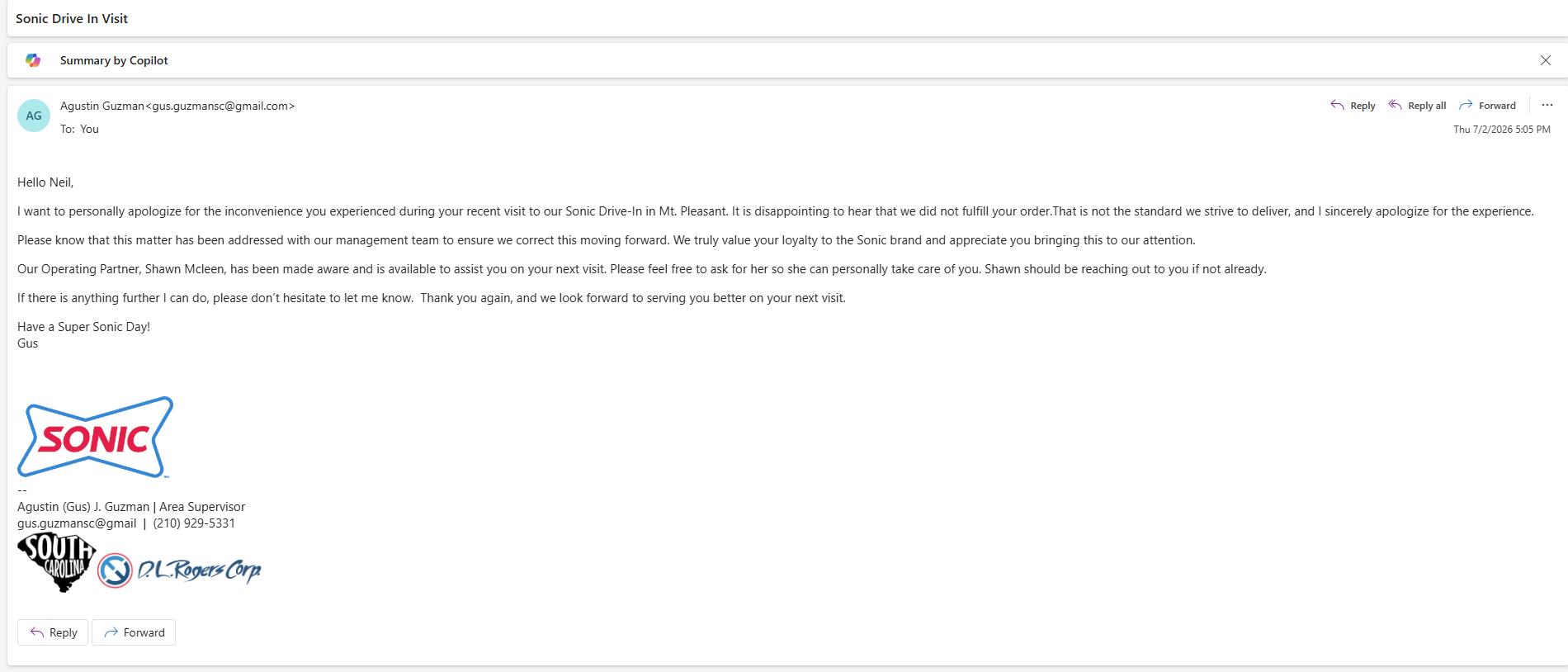
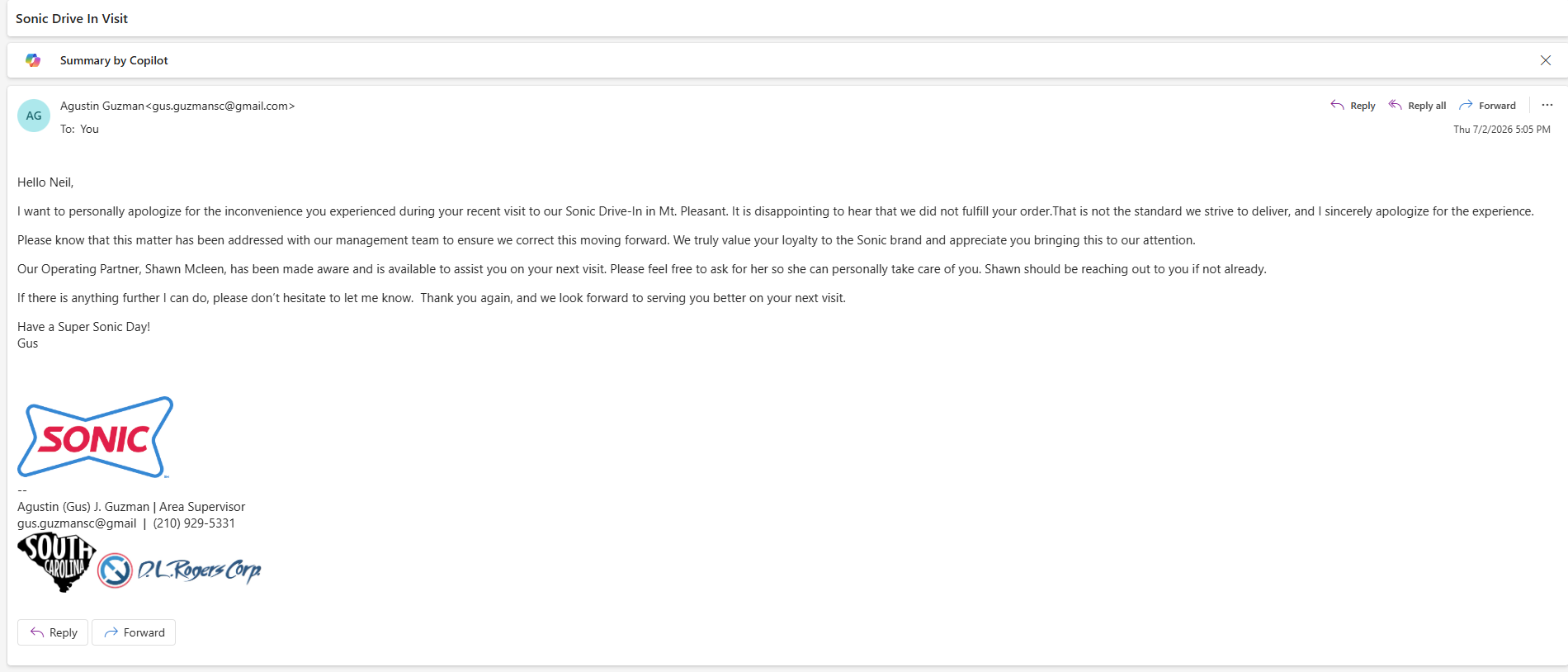
After submitting my feedback, I received a response telling me that "Shawn McLean" would be reaching out to me.
Guess what didn't happen?
Shawn McLean never contacted me.
From my perspective, that created two customer experience misses.
First, the app told me Coke Zero was available when it wasn't.
Second, I was told someone would contact me, but I haven't heard from anyone.
Neither issue was a major problem on its own. Together, though, they reminded me how important expectations are.
They also reminded me of Natalie Beckerman's book, When Did You Stop Caring?
I love technology. I appreciate mobile ordering. I enjoyed the burger. The pickles were outstanding.
But I value companies that do what they say they're going to do even more.
That's why I share feedback—not to complain, but because I genuinely believe companies can't improve what they don't know exists. Every piece of feedback is an opportunity to make the experience better for the next guest.
Join the discussion: what company has impressed you by setting the right expectations and then exceeding them?
NielFlamm.com/blog
When the Playlist Becomes the Customer Experience
This afternoon I was doing what I normally do on a weekend—working on my blog (yes... more of my "I hate Nextdoor" content), stopping at Costco Wholesale, then settling into the Starbucks on Highway 41 in Mount Pleasant, near Rivertowne.
My order? A Venti Black Iced Tea with an extra pump of Classic and a Cheese Danish. Great combination.
I arrived around 5:00 PM and planned to spend a couple of hours writing. Around 6:30 PM, something changed.
The café music stopped.
Then music started playing from a different source somewhere in the back of the store. First came death metal. Then a rap song filled with profanity, including the N-word. Curious, I asked Shazam what it was. The only thing it identified was a sample from Star by Sly and the Family Stone. (Yes, I'm old enough to remember them.)
It was one of those moments where you wonder who is actually in charge of the customer experience.
For full transparency, I laughed at myself because I've been on the other side.
When I was about 13, I was helping run the Village Delicatessen in Westbury. Before customers came in, I'd blast Def Leppard's Hysteria while drinking wine coolers. Later, while working at Piece By Peace on the Upper East Side, someone decided that Darude's "Sandstorm" was appropriate store music. In both cases, though, the music stopped when customers walked in.
Today, I provided feedback while I was still in the store using the Starbucks website chat. I explained exactly what happened, noted that I had short videos of both songs, and even offered to share them with local management.
After about 20 minutes of answering questions, I was asked to call a phone number instead.
That experience was more disappointing than the music.
Here are my suggestions for Starbucks:
• If a customer clearly states they're trying to provide store feedback, don't spend 20 minutes collecting information only to redirect them to another channel.
• Customer experience impacts revenue. I skipped the grilled cheese and left.
• Consider creating or expanding a Customer Experience QA team that periodically visits stores, much like secret shoppers. Today's technology makes it easier than ever to understand what customers actually experience in your locations.
One final thought.
I don't care what's on the secret menu nearly as much as I care about feeling heard, welcomed, and valued as a customer.
If you'd like to see the short videos from today's visit, they're available at NielFlamm.com/videos/starbucks.
I'd love to hear from others in customer experience, retail, hospitality, and leadership.
How should companies make it easier for customers to provide feedback before they decide not to come back?
Join the discussion on NielFlamm.com.
Is It Time to Rethink the Automotive Franchise Model?
I was thinking about the automotive franchise model and how dealerships under the same manufacturer compete against each other.
When you look around, there are other industries with similar franchise or dealer distribution models: heavy equipment, manufactured homes, commercial trucks, recreational vehicles, business-to-business equipment, tools, and office equipment.
Then I started thinking about traditional franchises like McDonald’s, Subway, and Chick-fil-A. Corporate may allow locations to have overlapping or fuzzy territory boundaries, but you typically don’t see one location dramatically undercutting another location selling the exact same product.
Automotive retail has operated differently for decades.
A customer can shop multiple dealerships selling the exact same vehicle from the exact same manufacturer and receive different pricing, incentives, fees, and experiences. Dealerships are not just competing against other brands — they are competing against their own brand family.
Part of why this structure continues is dealer protection laws. These laws were originally designed to protect independent businesses from powerful manufacturers, preventing automakers from simply replacing dealers after they invested millions into facilities, employees, and communities.
That purpose made sense.
But the question today is whether those same protections are also slowing innovation and preventing a more customer-focused purchasing experience.
Look at the complexity of a lemon law buyback situation. The customer bought the vehicle from the dealer. The manufacturer built the vehicle. The dealer performs warranty repairs. The manufacturer ultimately controls many of the decisions. The customer is stuck navigating the middle.
Who owns the problem?
The customer shouldn’t have to figure that out.
If automotive manufacturers moved toward a direct-to-consumer model, what could change?
• More consistent pricing
• Stronger margin control
• Better production and inventory planning
• Less dependence on end-of-month quotas and incentives
• Clearer ownership of customer issues
• A simpler process when something goes wrong
Dealerships have created thousands of successful businesses, jobs, and community relationships. Many provide outstanding service.
But purchasing a vehicle is one of the largest financial decisions people make, and the process should be designed around the customer first.
The future of automotive retail may not be about protecting how things have always been done.
It may be about building a better way forward.