

Another TikTok Car Deal — But Who Actually Has the Car?
At this point, TikTok may know my viewing habits a little too well.
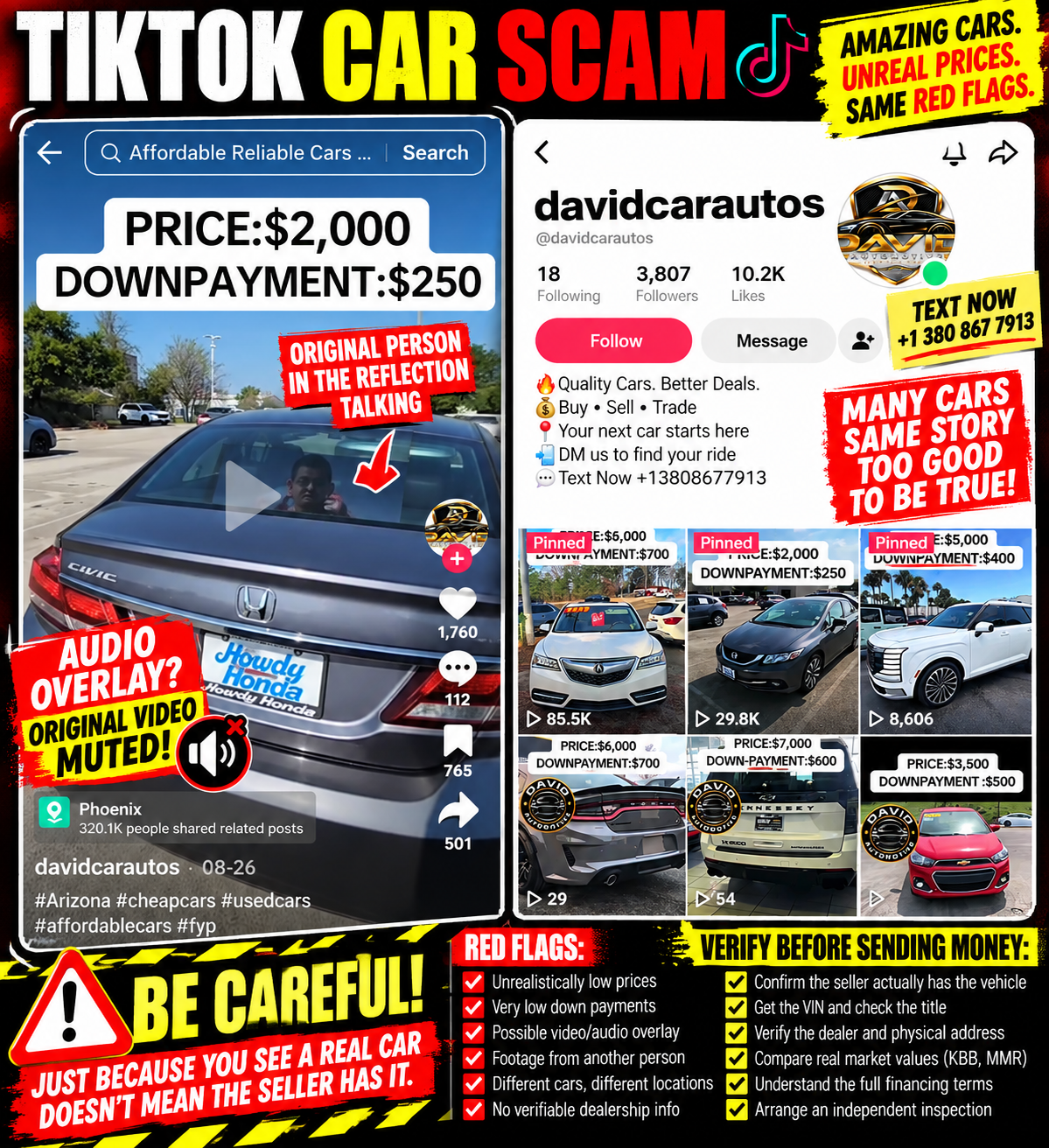
Another extremely inexpensive vehicle landed in my feed. This time, it's from an account called davidcarautos, and the featured vehicle looks like a Honda Civic.
The advertisement couldn't be much simpler:
PRICE: $2,000
DOWN PAYMENT: $250
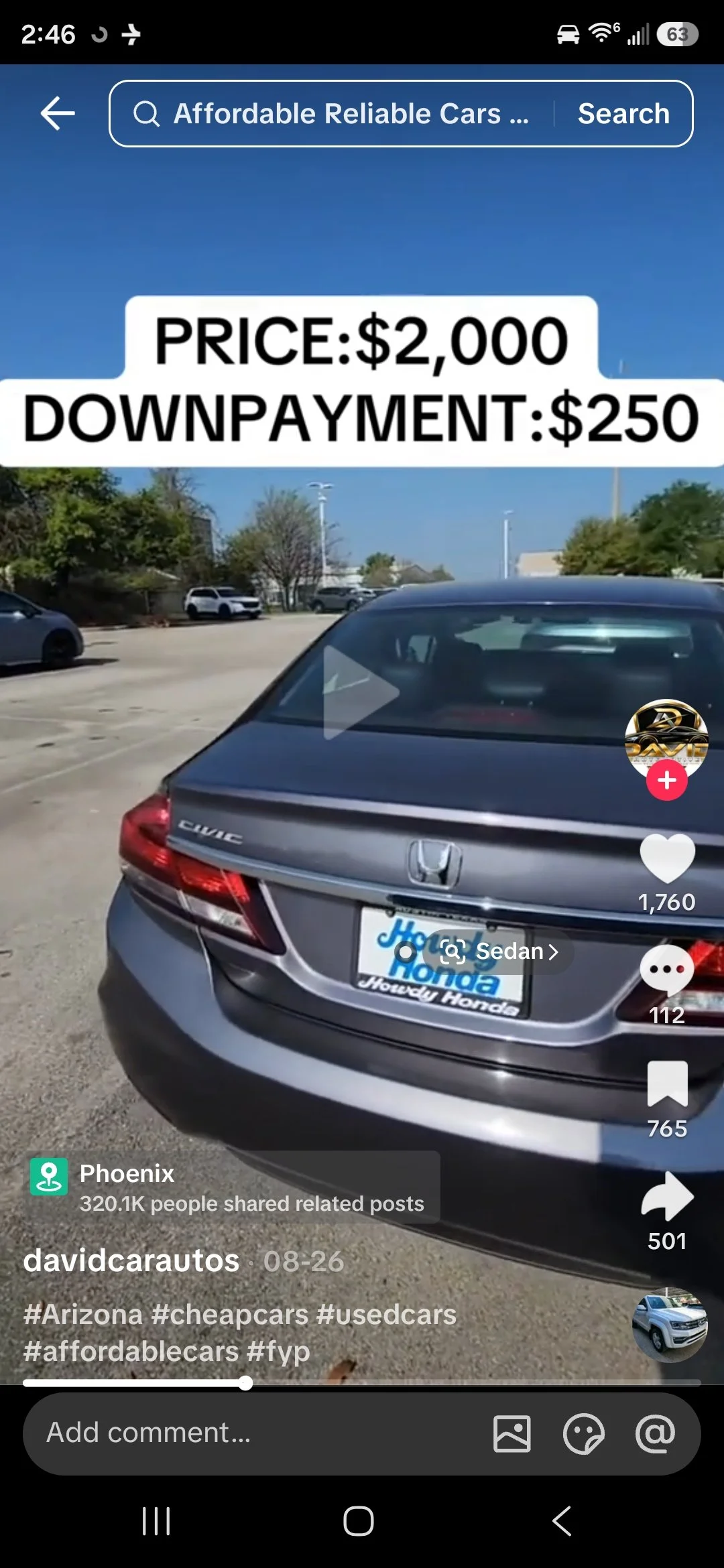
Two thousand dollars for the car, and apparently I can get started for $250.
But this video caught my attention for a reason beyond the price.
Wait—Whose Video Am I Watching?
I watched the video instead of just looking at the price.
That's when something looked odd.
The video appears to have been overlaid with new audio while the original video's audio is muted. As the camera moves around the Honda, I can see what appears to be the original person recording or speaking reflected in the car's window.
Meanwhile, the narration I'm hearing doesn't seem to match what's happening in the original footage.
The new narration makes a particularly interesting pitch: you don't have to go to a dealership to purchase a car.
That's supposed to make the transaction sound easier.
To me, it raises the opposite question:
Does the person posting this TikTok actually possess this car?
I can't establish from these screenshots alone who originally recorded the video or whether the TikTok account has permission to use it. So I'm not going to claim I've proven the footage was stolen.
But an apparently repurposed video combined with a new sales narration is absolutely something I would investigate before sending $250 to anybody.
🚗 A Real Honda in a Video Doesn't Prove the Seller Owns It
This is becoming one of the recurring lessons in my TikTok car series:
A real car doesn't automatically make the offer real.
That's especially important here.
The Honda clearly exists.
A license-plate frame is visible that appears to say Howdy Honda. There's a parking lot. A person is reflected in the vehicle.
All of that makes the video look authentic.
But those things establish the existence of a car and a video.
They don't establish that @davidcarautos owns the car, possesses the car, represents the owner, or has authority to sell it for $2,000.
That's a huge distinction.
The FTC issued a consumer warning this month specifically about scammers impersonating dealerships. It says scammers can copy legitimate dealerships' branding, vehicle listings, and photos, then collect money for cars the supposed seller doesn't actually have. The FTC recommends independently verifying the dealership and, when you can't visit the vehicle yourself, arranging an independent inspection. Consumer Advice
The FBI has also warned about fraudulent online vehicle advertisements involving cars that aren't—and sometimes never were—in the advertiser's possession. Internet Crime Complaint Center
That's why this video's altered presentation matters to me.
“You Don't Have to Go to a Dealer”
Technically, that's true.
People legitimately purchase vehicles remotely every day.
Dealerships deliver cars. Buyers purchase vehicles from other states. Documents can be signed electronically. Independent inspections can be arranged.
Remote car buying isn't inherently suspicious.
But there's a big difference between:
“You don't have to physically visit our dealership.”
and:
“You don't need to independently establish that we actually have the car.”
That second part is non-negotiable for me.
If someone wants my money for a vehicle, I want to know exactly where that vehicle is sitting.
👀 Then I Looked at the Profile
The account had approximately:
3,807 followers
10,200 likes
Its bio says:
🔥 Quality Cars. Better Deals.
💰 Buy • Sell • Trade
📍 Your next car starts here
➡️ DM us to find your ride
💬 Text Now +1 380-867-7913
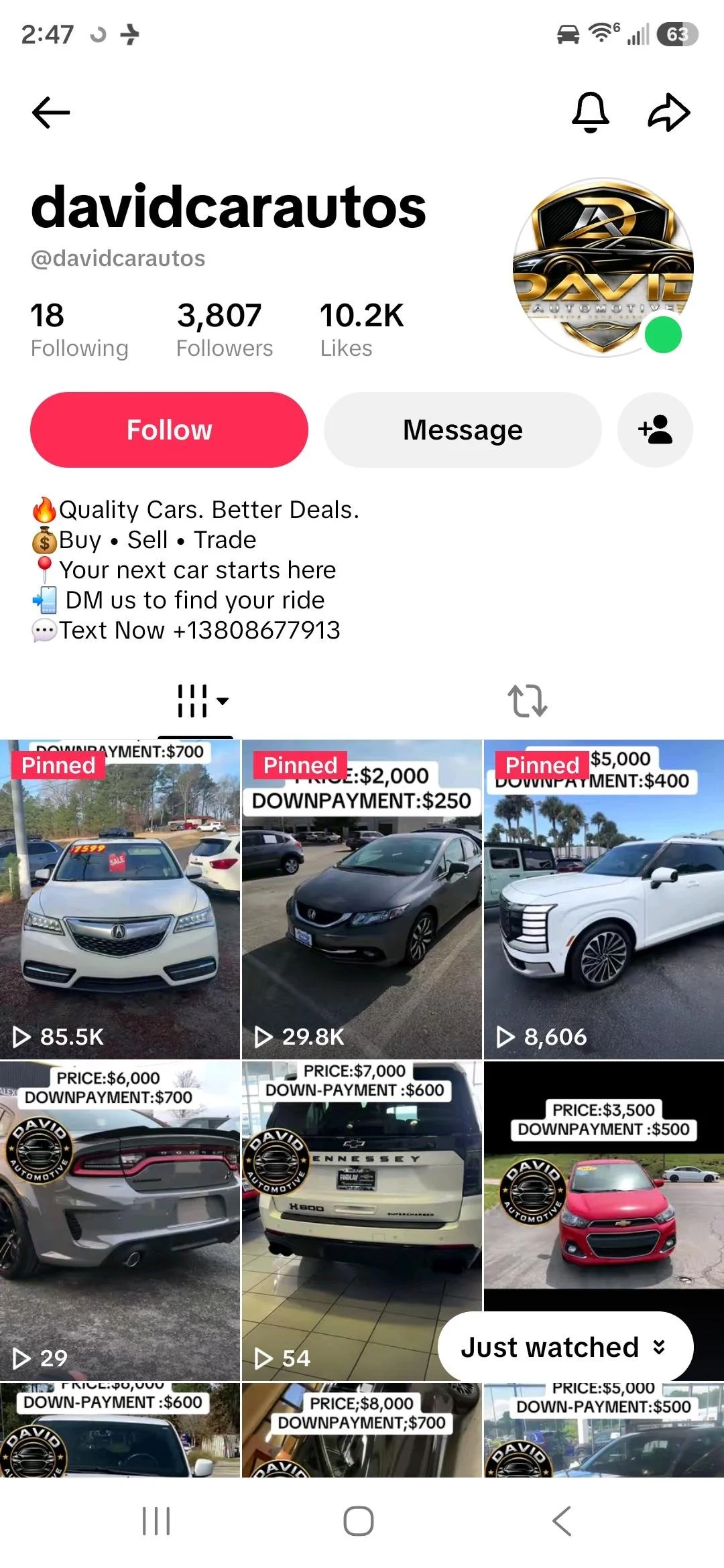
Then I looked at the inventory.
Here we go again.
The Honda is advertised for:
$2,000 — $250 down
Another vehicle:
$5,000 — $400 down
A Dodge:
$6,000 — $700 down
A Chevrolet Hennessey vehicle:
$7,000 — $600 down
Another:
$3,500 — $500 down
And more vehicles appear farther down the page with similarly low asking prices and down payments.
Different cars.
Different backgrounds.
Different dealerships appearing in some of the footage.
Same account selling all of them.
That doesn't prove anything by itself.
It does make one question increasingly important:
Where are these cars actually located?
📍 The Honda Video Says Phoenix
The TikTok interface on the Honda video displays Phoenix, and the hashtags include:
#Arizona #cheapcars #usedcars #affordablecars
Meanwhile, the visible dealership plate frame appears to identify a Honda dealership.
So before sending $250, I'd want to independently identify that dealership and call it using the telephone number from its own official website, not a number supplied by the TikTok account.
Then I'd ask a remarkably simple question:
Do you have this Honda, and is @davidcarautos authorized to sell it?
That could clear up a lot very quickly.
💰 And What Does “$250 Down” Actually Mean?
We've seen this repeatedly.
A tiny down payment gets enormous visual emphasis.
$250 DOWN!
That number feels attainable.
But it tells me almost nothing about the financing.
If the vehicle's total price really is $2,000 and I'm putting $250 down, the remaining amount is $1,750 before taxes, fees, interest and other charges.
So give me the rest:
What's the APR?
What's the term?
What's the monthly payment?
Who's the lender?
What's the total amount financed?
What's the total of payments?
What fees are included?
What credit requirements apply?
Is $2,000 actually the cash purchase price, or is there another condition attached to receiving that price?
The FTC has long warned consumers that unusually low advertised prices, down payments and monthly payments can come with qualifications or additional terms that aren't obvious from the headline advertisement. Consumer Advice
The giant number gets my attention.
The contract gets my money.
I care much more about the second one.
🎥 The Video Overlay May Be the Most Interesting Part
This is what distinguishes this post from some of the others I've documented.
The video itself appears to contain evidence of two different presentations:
The original footage.
And the new narration selling the vehicle.
Maybe there's a perfectly legitimate explanation.
Maybe the account licenses videos from dealerships.
Maybe it's a broker.
Maybe it has agreements with multiple dealers.
Maybe the person who made the original footage is connected with this account.
All of those possibilities can exist.
But I shouldn't have to guess.
If you're asking me to send money, tell me:
Who recorded the original video?
Who currently owns the vehicle?
Where is it physically located?
What's the VIN?
What's the dealer's legal business name?
Can I call that business independently?
Can someone inspect the vehicle before I pay?
A legitimate transaction should survive those questions.
🚨 This Isn't a Hypothetical Type of Scam
The FTC's September 2026 warning describes consumers paying supposed online dealerships only to discover that the actual dealership has no record of the order or payment and no car waiting for them. The FTC says fraudulent sellers can clone legitimate dealership material, including vehicle listings and photos. Consumer Advice
This problem isn't limited to websites, either. FTC data released this year show that nearly 30% of people reporting a scam loss in 2025 said the scam began on social media, with reported losses totaling $2.1 billion. Federal Trade Commission
So seeing a real automobile in a TikTok video isn't where my verification process ends.
It's where it begins.
🏡 Be a Good Neighbor
Here's the person I worry about.
Someone desperately needs transportation.
Their credit isn't great.
They've been turned down elsewhere.
They see:
HONDA CIVIC
PRICE: $2,000
DOWN PAYMENT: $250
And then they hear:
You don't even have to go to the dealership.
Convenient.
Affordable.
Easy.
Exactly what they need.
That's when somebody needs to say:
“Before you send the $250, let's verify the car.”
Not ridicule them.
Not call them stupid.
Help them investigate.
Reverse-search screenshots from the video. Identify the dealership visible in the footage. Call that dealership independently. Ask for the VIN. Verify the title. Check the seller's dealer license. Compare the price with KBB and wholesale values. Arrange an independent inspection.
And most importantly:
Verify that the person asking for your money actually has the legal ability to sell you the car.
The FTC's current advice is similarly straightforward: if you're too far away to see an online vehicle yourself, ask to have a mobile inspection service examine it. If the seller won't allow that, consider walking away. Consumer Advice
The Cars Keep Changing. My Question Doesn't.
Different TikTok accounts.
Different prices.
Different down payments.
And now apparently repurposed-looking video accompanied by a new narration telling me I don't have to visit a dealership.
I don't necessarily need to visit the dealership.
But before anybody gets one dollar from me, I need something considerably more important:
Proof that you actually have the car you're trying to sell me.
Because if the seller doesn't possess the vehicle or have authority to sell it, I'm not purchasing a car remotely.
I'm just sending $250 to somebody on TikTok.
Questions or another suspicious car listing you'd like me to look at? Reach out by DM or email niel@nielflamm.com.

Another “Bank Repossessed” TikTok Car Deal — And the Phone Numbers Don’t Even Match
TikTok apparently still thinks I need a ridiculously inexpensive performance car.
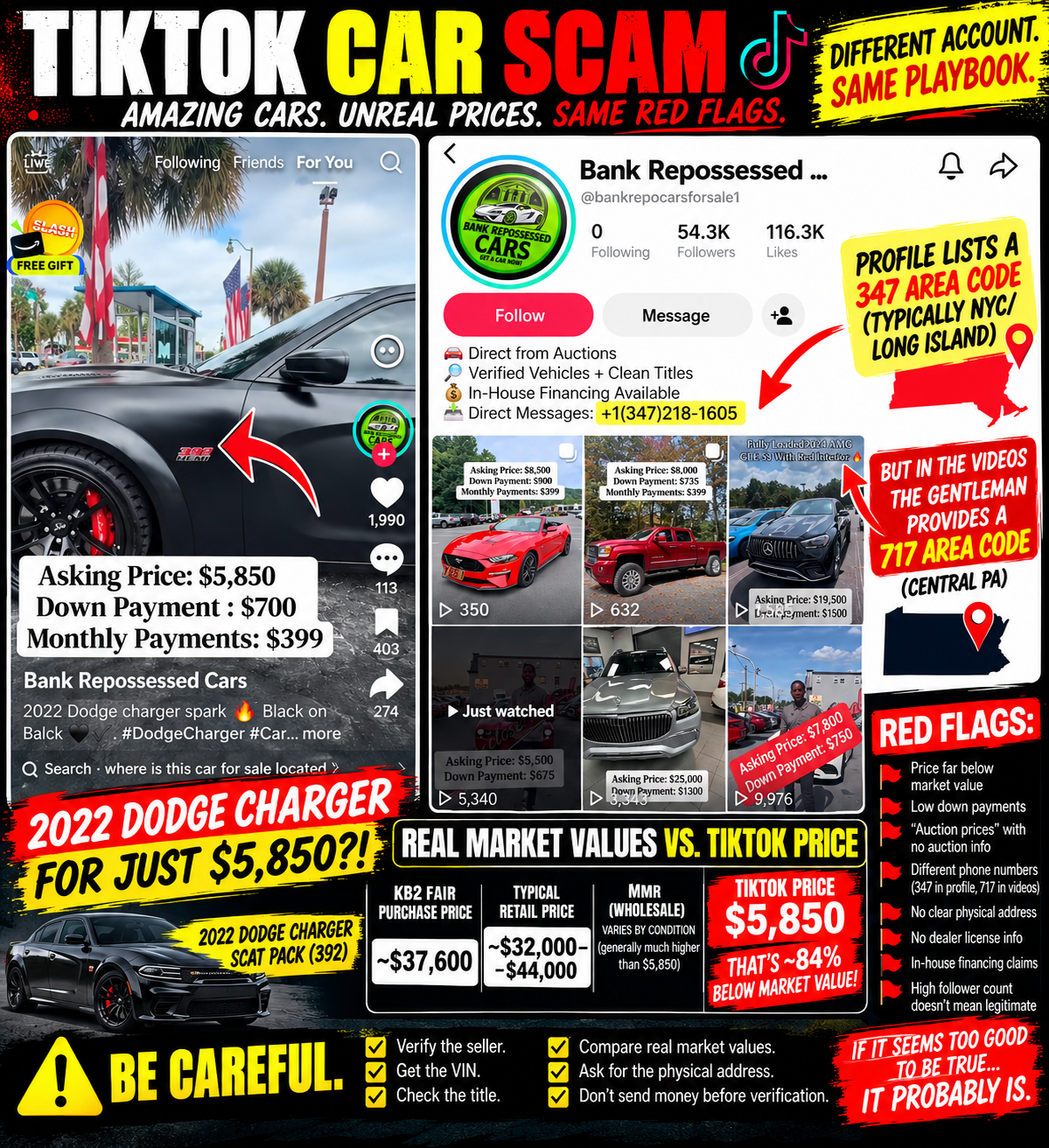
The latest account to appear in my feed calls itself “Bank Repossessed Cars” and uses the handle @bankrepocarsforsale1.
At the time of my screenshot, the account had:
54,300 followers.
116,300 likes.
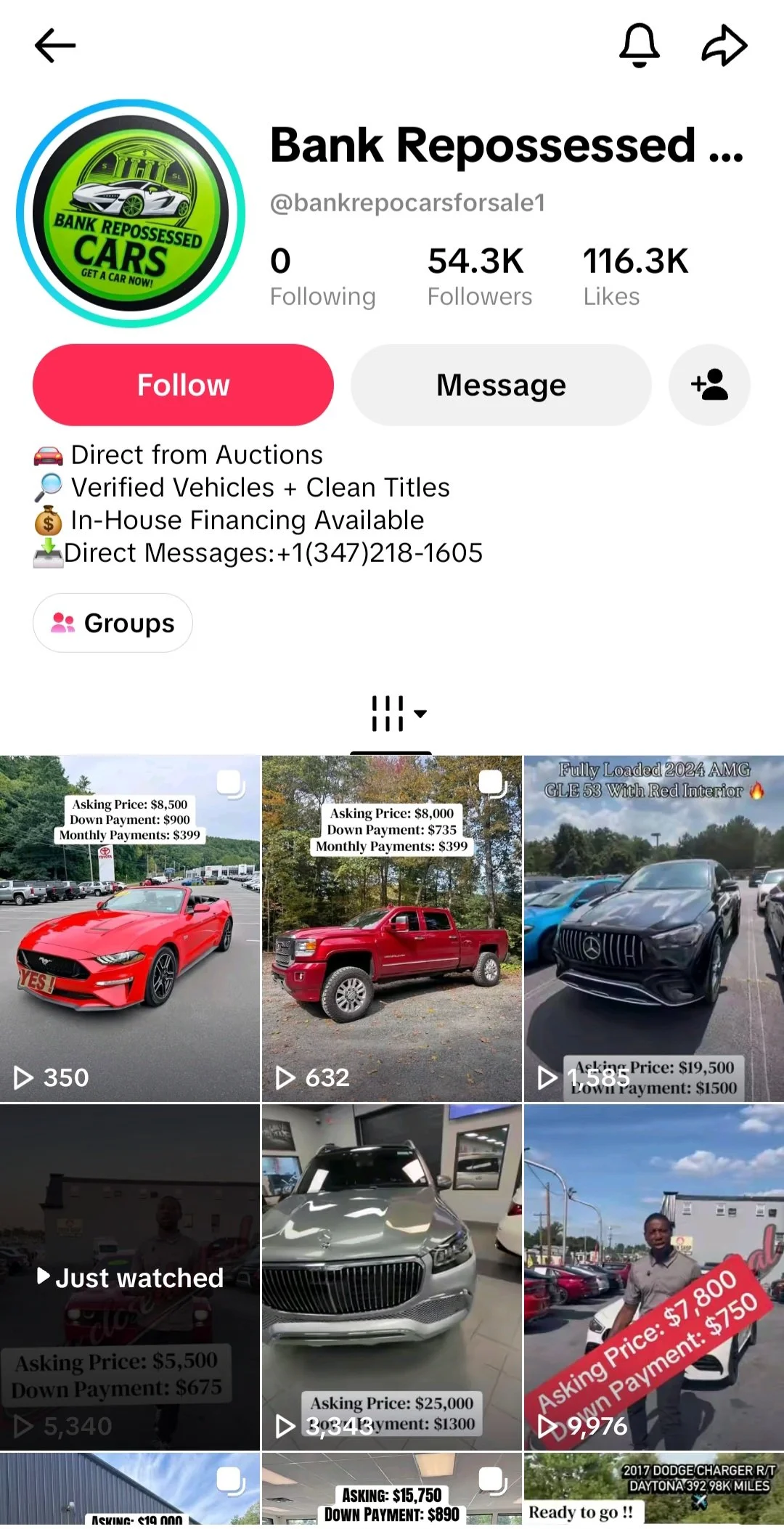
That's substantially larger than several of the questionable car accounts I've written about before.
The profile says:
🚗 Direct from Auctions
🔎 Verified Vehicles + Clean Titles
💰 In-House Financing Available
And then there's a telephone number for direct messages:
+1 (347) 218-1605
Sounds impressive.
Then I started watching the videos.
And once again, I have questions.
🚗 Today's Deal: A 2022 Dodge Charger for $5,850
The video that caught my attention shows what is described as a 2022 Dodge Charger with the following offer:
Asking Price: $5,850
Down Payment: $700
Monthly Payments: $399
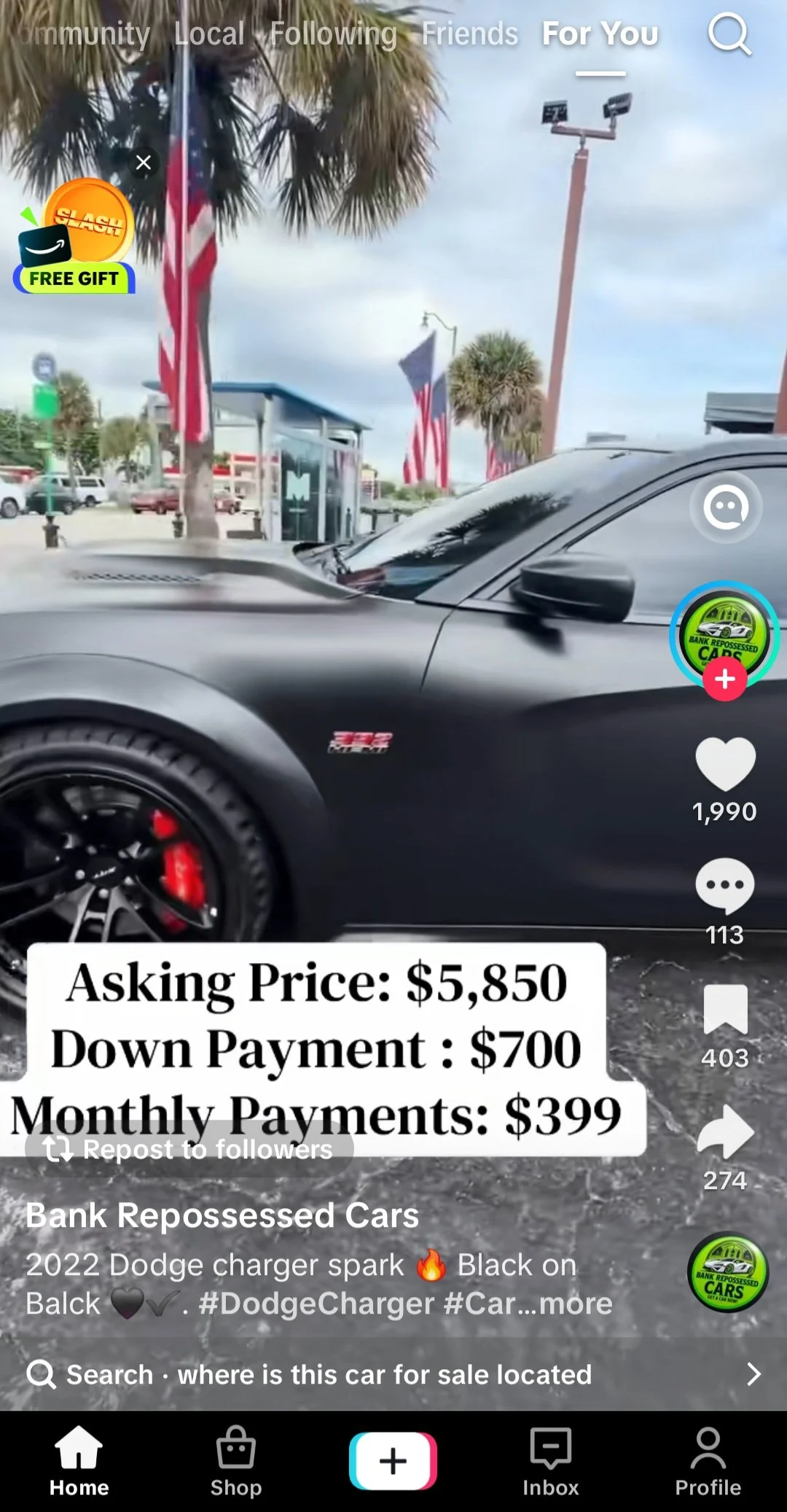
The caption describes it as a “2022 Dodge Charger spark”, although the vehicle shown appears to carry a 392 badge.
If this is actually a 2022 Charger Scat Pack/392, that $5,850 advertised price deserves a very close look.
Why?
Because the market numbers aren't even in the same neighborhood.
💰 Kelley Blue Book Says About $37,000 — Not $5,850
Kelley Blue Book currently puts the national Fair Purchase Price of a 2022 Dodge Charger Scat Pack around $37,600. KBB lists roughly $31,900 trade-in, $34,800 private-party, and $37,600 Fair Purchase Price for a good-condition example, while a Scat Pack Widebody is higher still at about $44,100 Fair Purchase Price. Exact values vary with mileage, condition, options, and location. Kbb.com
Edmunds tells a similar story: its current dealer-retail estimate for a regular 2022 Scat Pack ranges from roughly $32,300 in rough condition to $39,500 in outstanding condition. Edmunds
CARFAX's current listings put 2022 Charger Scat Packs at an average listing price of about $44,347, with its displayed range running roughly $36,747–$52,950. Carfax
TikTok?
$5,850.
That's roughly 84% below KBB's $37,600 Fair Purchase Price.
Maybe there's an explanation.
Fantastic.
I'd like to hear it.
🔨 But What About MMR and “Auction Prices”?
This account specifically promotes the vehicles as coming “Direct from Auctions.”
That's where the Manheim Market Report—or MMR—comes in.
MMR isn't the same thing as KBB retail value. Manheim describes MMR as a wholesale-market valuation based on actual vehicles sold through Manheim, with values that can be adjusted for factors such as odometer reading, selling region, condition grade and even color. Manheim
That's why I'm not going to invent an exact MMR for the Charger in this video.
I don't have its VIN.
I don't have verified mileage.
I don't have its condition report.
I don't have its auction location.
I don't have a current vehicle-specific Manheim report.
Without those things, saying, “The MMR is exactly $XX,XXX,” would be pretending to know something I don't.
But here's what we can compare.
KBB puts the Scat Pack's trade-in value around $31,900. JD Power estimates a trade-in base of around $31,250–$33,250, depending on condition. Those aren't MMR, but they're useful wholesale-side reference points. Kbb.com
So if this really is a clean-title 2022 Scat Pack being sold for $5,850, the question isn't simply:
“Is it cheaper because it came from an auction?”
The question is:
How did someone acquire a vehicle worth tens of thousands of dollars cheaply enough to retail it for $5,850?
“Auction” isn't a magic word that makes vehicle economics disappear.
📞 Then I Noticed the Phone Numbers
Here's where things became even more interesting.
The TikTok profile lists:
+1 (347) 218-1605
The 347 area code is associated with New York City, including the boroughs of Brooklyn, Queens, the Bronx and Staten Island. It's commonly encountered around the broader NYC/Long Island market, although an area code obviously doesn't establish where somebody currently lives or operates a business.
But I watched several of the account's videos.
The gentleman appearing in those videos provides a different telephone number—with a 717 area code.
The 717 area code serves south-central Pennsylvania, including Harrisburg, Lancaster, and York.
Again, people keep phone numbers after moving. Businesses can have multiple telephone numbers. VOIP numbers exist. None of this, by itself, proves anything improper.
But when I'm supposedly dealing with a business selling cars online, it's another question I'd want answered:
Why does the profile give me one phone number while the person in the videos gives me another?
And, more importantly:
What's the actual dealership?
Where is it physically located?
Which number belongs to that dealership?
Those should be remarkably easy questions for a legitimate automobile dealer to answer.
👀 And Look at the Rest of the Inventory
The Charger isn't alone.
The profile shows a Mustang advertised for:
$8,500 — $900 down — $399/month
A GMC pickup:
$8,000 — $735 down — $399/month
A Mercedes-AMG GLE 53 appears to be advertised around:
$19,500 — $1,500 down
Another vehicle:
$5,500 — $500 down
Another:
$7,800 — $750 down
There's even a vehicle shown around $25,000 with $1,300 down.
The scenery changes.
The dealerships and lots visible in the videos appear to change.
The vehicles range from ordinary transportation to expensive luxury and performance models.
Yet the formula remains remarkably familiar.
🚩 “Verified Vehicles + Clean Titles”
Great.
Verified by whom?
That's not sarcasm. That's an actual question I'd ask before buying.
If I'm buying one of these cars, give me the VIN.
Then I can verify the vehicle myself.
If it has a clean title, provide the documentation I need to confirm it independently.
If it came from an auction, tell me which auction.
If you're a licensed dealer, give me the legal business name, physical address, and dealer-license information.
If you're offering in-house financing, give me the written financing terms.
I don't need a green checkmark emoji.
I need documentation.
💳 $700 Down and $399 a Month — What's the Loan?
There's another mathematical problem worth examining.
The Charger is advertised at:
$5,850 purchase price
minus
$700 down
which leaves:
$5,150
If the payments really are $399 per month, $5,150 divided by $399 is only about 12.9 payments, before interest, taxes, fees, or anything else.
So what's the actual term?
What's the APR?
What's the amount financed?
What's the total of payments?
Who's extending the credit?
Are there additional fees?
If the actual vehicle costs $5,850, those should be straightforward questions.
If $5,850 isn't actually the total cash price, then I'd like to know what that number represents.
🚩 54,000 Followers Don't Answer Any of This
This account is bigger than many I've previously documented.
54,300 followers.
That's meaningful social proof.
Someone encountering the account might reasonably think:
They have 54,000 followers. They must be legitimate.
But we've been through this before.
Followers aren't a dealer license.
Likes aren't a title.
Views aren't a VIN.
A green checkmark emoji isn't vehicle verification.
And a real person standing beside a real automobile doesn't establish that the TikTok account displaying the footage owns that automobile or is authorized to sell it under the advertised terms.
🚗 A Real Car Still Doesn't Automatically Make the Offer Real
This has become a recurring theme in this series.
Some of these videos clearly contain actual cars.
Some appear to have been filmed at actual dealerships.
There are real salespeople.
Real parking lots.
Real transporters.
Real dealership signs.
That's persuasive imagery.
But the question isn't:
“Does the car in this video exist?”
It's:
“Does this TikTok account own or have authority to sell this exact vehicle for this exact price under these exact terms?”
Those are very different questions.
I'm not claiming the footage on this account was copied from somewhere else. I haven't established that.
But before sending a $700 deposit, I'd want to establish where the footage came from and whether the seller I'm communicating with is actually connected to that vehicle.
🏡 Be Careful — and Be a Good Neighbor
This is the part that matters most.
Imagine someone who has terrible credit.
Their car just died.
They need transportation Monday morning, or they risk losing their job.
Traditional dealerships have turned them down.
Then TikTok serves them:
2022 Dodge Charger
$5,850
$700 down
$399/month
In-house financing available
That doesn't necessarily look suspicious to someone in that situation.
It looks like hope.
That's why, if somebody you know is considering one of these deals, don't ridicule them.
Help them investigate.
Before sending money, get the VIN. Verify the title. Find the dealership's legal name and physical address independently. Verify the dealer license with the appropriate state regulator. Call a publicly listed number—not simply the number supplied in a TikTok profile. Get the complete financing agreement. Have the vehicle independently inspected. And compare the asking price with retail and realistic wholesale values.
If the seller won't let you do those things before sending a deposit?
Keep your $700.
Different Account. Same Questions.
I'm seeing this pattern often enough that I can practically write the checklist before opening the profile.
Extremely inexpensive desirable car.
Small down payment.
Low monthly payment.
“Direct from auction.”
“Clean title.”
“In-house financing.”
Private messages.
Phone numbers that raise additional questions.
And prices that appear wildly disconnected from ordinary retail values.
Maybe this account has a perfectly reasonable explanation for it all.
I'd be interested in hearing it.
Because based on the screenshot, a $5,850 2022 Charger that appears to be a 392, compared with a KBB Fair Purchase Price around $37,600 for a Scat Pack, is one heck of an explanation. Kbb.com
Until then:
Be careful. Verify everything. And don't let a $700 down payment make a $30,000 question disappear.
Follow the continuing series at NielFlamm.com/blog.

Update: The “Totally Legitimate” TikTok Car Seller Blocked Me
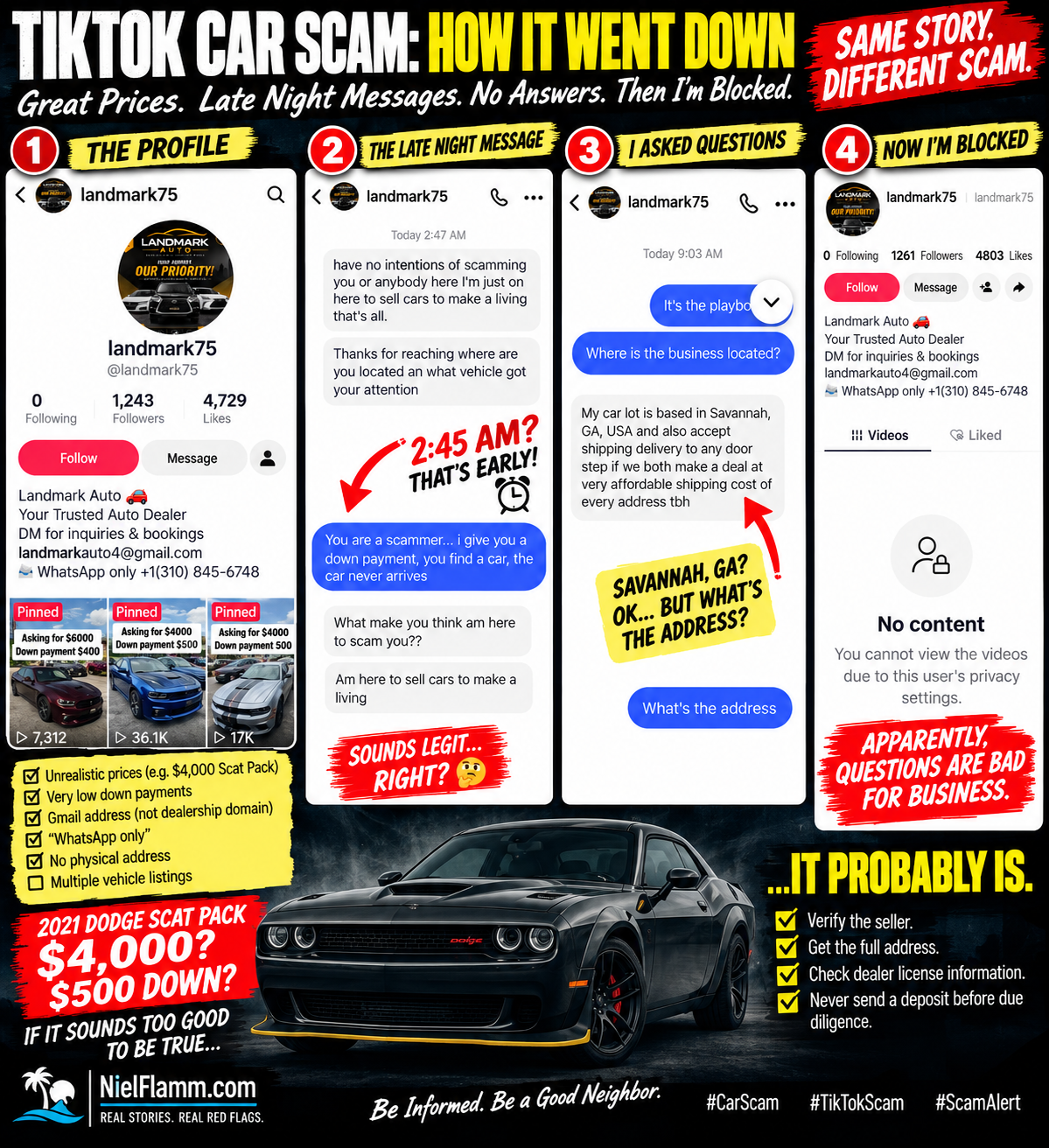
Well, that escalated quickly.
I've been documenting the TikTok account landmark75, which describes itself as “Landmark Auto” and has been advertising vehicles at prices that raised plenty of questions—including a supposed 2021 Dodge Scat Pack with 45,000 miles for $4,000 with $500 down.
Then they contacted me.
At 2:45 in the morning.
They assured me:
“have no intentions of scamming you or anybody here I'm just on here to sell cars to make a living that's all.”
Great.
So I started asking questions.
Apparently, that was the problem.
🚗 I Asked Where the Dealership Was Located
This shouldn't have been difficult.
They told me:
Savannah, Georgia.
Okay.
I asked:
What's the address?
Not exactly an interrogation worthy of the FBI.
If you're operating a car lot and offering to sell and ship vehicles to customers, asking where the car lot is located seems like a fairly reasonable question.
I wanted information I could independently verify.
Then something interesting happened.
😂 Apparently I Asked One Question Too Many
Today I went back to the TikTok account.
The profile is still there.
At the time of my latest screenshot, it showed:
1,261 followers
4,803 likes
The bio still says:
“Landmark Auto 🚗”
“Your Trusted Auto Dealer”
It still lists a Gmail address.
It still says:
“WhatsApp only”
But now the videos are gone—from my view.
TikTok tells me:
“No content”
and:
“You cannot view the videos due to this user's privacy settings.”
Well, that's convenient.
The account that contacted me in the middle of the night and wanted to discuss selling me a vehicle apparently no longer wants me looking at its vehicle listings.
🚩 Let's Review the Timeline
This is what makes the progression interesting.
I saw vehicles advertised at unusually low prices and down payments.
I started documenting them.
The account contacted me.
I openly questioned whether the operation was legitimate.
They told me they had no intention of scamming anybody and were simply trying to make a living selling cars.
I asked where the business was located.
They gave me a city and state:
Savannah, GA.
I asked for the actual street address.
And now I can no longer view their TikTok content.
That's what I can document from my screenshots.
Whether TikTok's restriction reflects a block or another privacy setting, I can't determine that independently from this screen alone. But the result for me is the same:
I can't see their videos anymore.
🤔 That's an Interesting Way to Build Customer Confidence
Remember, their profile calls them:
“Your Trusted Auto Dealer”
Trust generally works better when customers can verify things.
If I were considering sending hundreds of dollars to an online vehicle seller, I'd want some pretty basic information:
Where is your dealership?
What's the street address?
What's your legal business name?
What's your dealer license number?
What's the VIN?
Can I inspect the vehicle?
Can someone I choose inspect it?
Can I call the dealership using a number I find independently?
Can you provide the complete purchase and financing terms?
Those aren't hostile questions.
Those are car-buying questions.
🚩 Blocking Questions Doesn't Answer Questions
Here's the important part.
Not being able to view the account's videos doesn't, by itself, prove that every listing was fraudulent.
But it also doesn't resolve a single concern I raised.
The $4,000 Scat Pack doesn't suddenly make more sense.
The $500 down payments don't become independently verified.
“WhatsApp only” doesn't establish a dealership.
“Savannah, GA” still isn't a street address.
And preventing a skeptical viewer from seeing the listings doesn't provide any of the documentation that could establish the seller's legitimacy.
It simply prevents that viewer from continuing to examine the content.
😂 Apparently Due Diligence Is Bad for Business
Maybe my mistake was asking too many questions.
Perhaps I should have said:
“$500 down? Fantastic! Where do I send it?”
Instead, I committed the unforgivable sin of online car shopping.
I asked:
“What's the address?”
Oops.
🏡 This Is Exactly Why I Say: Be a Good Neighbor
Someone else might see a beautiful car and an affordable down payment and think they've finally found a solution.
Maybe their credit isn't great.
Maybe their current vehicle just died.
Maybe they desperately need transportation to keep their job.
That person doesn't need ridicule.
They need someone willing to say:
“Before you send that money, let's verify this.”
Check the dealership.
Check the address.
Check the VIN.
Check the dealer license.
Check the title.
Check the vehicle's market value.
Call a phone number obtained independently.
And never let someone rush you into sending a deposit before you've verified who you're dealing with.
I'll Keep Asking Questions
I said I'd continue engaging with this account for as long as I was able.
Apparently, “as long as I was able” didn't last very long.
😂
But there's a useful lesson here.
When you're considering sending money to someone online, don't judge legitimacy by how confidently they tell you they're legitimate.
Judge it by how easily you can independently verify their claims.
And if asking ordinary questions suddenly ends the conversation?
Don't stop asking questions.
Just stop sending money.
Follow the continuing scam series at NielFlamm.com/blog.

Update: The $4,000 Scat Pack Seller Messaged Me—At 2:45 in the Morning
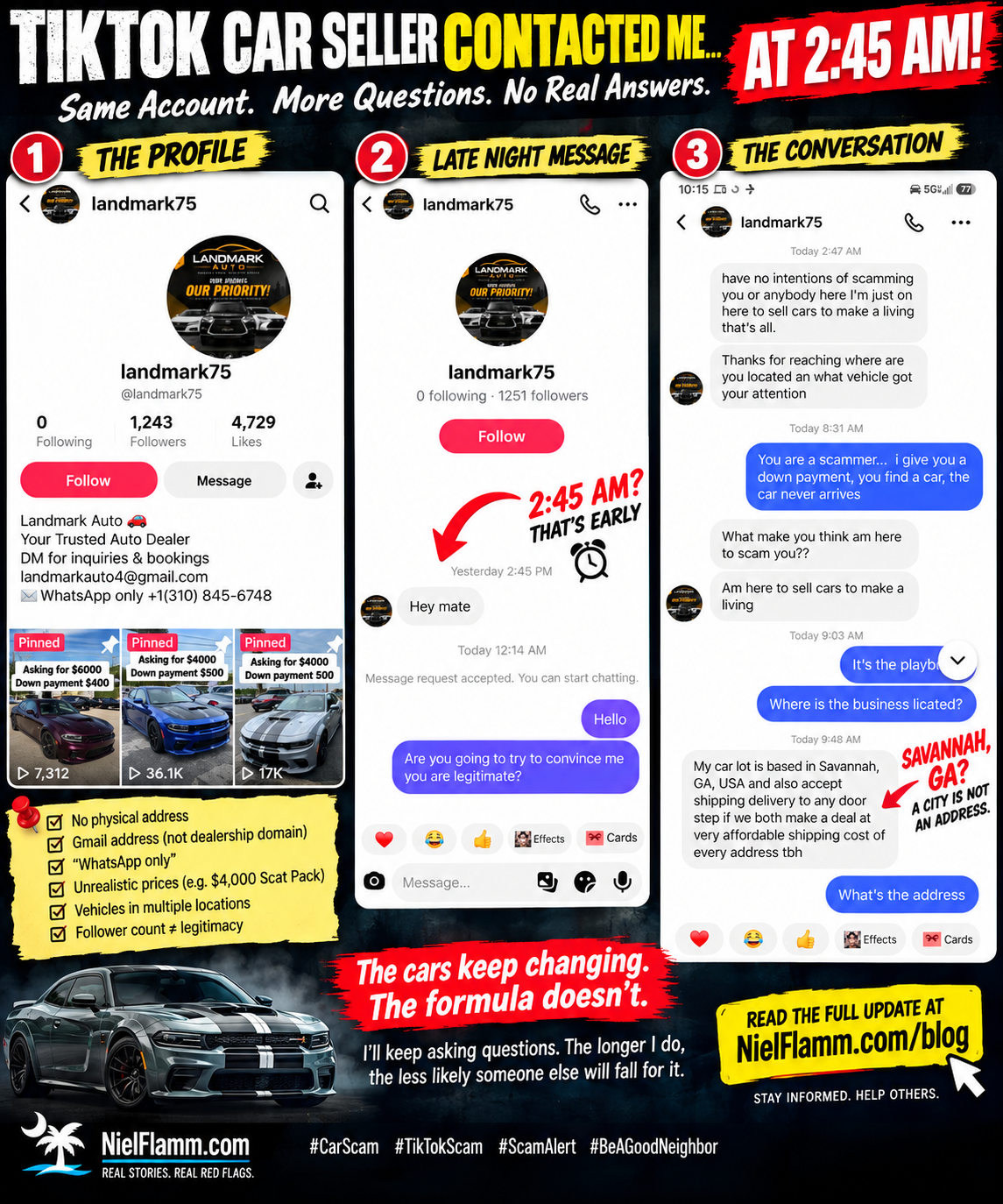
Well, this story just became interactive.
In my last post, I looked at the TikTok account landmark75, which describes itself as “Landmark Auto” and advertises vehicles at prices and down payments that immediately raised questions—including a purported 2021 Dodge Scat Pack with 45,000 miles for $4,000 and $500 down.
Now the account has contacted me directly.
And apparently, dealership hours start at 2:45 AM.
🌙 “Hey mate”
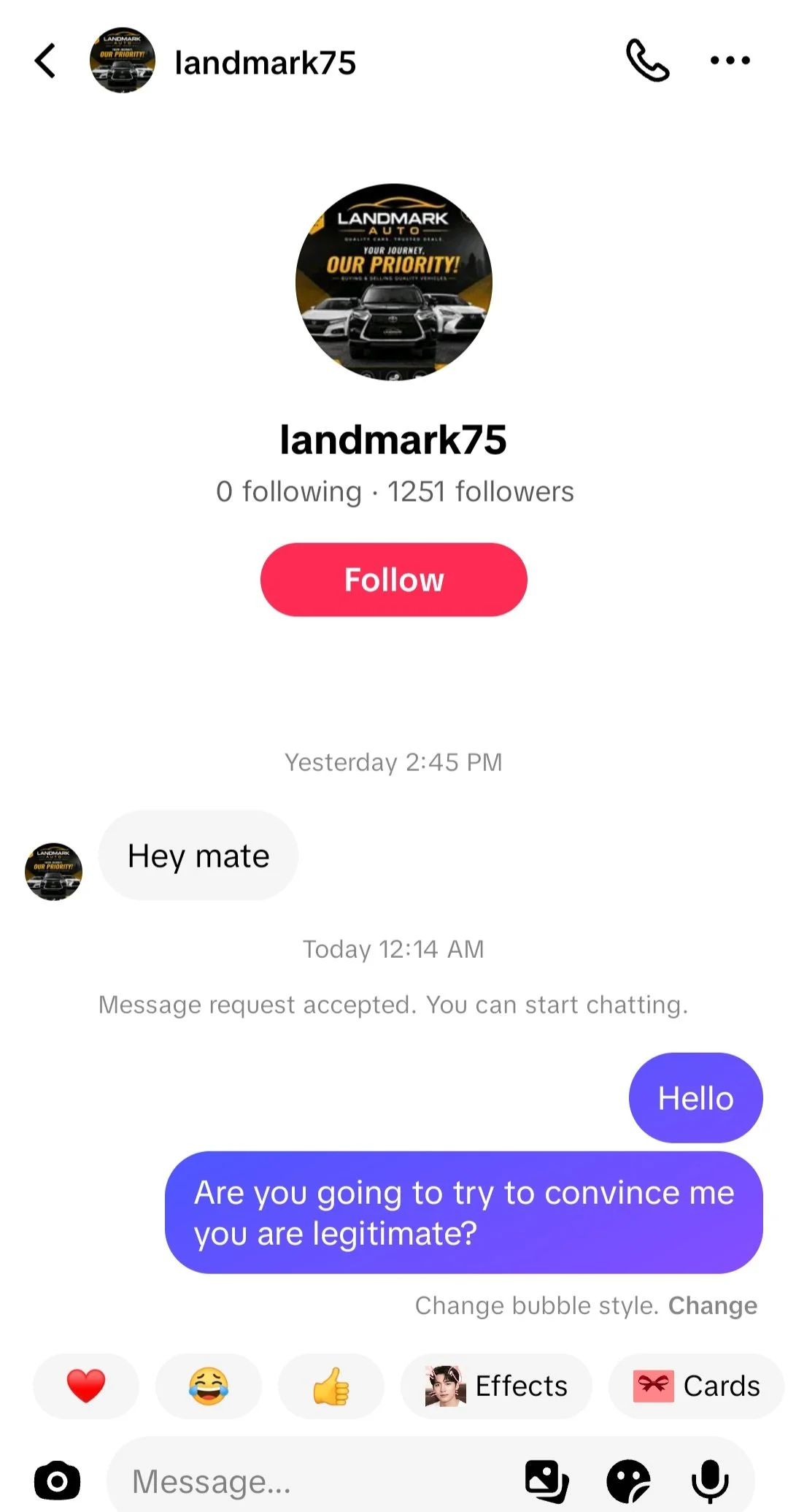
The first message arrived at 2:45 AM:
“Hey mate”
I eventually accepted the message request and didn't exactly hide my skepticism.
I asked:
“Are you going to try to convince me you are legitimate?”
The response came at 2:47 AM:
“have no intentions of scamming you or anybody here I'm just on here to sell cars to make a living that's all.”
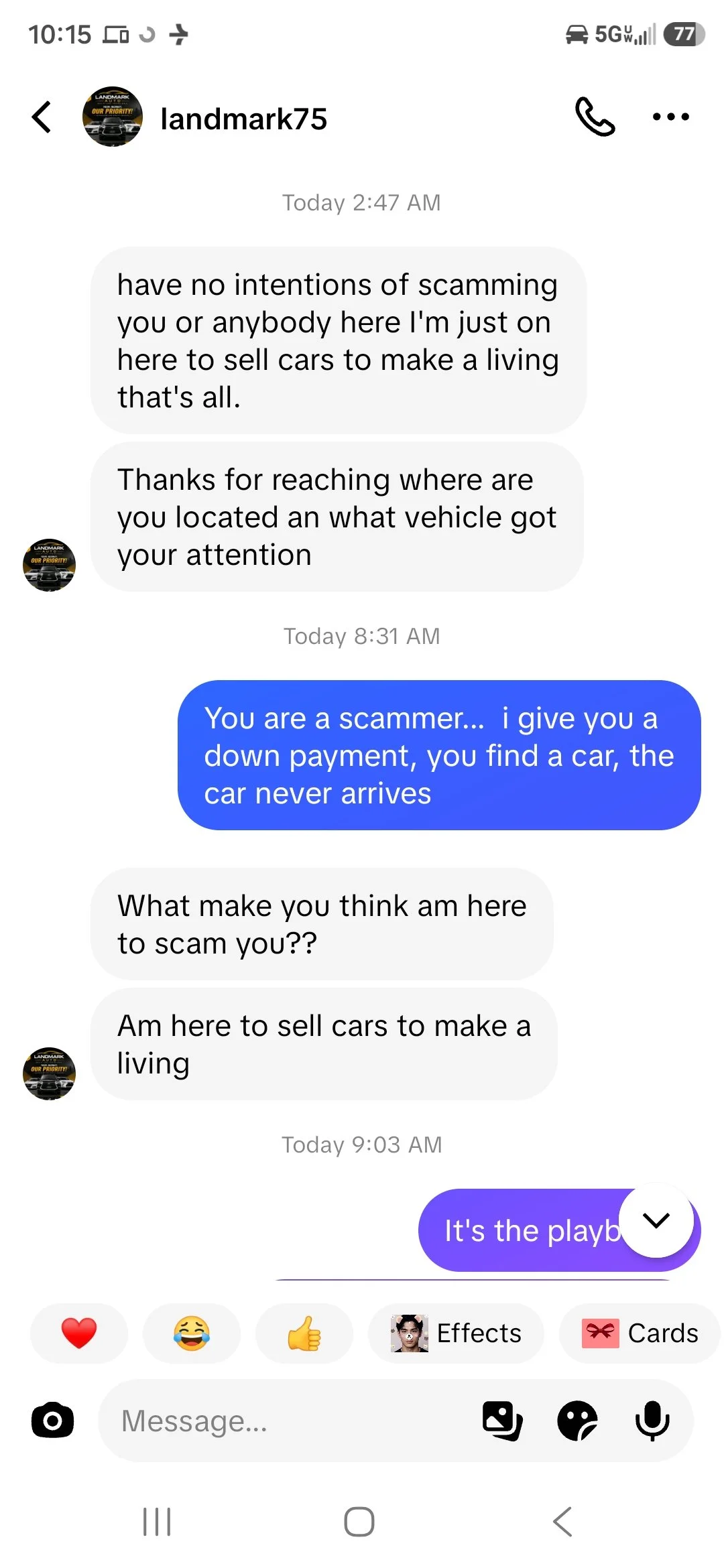
They then asked where I was located and which vehicle caught my attention.
Fair enough.
Except I wasn't shopping.
I was investigating.
🚩 I Asked Direct Questions. I Wanted Direct Answers.
I told the account why I was skeptical.
Their response was essentially: What makes you think I'm here to scam you? I'm here to sell cars and make a living.
But that's not really the question I need answered.
I don't need someone to tell me they're legitimate.
I need information that allows me to independently verify they're legitimate.
There's a big difference.
So I asked one of the simplest questions imaginable:
Where is the business located?
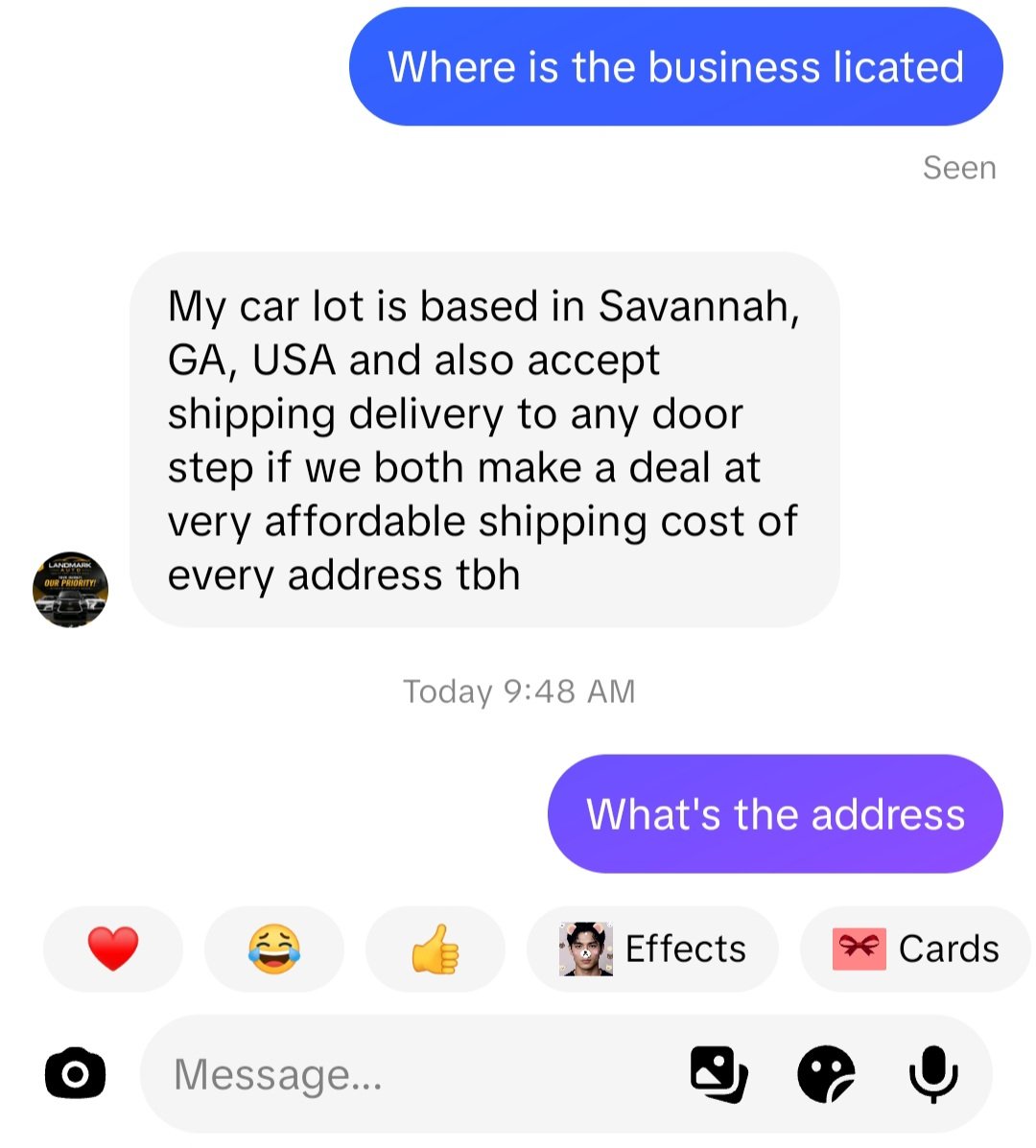
The answer:
“My car lot is based in Savannah, GA, USA and also accept shipping delivery to any door step if we both make a deal at very affordable shipping cost…”
Okay.
Savannah, Georgia.
That's a city.
It's not an address.
So I followed up with an even simpler question:
“What's the address?”
That's where the screenshots currently end.
🔎 I Tried Independently Verifying It
I also searched publicly available sources for the business information displayed on the TikTok profile.
The profile previously showed a Gmail address and a 310-area-code WhatsApp number, while the person messaging me now says the car lot is based in Savannah, Georgia.
My searches did turn up several legitimate businesses around the country using variations of the name “Landmark Auto,” but I did not find a Savannah used-car dealership in the local-business results that clearly matched this TikTok account, its displayed contact information, and the Savannah claim. Instead, search results surfaced unrelated Landmark businesses and other established Savannah used-car dealers with publicly listed street addresses. Landmark Auto Sales
That doesn't by itself prove the TikTok account is fraudulent.
But it certainly doesn't answer my question either.
One public phone-directory result also associates the 310-845 number block containing the number displayed on the TikTok profile with Culver City, California—not Savannah. Phone numbers can be retained, ported, and used remotely, so that isn't proof of anything by itself. It's simply another detail I'd want explained before sending money. Stan at Work
🚩 This Is Why “What's the Address?” Matters
If you're operating a physical car lot, an exact street address shouldn't be hard to provide.
In fact, a legitimate dealership normally wants customers to know where it is.
I should be able to independently look up that address and determine:
Does the dealership exist?
Is the business registered there?
Is it licensed to sell vehicles?
Does the business name match?
Does the phone number match?
Do the vehicles shown online actually belong to that dealership?
Can I physically inspect the car?
Can I call a publicly listed number instead of communicating only through TikTok or WhatsApp?
Those are ordinary due-diligence questions.
I'm not asking for the Coca-Cola recipe.
I'm asking where the car lot is.
🚩 The Conversation Is More Interesting Than the Sales Pitch
Something else stands out.
The account initiated this conversation with me.
They've continued responding even after I openly told them I believe the operation follows a familiar scam playbook.
That's useful.
Because every additional answer gives me something else I can potentially check independently.
If I get an address, I'll check it.
If I get a dealership name, I'll check it.
If I get a dealer-license number, I'll check it.
If I get a VIN for that $4,000 Scat Pack, I'll check it.
And if I get asked to send a deposit before I'm allowed to independently verify those things?
Well...
That'll be interesting too.
🧠 “Trust Me” Isn't Verification
This is one of the bigger lessons from this entire series.
Someone saying:
“I have no intention of scamming you.”
doesn't establish legitimacy.
Neither does:
“I'm just here to sell cars to make a living.”
Those statements might be completely sincere.
But legitimate businesses don't need customers to rely exclusively on sincerity.
They can provide independently verifiable information.
Business name.
Street address.
Dealer license.
VIN.
Title information.
Written purchase agreement.
Financing disclosures.
Independently verifiable telephone number.
That's evidence.
⏰ I'll Keep the Conversation Going
I'll keep engaging with this account as long as the conversation remains useful and safe.
Not because I plan to buy a car.
And definitely not because I'm sending a down payment.
I'm interested in seeing where the conversation goes and documenting the process.
There's another reason.
Time spent answering my questions is time not spent moving someone else quickly toward a deposit.
I can't know whether my conversation actually prevents someone else from being targeted, so I won't pretend it does.
But if keeping the conversation going gives me more information to verify—and gives readers a better look at how these interactions develop—I'm willing to keep asking questions.
And my next one is already sitting there:
What's the address?
A city isn't an address.
Let's see what comes next.
Follow the continuing story at NielFlamm.com/blog.

Another TikTok Car Deal: A $4,000 Scat Pack With $500 Down? Here We Go Again
Apparently TikTok has decided that one questionable car account wasn't enough for me.
After looking at an account advertising everything from inexpensive transportation to Porsches with tiny down payments, another account appeared in my feed.
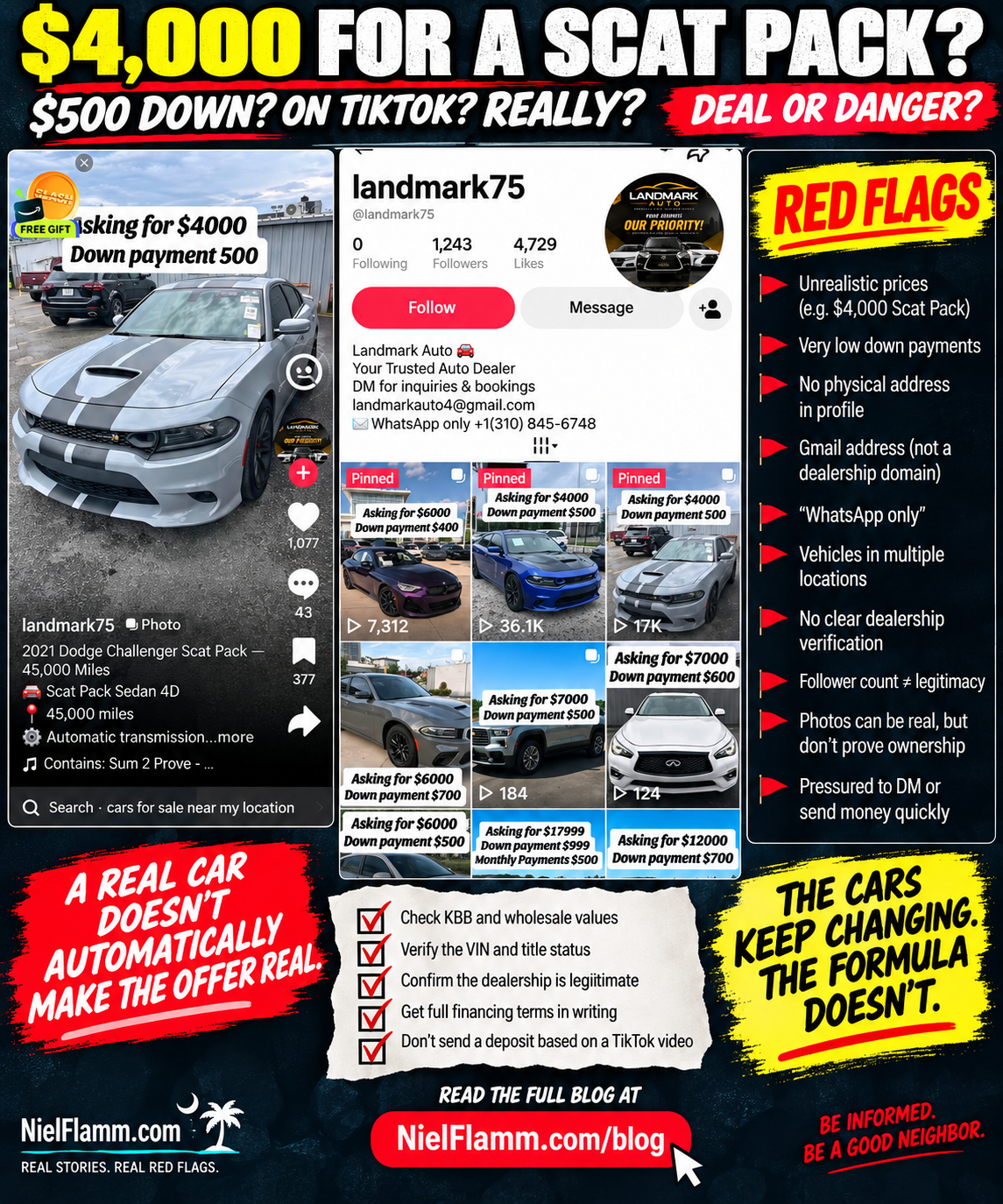
This one calls itself “landmark75.”
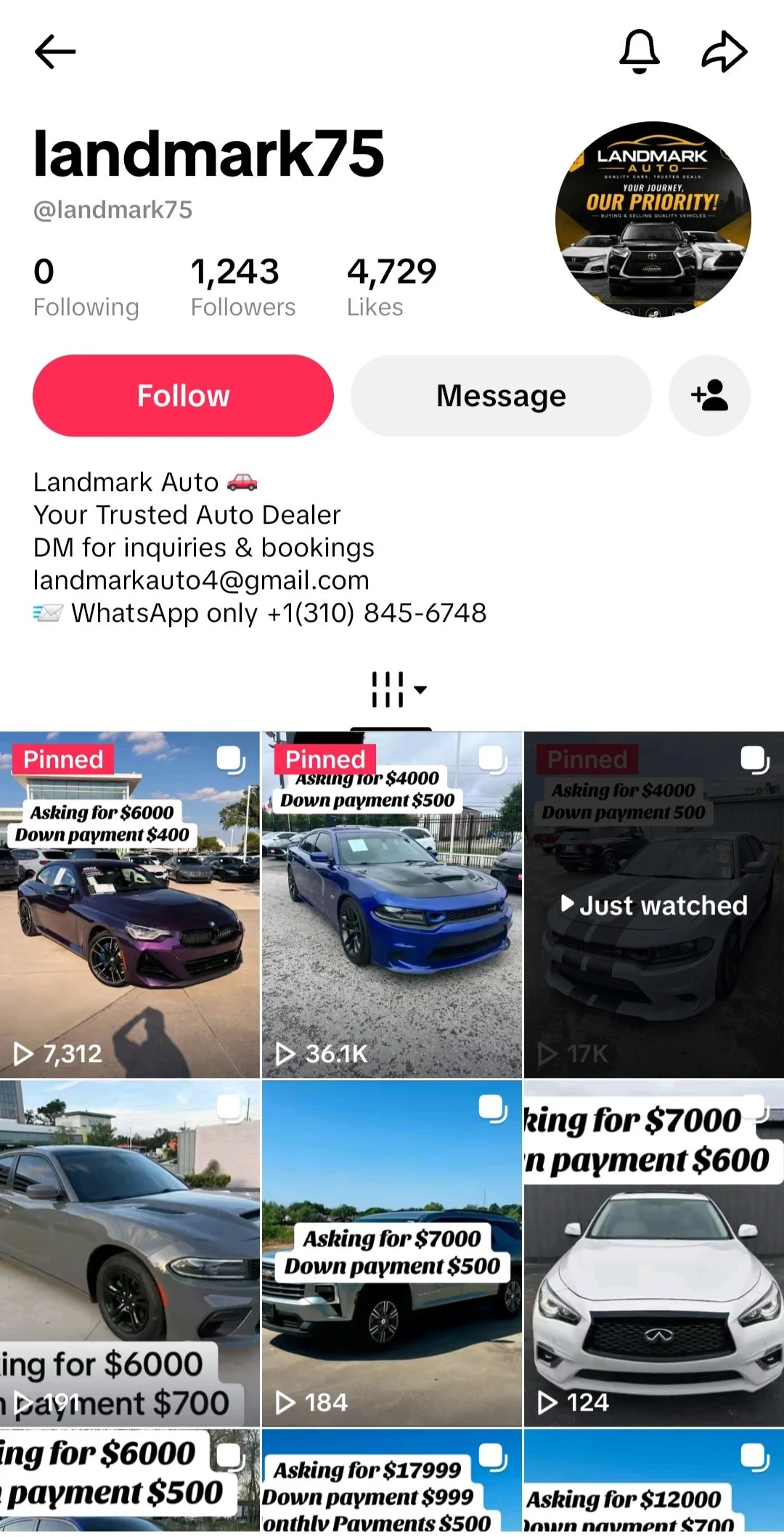
At the time of my screenshot, the profile showed more than 1,200 followers and 4,700 likes and described itself as:
“Landmark Auto 🚗
Your Trusted Auto Dealer
DM for inquiries & bookings”
Then things get interesting.
The profile lists a Gmail address and says
“WhatsApp only”
The profile doesn't show a physical dealership address.
And the inventory?
Once again, apparently we're living in the magical land of extremely inexpensive automobiles.
🚗 Today's Special: A 2021 Dodge Charger Scat Pack for $4,000
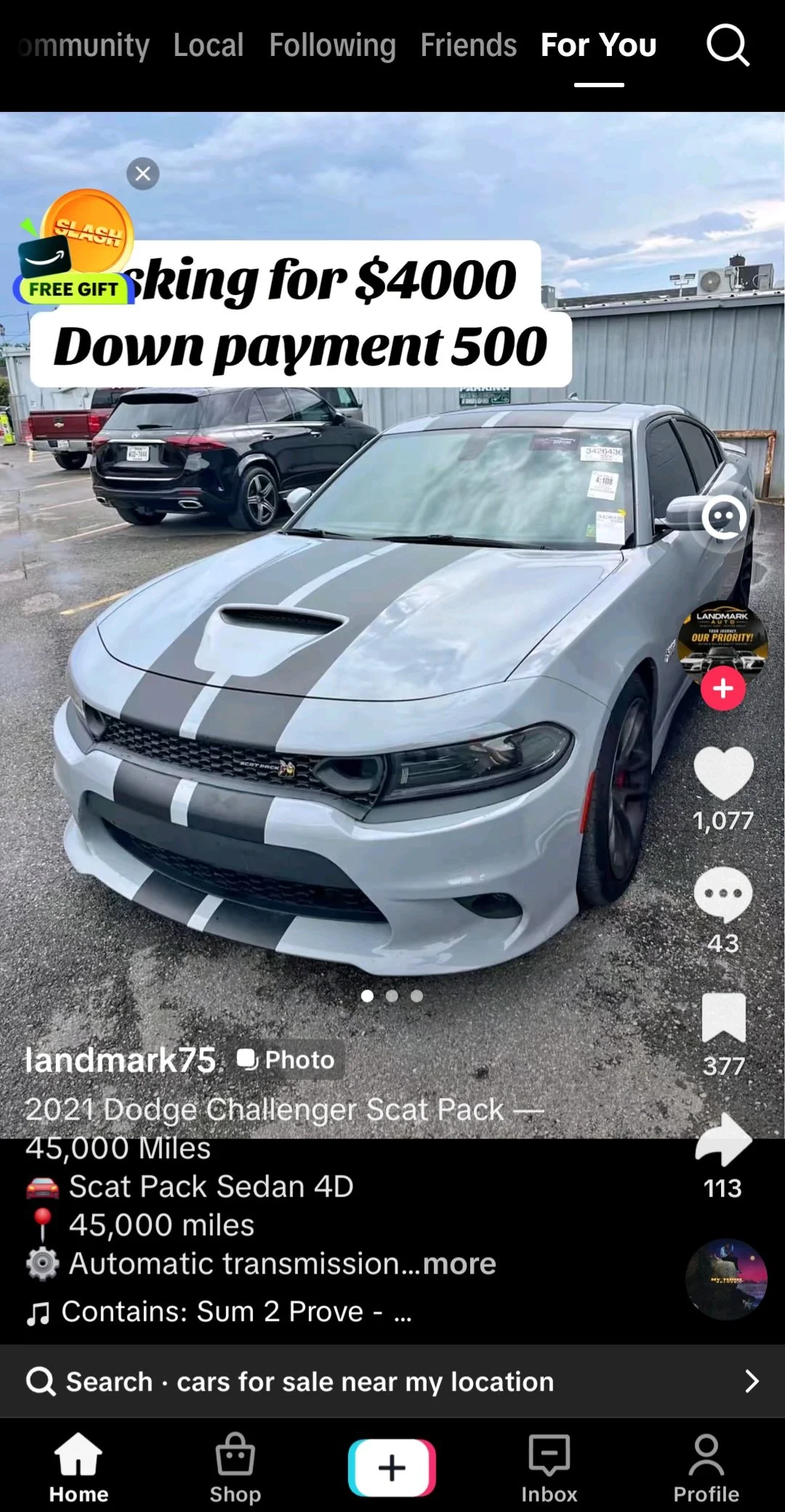
One post advertises what it describes as a:
2021 Dodge Charger Scat Pack
45,000 miles
And across the top of the photograph:
“Asking for $4000
Down payment 500”
Wait.
$4,000?
For a 2021 Charger Scat Pack with 45,000 miles?
I thought the $500 down payment was supposed to be the unbelievable part.
This time it's the alleged asking price.
And this wasn't some obscure post nobody had seen. My screenshot showed more than 1,000 likes, along with dozens of comments and hundreds of saves.
💰 Let's Check Reality
A 2021 Dodge Charger Scat Pack wasn't inexpensive when new, and clean used examples haven't suddenly become $4,000 cars.
Current Kelley Blue Book values vary considerably by mileage, equipment, condition, and location, but a 2021 Charger Scat Pack remains worth many times the $4,000 advertised here.
Even before knowing the VIN, vehicle history, or exact condition, that's enough of a pricing discrepancy to make me stop.
Could a $4,000 Charger exist?
Sure.
Maybe it's wrecked.
Maybe it has a branded or salvage title.
Maybe it has catastrophic mechanical problems.
Maybe it's missing an engine.
Maybe there's some other legitimate explanation.
But none of those explanations appear in the TikTok post.
Instead, I'm seeing a shiny Scat Pack photographed on what appears to be a dealer or auction lot and an advertised price of:
$4,000
That's when I want documentation, not emojis.
🚩 And It's Not Just the Scat Pack
Then I looked at the rest of the profile.
One pinned post appears to advertise a BMW for:
Asking: $6,000
Down payment: $400
Another Charger:
Asking: $4,000
Down payment: $500
Another vehicle:
Asking: $6,000
Down payment: $700
Another:
Asking: $7,000
Down payment: $500
An Infiniti appears with:
Asking: $7,000
Down payment: $600
Farther down, there's another vehicle advertised at $17,999 with $999 down and $500 monthly payments.
It's the same pattern I've been seeing repeatedly.
Attractive vehicles.
Extremely attractive prices.
Tiny down payments.
And social media as the storefront.
🚩 But Look at the Charger Photo More Closely
Here's something else that caught my attention.
The Charger has multiple stickers on the windshield.
That makes the vehicle look more credible because we're clearly looking at an actual car.
But that's something I've been stressing throughout this series:
A real car doesn't automatically make the offer real.
A vehicle can exist without the person posting its photograph owning it.
A vehicle can sit on an auction lot without a TikTok account having authority to sell it.
A photograph can come from another dealership, auction, listing or social-media account.
I'm not saying that's necessarily what happened here.
I'm saying a photograph isn't proof of ownership.
Before I send someone $500, I'd want the VIN and I'd want to independently establish exactly who owns the vehicle and where it's physically located.
📱 “WhatsApp Only”
Then we get to one of the biggest things that would make me cautious.
The profile doesn't direct potential buyers to a recognizable dealership website or give a street address.
Instead:
DM for inquiries & bookings
and
WhatsApp only
WhatsApp itself isn't suspicious. Millions of legitimate businesses use it.
But if I'm supposedly purchasing a vehicle from an auto dealer, I want more than a social-media profile and messaging account.
I want:
The legal business name.
Physical dealership address.
Dealer license information.
VIN.
Title status.
Vehicle history.
Actual cash selling price.
Financing terms.
APR.
Length of loan.
Total of payments.
And I want to verify those things independently, not solely through information sent to me by the person asking for my money.
💵 $500 Down Doesn't Tell Me What the Car Costs
This is another distinction consumers need to understand.
A legitimate dealer absolutely can sell a $30,000 vehicle with only $500 down.
That doesn't mean the vehicle costs $500.
The remaining balance gets financed.
That's why a post screaming “ONLY $500 DOWN!” tells me very little without the rest of the transaction.
But this Charger post goes further.
It appears to say the asking price itself is $4,000.
If that's genuinely the total purchase price for a running, roadworthy 2021 Charger Scat Pack with 45,000 miles and a transferable title, I would want to understand exactly why it is being offered so dramatically below normal market value.
🚩 Followers Still Aren't Verified
We've seen this before.
This account has more than a thousand followers.
One of its videos has tens of thousands of views.
That creates social proof.
People think:
“Other people are following them.”
“The video has 36,000 views.”
“There are hundreds of likes.”
“The cars are real.”
Therefore:
“The seller must be legitimate.”
Those aren't the same thing.
A follower isn't a dealer license.
A like isn't a title.
A view isn't a VIN.
And 36,000 views don't turn a $4,000 Scat Pack into a normal market transaction.
🧮 The Numbers Have to Make Sense
This is where I keep returning to KBB and wholesale-market values.
A legitimate business generally needs to acquire inventory for less than it sells that inventory for.
That's the business model.
If the normal wholesale value of a vehicle is dramatically higher than the advertised retail price, I want to know how that transaction works economically.
Maybe there's a legitimate explanation.
Great.
Show me.
That's what due diligence is for.
I don't have the VIN or enough vehicle-specific information from this TikTok post to produce an exact Manheim Market Report value, and I'm not going to invent one.
MMR depends on factors including mileage, condition, trim, region and recent auction transactions.
But that's actually part of the problem.
The information necessary to properly evaluate these deals isn't prominently provided.
The extraordinary price is.
🏡 Don't Be Passive. Be a Good Neighbor.
Here's why I continue writing about these.
Imagine someone who needs a car desperately.
Their credit is damaged.
Their current car just died.
They have to get to work.
Traditional financing hasn't gone well.
Then TikTok serves them:
2021 CHARGER SCAT PACK
$4,000
$500 DOWN
That doesn't just look like a deal.
It can look like a solution to a serious problem.
Before someone you know sends $500 through an app because they're afraid another buyer will grab the car first, help them investigate.
Ask for the VIN.
Verify the VIN independently.
Find the physical dealership.
Verify its dealer license.
Call the dealership using a phone number you find independently.
Check the title.
Compare KBB retail value.
Compare wholesale value.
Ask for complete financing terms in writing.
And if somebody says you need to send money right now before you can do those things?
That answer tells you something too.
The Cars Keep Changing. The Formula Doesn't.
Over the past several posts, I've seen Toyotas, Hondas, BMWs, Audis, Camaros, Porsches and now Dodge Scat Packs advertised on social media with extraordinarily low prices or down payments.
Different accounts.
Different cars.
Different backgrounds.
But some remarkably familiar marketing:
Low price.
Tiny down payment.
DM me.
Quick approval.
Shipping available.
Send money.
I'm not sending $500 to find out what happens next.
I'll keep doing the free part:
Asking questions.
Because whether this particular offer has some explanation I can't see from the TikTok post or not, $4,000 for a 2021 Charger Scat Pack with 45,000 miles deserves a lot more than a swipe and a DM.
Follow along at NielFlamm.com/blog as I continue looking at questionable vehicle offers, suspicious emails, recruiting scams, and whatever the algorithm decides to throw at me next.