
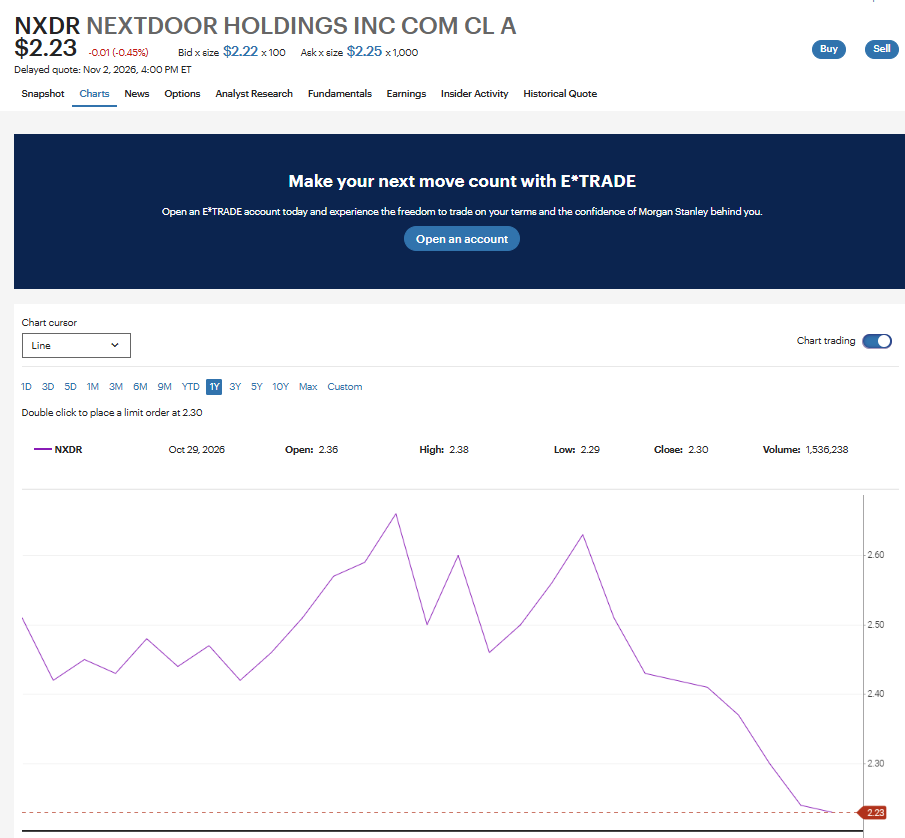
Day 140: NXDR Slides to $2.23 — What Is Driving Nextdoor's Decline?
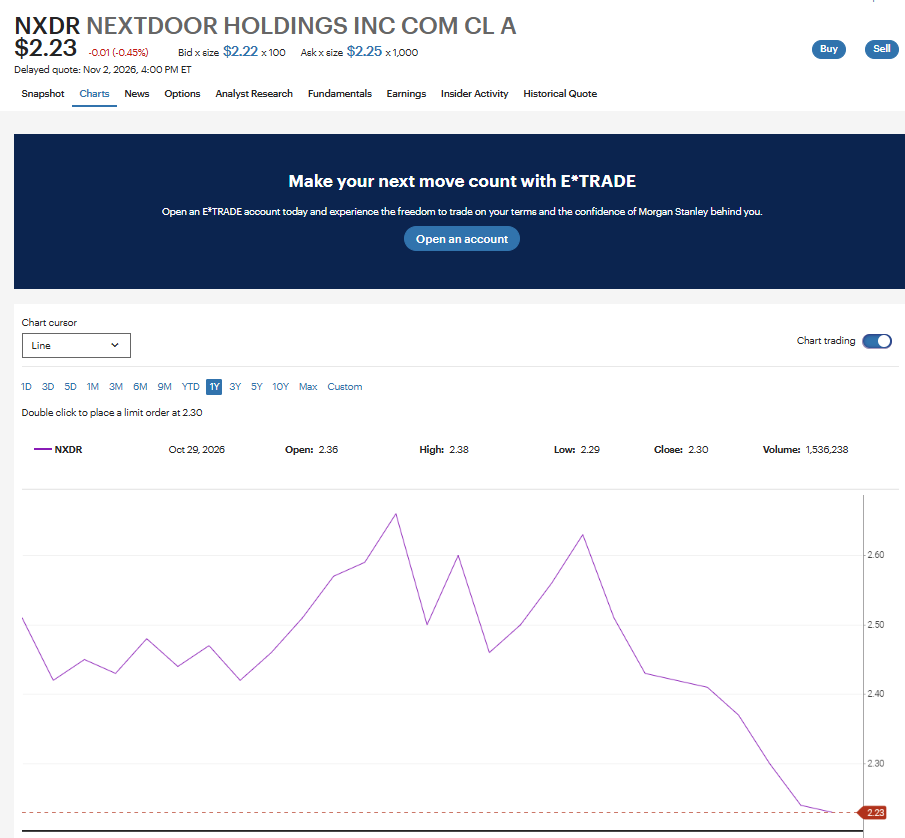
The slide continues.
Yesterday, NXDR closed at $2.24. Today, it closed at $2.23, down about 0.45%.
One day, another step backward. Not a dramatic drop on its own, but it's part of a trend that's caught my attention.
I've been watching this movement since October 22, 2026, and I'm curious about what's behind it.
Another day in the wrong direction
I've noticed a pattern in previous earnings cycles. NXDR would bump up in the days leading up to an earnings report, only to give back some of those gains shortly afterward.
This time, something looks different.
Instead of the pre-earnings momentum I’ve seen before, the stock has continued to drift downward.
So what's changed?
Is this normal market activity? Are investors waiting for the next earnings announcement? Are there concerns about the company's financial performance, its growth strategy, advertising expansion, or its ability to turn its audience into sustainable revenue?
I don't know the answer, and I'm not going to pretend that I do.
But I would like to hear an explanation.
So I asked The Google: Why do investors think NXDR is sliding?
I asked The Google why investors believe Nextdoor Holdings (NXDR) is declining.
The AI Overview returned several explanations. Some are particularly interesting because they overlap with issues I've been discussing over the past year.
Here's a summary of what The Google identified:
1. Execution and scale concerns
Investors and analysts may be questioning whether Nextdoor has the cost structure and overhead of a much larger technology platform without generating the revenue to support it.
In other words, does the business have the scale to justify its operating structure?
2. Muted guidance and slower growth
The AI Overview pointed to analyst price-target reductions, with targets moving toward the $2.10–$2.20 range, along with expectations for modest revenue growth and adjusted EBITDA margins.
Revenue growth is important, but investors also want to understand how that growth translates into sustainable profitability.
3. Moderation and user friction
This one should sound familiar.
The overview identified concerns about automated moderation, including ordinary neighbor recommendation posts being classified as commercial content and comment threads being closed.
I've spent considerable time discussing moderation, inconsistent enforcement, and the frustration users experience when legitimate neighborhood conversations are restricted.
A platform depends on its users. Make it difficult for them to participate, and you risk damaging the very community that makes the business valuable.
4. Internal culture and leadership questions
The overview also mentioned concerns surrounding employee stock compensation, workplace culture discussions, and leadership changes.
These are areas that deserve careful examination rather than assumptions. However, questions about leadership stability and the ability to execute a strategy can influence investor confidence.
5. A large cash cushion and corporate urgency
Finally, the overview referenced Nextdoor's substantial cash reserves and argued that a significant cash cushion could reduce pressure to make difficult changes.
Having cash is a strength. But cash alone doesn't guarantee a successful business model, profitable growth, or shareholder returns.
These points come from Google's AI Overview, not independently established explanations for today's price movement. They represent potential investor concerns and should be evaluated against company filings, earnings results, analyst research, and other evidence.
Here's what caught my attention
I may not have used the same polished language as Google's AI Overview, but I've raised every one of these issues over the last year or so.
Execution. Revenue growth. Moderation. User experience. Leadership. Company culture. Cash reserves—shareholder value.
I've written about these subjects repeatedly.
I've questioned whether Nextdoor is building a sustainable business or simply adding more advertising opportunities to a platform that still has fundamental user-experience problems.
I've asked whether the company understands the consequences of moderation decisions and how those decisions affect participation and engagement.
I've questioned whether leadership is listening to users and whether the company is doing enough to communicate with investors.
And I've repeatedly asked for answers to specific questions, including the two detailed research reports that remain outstanding.
Apparently, these aren't just questions coming from one neighbor writing a blog.
They're also among the concerns being discussed in the broader investment conversation.
That doesn't mean my commentary caused the stock decline, nor does it prove that every concern in the AI Overview is accurate. But it does reinforce why these subjects deserve attention.
Will management address the decline?
Nextdoor has an earnings report coming up. That creates an opportunity for management to address more than just revenue, user growth, and adjusted EBITDA.
I'd like to hear how leadership views the market's reaction to the company's performance.
Some questions I'd like answered:
What does management believe is driving the recent decline in NXDR?
Is investor confidence changing?
How is Nextdoor measuring the success of its newer advertising and sponsored-search initiatives?
What is the path toward sustainable GAAP profitability?
What is the company doing to create long-term shareholder value?
How does Nextdoor plan to improve trust and engagement among the neighbors who make the platform valuable?
Revenue growth and user numbers are important. But they don't automatically translate into investor confidence or a stronger stock price.
My concern: Will we get any real answers?
Here's where my skepticism comes in.
I expect the earnings report to focus on the usual financial metrics and forward-looking statements. I wonder whether management will address the questions investors are actually asking about the stock's performance.
And that brings me back to a recurring concern throughout this case study: transparency.
I've spent 141 days raising questions about Nextdoor's communication, leadership, moderation, advertising strategy, and accountability.
I've also requested two detailed research reports and am still waiting for a meaningful response.
The company talks about community, connection, and creating value. But those promises need to extend beyond marketing language.
Investors deserve meaningful communication. Users deserve a platform that puts their experience first.
Day 141: The numbers are telling a story. Is anyone listening?
A 0.45% decline in one trading session isn't necessarily a warning sign on its own. I know stock prices move for many reasons, and I don't have enough information to attribute this decline to any one factor.
But the direction since October 22 deserves attention.
Nextdoor has celebrated 15 years, announced new revenue opportunities, and promoted its partnerships. That's great.
Now I'd like to see the company demonstrate how those milestones translate into investor confidence, sustainable growth, and a better experience for its neighbors.
Nirav Tolia and the Nextdoor leadership team: What is driving the slide, and will you address it?
I'll be watching the earnings report.
Day 141. The slide continues. The questions continue. And the wait for answers continues.

Day 129: NXDR Is at $2.64. I've Seen This Movie Before.

The stock is rising, earnings are approaching, and I'm watching the same story unfold again.
I checked where Nextdoor Holdings (NXDR) was trading as I wrote this post: $2.64 per share.
Am I shocked? Not at all.
In fact, I expect the price to continue rising as we approach the next earnings report, scheduled for November 2. My theory is that short-term buyers are positioning themselves ahead of the announcement, hoping to benefit from the excitement and whatever numbers Nextdoor puts on the table.
That's my expectation, not a certainty. The market can always surprise us.
But here's what I think may happen.
The Run-Up to November 2
I expect NXDR to keep climbing through the earnings announcement and potentially for a few days afterward.
I also expect the earnings narrative to paint a glorious picture of Nextdoor-land.
Weekly active users are up. Revenue is up. Sales are up. The company will likely emphasize its progress, its advertising opportunities, and the potential of its neighborhood platform.
And those numbers may well show genuine progress. I'm not suggesting that improved metrics are meaningless.
But there's a bigger question that doesn't get answered by a polished earnings presentation:
What does all that progress mean for the long-term investor?
A company can report improving metrics and still leave investors waiting for a meaningful return. Revenue growth, user engagement, and operational progress are important, but they don't automatically translate into sustained stock appreciation or shareholder distributions.
That's the distinction I keep coming back to.

Why I Sold My Shares
I sold my NXDR shares on October 12.
I could only hold on for so long, waiting for the promise to turn into execution and for the long-term investment case to become more compelling.
I reached a point where I decided to sell at the price available to me rather than continue waiting for a future that might or might not arrive.
I don't regret that decision, even though the stock is now at $2.64.
Could it rise further? Absolutely.
Could it fall after earnings? That's possible, too.
I don't have a crystal ball, and I won't pretend to know what the market will do. I based my decision on my own assessment of the investment and how long I was willing to wait.
A rising stock price doesn't automatically answer the long-term questions.
A Facebook Reminder Took Me Back a Year
A few days ago, Facebook reminded me of something I had posted about a year earlier.
That reminder took me back to the beginning of my study of Nextdoor, Nirav Tolia, and the gap between the company's promises and its execution.
I began looking beyond the marketing messages and asking questions about users' experience on the platform.
What happens when the company removes posts and comments? How consistent is moderation? Where does accountability sit? How does the company respond when people raise questions? And how effectively does leadership listen to feedback?
Over time, my focus expanded to include research transparency, commercializing neighborhood knowledge, corporate governance, and the relationship between company performance and long-term shareholder value.
What started as a closer look at one platform became an ongoing case study of a public company and its leadership.
And here I am, roughly a year later, still asking some of the same questions.
The CEO, the X Posts and the Questions That Remain
One thing I documented early in this project was that Nirav Tolia hadn't reached out to the public in response to the issues I raised. I even started a countdown to track how much time passed.
Since then, Nirav has posted on X, but he has also blocked me twice from participating in conversations on his posts.
He has every right to control his own social media account. I don't know why he blocked me, and I won't pretend to.
But I do find the contrast interesting.
There are public conversations about topics that don't necessarily change the landscape of the platform, while questions about moderation, communication, accountability, and execution remain unresolved from my perspective.
Posting on X is communication. Blocking someone is a personal choice. Neither action, by itself, tells us whether the organization is listening to difficult feedback or fixing underlying problems.
The question isn't whether a CEO posts. It's whether the company learns, adapts, and follows through.

What About the Board?
This brings me to Nextdoor's board of directors.
A board has responsibilities that extend beyond supporting the CEO's strategy. Directors are expected to exercise independent judgment, oversee management, and consider the company's long-term interests.
I have questions about whether Nextdoor's governance provides enough visible accountability and whether leadership is effectively challenged when execution falls short.
I don't have evidence that the board is improperly aligned with Nirav, and I won't claim that it is. Directors can support a CEO while still exercising independent oversight.
But from the outside, shareholders and the public have limited visibility into the substance of those internal discussions.
If the board believes the current direction is working, it should be able to point to measurable results and explain how it evaluates progress, risk and leadership performance.
If problems persist, shareholders should understand how those concerns are being addressed.
A board's job isn't simply to stand behind the CEO. It's to help ensure the company delivers.
The Same Story, Another Earnings Report
As November 2 approaches, I expect the conversation around Nextdoor to focus on its numbers.
How many weekly active users? How much revenue? How strong are sales? What is management saying about the future?
Those are all reasonable questions.
But I will also be looking for evidence that the company is addressing the issues that don't fit neatly into a quarterly earnings slide: user trust, moderation, transparency, accountability, and the ability to turn a promising platform into a durable business.
I'm no longer a shareholder, but I still want Nextdoor to succeed. I would like to see it build a stronger business and deliver lasting value.
For now, I see a stock at $2.64, an earnings report approaching, and a year-old set of questions that still deserves attention.
The market may reward the next earnings narrative. The more important test is whether Nextdoor can sustain its progress beyond the announcement.
A good earnings report can move a stock. Consistent execution is what builds a business.
I'll be watching what Nextdoor reports on November 2—and, just as importantly, what happens after the headlines fade.
👉 Follow the continuing Nextdoor case study at NielFlamm.com/blog.

Day 53: Is the Market Celebrating Improvement or Ignoring the Questions?
As I write this, NXDR is up.
The market is clearly reacting positively to Nextdoor's latest earnings report.
I understand why.
The company reported a smaller loss than in previous quarters, along with revenue growth and improved operating metrics.
As a shareholder, I'm glad to see progress.
But I also see it differently.
To me, it's a bit like a marathon where you've consistently finished last and this year you finish second-to-last.
That's an improvement.
It deserves acknowledgment.
But you still didn't win the race.
Nextdoor is still reporting a GAAP net loss.
The company has now been operating for approximately 15 years, and while CEO Nirav Tolia described this as the company's best quarter, I believe it's also fair for shareholders to ask what "best" should ultimately look like.
For me, financial performance is only part of the equation.
Today also marks Day 53 since I requested a study from Jacob Chavis.
Fifty-three days later:

No study.
No acknowledgment.
No explanation.
No response.
I've also noticed that the last Nextdoor Insights article appears to have been published on July 6, 2026.
As a shareholder, I naturally wonder:
Are new studies still being produced?
Has the research strategy changed?
Is the Insights program on pause?
I don't know.
That's exactly why I've continued asking.
This isn't about criticizing improvement.
It's about asking whether improving financial results should also be accompanied by improvements in communication, transparency, and accountability.
Potential alone doesn't create long-term shareholder value.
Execution does.
Communication does.
Culture does.
One quarter doesn't define a company, just as one stock move doesn't define its future.
I'll continue recognizing progress when I see it, and I'll continue asking questions when I believe they're warranted.
That's what engaged shareholders should do.
Join the discussion at NielFlamm.com/blog. Leave some feedback—I'd love to hear from you.

Day 52: Better Numbers. The Same Questions.

Nextdoor released its Q2 2026 financial results, and there are positive developments that deserve recognition.
Revenue increased to $75 million, up 15% year over year.
Platform Weekly Active Users grew to 22.9 million, a 5% increase.
The company also narrowed its GAAP net loss to $2 million, compared with $15 million a year ago, reported $10 million in Adjusted EBITDA, and maintained $378 million in cash.
As a shareholder, I'm glad to see progress.
Credit should be given where it's due.
However, one number still stands out:
Nextdoor is still losing money.
The loss is much smaller, but it's still a loss. Financial results reflect leadership decisions about where to invest, cut costs, monetize the platform, and allocate capital.
Today marks Day 52 since I requested a study from Jacob Chavis.
Fifty-two days later, I still haven't received:
An acknowledgment.
A timeline.
Another observation caught my attention.
The last Nextdoor Insights article appears to have been published on July 6, 2026.
I'm still waiting on a response from Jacob Chavis, and I haven't seen a new Insights article in about a month.
Those may be unrelated.
As a shareholder, I have a few questions.
Has Nextdoor shifted away from publishing Insights?
Are new studies still being produced?
I don't know.
That's why I've continued asking.
A simple response—even "the study isn't public"—would provide clarity. Silence leaves shareholders filling in the blanks.
I've written extensively about what I believe are three major challenges:
A communication culture that doesn't adequately engage with shareholders.
An unpaid moderation model that creates inconsistent user experiences.
Strategic decisions that deserve scrutiny, from monetization to capital allocation.
The earnings report shows improvement, and I hope that trend continues.
I genuinely want Nextdoor to succeed.
But I also believe leadership decisions influence profitability, corporate culture, and shareholder confidence.
I've said this repeatedly because I believe it:
Communication isn't measured when everything is going well. It's measured by how a company responds when someone asks a simple question.
I'll continue acknowledging progress while also raising concerns.
That's what I believe engaged shareholders should do.
Join the discussion at NielFlamm.com/blog. Leave some feedback—I'd love to hear from you.