
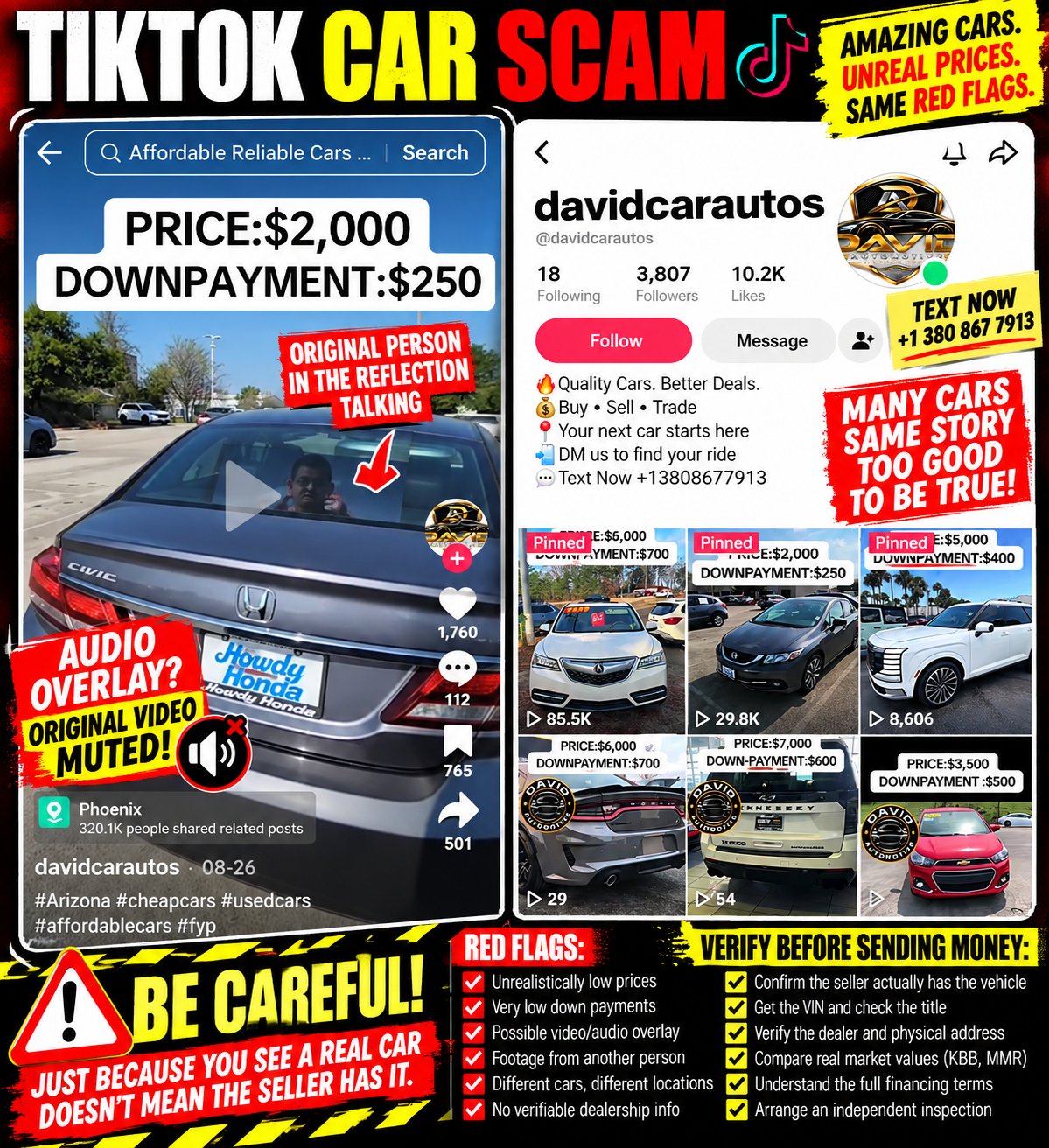
Another TikTok Car Deal — But Who Actually Has the Car?
At this point, TikTok may know my viewing habits a little too well.
Another extremely inexpensive vehicle landed in my feed. This time, it's from an account called davidcarautos, and the featured vehicle looks like a Honda Civic.
The advertisement couldn't be much simpler:
PRICE: $2,000
DOWN PAYMENT: $250
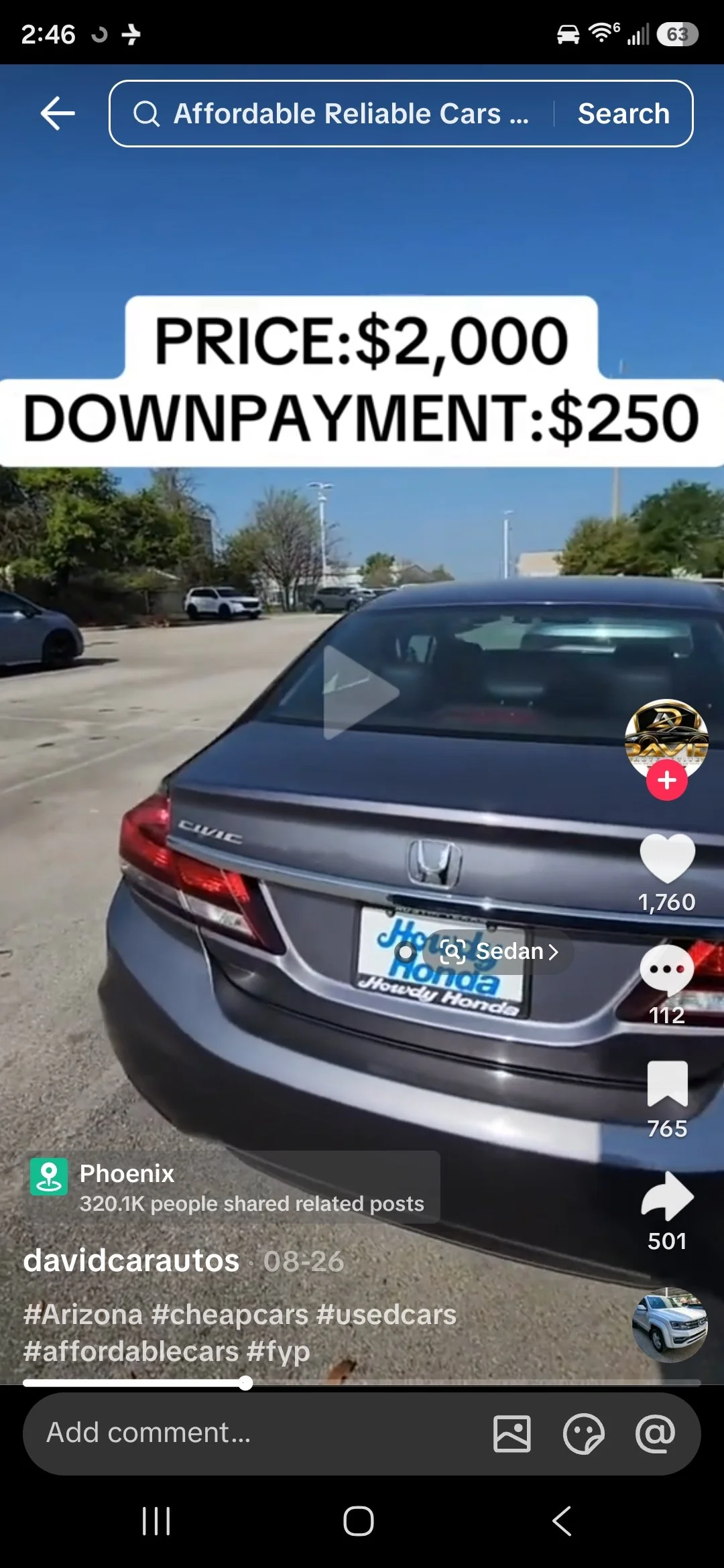
Two thousand dollars for the car, and apparently I can get started for $250.
But this video caught my attention for a reason beyond the price.
Wait—Whose Video Am I Watching?
I watched the video instead of just looking at the price.
That's when something looked odd.
The video appears to have been overlaid with new audio while the original video's audio is muted. As the camera moves around the Honda, I can see what appears to be the original person recording or speaking reflected in the car's window.
Meanwhile, the narration I'm hearing doesn't seem to match what's happening in the original footage.
The new narration makes a particularly interesting pitch: you don't have to go to a dealership to purchase a car.
That's supposed to make the transaction sound easier.
To me, it raises the opposite question:
Does the person posting this TikTok actually possess this car?
I can't establish from these screenshots alone who originally recorded the video or whether the TikTok account has permission to use it. So I'm not going to claim I've proven the footage was stolen.
But an apparently repurposed video combined with a new sales narration is absolutely something I would investigate before sending $250 to anybody.
🚗 A Real Honda in a Video Doesn't Prove the Seller Owns It
This is becoming one of the recurring lessons in my TikTok car series:
A real car doesn't automatically make the offer real.
That's especially important here.
The Honda clearly exists.
A license-plate frame is visible that appears to say Howdy Honda. There's a parking lot. A person is reflected in the vehicle.
All of that makes the video look authentic.
But those things establish the existence of a car and a video.
They don't establish that @davidcarautos owns the car, possesses the car, represents the owner, or has authority to sell it for $2,000.
That's a huge distinction.
The FTC issued a consumer warning this month specifically about scammers impersonating dealerships. It says scammers can copy legitimate dealerships' branding, vehicle listings, and photos, then collect money for cars the supposed seller doesn't actually have. The FTC recommends independently verifying the dealership and, when you can't visit the vehicle yourself, arranging an independent inspection. Consumer Advice
The FBI has also warned about fraudulent online vehicle advertisements involving cars that aren't—and sometimes never were—in the advertiser's possession. Internet Crime Complaint Center
That's why this video's altered presentation matters to me.
“You Don't Have to Go to a Dealer”
Technically, that's true.
People legitimately purchase vehicles remotely every day.
Dealerships deliver cars. Buyers purchase vehicles from other states. Documents can be signed electronically. Independent inspections can be arranged.
Remote car buying isn't inherently suspicious.
But there's a big difference between:
“You don't have to physically visit our dealership.”
and:
“You don't need to independently establish that we actually have the car.”
That second part is non-negotiable for me.
If someone wants my money for a vehicle, I want to know exactly where that vehicle is sitting.
👀 Then I Looked at the Profile
The account had approximately:
3,807 followers
10,200 likes
Its bio says:
🔥 Quality Cars. Better Deals.
💰 Buy • Sell • Trade
📍 Your next car starts here
➡️ DM us to find your ride
💬 Text Now +1 380-867-7913
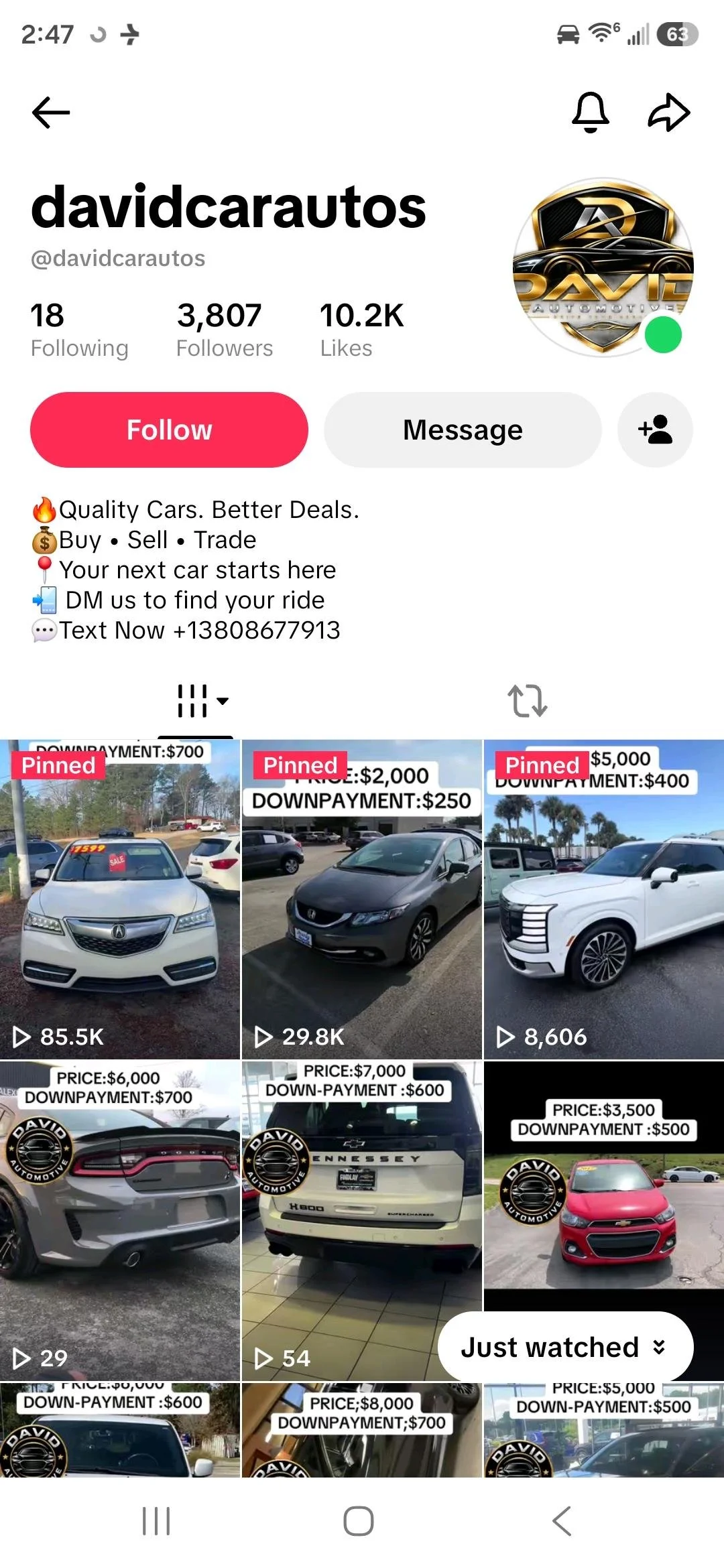
Then I looked at the inventory.
Here we go again.
The Honda is advertised for:
$2,000 — $250 down
Another vehicle:
$5,000 — $400 down
A Dodge:
$6,000 — $700 down
A Chevrolet Hennessey vehicle:
$7,000 — $600 down
Another:
$3,500 — $500 down
And more vehicles appear farther down the page with similarly low asking prices and down payments.
Different cars.
Different backgrounds.
Different dealerships appearing in some of the footage.
Same account selling all of them.
That doesn't prove anything by itself.
It does make one question increasingly important:
Where are these cars actually located?
📍 The Honda Video Says Phoenix
The TikTok interface on the Honda video displays Phoenix, and the hashtags include:
#Arizona #cheapcars #usedcars #affordablecars
Meanwhile, the visible dealership plate frame appears to identify a Honda dealership.
So before sending $250, I'd want to independently identify that dealership and call it using the telephone number from its own official website, not a number supplied by the TikTok account.
Then I'd ask a remarkably simple question:
Do you have this Honda, and is @davidcarautos authorized to sell it?
That could clear up a lot very quickly.
💰 And What Does “$250 Down” Actually Mean?
We've seen this repeatedly.
A tiny down payment gets enormous visual emphasis.
$250 DOWN!
That number feels attainable.
But it tells me almost nothing about the financing.
If the vehicle's total price really is $2,000 and I'm putting $250 down, the remaining amount is $1,750 before taxes, fees, interest and other charges.
So give me the rest:
What's the APR?
What's the term?
What's the monthly payment?
Who's the lender?
What's the total amount financed?
What's the total of payments?
What fees are included?
What credit requirements apply?
Is $2,000 actually the cash purchase price, or is there another condition attached to receiving that price?
The FTC has long warned consumers that unusually low advertised prices, down payments and monthly payments can come with qualifications or additional terms that aren't obvious from the headline advertisement. Consumer Advice
The giant number gets my attention.
The contract gets my money.
I care much more about the second one.
🎥 The Video Overlay May Be the Most Interesting Part
This is what distinguishes this post from some of the others I've documented.
The video itself appears to contain evidence of two different presentations:
The original footage.
And the new narration selling the vehicle.
Maybe there's a perfectly legitimate explanation.
Maybe the account licenses videos from dealerships.
Maybe it's a broker.
Maybe it has agreements with multiple dealers.
Maybe the person who made the original footage is connected with this account.
All of those possibilities can exist.
But I shouldn't have to guess.
If you're asking me to send money, tell me:
Who recorded the original video?
Who currently owns the vehicle?
Where is it physically located?
What's the VIN?
What's the dealer's legal business name?
Can I call that business independently?
Can someone inspect the vehicle before I pay?
A legitimate transaction should survive those questions.
🚨 This Isn't a Hypothetical Type of Scam
The FTC's September 2026 warning describes consumers paying supposed online dealerships only to discover that the actual dealership has no record of the order or payment and no car waiting for them. The FTC says fraudulent sellers can clone legitimate dealership material, including vehicle listings and photos. Consumer Advice
This problem isn't limited to websites, either. FTC data released this year show that nearly 30% of people reporting a scam loss in 2025 said the scam began on social media, with reported losses totaling $2.1 billion. Federal Trade Commission
So seeing a real automobile in a TikTok video isn't where my verification process ends.
It's where it begins.
🏡 Be a Good Neighbor
Here's the person I worry about.
Someone desperately needs transportation.
Their credit isn't great.
They've been turned down elsewhere.
They see:
HONDA CIVIC
PRICE: $2,000
DOWN PAYMENT: $250
And then they hear:
You don't even have to go to the dealership.
Convenient.
Affordable.
Easy.
Exactly what they need.
That's when somebody needs to say:
“Before you send the $250, let's verify the car.”
Not ridicule them.
Not call them stupid.
Help them investigate.
Reverse-search screenshots from the video. Identify the dealership visible in the footage. Call that dealership independently. Ask for the VIN. Verify the title. Check the seller's dealer license. Compare the price with KBB and wholesale values. Arrange an independent inspection.
And most importantly:
Verify that the person asking for your money actually has the legal ability to sell you the car.
The FTC's current advice is similarly straightforward: if you're too far away to see an online vehicle yourself, ask to have a mobile inspection service examine it. If the seller won't allow that, consider walking away. Consumer Advice
The Cars Keep Changing. My Question Doesn't.
Different TikTok accounts.
Different prices.
Different down payments.
And now apparently repurposed-looking video accompanied by a new narration telling me I don't have to visit a dealership.
I don't necessarily need to visit the dealership.
But before anybody gets one dollar from me, I need something considerably more important:
Proof that you actually have the car you're trying to sell me.
Because if the seller doesn't possess the vehicle or have authority to sell it, I'm not purchasing a car remotely.
I'm just sending $250 to somebody on TikTok.
Questions or another suspicious car listing you'd like me to look at? Reach out by DM or email niel@nielflamm.com.
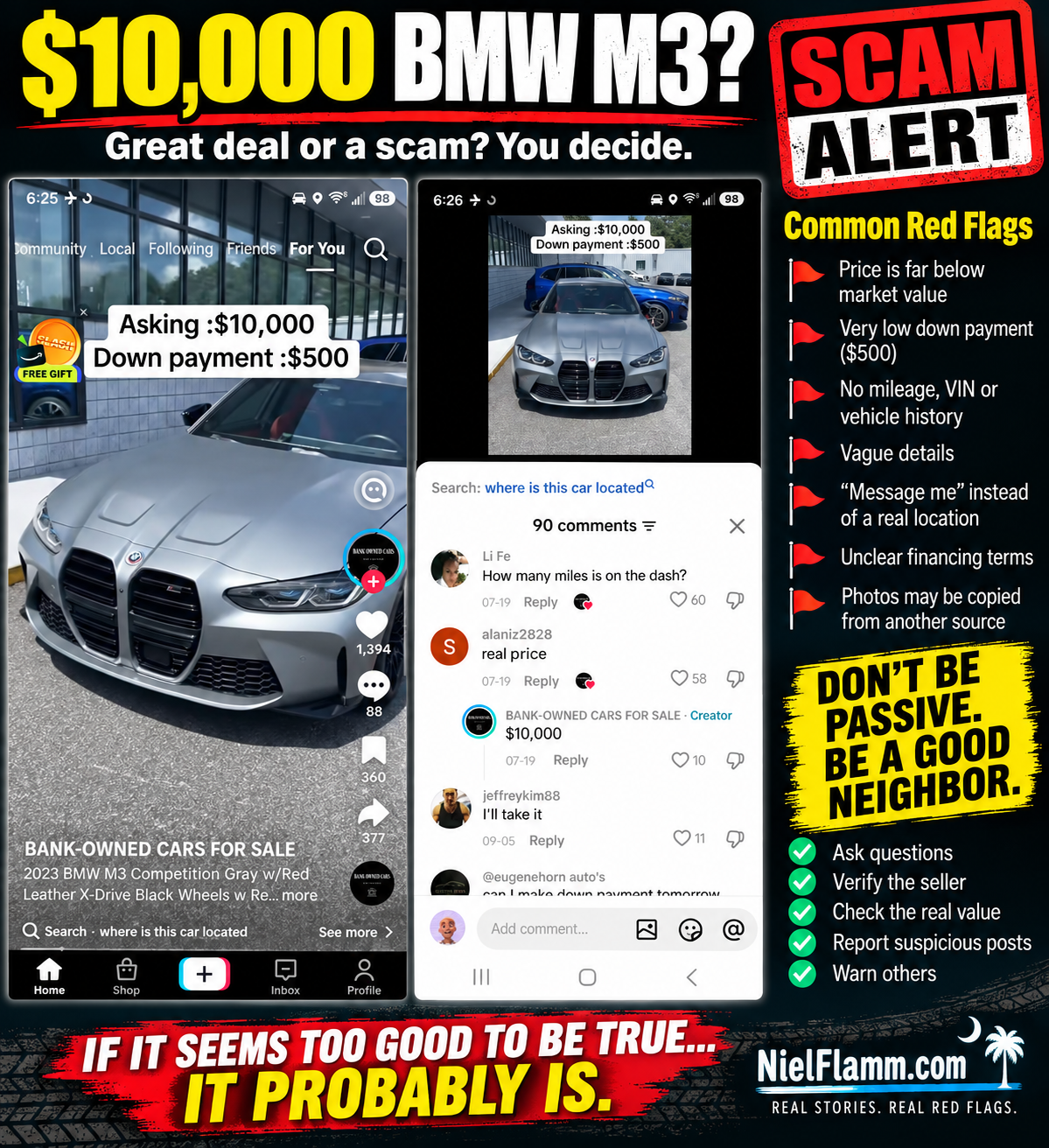
A $10,000 2023 BMW M3 Competition? TikTok Has Apparently Entered the Luxury-Car Business
TikTok must really want me to buy a car.
After showing me suspiciously cheap Toyotas and Hondas, the algorithm has apparently decided I deserve an upgrade.
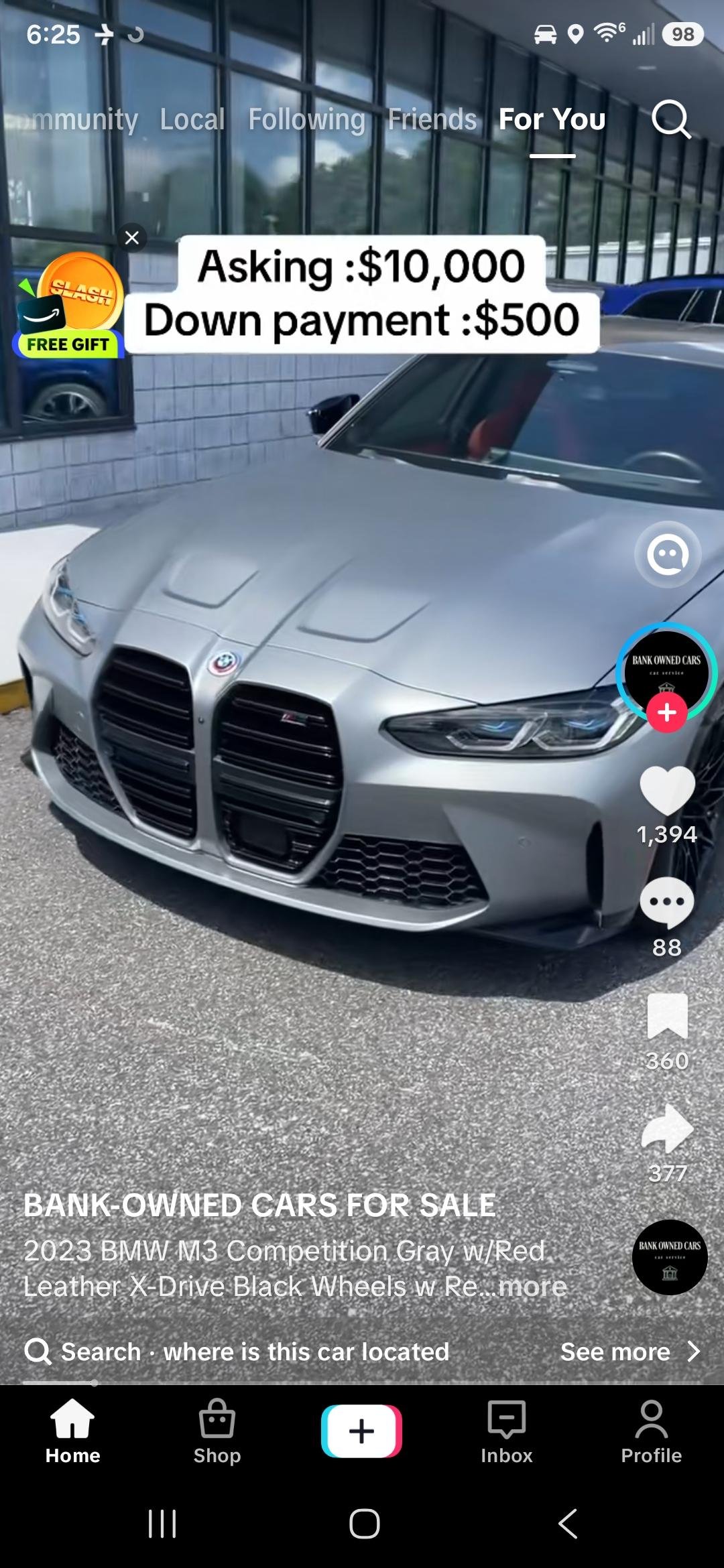
This time, the account is called “BANK-OWNED CARS FOR SALE,” and the vehicle in the video is described as a:
2023 BMW M3 Competition
Asking price: $10,000
Down payment: $500
Yes.
A 2023 BMW M3 Competition for ten grand.
At least we're moving up in the world.
🚩 Let's Check What a 2023 BMW M3 Competition Is Actually Worth
This is where the offer becomes interesting.
Kelley Blue Book currently puts a typical 2023 BMW M3 Competition at roughly $74,000–$75,000 as a Fair Purchase Price. KBB lists private-party value around $69,000 and trade-in value around $65,000, though actual values vary substantially with mileage, condition, and location. Kbb.com
And if the car pictured is the Competition xDrive version, KBB puts the Fair Purchase Price even higher—roughly $77,000. Kbb.com
TikTok?
$10,000.
That's not a good deal.
That price demands an explanation.
If the typical Competition is worth around $74,000, the TikTok price is roughly 86% lower.
Maybe the vehicle has substantial damage.
Maybe there's a title issue.
Maybe it has astronomical mileage.
Maybe there's some other legitimate explanation.
But that's precisely the information a buyer needs before getting excited about a $500 down payment.
🚩 Wait... How Many Miles Does It Have?
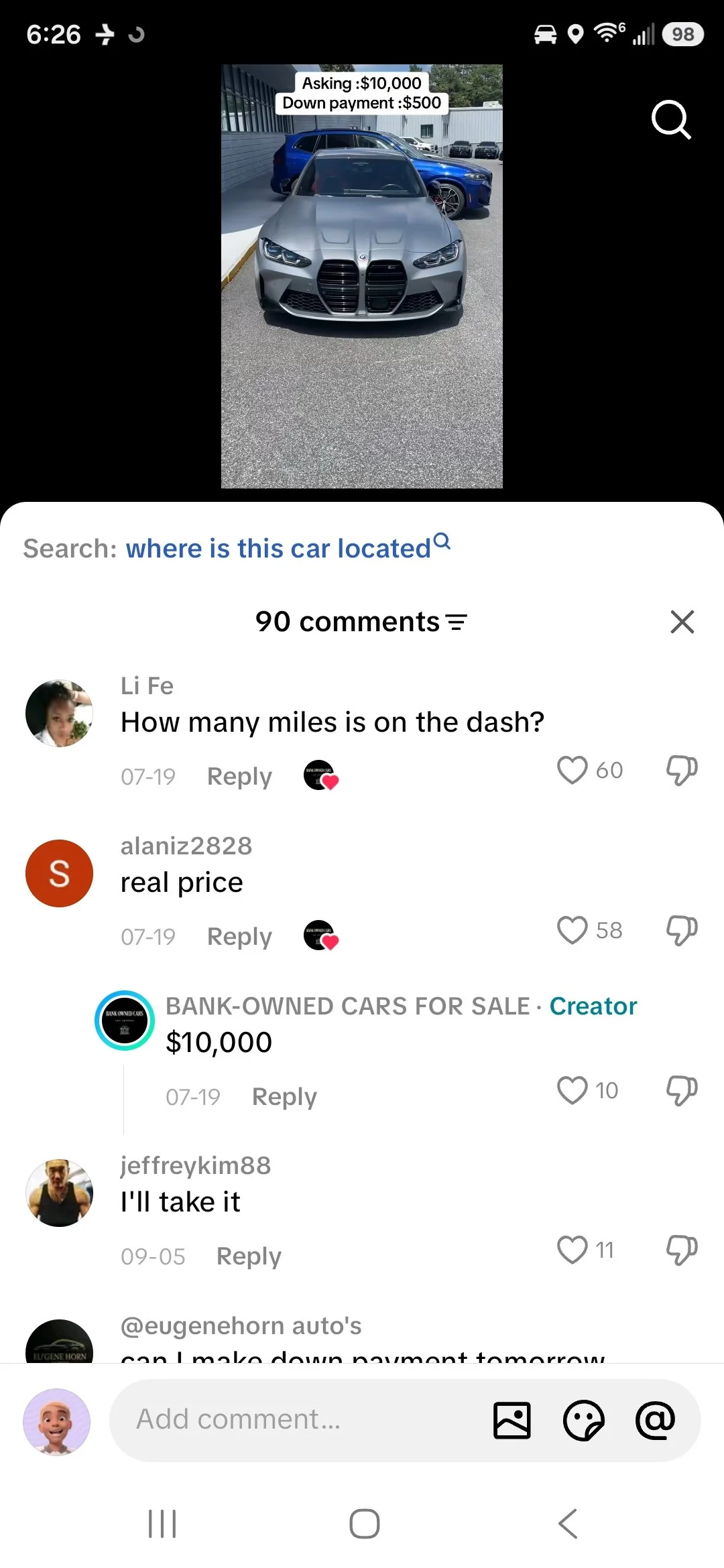
Someone in the comments asked:
“How many miles are on the dash?”
Excellent question.
The screenshot doesn't tell us.
Mileage matters when we're discussing why a late-model performance BMW is supposedly selling for a fraction of its normal value.
Another commenter simply writes:
“real price”
The account responds:
“$10,000”
Okay.
That answers the question without actually answering the much bigger question:
WHY is it $10,000?
🚩 But It's “Bank-Owned!”
This version adds a new ingredient to the recipe.
The account calls itself:
BANK-OWNED CARS FOR SALE
That sounds official, doesn't it?
Maybe people imagine a bank repossessed the BMW and just wants to recover whatever money it can.
But think about the economics.
If a bank legitimately repossessed an asset potentially worth tens of thousands of dollars, why would it voluntarily sell it for $10,000 if substantially more could potentially be recovered through established wholesale or auction channels?
“Bank-owned” doesn't magically make market value disappear.
If anything, that description makes me want more documentation, not less.
Which bank owns it?
Where is the vehicle?
What's the VIN?
What's the mileage?
What's the title status?
Where can I inspect it?
Who is legally authorized to sell it?
Those are boring questions.
Boring questions are extremely useful when somebody wants your money.
🚩 And My Old Friend Is Back: $500 Down
There it is again.
$500 DOWN.
This number has become a recurring character in the questionable vehicle ads showing up in my TikTok feed.
The vehicles change.
The prices change.
The accounts change.
But somehow that small, psychologically appealing down payment keeps appearing.
This time we're supposed to believe that $500 gets the process started on a late-model BMW M3 Competition.
What happens to the remaining $9,500?
What's the APR?
What's the loan term?
What's the monthly payment?
Who's financing it?
What are the credit requirements?
The screenshots don't tell us.
That's a lot of missing information for an advertisement prominently featuring a down payment.
🚩 Look at the Engagement
This is why I don't simply laugh and scroll away.
The video shows:
1,394 likes.
88 comments.
360 saves.
377 shares.
And in the comments, someone says:
“I'll take it”
That's the part that matters.
Because a person who knows what an M3 Competition normally costs may immediately recognize how extraordinary this offer is.
Someone else might not.
They may simply see:
BMW M3
$10,000
$500 DOWN
And think they just stumbled across the opportunity of a lifetime.
🚩 “Where Is This Car Located?”
There's another interesting detail right on the TikTok screenshot.
The suggested search says:
“where is this car located”
That's exactly what I'd want to know.
If I were seriously considering this vehicle, I wouldn't begin with:
“How do I send the $500?”
I'd begin with:
Where is it?
Then:
What's the VIN?
Then:
Who owns it?
Then:
Can I see the title?
Then:
Can I have an independent mechanic inspect it?
Then:
Can I see the car in person before paying you anything?
A legitimate transaction should survive those questions.
🚩 The Pictures Don't Prove Who Owns the BMW
The screenshots show what appears to be a real BMW M3 sitting outside an automotive business.
That's useful for showing us that a BMW existed somewhere when the images were taken.
It does not, by itself, establish that the TikTok account owns the vehicle or is authorized to sell it.
That's one of the most important lessons with social-media vehicle listings.
A photograph of a real car doesn't automatically make the offer real.
Dealer photographs can be copied.
Auction photographs can be copied.
Videos can be reposted.
Descriptions can be copied.
A scammer doesn't necessarily need to invent a car.
They may only need pictures of someone else's car.
I'm not saying that's what happened here; I haven't independently established who owns the BMW in these screenshots. But that's exactly why verification matters.
🧮 Let's Put the Numbers Side by Side
According to KBB, a typical 2023 M3 Competition currently has a Fair Purchase Price around $74,000, while the xDrive version is around $77,000. Kbb.com
The TikTok advertisement:
$10,000
Down payment:
$500
Mileage shown:
Not in these screenshots
VIN shown:
Not in these screenshots
Bank identified:
Not in these screenshots
Financing terms:
Not in these screenshots
Someone ready to buy:
“I'll take it.”
That's exactly why these posts deserve attention.
🏡 Don't Be Passive. Be a Good Neighbor.
I've been saying this more frequently because I think it's important.
When you see something online that looks suspicious, don't automatically assume everyone else sees what you see.
Someone may desperately need transportation.
Someone may not know what an M3 normally costs.
Someone may believe that “bank-owned” explains the enormous discount.
Someone may be one private message away from being told:
“Send $500, and we'll reserve it.”
I have not messaged this account, so I don't know what happens next, and I'm not claiming that's what this seller does.
But if you see someone preparing to send money on an extraordinary social-media offer, say something.
Ask questions.
Report suspicious posts.
Help them verify the seller.
Look up the vehicle's real value.
Ask for the VIN.
Independently identify the dealership or bank supposedly selling it.
And most importantly:
Don't send a deposit merely because someone on social media says the deal won't last.
Being a good neighbor doesn't stop when you go online.
Sometimes it simply means telling somebody:
“Before you send that $500, let's figure out why a $74,000 BMW supposedly costs $10,000.”
Because if there's a legitimate explanation, the seller should be able to provide it.
And if there isn't?
You may have just helped somebody keep their $500.
Follow along at NielFlamm.com/blog for more questionable vehicle offers, suspicious emails, recruiting scams and whatever the algorithm sends me next.
The Scammers Have Apparently Moved On From Bitcoin — Now I’m Getting My Watch Repaired
Well, the scammers are branching out.
Over the past couple of weeks, I've apparently purchased Bitcoin, renewed Geek Squad protection multiple times, and been invited to Facebook events celebrating these financial accomplishments.
Today, we have something new.
Apparently, I'm getting a watch repaired.
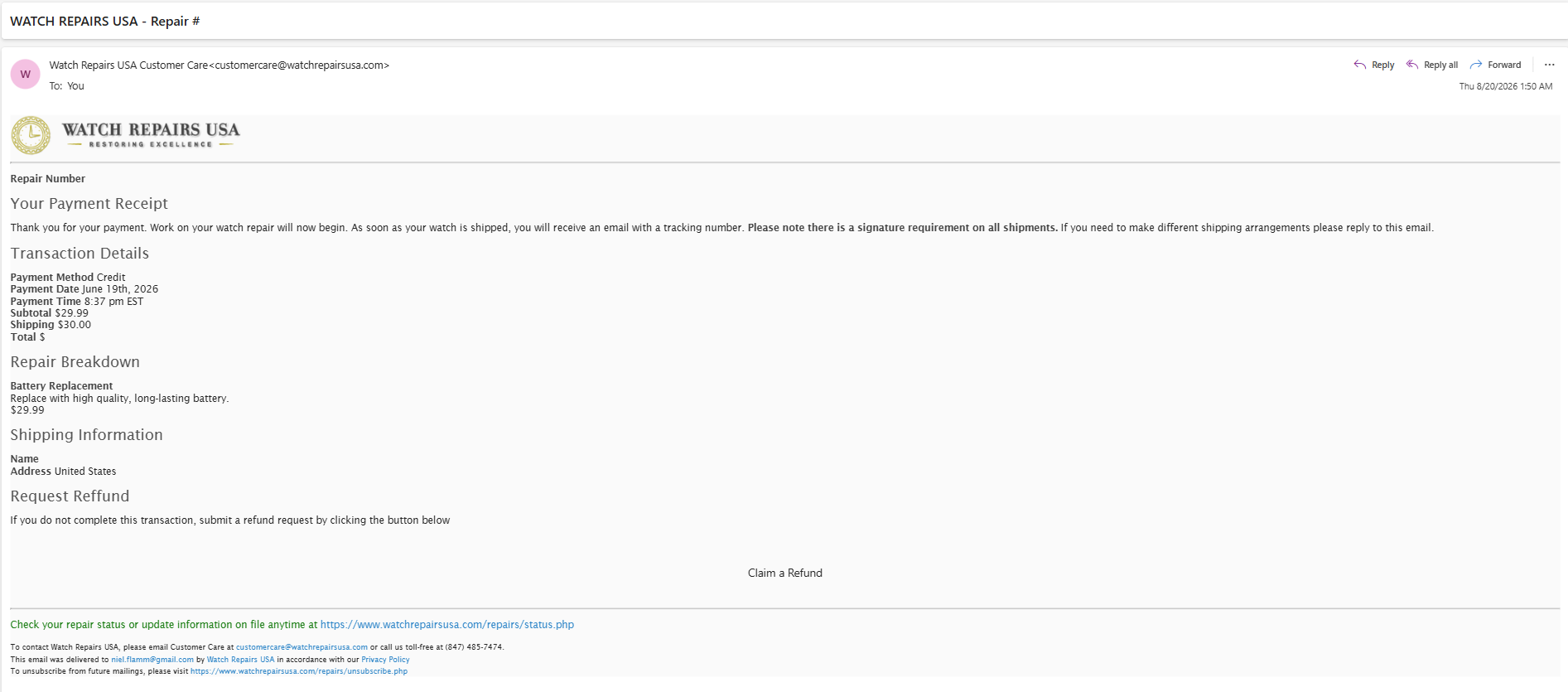
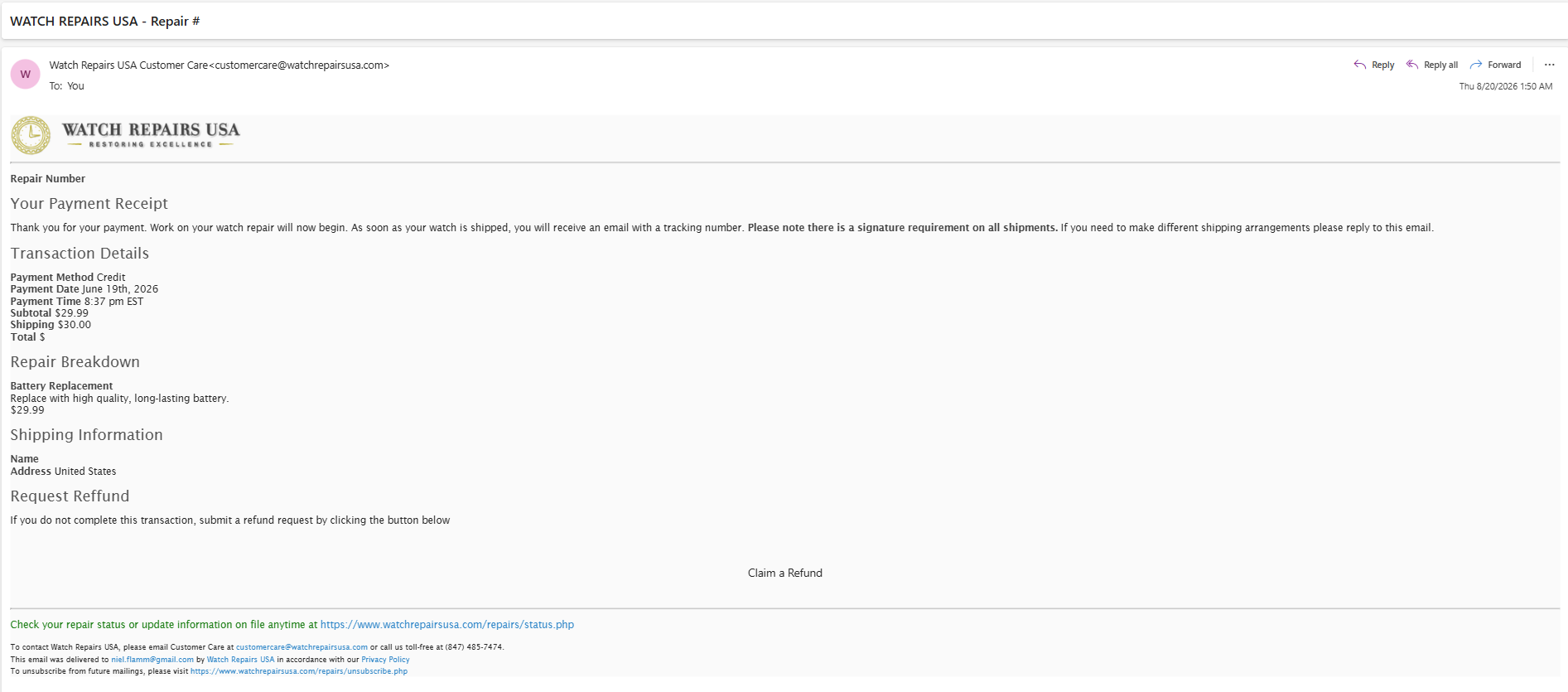
I received an email from something calling itself Watch Repairs USA Customer Care with the subject:
“WATCH REPAIRS USA - Repair #”
Repair number what?
Excellent question.
There isn’t a repair number after the #.
We're off to a strong start.
Thank You for My Payment!
The email proudly announces:
“Your Payment Receipt.”
It then thanks me for my payment and says work on my watch will now begin.
Wonderful!
Except for one minor detail:
I DIDN'T SEND THEM A WATCH.
According to the email, I'm getting a battery replacement for $29.99, plus $30.00 for shipping.
That's some serious shipping for a watch battery.
The transaction information also has some interesting details.
Name: blank.
Address: United States.
That's it.
Apparently, somewhere among approximately 340 million people, there's a watch heading my way.
Good luck, FedEx.
My Favorite Part: “Total $.”
The email lists:
Subtotal $29.99
Shipping $30.00
Total $
That's right.
No number.
Just a dollar sign.
I appreciate a company that lets me use my imagination.
Maybe the total is $59.99.
Maybe it's $5,999.
Maybe they're waiting for me to choose.
This is less of a receipt and more of a financial Mad Lib.
But Don't Worry — There's a Refund Button!
Naturally, the email includes a section titled:
“Request Refund.”
How convenient.
If I didn't complete this transaction, all I have to do is click the nice “Claim a Refund” button.
And that's exactly where my scam radar starts screaming.
An unexpected purchase.
A transaction I don't recognize.
Incomplete information.
Then a convenient button offering to fix everything.
The objective is familiar even though the packaging has changed:
Make me worried about money and get me to react.
This One Is More Interesting
What makes this message different from the recent Facebook event scams is that it looks much more like an ordinary business transaction email.
There's a logo.
There's a payment section.
There's a repair breakdown.
There's shipping information.
There's contact information.
There are links at the bottom.
It has all the ingredients that can make someone think:
“Wait...did I actually order this?”
And that's why unexpected transactional emails deserve a few extra seconds of thought before clicking anything.
A professional-looking email isn't proof that the transaction is yours.
I'm Still Not Clicking
My approach hasn't changed.
If I receive an email saying I've been charged for something I don't remember buying, I won't click the refund button in the email right away.
First, I'll independently check my credit card or bank account.
If there's no charge, there's nothing to refund.
If there is an unauthorized charge, I'll contact the financial institution using contact information I obtain independently—not whatever is presented in the suspicious message.
The important thing is to avoid letting the email dictate what I do next.
That's exactly what these messages are designed to accomplish.
My Imaginary Spending Is Getting Out of Control
Let's review my recent financial activity according to my inbox:
Bitcoin.
More Bitcoin.
A mystery subscription.
Geek Squad.
More Geek Squad.
And now...
A watch battery.
My imaginary self is apparently terrible with money.
Imaginary Niel has excellent diversification.
Cryptocurrency.
Technology services.
Luxury accessories.
It's practically a portfolio.
I'm just waiting for tomorrow's email:
“Congratulations! Your $799 annual yacht maintenance plan has successfully renewed.”
That'll be disappointing.
Mostly because I don't have a yacht.
Although, based on my inbox, apparently I might.