

Do as I Say, Not as I Do?
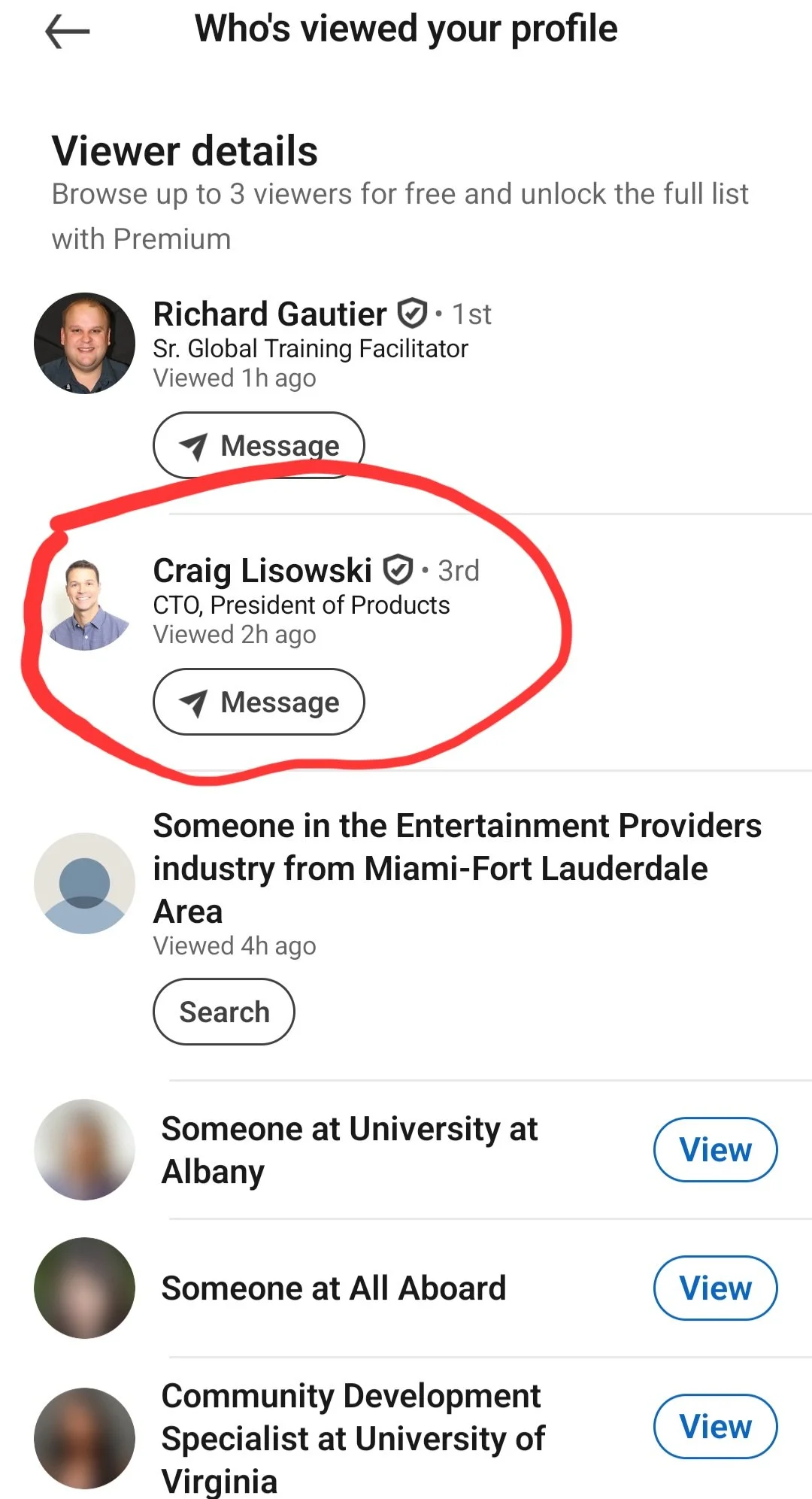
Earlier today, I wrote a post asking questions about Nextdoor’s workplace strategy.
From what I’ve seen, members of the C-suite appear to work from various locations, while engineers are expected to report to a new engineering hub in Dallas, Texas. If that’s the strategy, I’d genuinely like to understand the business rationale behind it.
I tagged several members of Nextdoor’s leadership team. Some I couldn’t tag because I couldn’t locate their LinkedIn profiles. Ironically, one of them was Kelsey Grady, Executive Vice President, Communications.
An interesting thing happened afterward.
Craig Lisowski viewed my LinkedIn profile.
According to his LinkedIn profile, he is CTO (Chief Technical Officer) and President of Products, and his location is listed as San Francisco, California.
If the engineering “meeting of the minds” is centered in Dallas, that’s quite a commute.
So I’ll ask again, respectfully:
What is the leadership philosophy behind having executives distributed across multiple locations while requiring engineers to work from a centralized office?
There may be a sound business reason. If so, I’d love to hear it. Transparency around decisions like these helps employees, prospective candidates, shareholders, and customers better understand the company’s direction.
Someone, please explain this to me.
Join the discussion on NielFlamm.com/blog
AI Doesn't Eliminate Economics
OpenAI recently highlighted how Nextdoor is using Codex to accelerate software development, including examples where a feature that once required three engineering teams can now be built end-to-end by a single engineer. It's an impressive showcase of what AI-assisted development can accomplish.
Read the case study:
https://openai.com/index/nextdoor/
But it also raises a bigger economic question.
If AI enables one engineer to do the work that previously required multiple specialists, what happens to labor demand?
Markets are driven by supply and demand. During COVID, shortages drove prices up across nearly every industry. The reverse is also true: if AI increases productivity while expanding the effective supply of engineering talent, compensation pressure seems inevitable over time.
I’m struggling with the messaging from Nextdoor leadership.
Nirav Tolia earned a BA in English from Stanford, one of the world's premier universities. He communicates well, but the broader corporate message often feels scattered—part neighborhood platform, part AI company, part advertising network, and part social media experiment. Having Cory Dolphin, Head of Engineering, deliver this message may have also insulated executive leadership from discussing the broader labor implications of AI.
Here's my unpopular opinion.
If AI truly allows one engineer to do the work of several engineers, then basic economics suggests IT salaries should eventually normalize downward. There is little economic justification for maintaining compensation levels that were established during a period of exceptionally high demand and limited supply if AI permanently changes that equation. Productivity gains don't just change how work gets done—they change the value of labor in the marketplace.
That may not be a popular viewpoint, but markets have never been driven by popularity.
I'm also a believer in AI. I use ChatGPT to organize my thoughts, strengthen my writing, and increase my own productivity. AI is an incredible tool when used responsibly.
But if Nextdoor leadership is truly as bullish on AI, its product, and its future as these announcements suggest, perhaps it's time to put even more conviction behind that belief. Nirav Tolia is the company's largest shareholder. If the future is as bright as advertised, why not take the company private and invest even more heavily in that vision?
Perhaps the real bottleneck isn't engineering anymore.
Perhaps it's strategy and leadership clarity.
I'd love to hear other perspectives.
Subscribe to NielFlamm.com.