
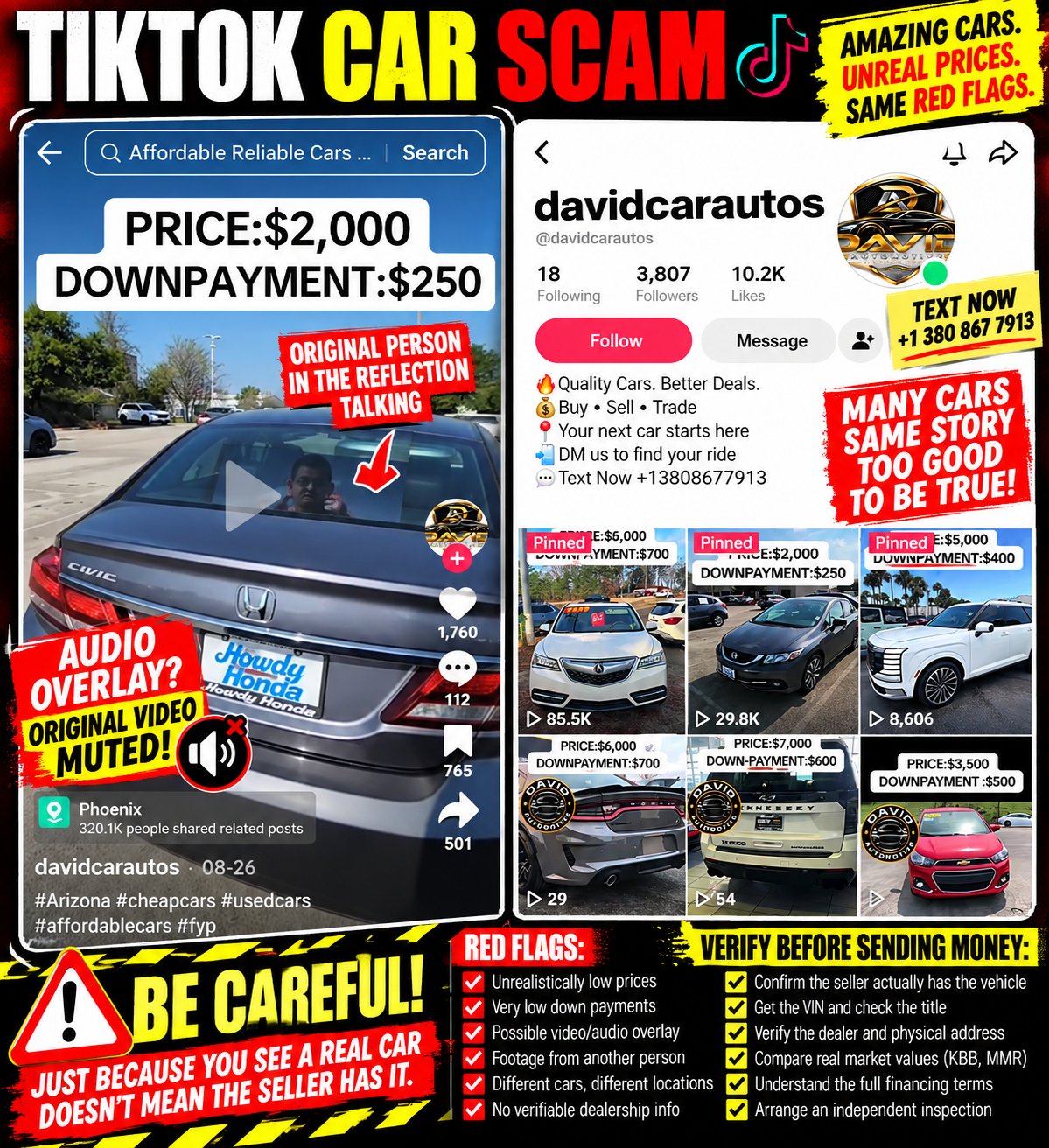
Another TikTok Car Deal — But Who Actually Has the Car?
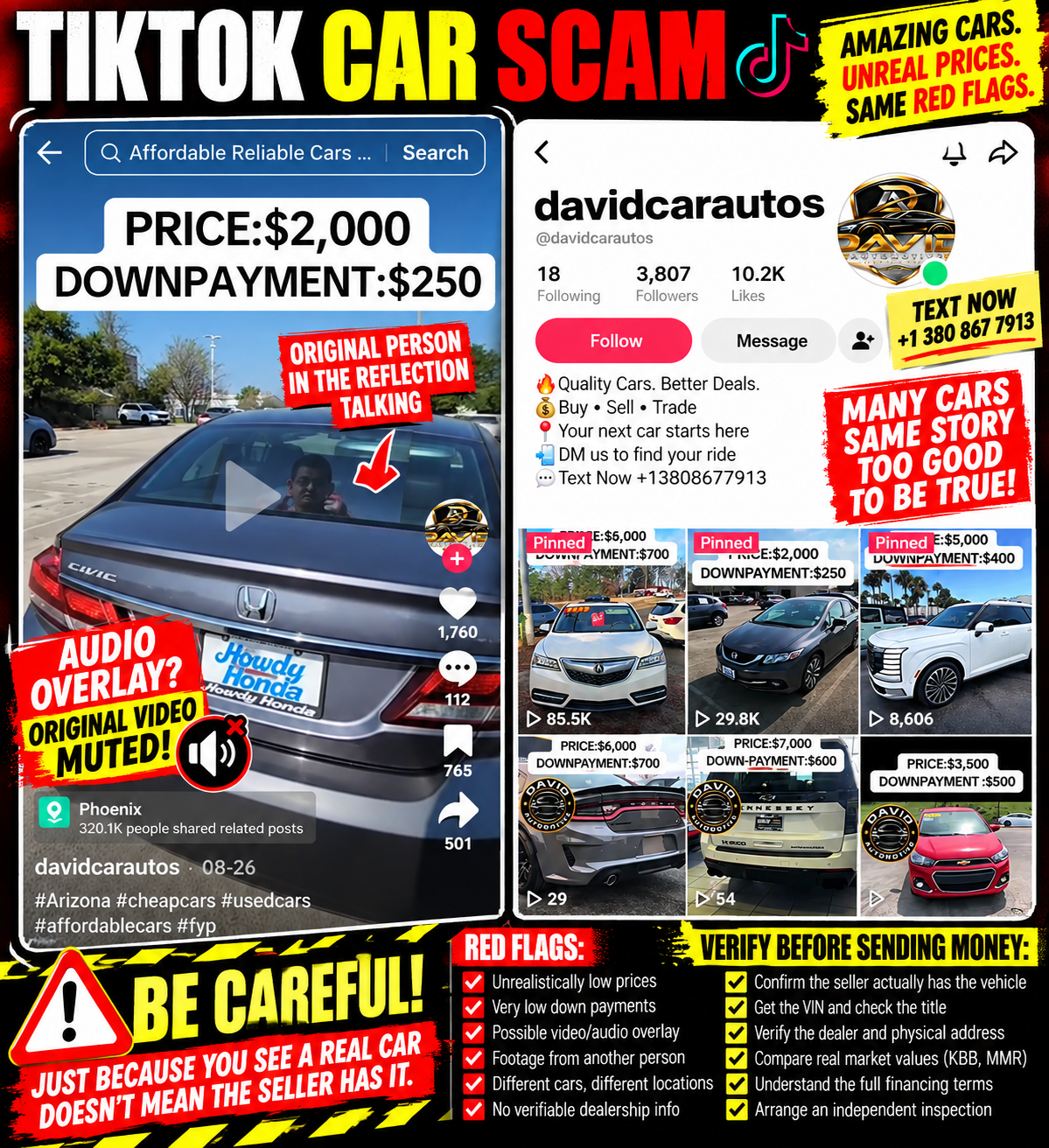
At this point, TikTok may know my viewing habits a little too well.
Another extremely inexpensive vehicle landed in my feed. This time, it's from an account called davidcarautos, and the featured vehicle looks like a Honda Civic.
The advertisement couldn't be much simpler:
PRICE: $2,000
DOWN PAYMENT: $250
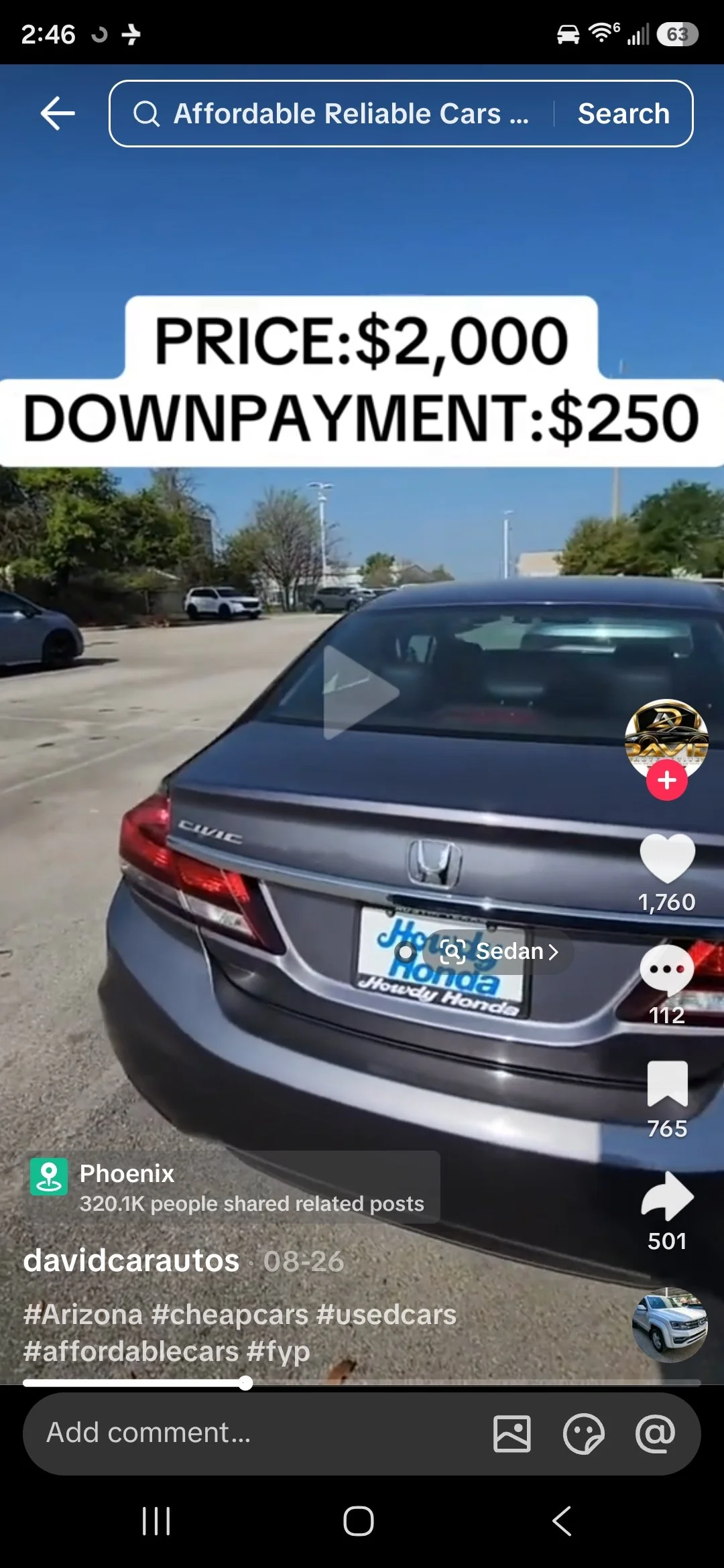
Two thousand dollars for the car, and apparently I can get started for $250.
But this video caught my attention for a reason beyond the price.
Wait—Whose Video Am I Watching?
I watched the video instead of just looking at the price.
That's when something looked odd.
The video appears to have been overlaid with new audio while the original video's audio is muted. As the camera moves around the Honda, I can see what appears to be the original person recording or speaking reflected in the car's window.
Meanwhile, the narration I'm hearing doesn't seem to match what's happening in the original footage.
The new narration makes a particularly interesting pitch: you don't have to go to a dealership to purchase a car.
That's supposed to make the transaction sound easier.
To me, it raises the opposite question:
Does the person posting this TikTok actually possess this car?
I can't establish from these screenshots alone who originally recorded the video or whether the TikTok account has permission to use it. So I'm not going to claim I've proven the footage was stolen.
But an apparently repurposed video combined with a new sales narration is absolutely something I would investigate before sending $250 to anybody.
🚗 A Real Honda in a Video Doesn't Prove the Seller Owns It
This is becoming one of the recurring lessons in my TikTok car series:
A real car doesn't automatically make the offer real.
That's especially important here.
The Honda clearly exists.
A license-plate frame is visible that appears to say Howdy Honda. There's a parking lot. A person is reflected in the vehicle.
All of that makes the video look authentic.
But those things establish the existence of a car and a video.
They don't establish that @davidcarautos owns the car, possesses the car, represents the owner, or has authority to sell it for $2,000.
That's a huge distinction.
The FTC issued a consumer warning this month specifically about scammers impersonating dealerships. It says scammers can copy legitimate dealerships' branding, vehicle listings, and photos, then collect money for cars the supposed seller doesn't actually have. The FTC recommends independently verifying the dealership and, when you can't visit the vehicle yourself, arranging an independent inspection. Consumer Advice
The FBI has also warned about fraudulent online vehicle advertisements involving cars that aren't—and sometimes never were—in the advertiser's possession. Internet Crime Complaint Center
That's why this video's altered presentation matters to me.
“You Don't Have to Go to a Dealer”
Technically, that's true.
People legitimately purchase vehicles remotely every day.
Dealerships deliver cars. Buyers purchase vehicles from other states. Documents can be signed electronically. Independent inspections can be arranged.
Remote car buying isn't inherently suspicious.
But there's a big difference between:
“You don't have to physically visit our dealership.”
and:
“You don't need to independently establish that we actually have the car.”
That second part is non-negotiable for me.
If someone wants my money for a vehicle, I want to know exactly where that vehicle is sitting.
👀 Then I Looked at the Profile
The account had approximately:
3,807 followers
10,200 likes
Its bio says:
🔥 Quality Cars. Better Deals.
💰 Buy • Sell • Trade
📍 Your next car starts here
➡️ DM us to find your ride
💬 Text Now +1 380-867-7913
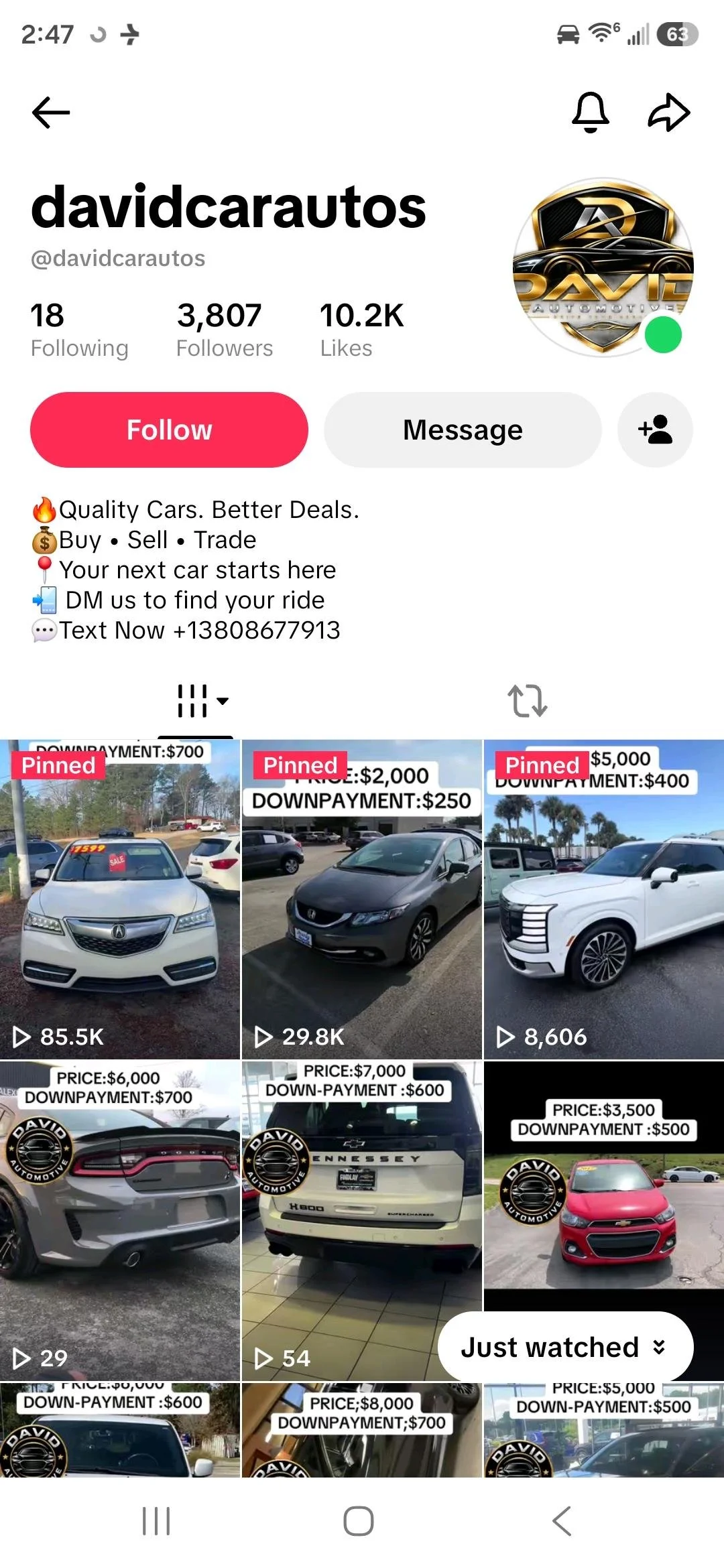
Then I looked at the inventory.
Here we go again.
The Honda is advertised for:
$2,000 — $250 down
Another vehicle:
$5,000 — $400 down
A Dodge:
$6,000 — $700 down
A Chevrolet Hennessey vehicle:
$7,000 — $600 down
Another:
$3,500 — $500 down
And more vehicles appear farther down the page with similarly low asking prices and down payments.
Different cars.
Different backgrounds.
Different dealerships appearing in some of the footage.
Same account selling all of them.
That doesn't prove anything by itself.
It does make one question increasingly important:
Where are these cars actually located?
📍 The Honda Video Says Phoenix
The TikTok interface on the Honda video displays Phoenix, and the hashtags include:
#Arizona #cheapcars #usedcars #affordablecars
Meanwhile, the visible dealership plate frame appears to identify a Honda dealership.
So before sending $250, I'd want to independently identify that dealership and call it using the telephone number from its own official website, not a number supplied by the TikTok account.
Then I'd ask a remarkably simple question:
Do you have this Honda, and is @davidcarautos authorized to sell it?
That could clear up a lot very quickly.
💰 And What Does “$250 Down” Actually Mean?
We've seen this repeatedly.
A tiny down payment gets enormous visual emphasis.
$250 DOWN!
That number feels attainable.
But it tells me almost nothing about the financing.
If the vehicle's total price really is $2,000 and I'm putting $250 down, the remaining amount is $1,750 before taxes, fees, interest and other charges.
So give me the rest:
What's the APR?
What's the term?
What's the monthly payment?
Who's the lender?
What's the total amount financed?
What's the total of payments?
What fees are included?
What credit requirements apply?
Is $2,000 actually the cash purchase price, or is there another condition attached to receiving that price?
The FTC has long warned consumers that unusually low advertised prices, down payments and monthly payments can come with qualifications or additional terms that aren't obvious from the headline advertisement. Consumer Advice
The giant number gets my attention.
The contract gets my money.
I care much more about the second one.
🎥 The Video Overlay May Be the Most Interesting Part
This is what distinguishes this post from some of the others I've documented.
The video itself appears to contain evidence of two different presentations:
The original footage.
And the new narration selling the vehicle.
Maybe there's a perfectly legitimate explanation.
Maybe the account licenses videos from dealerships.
Maybe it's a broker.
Maybe it has agreements with multiple dealers.
Maybe the person who made the original footage is connected with this account.
All of those possibilities can exist.
But I shouldn't have to guess.
If you're asking me to send money, tell me:
Who recorded the original video?
Who currently owns the vehicle?
Where is it physically located?
What's the VIN?
What's the dealer's legal business name?
Can I call that business independently?
Can someone inspect the vehicle before I pay?
A legitimate transaction should survive those questions.
🚨 This Isn't a Hypothetical Type of Scam
The FTC's September 2026 warning describes consumers paying supposed online dealerships only to discover that the actual dealership has no record of the order or payment and no car waiting for them. The FTC says fraudulent sellers can clone legitimate dealership material, including vehicle listings and photos. Consumer Advice
This problem isn't limited to websites, either. FTC data released this year show that nearly 30% of people reporting a scam loss in 2025 said the scam began on social media, with reported losses totaling $2.1 billion. Federal Trade Commission
So seeing a real automobile in a TikTok video isn't where my verification process ends.
It's where it begins.
🏡 Be a Good Neighbor
Here's the person I worry about.
Someone desperately needs transportation.
Their credit isn't great.
They've been turned down elsewhere.
They see:
HONDA CIVIC
PRICE: $2,000
DOWN PAYMENT: $250
And then they hear:
You don't even have to go to the dealership.
Convenient.
Affordable.
Easy.
Exactly what they need.
That's when somebody needs to say:
“Before you send the $250, let's verify the car.”
Not ridicule them.
Not call them stupid.
Help them investigate.
Reverse-search screenshots from the video. Identify the dealership visible in the footage. Call that dealership independently. Ask for the VIN. Verify the title. Check the seller's dealer license. Compare the price with KBB and wholesale values. Arrange an independent inspection.
And most importantly:
Verify that the person asking for your money actually has the legal ability to sell you the car.
The FTC's current advice is similarly straightforward: if you're too far away to see an online vehicle yourself, ask to have a mobile inspection service examine it. If the seller won't allow that, consider walking away. Consumer Advice
The Cars Keep Changing. My Question Doesn't.
Different TikTok accounts.
Different prices.
Different down payments.
And now apparently repurposed-looking video accompanied by a new narration telling me I don't have to visit a dealership.
I don't necessarily need to visit the dealership.
But before anybody gets one dollar from me, I need something considerably more important:
Proof that you actually have the car you're trying to sell me.
Because if the seller doesn't possess the vehicle or have authority to sell it, I'm not purchasing a car remotely.
I'm just sending $250 to somebody on TikTok.
Questions or another suspicious car listing you'd like me to look at? Reach out by DM or email niel@nielflamm.com.