
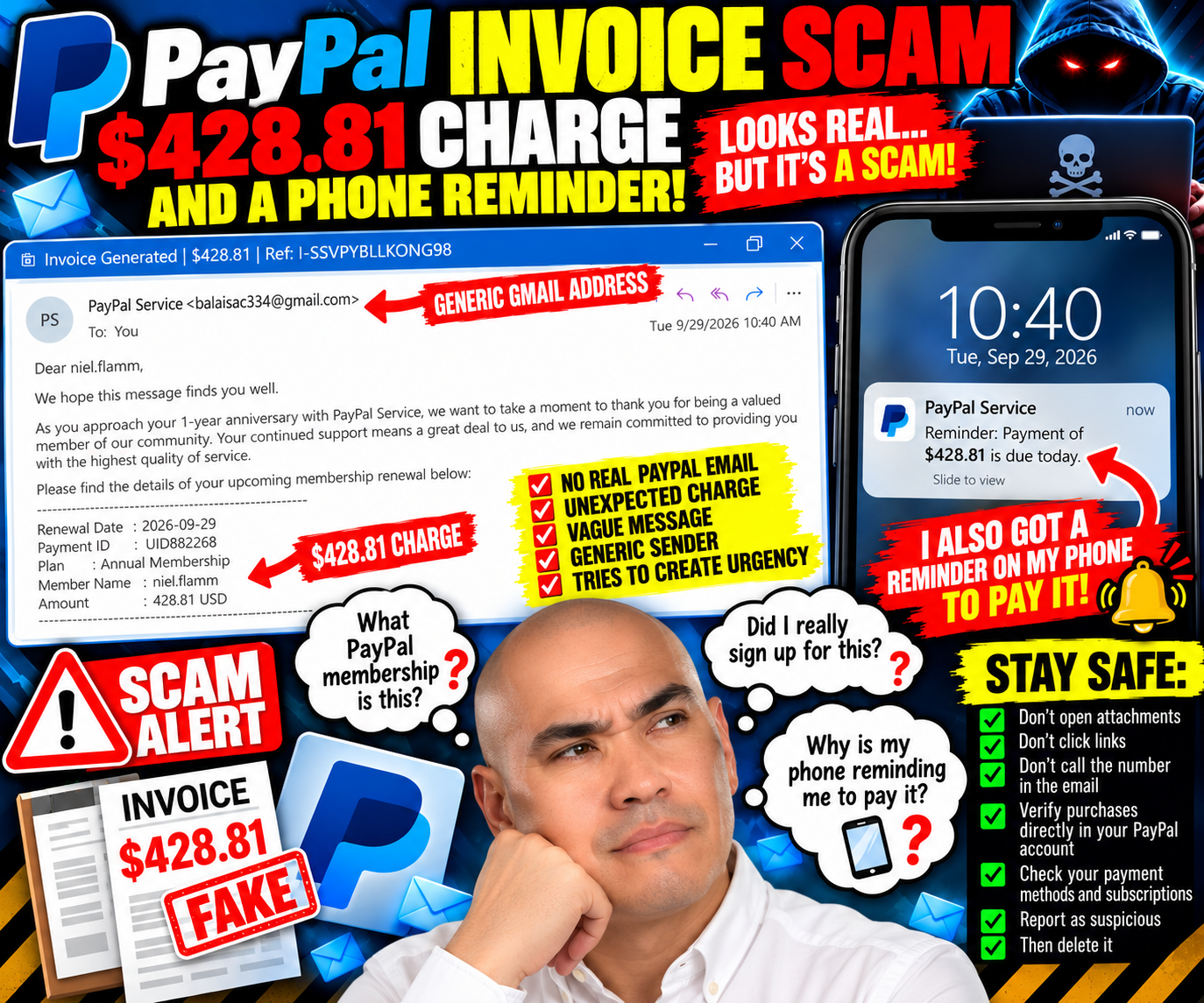
The PayPal Scam That Apparently Scheduled Its Own Reminder on My Phone
The scammers are getting ambitious.
Lately, I’ve been getting mystery order emails with almost no information. Apparently, somebody decided those weren't convincing enough.
This time, I received what looks like a much more complete invoice.
And then something happened that made this one especially interesting:
I also got a reminder on my phone telling me to pay it.
That will get my attention.
Apparently, I Have a $428.81 “PayPal Service” Membership
The subject line reads:
“Invoice Generated | $428.81 | Ref: I-SSVPYBLLKONG98”
Right away, the email gives me something the previous mystery emails didn't: a specific dollar amount.
$428.81.
The sender's display name says “PayPal Service.”
Sounds official.
Except the actual email address shown next to it is:
There's my first rather large red flag.
If someone is going to impersonate a major financial company, using a random Gmail account while displaying “PayPal Service” isn't exactly subtle.
Happy Anniversary to Me!
According to the email, I'm approaching my one-year anniversary with “PayPal Service.”
How thoughtful.
It thanks me for being a “valued member” and tells me about my upcoming membership renewal.
The supposed details include:
Renewal Date: September 29, 2026
Plan: Annual Membership
Member Name: niel.flamm
Amount: $428.81 USD
The message claims the membership will automatically renew using my saved payment method.
There's just one little problem:
What PayPal annual membership?
That question matters more to me than the email's professional appearance.
🚩 Then Comes the Phone Number
The message tells me that if I want to update my billing information, change my plan, or ask questions, I should call:
1 (816) 372-4805
And there it is.
The email creates the problem:
You're about to be charged $428.81!
Then it conveniently provides the solution:
Call us!
That's exactly when I don't call the number in the email.
If I were concerned about an actual PayPal transaction, I'd open PayPal independently—not use contact information supplied by the message that created the emergency.
But This One Had an Extra Trick
What really got my attention wasn't just the email.
I also got a reminder on my phone to pay it.
That makes the experience considerably more convincing.
Now I'm not simply looking at an unsolicited email.
My phone is also reminding me about the supposed payment.
For a moment, that can create an entirely different psychological reaction:
Wait. Did I actually schedule this?
Did I forget about something?
Did my phone pull this from somewhere legitimate?
That's precisely why I found this one worth documenting.
A reminder appearing on my phone doesn't independently authenticate the underlying invoice. Depending on the phone, email, calendar, assistant, and account settings involved, information from messages can sometimes surface elsewhere automatically.
The reminder made the claim feel more legitimate.
It didn't make the sender's Gmail address disappear.
This Is Why I Look at the Actual Sender
A familiar logo can be copied.
A company name can be typed into an email.
“PayPal Service” can appear as a display name.
A professional-looking invoice number can be invented.
An amount like $428.81 feels specific enough to seem real.
Even a reminder appearing on my phone can make the situation feel more urgent.
But I keep coming back to the basics.
Who actually sent this?
In this case, the screenshot shows:
PayPal Service balaisac334@gmail.com
That's enough for me to stop interacting with the message and verify everything independently.
The Weird Details Keep Coming
Other things make me skeptical.
The email refers repeatedly to “PayPal Service” as though I'm paying for an annual membership.
There's also some mangled text:
“we’re here to help.”
Then the signature lists:
PayPal Service
12014 Copernicus Ave
Bakersfield Ca 93312 Usa
Again, you don't need to investigate those details through the email itself.
That's an important distinction.
I don't have to prove every element is fake before deciding not to trust an unsolicited message.
I can independently verify the account that is said to owe the money.
Don't Let a $428.81 Charge Create Panic
This type of message depends on urgency.
Four hundred twenty-eight dollars and eighty-one cents isn't pocket change.
Someone sees that amount and thinks:
Please stop this charge now.
That's when judgment can disappear.
Instead, I'd do the boring thing.
Open PayPal independently.
Check my activity.
Check automatic payments and subscriptions.
Check the payment methods attached to the account.
If necessary, contact PayPal using contact information obtained independently from PayPal—not the telephone number in the suspicious email.
If the $428.81 transaction isn't there, I'm certainly not going to call a stranger and give them account information so they can “cancel” it.
The Phone Reminder Is the Best Part of This One
Not because it's funny—although something is amusing about a suspicious invoice apparently getting promoted to my personal to-do list.
It matters because it shows how context can influence trust.
An email alone?
Suspicious.
An email plus a phone reminder?
Suddenly my brain gets another signal suggesting that maybe this is something I previously knew about.
That's when I have to separate familiarity from verification.
My phone displaying information doesn't prove it’s legitimate.
A professional-looking invoice doesn't prove it's legitimate.
The exact amount doesn't prove it's legitimate.
The reference number doesn't prove it's legitimate.
And putting “PayPal Service” next to a Gmail address certainly doesn't prove it's PayPal.
Be a Good Neighbor
This is another one worth showing to someone who isn't as comfortable spotting suspicious messages.
Don't just tell them:
“That's obviously fake.”
Show them why you're suspicious.
Point to the sender address.
Ask whether they actually have the membership being described.
Show them how to open the real company's app or website on their own.
Explain why they shouldn't call the telephone number supplied by the same message claiming there's a problem.
And if their phone generates a reminder from the message, explain something else:
A reminder is a reminder. It isn't authentication.
The scammers don't need everybody to believe their story.
They need one person to see $428.81, panic, and make that phone call.
As for my alleged PayPal Service anniversary?
I don't think I'll be celebrating.
I won’t be sending a card.