
The Scammers Have Apparently Moved On From Bitcoin — Now I’m Getting My Watch Repaired
Well, the scammers are branching out.
Over the past couple of weeks, I've apparently purchased Bitcoin, renewed Geek Squad protection multiple times, and been invited to Facebook events celebrating these financial accomplishments.
Today, we have something new.
Apparently, I'm getting a watch repaired.
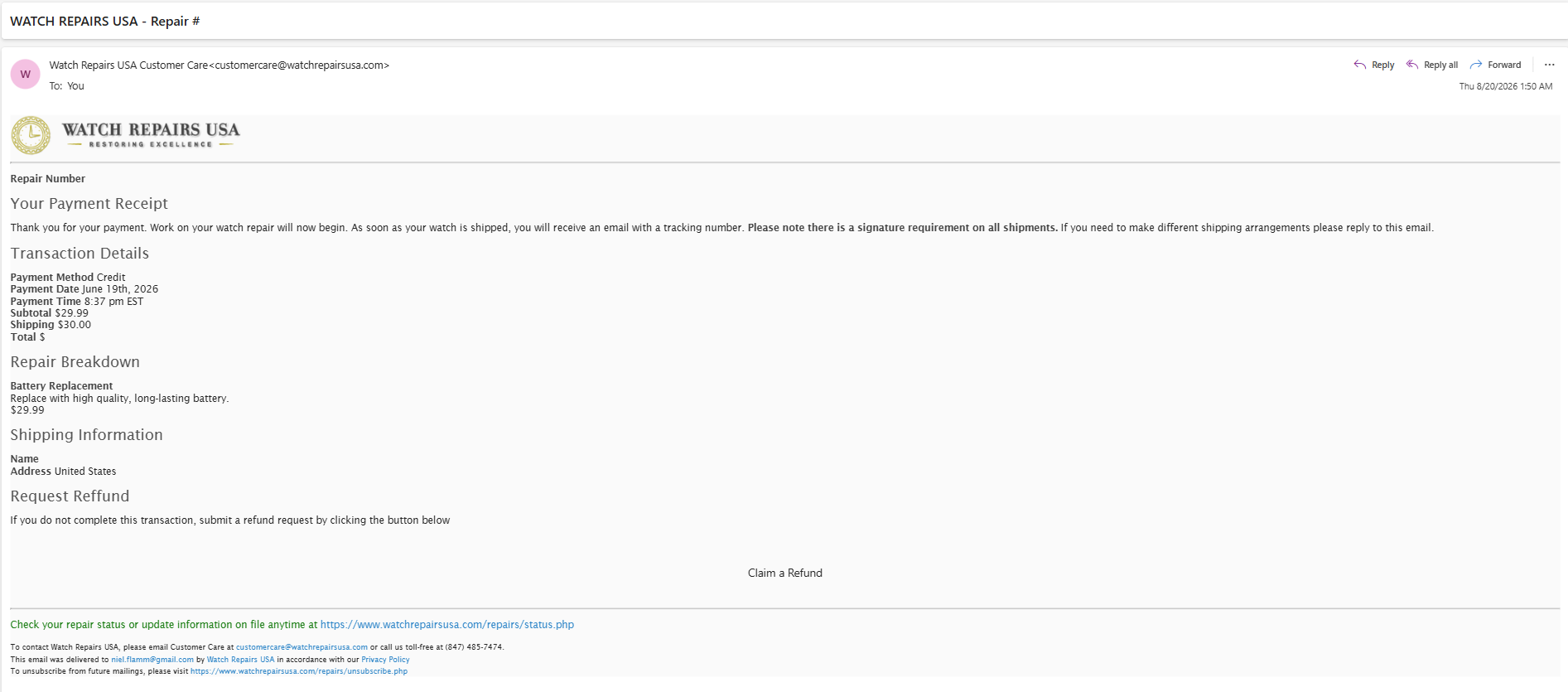
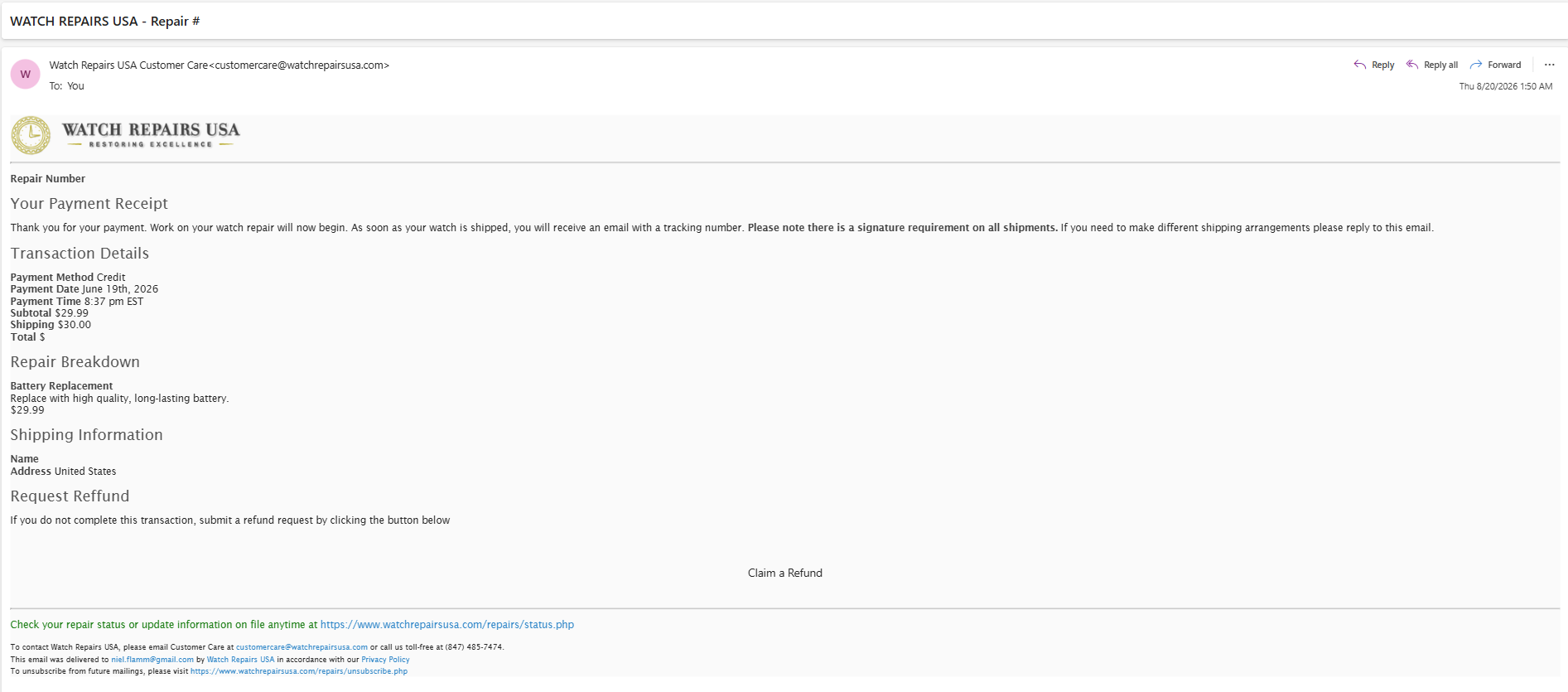
I received an email from something calling itself Watch Repairs USA Customer Care with the subject:
“WATCH REPAIRS USA - Repair #”
Repair number what?
Excellent question.
There isn’t a repair number after the #.
We're off to a strong start.
Thank You for My Payment!
The email proudly announces:
“Your Payment Receipt.”
It then thanks me for my payment and says work on my watch will now begin.
Wonderful!
Except for one minor detail:
I DIDN'T SEND THEM A WATCH.
According to the email, I'm getting a battery replacement for $29.99, plus $30.00 for shipping.
That's some serious shipping for a watch battery.
The transaction information also has some interesting details.
Name: blank.
Address: United States.
That's it.
Apparently, somewhere among approximately 340 million people, there's a watch heading my way.
Good luck, FedEx.
My Favorite Part: “Total $.”
The email lists:
Subtotal $29.99
Shipping $30.00
Total $
That's right.
No number.
Just a dollar sign.
I appreciate a company that lets me use my imagination.
Maybe the total is $59.99.
Maybe it's $5,999.
Maybe they're waiting for me to choose.
This is less of a receipt and more of a financial Mad Lib.
But Don't Worry — There's a Refund Button!
Naturally, the email includes a section titled:
“Request Refund.”
How convenient.
If I didn't complete this transaction, all I have to do is click the nice “Claim a Refund” button.
And that's exactly where my scam radar starts screaming.
An unexpected purchase.
A transaction I don't recognize.
Incomplete information.
Then a convenient button offering to fix everything.
The objective is familiar even though the packaging has changed:
Make me worried about money and get me to react.
This One Is More Interesting
What makes this message different from the recent Facebook event scams is that it looks much more like an ordinary business transaction email.
There's a logo.
There's a payment section.
There's a repair breakdown.
There's shipping information.
There's contact information.
There are links at the bottom.
It has all the ingredients that can make someone think:
“Wait...did I actually order this?”
And that's why unexpected transactional emails deserve a few extra seconds of thought before clicking anything.
A professional-looking email isn't proof that the transaction is yours.
I'm Still Not Clicking
My approach hasn't changed.
If I receive an email saying I've been charged for something I don't remember buying, I won't click the refund button in the email right away.
First, I'll independently check my credit card or bank account.
If there's no charge, there's nothing to refund.
If there is an unauthorized charge, I'll contact the financial institution using contact information I obtain independently—not whatever is presented in the suspicious message.
The important thing is to avoid letting the email dictate what I do next.
That's exactly what these messages are designed to accomplish.
My Imaginary Spending Is Getting Out of Control
Let's review my recent financial activity according to my inbox:
Bitcoin.
More Bitcoin.
A mystery subscription.
Geek Squad.
More Geek Squad.
And now...
A watch battery.
My imaginary self is apparently terrible with money.
Imaginary Niel has excellent diversification.
Cryptocurrency.
Technology services.
Luxury accessories.
It's practically a portfolio.
I'm just waiting for tomorrow's email:
“Congratulations! Your $799 annual yacht maintenance plan has successfully renewed.”
That'll be disappointing.
Mostly because I don't have a yacht.
Although, based on my inbox, apparently I might.