

Expectations Matter: Why I Share Feedback
If you think I'm being a Karen or a Keith (my apologies to everyone with those names, especially my friend Karen Romero), that isn't my intent.
I believe people and companies can't fix what they don't know.
I look for feedback all the time. Sometimes it's a bitter pill to swallow, but I know it's one of the best ways for me to improve, grow, and become better.
On my way to bring a recovery meeting to a detox behavioral health facility, I stopped at my local SONIC in Mount Pleasant. A fresh burger with pickles, onions, lettuce, and tomato (no cheese, please—I'm lactose intolerant... probably TMI 😄), a large order of tater tots, and an extra-large The Coca-Cola Company Zero—my favorite—sounded perfect for the 30-minute drive.
To make things quick and easy, I ordered through the app.
When I pulled into the drive-in stall, the carhop told me, "We're out of Coke Zero. Would you like Diet Coke instead?"
My real answer was no—I didn't want Diet Coke. I accepted it because I wasn't going to make an issue out of it. I also tipped the carhop, as I always do. The carhop didn't create the problem.
Later, I filled out the customer survey.
I wasn't looking for a free meal, a coupon, or any compensation. I shared an observation. At another fast-food chain, if a location runs out of a drink or food item, it disappears from the app. That means I know before I order that the item isn't available. It sets the right expectation from the beginning and prevents disappointment.
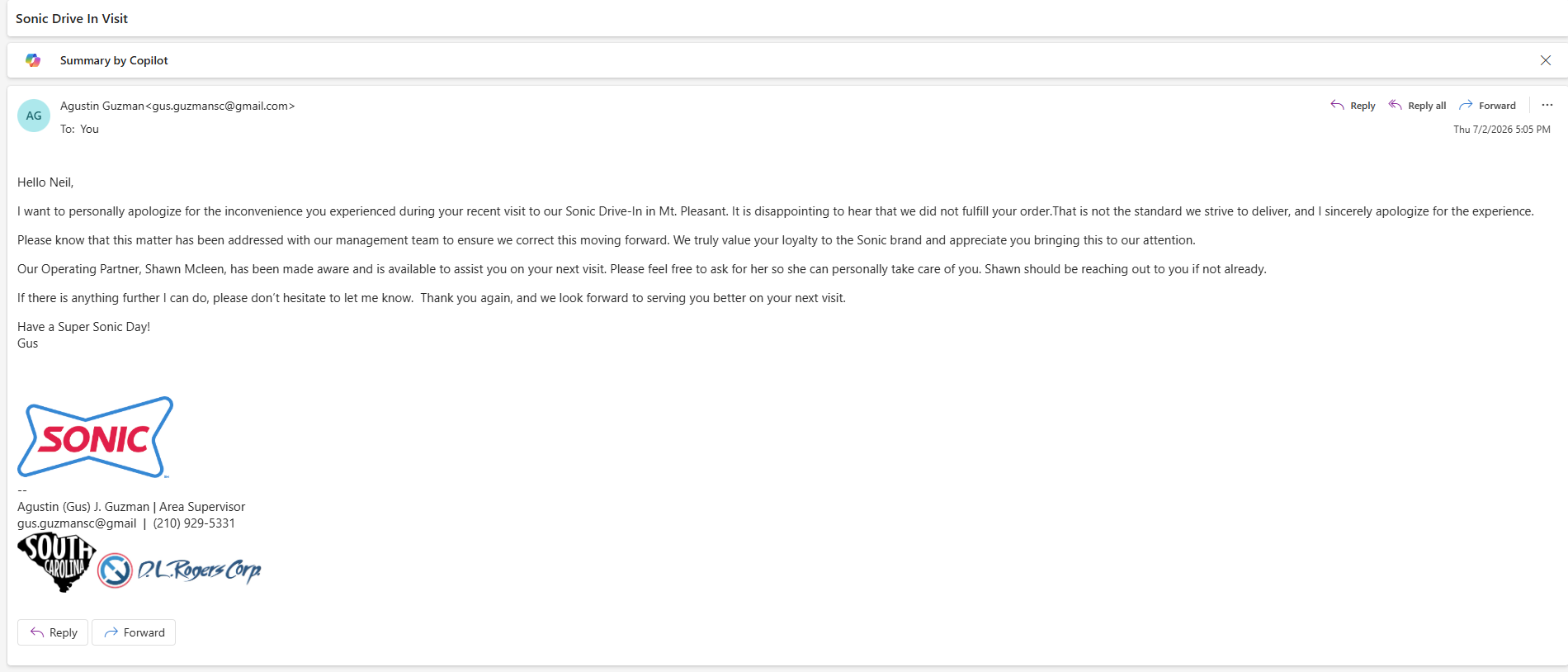
After submitting my feedback, I received a response telling me that "Shawn McLean" would be reaching out to me.
Guess what didn't happen?
Shawn McLean never contacted me.
From my perspective, that created two customer experience misses.
First, the app told me Coke Zero was available when it wasn't.
Second, I was told someone would contact me, but I haven't heard from anyone.
Neither issue was a major problem on its own. Together, though, they reminded me how important expectations are.
They also reminded me of Natalie Beckerman's book, When Did You Stop Caring?
I love technology. I appreciate mobile ordering. I enjoyed the burger. The pickles were outstanding.
But I value companies that do what they say they're going to do even more.
That's why I share feedback—not to complain, but because I genuinely believe companies can't improve what they don't know exists. Every piece of feedback is an opportunity to make the experience better for the next guest.
Join the discussion: what company has impressed you by setting the right expectations and then exceeding them?
NielFlamm.com/blog
AI Isn't New. It's Just Better Marketing.
I've been watching the recent messaging from Nextdoor CEO Nirav Tolia about how AI will revolutionize the way we interact with neighbors and local businesses. While AI is certainly advancing rapidly, the idea itself isn't exactly new.
Nirav joined Yahoo as employee #84 and spent years helping shape the early internet. From web directories to e-commerce and eventually becoming one of the company's public faces, he has an impressive background. The spokesperson role certainly explains why he's comfortable in front of a camera.
But if he'd spent more time in the operational trenches, he might realize many of us have been working alongside AI for decades.
My career started in primary automotive collections—a far cry from Silicon Valley glamour. I worked predictive dialers, managed collection queues, answered inbound calls, negotiated payment arrangements, and made lending decisions. It was hard work, but I'm grateful for the experience because it exposed me to AI long before it became today's buzzword.
Some examples:
• Phone IVR Systems – "Press 1 for English. Oprima el dos para español." These systems intelligently routed calls, reduced congestion, improved service levels, and matched customers with the right department. Primitive by today's standards, but still AI-driven automation.
• Grammarly (2009) – When I transitioned into Learning & Development, I began relying heavily on Grammarly to help create participant workbooks, facilitator guides, instructional materials, one-page FAQs, job aids, and other learning documentation. It became an invaluable AI writing assistant that not only catches spelling and grammar mistakes but also predicts the author's intent, improves readability, and suggests clearer ways to communicate ideas. Even today, I use Grammarly alongside ChatGPT and other AI tools to ensure my message is conveyed as effectively as possible.
• Siri (2010) – Before becoming part of iOS, Siri launched as a standalone app capable of voice commands, sending texts, answering questions, and controlling device functions through natural language.
• Automotive Credit Decisioning Matrices – During my automotive finance career, I purchased loans and leases from franchise dealerships. A human didn’t do the first review—it was performed by an automated decision engine evaluating the four Cs of credit: Character, Capacity, Capital, and Collateral. Straightforward approvals and declines happened automatically, while analysts focused on the more complex borderline applications. Business rules could be adjusted as risk appetite changed.
AI has been quietly improving efficiency for decades. Today's generative AI is more powerful and accessible, but it didn't suddenly appear overnight.
Before declaring AI "revolutionary," let's take a moment to acknowledge the thousands of engineers, call center employees, underwriters, operations leaders, and technologists who have been working with AI since the 1990s and long before it became the latest corporate buzzword.