
Nextdoor Didn’t Make the Top 100. Why Not?
The more I thought about Nextdoor’s LinkedIn post celebrating Publix making PEOPLE’s 100 Companies That Care, the more I realized I was focused on the wrong part of the story.
Yes, Publix ranked No. 4.
Yes, Nextdoor highlighted a Publix associate who used the Nextdoor app to discover an elderly neighbor needed help before Hurricane Milton.
It's a great story, and the employee deserves recognition.
But there's another question that I find much more interesting:
Where was Nextdoor?
Nextdoor didn't make the Top 100.
For a company whose identity revolves around neighbors, community, connection, trust and helping people locally, that's something worth examining.
Technology Companies Made the List
This wasn't a ranking limited to grocery stores, hospitals and nonprofits.
Technology companies made it.
Companies including Salesforce, Intuit, Hewlett Packard Enterprise, Adobe, ServiceNow and NVIDIA were recognized.
Salesforce ranked an impressive No. 5.
So technology isn't the barrier.
And that makes me wonder:
For a company that promotes itself as a platform for connection and community, why wasn't Nextdoor there?
We Don't Know Why—and That's Important
I don't know whether Nextdoor applied.
I don't know whether it was evaluated.
I don't know whether it qualified but didn't score high enough.
And because the published ranking ends at 100, I don't know whether Nextdoor would have been No. 101 or No. 1,001.
I'm not going to manufacture an explanation.
But I can look at some of the issues I've documented and ask whether they provide opportunities for Nextdoor to improve.
Because that's what feedback should ultimately accomplish.
Start With Small Businesses
Nextdoor talks frequently about supporting local businesses.
I've also provided feedback about what I see as an increasingly aggressive effort to monetize those businesses.
Business Pages.
Advertising.
Paid products.
Opportunity Alerts.
Nextdoor needs to make money.
Let me emphasize that because I'm a shareholder:
I WANT NEXTDOOR TO MAKE MONEY.
My concern is where intelligent monetization ends and what I've described as a money grab begins.
If you're going to position yourself as the champion of neighborhood businesses, those businesses should feel like valued members of the ecosystem—not simply another opportunity to extract revenue.
Nextdoor needs to make money with small businesses, not merely from them.
There's a difference.
Then There’s the Moderator Model
I've also repeatedly provided feedback about what I believe is a flawed volunteer moderator model.
I've questioned consistency.
Training.
Accountability.
Quality assurance.
Centralized oversight.
And what happens when personal neighborhood disputes collide with moderation authority.
When moderation works, most people probably never notice it.
When it doesn't, moderation can become the entire Nextdoor experience.
If Nextdoor wants to sell trust, its moderation system needs to consistently create trust.
That requires more than asking unpaid neighbors to police other neighbors.
And Then There’s the “Karen” Problem
Let's address the person demanding to speak with the neighborhood manager.
Nextdoor has faced a long-running public reputation in commentary as something of the “Karen” of social-media platforms.
Fair or unfair, the reputation exists.
Suspicious-neighbor posts.
Parking complaints.
Garbage-can disputes.
Political arguments.
Dog-poop investigations worthy of CSI: Suburbia.
And the classic:
“Did anyone else hear that boom?”
Nextdoor can't control every ridiculous thing someone posts.
But Nextdoor can influence the experience surrounding those posts.
Moderation.
Product design.
Algorithms.
Enforcement.
Community standards.
Leadership.
If a platform develops a cultural reputation for complaining, suspicion and neighborhood conflict, marketing alone isn't going to change it.
You have to change the experience that created the reputation.
But Here’s What Really Got My Attention About Those Tech Companies
Companies such as Salesforce, NVIDIA, Intuit, Adobe, ServiceNow, and HPE aren't charities.
They're businesses.
And some of them are extraordinarily profitable businesses.
That's important because sometimes conversations about corporate responsibility create a false choice:
Make money
or
do good.
The companies appearing on this list demonstrate that it doesn't have to work that way.
Caring and Making Money Aren’t Opposites
Take Salesforce.
Salesforce ranked No. 5 on the Companies That Care list.
In fiscal 2026, Salesforce reported a 20.1% GAAP operating margin, generated approximately $14.4 billion in free cash flow, and returned approximately $14.3 billion to shareholders through stock repurchases and dividends.
At the same time, its community efforts included its AI for Impact initiative and millions of dollars in funding, technology, and expertise for nonprofits.
Then there's NVIDIA.
NVIDIA made the Companies That Care list while also returning enormous amounts of capital to shareholders. During fiscal 2026, NVIDIA reported approximately $40.4 billion in share repurchases and $974 million in dividends.
Intuit made the list while continuing to operate a profitable technology business and connecting its community initiatives directly to its mission of “powering prosperity.”
See the pattern?
These companies didn't have to choose.
They could make money.
They could return money to shareholders.
They could invest in employees.
They could support communities.
And they could still work toward fulfilling their stated missions, visions and values.
Mission Shouldn’t Be a Substitute for Results
This is where I think the comparison becomes particularly relevant to Nextdoor.
Mission statements are wonderful.
Values are wonderful.
Community is wonderful.
But shareholders can't deposit a mission statement.
And customers can't experience corporate values that exist only on a website.
Mission, vision, and values shouldn't substitute for business results.
But the reverse is equally important:
Business results shouldn't require abandoning mission, vision and values.
Great companies figure out how to do both.
That's the standard.
And That’s Why Nextdoor’s Absence Interests Me
Think about the proposition Nextdoor is trying to sell.
It's the neighborhood platform.
The connection platform.
The place where real people connect with real neighbors.
The place where local businesses connect with customers.
The place where communities supposedly become stronger.
If I were designing a company specifically to compete for something called “100 Companies That Care,” that sounds like a pretty good starting point.
Yet Nextdoor didn't make the Top 100.
Meanwhile, companies that don't have “neighborhood connection” at the center of their entire identity did.
That's fascinating.
Maybe Connection Needs to Start at Home
Here's the question I'd ask Nextdoor:
Does the experience inside and around Nextdoor match the values Nextdoor markets outside?
Do employees feel connected?
Do neighbors trust the platform?
Do small businesses feel supported—or monetized?
Do volunteer moderators have the training, oversight, and accountability they need?
Does leadership welcome difficult feedback?
Does the platform's actual reputation resemble the brand Nextdoor wants people to see?
Is the company building sustainable profitability?
And are shareholders seeing the value created by all of it?
Those aren't accusations.
They're questions.
But they're questions I think any company built around connection should be willing to ask.
Profitability Is Part of Caring Too
This may sound strange, but I believe it.
A company that can't sustain itself can't fulfill its mission for very long.
Profit matters.
Cash flow matters.
Shareholder returns matter.
Capital allocation matters.
Employees need a financially healthy employer.
Customers need a financially sustainable product.
Communities benefit when companies can continue investing in them.
And shareholders provided capital with the expectation that management would create value.
Profit isn't the enemy of purpose.
Done correctly, profit helps fund purpose.
That's why I'm impressed when a company can simultaneously generate profits, reward shareholders, invest in employees and communities, and remain aligned with its stated values.
Imagine the Better LinkedIn Post
Rather than Nextdoor posting:
“Publix made the list, and somebody from Publix used Nextdoor!”
Imagine next year:
“Nextdoor Named One of PEOPLE’s 100 Companies That Care.”
Now we're talking.
No Six Degrees of Kevin Bacon.
No connection through Publix.
No borrowed spotlight.
Nextdoor's accomplishment.
Then imagine being able to add:
Revenue growing.
Profitable.
Employees engaged.
Small businesses succeeding.
Moderation improving.
Neighbors finding genuine value.
Shareholders receiving returns.
Community mission intact.
That's the story I'd love to write.
Here’s My Challenge to Nextdoor
Don't dismiss the Top 100 list.
Study it.
Look at the technology companies that made it.
Look at how they treat employees.
Look at their philanthropy.
Look at their community investment.
Look at their corporate cultures.
And importantly, look at how some of them simultaneously make money and create shareholder value.
Then look inward.
Fix what needs fixing.
Improve the moderator model.
Make small businesses feel like partners rather than ATMs.
Continue improving communication.
Address the platform's “Karen” reputation by improving the actual experience.
Listen to feedback—even when it's uncomfortable.
Build sustainable profitability.
Create shareholder value.
And make sure the company's actions reflect the mission, vision and values it talks about publicly.
Because you don't have to choose between:
Caring about communities
and
caring about shareholders.
The best companies can do both.
Nextdoor's mission should actually give it an advantage.
Now it needs to prove it.
Don't just connect yourself to Companies That Care.
Become a profitable Company That Cares.
And give the neighbors, employees, small businesses and shareholders something worth celebrating.
If Nextdoor makes that list someday?
I'll happily applaud them.
Read my continuing Nextdoor case study at NielFlamm.com/blog.
If the Ads Are There, Where Are the Profits?
My Nextdoor experiment continues.
This time I wanted to look at something simple:
How quickly does a user see a paid advertisement?
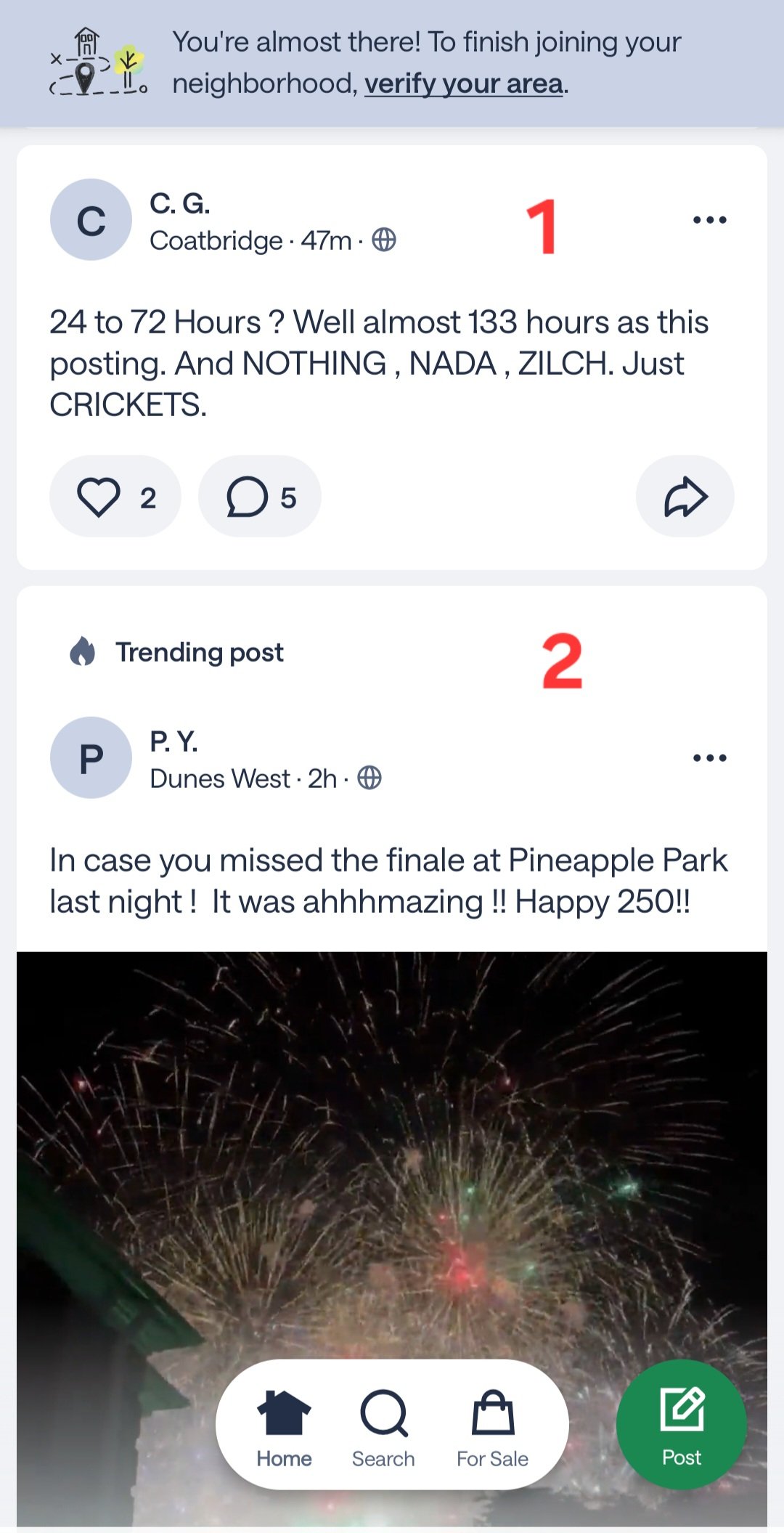
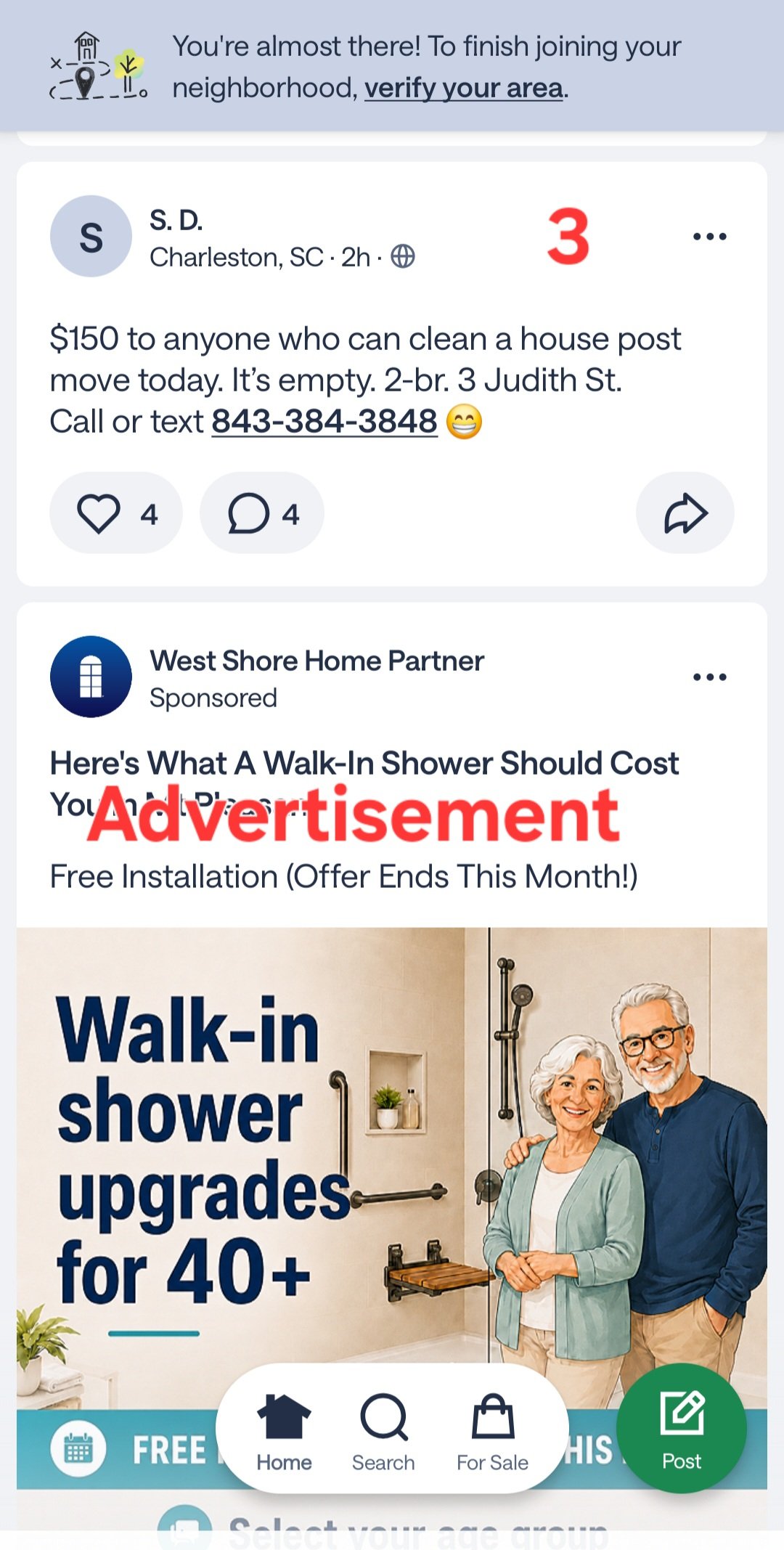
While scrolling through the app, I counted.
That’s it.
After only three neighbor posts, I was served a nationally sponsored advertisement. Not a local small business promoting a neighborhood service—a national advertiser.
So I kept testing.
More scrolling.
Same result.
Approximately three posts, then another sponsored placement.
That got me thinking about the bigger business question.
Nextdoor highlights statistics such as over 100 million neighbors, tens of millions of active users, and significant household reach.
With that kind of audience, and advertisements appearing that frequently in the user experience, I keep coming back to the same question as a shareholder:
How is Nextdoor still struggling to reach sustained profitability?
Where is the revenue going?
A social platform can always increase ad load—but is moving toward more ads really the answer for users?
A 1:1 ratio of posts to advertisements?
Fantastic user experience.
(Yes, that’s sarcasm.)
The challenge, in my opinion, isn’t simply adding more advertisements.
It’s leadership, execution, capital allocation, and turning engagement into a sustainable business model.
At the end of the day, the CEO is responsible for results.
Nirav Tolia owns the strategy, and shareholders should evaluate the outcome.
The question isn’t whether Nextdoor has an audience.
The question is whether the current leadership approach is converting that audience into long-term value.
Join the discussion at NielFlamm.com.
If the Model Is Working, Why Isn’t the Business?
One thought keeps coming back to me during my ongoing Nextdoor experiment.
I’ve often heard that local moderators know their neighborhoods best, and that’s why a decentralized, unpaid moderator model works.
Perhaps that’s true.
But what if the real motivation isn’t simply local knowledge?
What if it’s about scaling the business while keeping operating costs low?
Using unpaid moderators significantly reduces labor costs. From a business perspective, that’s understandable.
The question is whether the strategy is producing results.
Nextdoor has been around for roughly 15 years.
Despite relying on an unpaid moderation workforce for much of that time, the company has struggled to achieve sustained profitability, and its financial performance and stock price continue to raise questions among investors.
For comparison, Meta reportedly reached profitability in about five years. Every company is different, but shareholders naturally ask whether the current strategy is delivering the outcomes leadership promised.
If a low-cost moderation model hasn’t translated into consistent profitability or stronger shareholder returns after 15 years, is it time to reevaluate the strategy?
This isn’t simply about moderators.
It’s about whether the company’s leadership, operating model, and capital allocation are producing measurable results.
As a shareholder, I believe that’s a fair question for the Board of Directors to ask.
Leadership should be measured not only by vision, but by execution and results.
Join the discussion on NielFlamm.com.