
Day 151: The Nasdaq Closing Bell — A Celebration, a New Beginning, or Just a Change of Address?
Apparently, I wasn't finished writing about today's activities.
Around 9 AM Eastern, after publishing my 4:44 AM post, I hopped onto X and came across another post from Nirav Tolia.
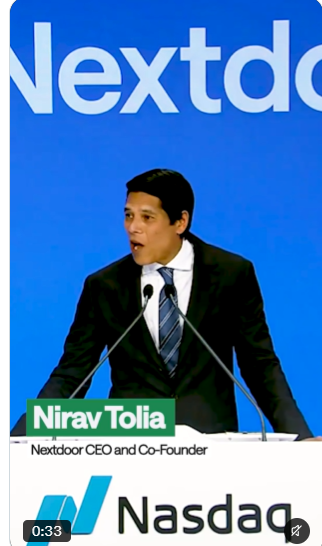
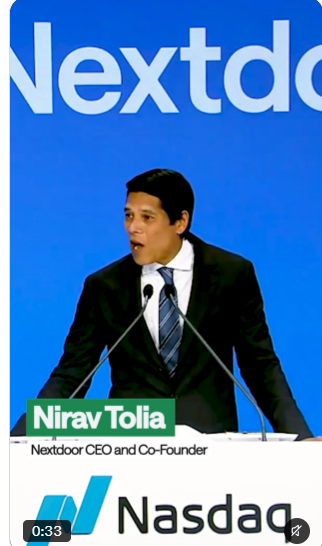
This time, he was reflecting on ringing the Nasdaq Closing Bell a couple of weeks earlier.
Here's what he wrote:
A couple of weeks on, what I remember most about ringing the @NasdaqExchange Closing Bell is who was in the room. It took a lot of people to get @Nextdoor to that podium, and fifteen years is a long time to build anything. I'm lucky to do it with this team and these neighbors. Thank you, Nasdaq, for having us. It meant a lot to celebrate our move and join some of the most innovative public tech companies.
A nice celebration. A milestone. Fifteen years of building a company.
But I started wondering something.
What does moving from the New York Stock Exchange to Nasdaq actually accomplish?
So, I asked The Google.
And the answers were interesting.
Why would a company move from the NYSE to Nasdaq?
There are several legitimate reasons a publicly traded company might decide to transfer its stock listing.
Here are some of the benefits The Google identified.
1. Brand alignment and perceived innovation
Nasdaq has built a reputation around technology, innovation, and growth-oriented companies.
For a consumer technology or software company, being listed alongside other technology businesses may create a stronger association with the industry it wants to represent.
Nasdaq's branding, events, and promotional opportunities also bring visibility.
Let's face it: ringing the Closing Bell makes for a great photograph and a nice social media post.
2. Access to indices, including the Nasdaq-100
This one caught my attention.
The Nasdaq-100 is a well-known index that tracks 100 of the largest non-financial companies listed on the Nasdaq Stock Market.
Being listed on Nasdaq can create an opportunity to meet the exchange's eligibility requirements for certain indices.
But there's a distinction: moving to Nasdaq does not automatically qualify a company for the Nasdaq-100.
Index inclusion depends on specific eligibility requirements and selection criteria.
Still, the possibility of becoming eligible for additional index exposure can be attractive.
3. Lower costs and different fee structures
Exchanges have different listing fee structures and services.
A company may find that transferring to Nasdaq offers a more attractive overall cost structure, depending on its circumstances and the services it uses.
Those costs can matter, particularly for companies looking to manage operating expenses.
4. Market quality and trading metrics
Nasdaq has published research suggesting that companies transferring from the NYSE can experience improvements in certain trading measures, including bid-ask spreads and liquidity.
Of course, those are market-wide observations, not a guarantee that every company will experience the same results.
A change of exchange doesn't automatically make a stock more attractive to investors.
The company's financial performance, growth prospects, investor confidence, and fundamentals still matter.
Nasdaq outlines its reasons for attracting companies here:
https://www.nasdaq.com/products/listings/transfer-to-nasdaq
Now, the other question: Could a company be hiding something?
This is where I asked The Google a second question.
What might a company be hiding by moving from one exchange to another?
The response included several potential red flags.
I want to emphasize something: these are general possibilities to investigate, not accusations about any particular company. A transfer by itself is not evidence of wrongdoing or financial trouble.
But investors should understand what to look for.
1. Avoiding an imminent NYSE delisting
If a company is struggling to meet an exchange's continued listing requirements, investors should investigate.
Listing requirements can involve share price, market capitalization, financial standards, and other criteria.
A company that receives a deficiency notice may have a period to regain compliance.
But simply moving to another exchange doesn't erase the need to disclose relevant listing problems or satisfy the new exchange's requirements.
2. Distracting from operational or financial problems
A major corporate announcement can create positive publicity.
A Closing Bell ceremony, photographs with executives, a new exchange listing, and a message about innovation can all generate attention.
But investors should not confuse publicity with financial performance.
A company can celebrate a move to Nasdaq while still facing challenges involving revenue growth, profitability, customer retention, or monetization.
The two things can exist simultaneously.
3. Governance and oversight
Investors should also look at corporate governance.
Are the board and management accountable? Are executive incentives aligned with long-term shareholder value? Are disclosures clear? Are investors receiving meaningful information about the company's performance?
These questions don't disappear because a company changes exchanges.
4. Financial restatements or structural changes
Evaluate a company making a major listing change alongside its financial reporting history.
Have there been financial restatements? Changes in auditors? Material weaknesses in internal controls? Significant changes in corporate structure?
Those issues deserve attention regardless of which exchange displays the ticker symbol.
And a transfer doesn't provide a hiding place for required disclosures.

The Google bonus: How investors can spot red flags
This was probably the most useful part of the response.
The Google suggested that investors examine three areas:
1. SEC Form 8-K filings
In particular, look at Item 3.01, which covers notices of delisting or failure to satisfy continued listing standards, as well as listing transfers.
The SEC explains what investors should look for in its guide:
https://www.sec.gov/investor/pubs/readan8k.pdf
A company may have to disclose a notice of noncompliance, a delisting action, or its decision to withdraw its listing from an exchange.
2. Which Nasdaq market tier?
Nasdaq has different listing tiers, including:
Nasdaq Global Select Market
Nasdaq Global Market
Nasdaq Capital Market
These markets have different listing and continued-listing standards.
Investors should understand which market a company is joining rather than assuming that every Nasdaq listing carries the same requirements.
3. Reverse stock splits
A reverse stock split is another item worth reviewing.
Companies sometimes use reverse splits to increase their share price and address minimum bid-price requirements.
A reverse split isn't automatically bad, and it doesn't necessarily mean a company is in financial trouble.
But if a reverse split, listing deficiency, and exchange transfer occur around the same time, investors may want to investigate the circumstances.
The point is to look at the entire picture rather than one announcement.
A Closing Bell is a celebration. What happens after the ceremony?
I can appreciate the significance of ringing the Nasdaq Closing Bell.
Fifteen years is a long time to build a company. Reaching the point where a business is publicly traded and participates in an exchange ceremony is a milestone.
And the people who helped build the business deserve recognition.
But there's another side.
Investors don't buy a stock because the CEO got to ring a bell.
They invest because they believe the company has a business model that can produce future value.
A new exchange listing can improve visibility, create opportunities, and potentially offer other advantages.
But it doesn't automatically solve the underlying business challenges.
It doesn't guarantee revenue growth.
It doesn't guarantee profitability.
It doesn't guarantee a higher stock price.
And it certainly doesn't guarantee that investors will suddenly become more confident.
Day 151: New exchange, same questions
I'm interested in watching what happens next.
Will the move to Nasdaq improve visibility? Will it help attract new investors? Will it create additional opportunities for index eligibility? Will the company benefit from different trading dynamics?
Those are all reasonable questions.
But I also want to see the fundamentals.
Revenue growth. Sustainable profitability. Strong customer retention. Advertiser value. Transparent research. Better communication. And a business that earns the confidence of its users and investors.
A new exchange can be a fresh chapter.
But changing the sign outside the building doesn't necessarily change what's happening inside.
The Closing Bell is one moment. Delivering shareholder value is the long game.
That's my two cents.
Following the Money: A Look at Nextdoor CEO Compensation
After not receiving the SEC disclosure information directly from Nextdoor Investor Relations despite my request, I decided to obtain the publicly available filings myself.
I reviewed the SEC disclosures and created the attached spreadsheet to better understand CEO Nirav Tolia's compensation in 2024 and 2025.
Here are a few observations:
Base Salary
2024: $334,615 (prorated due to his May 8, 2024, start date as CEO; annualized salary of $500,000)
2025: $500,000
Earned Bonus
2024: $500,000
2025: $543,367
According to the SEC disclosures, the 2024 annual incentive was weighted 50% toward achieving $235 million in revenue and 50% toward an adjusted EBITDA loss target of less than $57 million. The filings describe how these performance measures factored into the annual incentive award.
Stock & Option Awards
2024: $20,183,196 (new-hire equity grants)
2025: $2,216,555
Other Compensation
2024: $59,008
2025: $2,300
This resulted in reported total compensation of approximately:
2024: $21.08 million
2025: $3.26 million
As a shareholder, I'm not criticizing executive compensation simply because it's executive compensation.
It's about understanding how compensation aligns with company performance and shareholder outcomes.
Executive incentive plans are designed to reward specific objectives. The important questions are:
Were the performance metrics the right ones?
Did they drive long-term shareholder value?
How should investors evaluate bonuses when some company performance indicators remain challenged?
Do the incentives encourage sustainable growth, profitability, and accountability?
These are governance questions every public company investor should ask—not just about Nextdoor, but about any company they own.
That's why I continue reading the SEC filings myself. They're often one of the best ways to understand how a board evaluates leadership performance.
I'd be interested to hear how other investors evaluate executive compensation packages. What metrics do you believe matter most?
Join the discussion on NielFlamm.com.

Shareholders Deserve Questions—Not Just Talking Points

As a shareholder, I’ve watched Nirav Tolia appear on podcasts, conference stages, and interviews discussing the future of AI, verified neighbors, and the company’s vision.
Yet I rarely see the difficult questions being asked.
Where are the interviews that examine why Nextdoor has yet to achieve sustained profitability after roughly 15 years as a company?
Where are the questions about capital allocation? If the company has resources for initiatives such as a new Dallas office, how does management evaluate those investments alongside creating long-term value for shareholders?
I’ve also written about my own experience creating a new account using information that I believe raises questions about the effectiveness of the platform’s “verified neighbors” concept. I’d welcome a public discussion of those concerns.
Rather than another interview focused on optimistic talking points, I’d like to see a respected business or technology media outlet host a moderated conversation between Nirav, me, and other concerned shareholders. Open dialogue benefits everyone—management, investors, employees, and the community.
As I write this on July 2, the company’s official social media activity appears to have slowed ahead of the Independence Day holiday. There’s nothing wrong with taking time off, but shareholders also expect consistent execution and accountability for the capital they’ve entrusted to the company.
The best companies don’t shy away from difficult questions—they answer them.