
When a Communication Strategy Becomes a Communication Problem
I've spent 61 days documenting what I see as a fundamental communication failure at Nextdoor.
At this point, it's no longer one unanswered request.
Look at the pattern I've experienced:
Nirav Tolia blocked me on LinkedIn.
Comments are routinely turned off on Nextdoor's LinkedIn posts.
I've sent direct emails to Jacob Chavis, Nirav Tolia, Sarah Leary, Communications, and Investor Relations, but have not received a substantive response to my request.
And now there's another example involving Sarah Leary.
I had been commenting on an older X post she reposted about a Massachusetts community—if I remember correctly, Beacon Hill—preparing for significant snowfall and other neighborhood happenings.
The post eventually accumulated approximately 180 comments.
I'd estimate at least 75% were mine, documenting my ongoing Nextdoor experience.
Then the post disappeared.
To be clear: I don't know why it was deleted or whether my comments had anything to do with the decision.
But it got me thinking.
Yes, there may have been steam coming from my ears. 💨
If Nextdoor had an effective communication strategy for handling critical feedback, would any of this be happening?
That's when I started thinking about Kelsey Grady, Executive Vice President of Communications at Nextdoor.
I looked at the typical responsibilities associated with an executive communications role. At that level, we're talking about responsibility for an organization's internal and external messaging, brand reputation, public relations, crisis response, and advising executive leadership on communication strategy.
Which raises some fascinating questions.
Is ignoring my emails an intentional communications strategy?
Was blocking me on LinkedIn part of a strategy?
Is routinely disabling comments part of it?
Did anyone advise Sarah to remove that X post?
Or are executives individually deciding how—or whether—to engage?
I don't know.
I'm deliberately asking rather than pretending I know what happens inside Nextdoor.
But that's precisely why communication matters.
A coordinated communications strategy shouldn't leave outsiders spending 61 days trying to determine whether there even is a strategy.
And ultimately, responsibility travels upward.
Kelsey Grady may oversee Communications, but Nirav Tolia is CEO.
The buck eventually stops there.
One of the most important responsibilities of executive communications is crisis management.
Now, I'm certainly not suggesting one small shareholder asking for a study constitutes a corporate crisis.
But something that could have been resolved with a simple email has now generated 61 consecutive days of public commentary about Nextdoor's leadership, moderation, culture, investor relations, verification, business strategy and communication.
That's the part I find remarkable.
My grade for handling this particular situation?
Crisis Management: F.
Not because Nextdoor hasn't given me the answer I want.
Because after 61 days, Nextdoor still hasn't given me an answer.
Perhaps the most useful question isn't "Why does this shareholder keep posting?"
Maybe it's:
"How did we allow a simple request to become a 61-day public case study in communication?"
I'd genuinely like to hear Kelsey Grady's perspective on that one.
Join the discussion at NielFlamm.com/blog. Leave some feedback—I'd love to hear your perspective.

Day 37: Building a Brand vs. Repairing One

Yesterday, Nextdoor CEO Nirav Tolia shared a clip from a podcast interview with David Bergnaud on X:
https://x.com/niravtolia/status/2079617582869684510
I intentionally use the word participated.
Early in my career, I completed an unpaid internship with a small public relations agency in New York City. We shared office space with a web development company, pitched stories to journalists, worked to secure media opportunities for clients, and attended technology events at the Javits Center.
One lesson I learned is that, unless you're already a household name, podcast appearances rarely happen by chance. Public relations teams develop a strategy and actively work to place executives in front of audiences to expand brand awareness.
That made me think.
If time and resources are being invested in expanding the Nextdoor brand, shouldn't equal attention be given to strengthening the product and the customer experience behind that brand?
A compelling interview can create awareness, but awareness alone doesn't define a company's identity. Products, communication, and user experience do.
That brings me to Day 37.
It has now been 37 days since I requested a copy of a Nextdoor study that company communications directed readers to request from Jacob Chavis.
I still haven't received the study.
After reviewing similar job descriptions, my opinion has evolved. I now wonder whether the role is less about leading research operations and more focused on helping businesses understand and use research to support advertising decisions. I don't know if that's the case, but it's one possible explanation for why a straightforward request has remained unanswered for more than a month.
Regardless of the reason, this has become less about the study itself and more about communication.
I've said it before, and I'll say it again:
We tolerate what we allow.
As a shareholder, I believe companies should welcome thoughtful questions and respond to reasonable requests. That is how trust is built—with users, advertisers, employees, and investors alike.
Join the discussion on NielFlamm.com.
Leadership Is More Than Looking Back
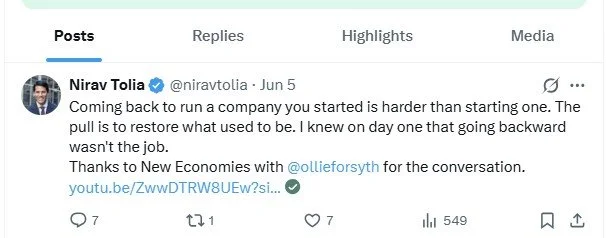
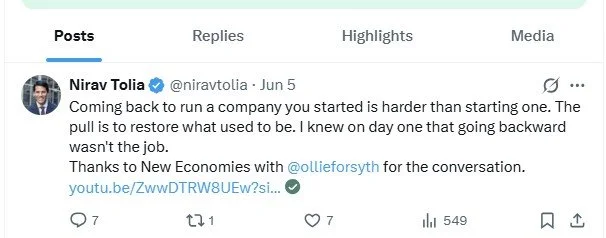
I came across a recent post on X from Nextdoor CEO Nirav Tolia reflecting on the challenges of returning to lead a company he founded. My reaction? It reads more as frustration than inspiration.
Running a public company is difficult, and every CEO faces pressure. But leadership is about setting the tone for employees, shareholders, customers, and the broader community. Looking backward can be part of the journey, but people also want to hear a vision for moving forward.
I've also seen current and former employees post online about what they describe as a difficult workplace culture. Those are their opinions and experiences, not mine, but they reinforce the importance of leadership messaging.
In a previous blog, I also commented on a March 3, 2026 X post that began with the phrase, "I'll be honest…" I believe communicators should avoid that expression because it can unintentionally invite readers to question whether previous statements were equally candid.
Which brings me to another question: Does Nextdoor have a public relations strategy that helps shape these messages? The company has a Media Relations team, but strong executive communications require more than media outreach.
If you need additional communications expertise, firms like JMac PR, led by John McCartney and known for technology and media campaigns, can provide strategic messaging support to help organizations better connect with stakeholders.
Leadership isn't just about what you say—it's about the confidence and clarity people take away after hearing it.
Subscribe to NielFlamm.com.
"Helping People Live Their Best Local Life" — How Exactly?
When Stanford Professor Brian Lowery asked Nirav Tolia what Nextdoor is, Nirav responded:
"Nextdoor is dedicated to making you better equipped to live the best version of your local life."
That sounds great.
But how exactly is Nextdoor helping people live their best local life?
In the discussion, Nirav described Nextdoor as:
• A platform focused on utility, not outrage.
• A place where disagreement should occur without being disagreeable.
• A community where diverse viewpoints can be expressed safely.
• A company that wants to amplify conversations that bring people together rather than pull them apart.
• A platform where people should not retreat into echo chambers.
• A business whose success should be measured by both financial results and positive human outcomes.
• A company whose leadership should accept responsibility for both the benefits and consequences of the platform.
Yet many users would argue they experience the opposite.
They describe:
• Moderation that appears inconsistent.
• Appeals processes that lack transparency.
• Criticism being limited while official channels often remain one-way conversations.
• Engagement metrics being emphasized while user trust remains a recurring concern.
• Discussions being curtailed rather than expanded.
• Policies that can feel subjective depending on who is enforcing them.
Perhaps the most interesting moment came when Nirav acknowledged that chasing engagement can encourage controversy and that increasing engagement metrics while customer satisfaction declines is ultimately unsustainable. He specifically discussed the dangers of platforms becoming dominated by the loudest voices and "rabble-rousers."
That observation raises an important question:
If Nextdoor understands these risks so clearly, why do so many users still feel they are experiencing them?
As an investor, I am less interested in slogans and more interested in outcomes.
Helping people live their best local life is an admirable mission.
The question is whether today's Nextdoor is delivering on the vision Nirav described at Stanford.