
Southern Hello Comes with a Recipe
Yesterday, I hobbled across the parking lot into the Harris Teeter at Rivertowne, focused on getting from my car to a scooter cart.
Behind me, a gentleman older than I am said hello. He wore jeans, a T-shirt, and a large checkered long-sleeve shirt, which struck me as a lot of clothing for the temperature. I was already working up a sweat just watching him.
Naturally, I said hello back.
It’s the South. You say hello. What you don’t always realize is that you’ve just agreed to attend a presentation.
“I love Bojangles rice and red beans,” he announced.
No introduction. No transition. We went straight from greetings to side dishes.
Great! I hadn’t known he didn’t like them, but I was pleased we’d cleared that up.
I kept hobbling. He kept talking.
He explained that he buys the family size.
This man really loves his rice and beans, I thought. We hadn’t even reached the store, and I already knew his preferred restaurant, his preferred side, and his purchasing strategy.
Then he said he keeps them for a few days.
Then he said he doesn’t.
At this point, I wasn’t sure whether we were discussing leftovers or taking sworn testimony.
What he does, he explained, is put the rice and beans in a pan. Then he cracks an egg into it, scrambles it, and mixes the whole thing together.
And that, friends, is where he lost me.
“I don’t eat eggs,” I told him. “Eggs are gross.”
Now, I could have stopped there. A person with a functioning conversational brake pedal probably would have.
Instead, I explained that I think of eggs as chicken menstruation. An unfertilized egg. Yes, I know that’s not a technically accurate description. It is, however, the description my brain has committed to, and my brain is not accepting public comment.
He had offered me a recipe. I had responded with poultry reproductive concerns.
Neither of us had asked for any of this.
By then, we’d made it to the produce section—the whole-food portion of Harris Teeter, where a banana could simply be a banana without either of us cracking an egg over it.
We parted ways among the fruit.
“It was nice chatting with you,” I said. “Have an awesome day!”
And I meant it.
He went off to do his shopping. I hobbled off to do mine, now carrying a recipe I would never make and more information about a stranger’s rice-and-bean habits than I have about several members of my own family.
That’s the South.
Sometimes “hello” means “hello.”
Sometimes it means, “Walk with me. There’s something you need to know about Bojangles.”

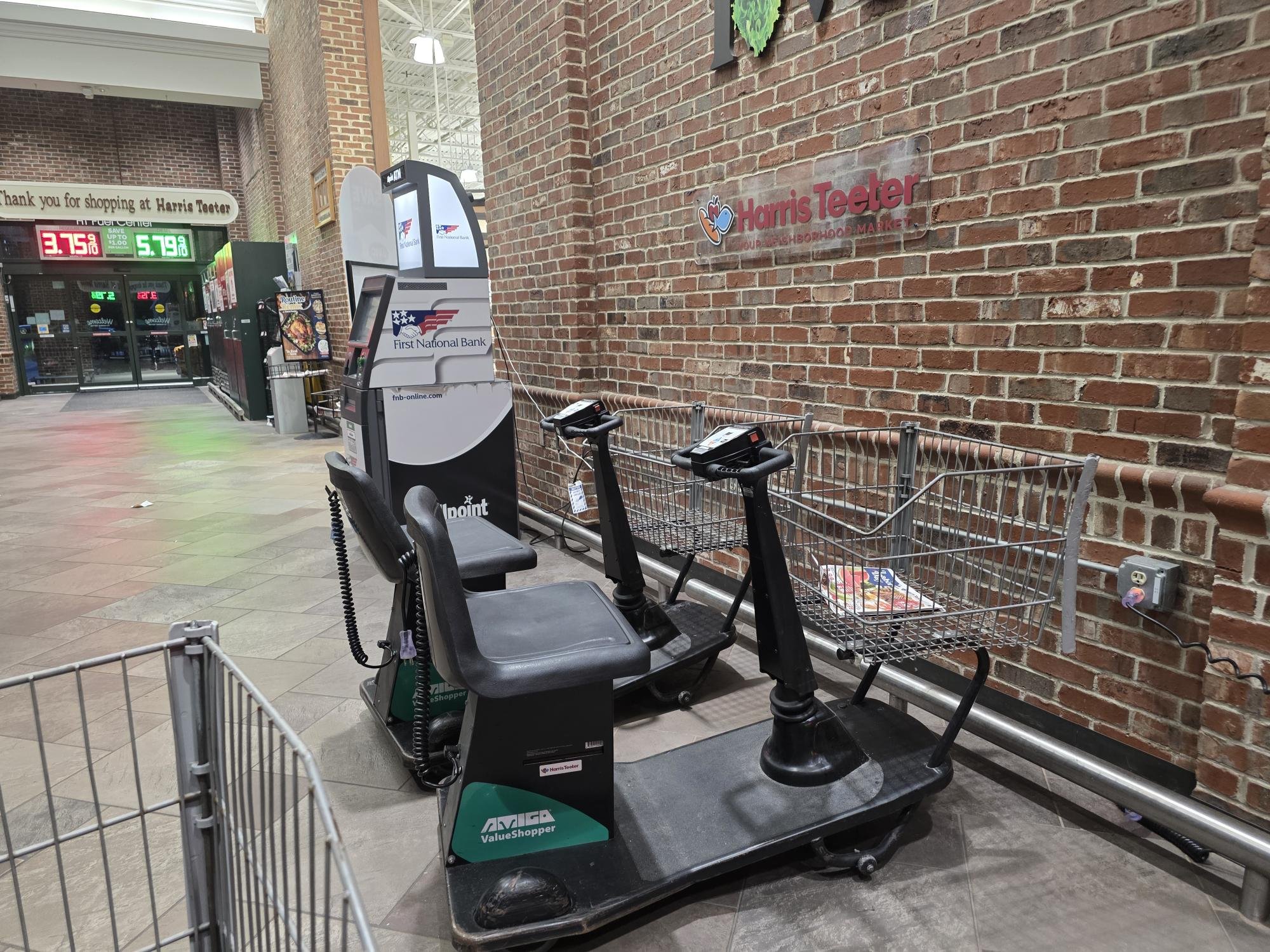
What is wrong with this picture?
Accessibility Should Start in the Parking Lot
I was at the Harris Teeter in the Rivertowne area on Thursday and saw these electric shopping scooters parked inside. Most of you might not notice anything wrong. In my opinion, though, this picture shows a gap in how we think about accessibility.
First, let me say thank you to Harris Teeter for providing this equipment for customers with mobility issues, including me. These scooters make grocery shopping easier and less stressful. I appreciate having them available.
Here is where my opinion may be controversial—or perhaps seem petty to someone who has never struggled to walk across a parking lot.
The scooters are inside.
Someone who needs one must first get from their vehicle to the store and through the entrance before reaching the equipment that helps them get around. For some customers, that journey is already difficult.
The help is there. But you have to reach it first.
I do not know whether stores are required under the Americans with Disabilities Act to provide these scooters. My concern is about the everyday experience of using them. From my perspective, providing mobility assistance only after someone gets inside feels like a half-measure.
I have suggested keeping scooters in a designated, sheltered area near the accessible parking spaces during store hours, with the spaces and access aisles kept clear. Employees who collect shopping carts could check that area and bring the scooters inside when the store closes.
I understand these machines are expensive. Weather, charging, security, and upkeep all need to be considered. That is why I am suggesting a managed arrangement during business hours. If outdoor storage isn't practical, an easy way to request a scooter from the parking lot could help close that gap.
The people who need these devices should have a say in where and how they are made available.
I have written reviews of hotels where, from my experience as a guest with mobility issues, the approach to accessibility felt like doing the minimum—especially in bathrooms. A feature can be present and still be awkward or difficult to use. The details matter when you are the person depending on them.
I would love to see a company take the lead by asking customers, “What would make your visit easier from the moment you arrive?”
I believe that kind of care could bring a meaningful return through loyalty, repeat visits, and recommendations. When a business makes an everyday task easier, people remember.
So, thank you, Harris Teeter, for providing these scooters. They make a difference to customers like me.
Please consider taking that care a few steps farther—out to the parking lot, where we may need it first.