
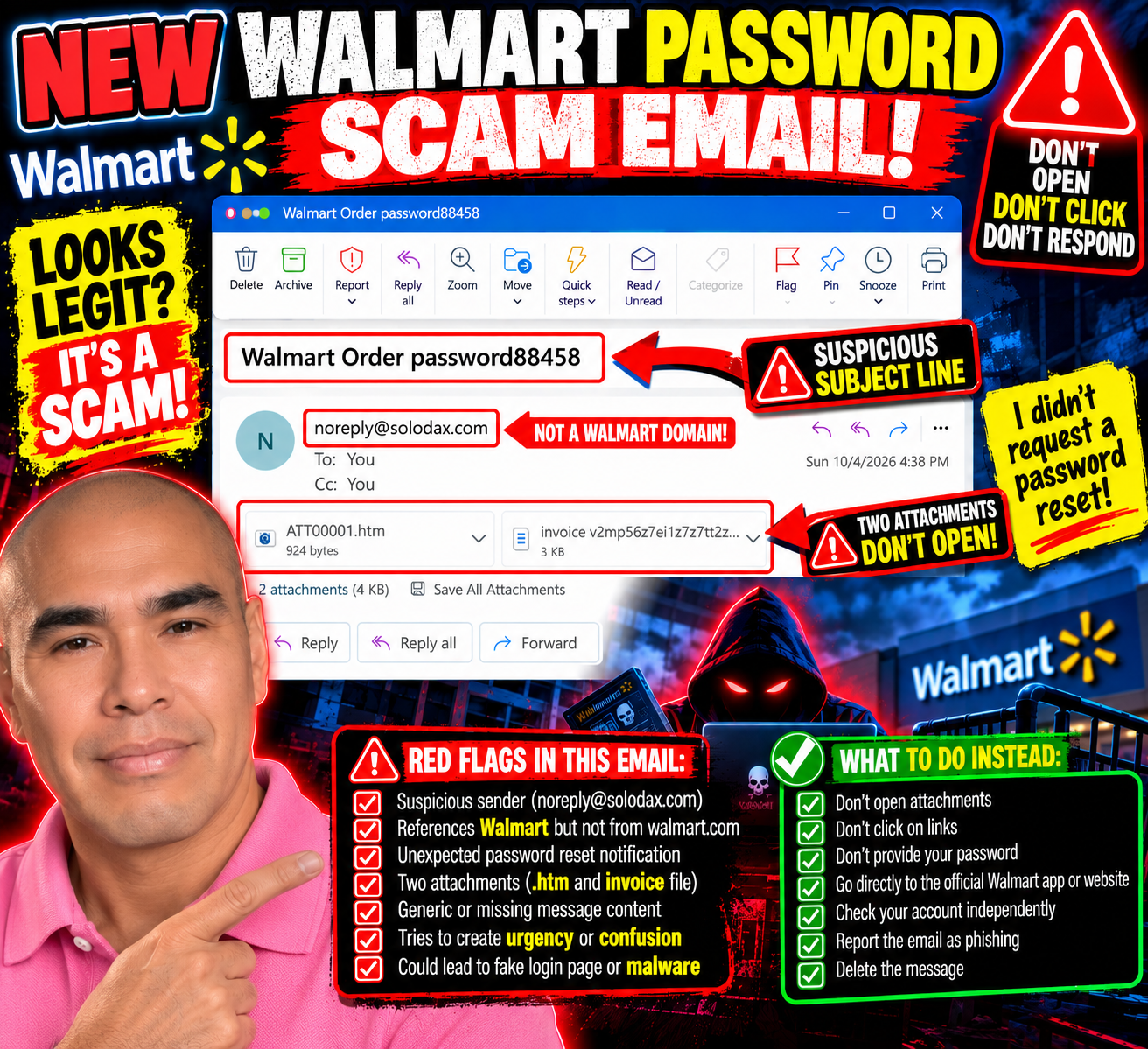
A New Scam Tactic Made Me Do a Double Take: “Walmart Order password88458”
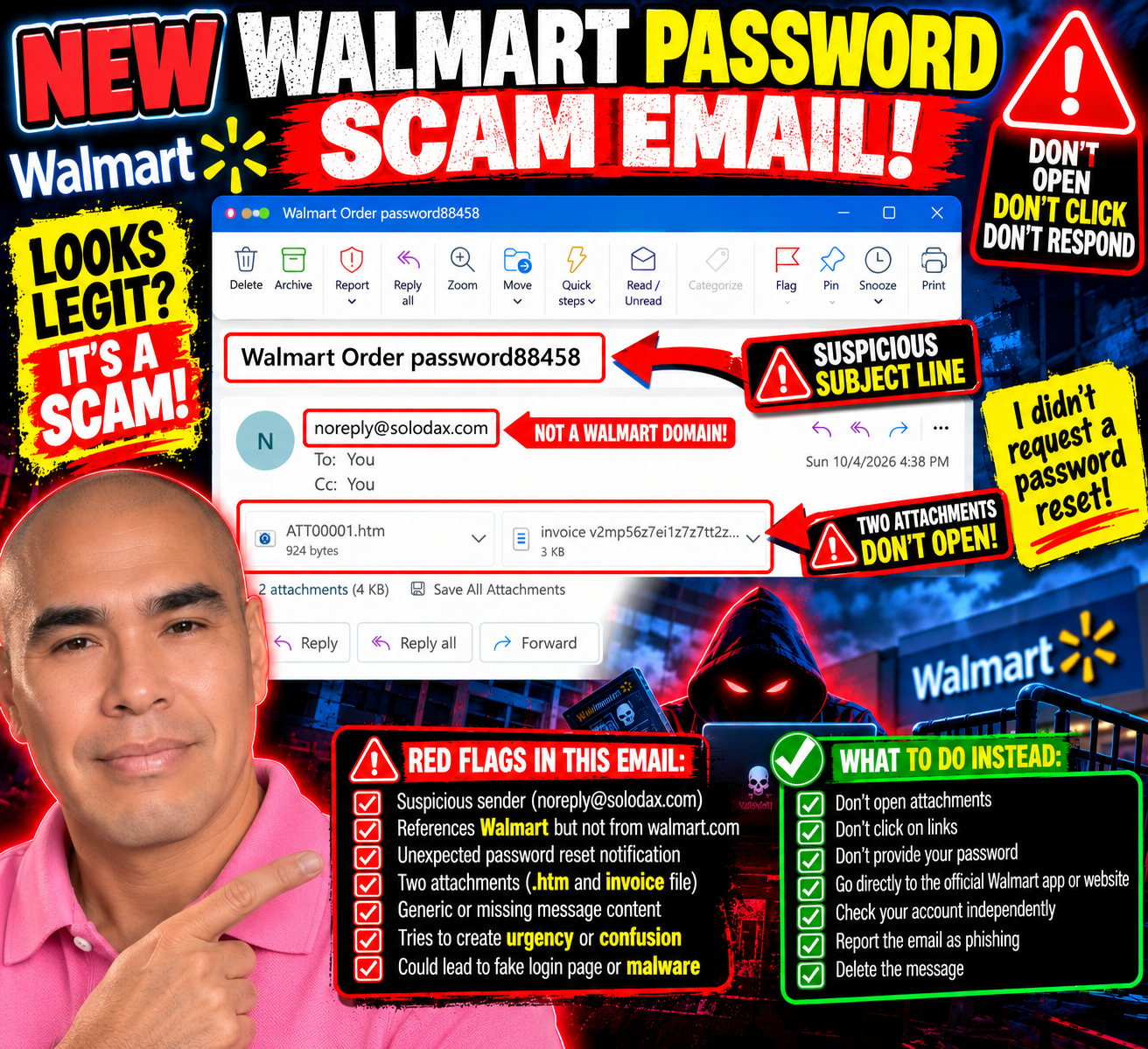
When I thought my inbox scammers had settled into a comfortable routine of fake PayPal charges, Geek Squad subscriptions, and invitations to give away hundreds of dollars, somebody apparently decided the script needed an update.
This one actually made me do a double take.
The subject line reads:
“Walmart Order password88458”
Password?
Wait.
Did I ask for my Walmart password to be reset?
No.
And that tiny moment of uncertainty is exactly what caught my attention.
This One Feels Different
Most of the scam emails I've been receiving practically announce themselves.
YOU SPENT $499.99!
YOUR GEEK SQUAD SUBSCRIPTION RENEWED!
CALL THIS NUMBER IMMEDIATELY!
They want panic.
This one is quieter.
The email body has no real message. Instead, it has two attachments: an HTML file and what looks like an invoice.
The sender shown is:
Yet the subject references Walmart.
That's enough for me to stop.
If this is supposedly about my Walmart account, why is the message coming from a completely unrelated domain?
And why would I need to open attachments to figure out what's happening with my password?
No thanks.
The “Password” Word Almost Worked
That's what I find interesting about this one.
I saw “password” and instinctively wondered whether I'd requested a password reset.
For a moment, the message made me question my own memory.
That's potentially much more effective than another ridiculous $499.99 invoice.
People reset passwords all the time. Sometimes we forget that we requested one. Sometimes an app logs us out. Sometimes we get legitimate security alerts when someone attempts to access an account.
So seeing Walmart + Order + Password mashed together in a subject line can create just enough confusion to make someone investigate.
And investigating might mean opening one of those attachments.
That's where I stop.
Two Attachments? I'm Good.
One attachment ends in .htm.
That's an HTML file—a webpage packaged as a file.
Opening an unexpected HTML attachment can potentially take someone into a fake login or other deceptive content designed to look legitimate. I'm not opening it to find out what this particular one does.
The second attachment appears to be an invoice.
I'm not opening that one either, thank you.
If Walmart needs me to take action on my account, I don't need an attachment from solodax.com to proceed.
I can independently open the Walmart app or type the legitimate Walmart website into my browser and check my account there.
The suspicious email doesn't give me a roadmap for how to investigate it.

This Is Why I Keep Sharing These
Scams don't always look like:
“HELLO DEAR SIR, YOU HAVE WON $47 MILLION.”
Sometimes they're messy.
Sometimes they're polished.
Sometimes they use familiar company names.
And sometimes all they need is one word—like password—to make me stop and wonder:
“Wait...did I do something?”
I did the double take.
Then I looked at the sender.
Then I looked at the attachments.
And I remembered:
I didn't request a password reset.
Mystery solved.
No attachments opened.
No links clicked.
No passwords entered.
And, for once, Bill apparently had the day off.
Send Me Your Scam Attempts
I'm still documenting the different tactics that land in my inbox because seeing real examples can make the next suspicious message easier to recognize.
If you've received an unusual scam email, phishing attempt, fake invoice, suspicious password-reset message, or another creative attempt to get your information, send me a screenshot and your experience:
First, remove or cover any sensitive personal, financial, or account information.
The scammers changed tactics.
So I'll keep paying attention.
If I didn't request a password reset, I won’t open an attachment to understand why someone believes I did.
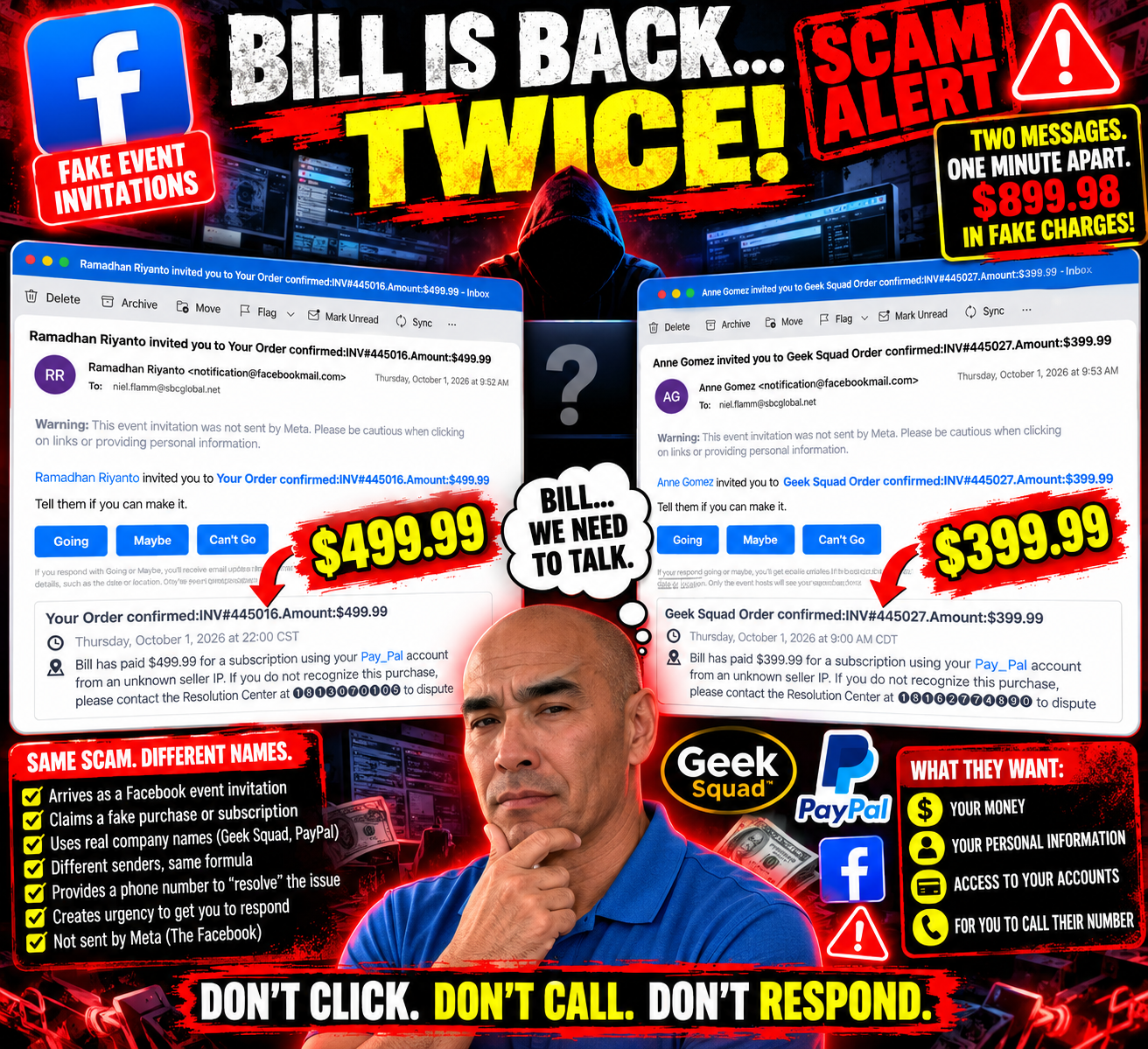
Bill Is Back—Twice: Apparently My Fake PayPal Account Had a Busy Morning
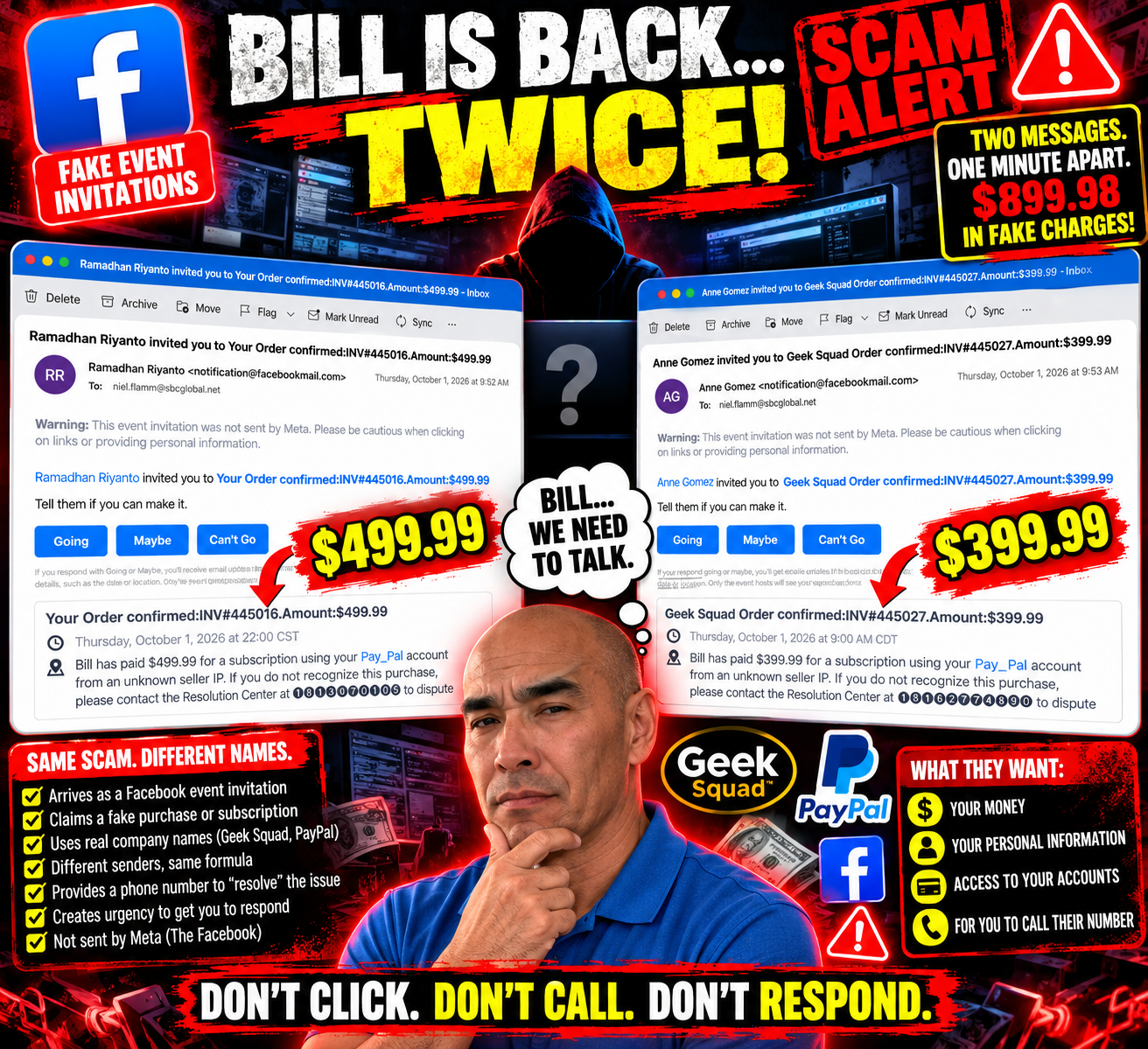
At this point, I think Bill needs an intervention.
If you've been following my continuing adventures with scam emails, you may remember Bill. Bill is the mysterious person who keeps appearing in these fake invoices and event invitations, supposedly using my PayPal account to buy things I never ordered.
Well, Bill is back.
And this time, he brought friends.
On October 1, I received two more suspicious event invitations. They arrived just one minute apart.
The first came from Ramadhan Riyanto at 9:52 a.m.
The second came from Anne Gomez at 9:53 a.m.
Apparently, scammers believe in efficiency.
First Invitation: $499.99
Ramadhan invited me to:
“Your Order confirmed: INV#445016. Amount:$499.99”
How thoughtful.
According to the invitation, Bill supposedly paid $499.99 for a subscription using my “Pay_Pal” account.
Yes, Pay_Pal.
Maybe PayPal's lesser-known cousin.
And, naturally, if I didn't recognize the purchase, there was a convenient telephone number for the “Resolution Center.”
Convenient for whom is another question.
The invitation even gave me the familiar choices:
Going. Maybe. Can't Go.
I'm going with Can't Go.
I have a scheduling conflict.
I'm busy not losing $499.99.
One Minute Later: Another Party!
Apparently, declining one imaginary purchase wasn't enough.
At 9:53 a.m.—just one minute later—Anne Gomez invited me to another event:
“Geek Squad Order confirmed: INV#445027. Amount:$399.99”
And guess who made the purchase?
BILL!
Bill allegedly spent another $399.99 using my imaginary Pay_Pal account.
So within one minute, Bill supposedly racked up $899.98 in fake charges.
Bill, buddy...
We need to talk about your spending habits.

The Similarities Are Almost Comical
Put these two messages side by side, and the pattern is hard to miss.
Different sender.
Different invoice number.
Different dollar amount.
Different supposed Resolution Center phone number.
But almost everything else follows the same formula.
Both arrived as event invitations.
Both claim Bill used my PayPal account.
Both mention an “unknown seller IP.”
Both provide a telephone number to dispute the transaction.
Both create a sense of urgency around a purchase I supposedly didn't make.
And both contain a warning right there in the email:
“This event invitation was not sent by Meta. Please be cautious when clicking on links or providing personal information.”
At this point, the warning may as well be flashing in neon.
Yesterday It Was Geek Squad. Today It's a Doubleheader.
What makes this even funnier is that these arrived right after another fake Geek Squad invitation I recently wrote about.
That one claimed Bill spent $399.99.
Now Bill supposedly spent another $499.99 and $399.99.
My fictional friend is having quite a shopping spree.
If this keeps up, I'll need to stage a fictional financial intervention.
Why Send Two So Close Together?
I obviously can't know who is behind these messages from the emails alone, and I can't say whether the two invitations were generated by the same person or operation.
But the nearly identical wording and timing are worth noticing.
That's part of why I keep documenting these messages.
One strange email might make someone stop and wonder whether there's really a problem with an account.
When several nearly identical versions appear, the formula becomes much easier to see.
The company name can change.
The amount can change.
The sender can change.
The telephone number can change.
But the basic objective appears to remain the same:
Get me worried enough to respond before I stop and think.
I'm Still Not Calling
If I received a legitimate-looking notice about a PayPal, Geek Squad, bank or credit-card transaction I didn't recognize, I wouldn't use the telephone number supplied in a suspicious email.
I'd go directly to the company's official app or website and check my account independently.
The email doesn't tell me how to verify it.
That's an important distinction.
And I'm definitely not calling a mystery “Resolution Center” because Bill supposedly went shopping again.
Going? Maybe? Can't Go?
I still love that these arrive as event invitations.
Imagine putting these on my calendar:
9:00 a.m. — Lose $399.99
10:00 p.m. — Lose another $499.99
Dress code: Business casual.
Refreshments: None.
Financial regret: Complimentary.
RSVP?
Can't Go.

Keep Sending Me Your Scam Stories
I'll keep documenting these because the more examples we see, the easier it becomes to recognize the patterns.
If you've received a suspicious invoice, fake purchase notification, Facebook event scam, PayPal impersonation, Geek Squad message, or another creative attempt to separate you from your money, send me your story and screenshots at:
Just remove or cover any sensitive personal or financial information before sending it.
As for Bill?
If anyone sees him, please tell him his Pay_Pal privileges have officially been revoked.
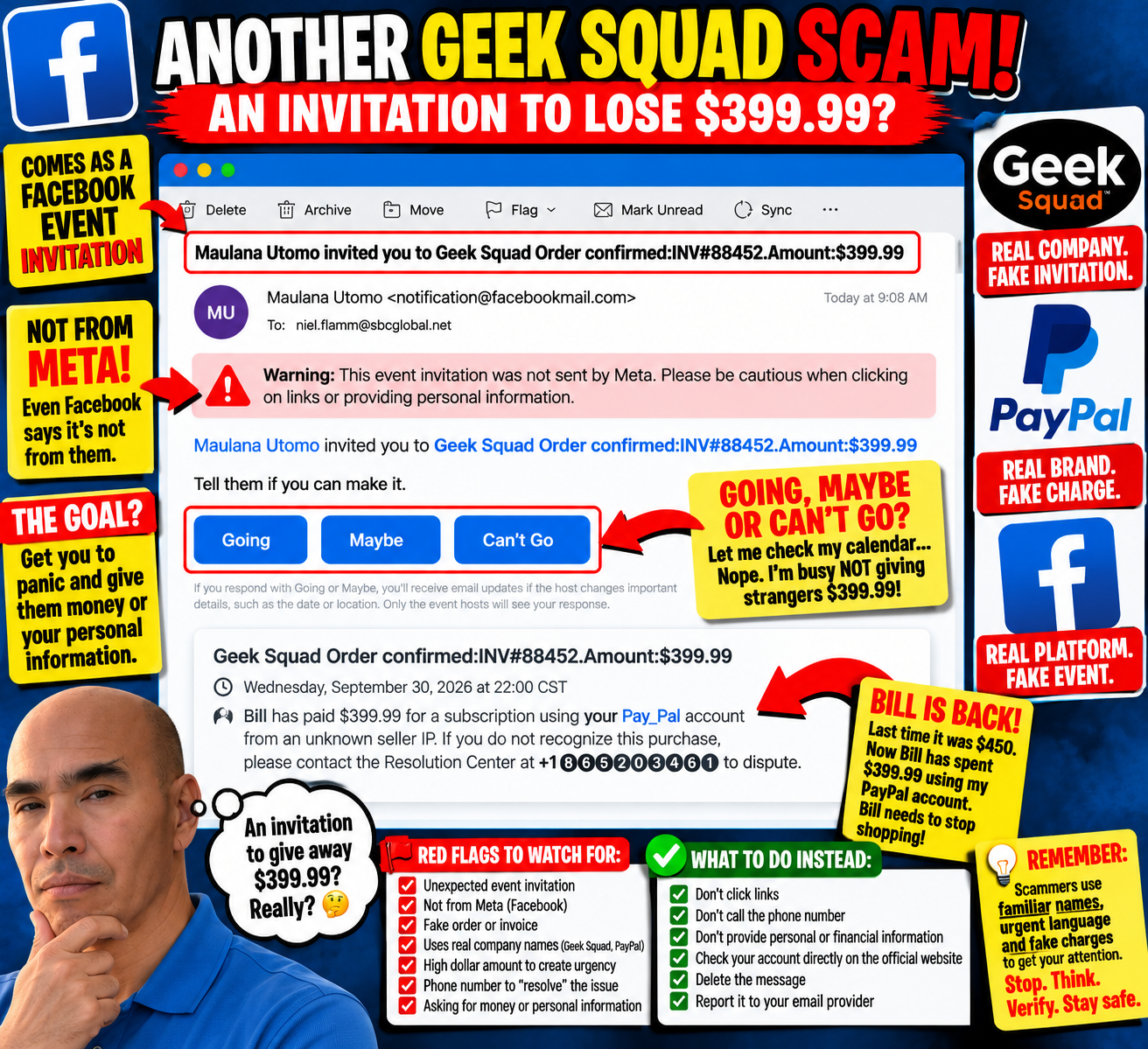
Another Scam Invitation: Apparently I’m Invited to Give Away $399.99
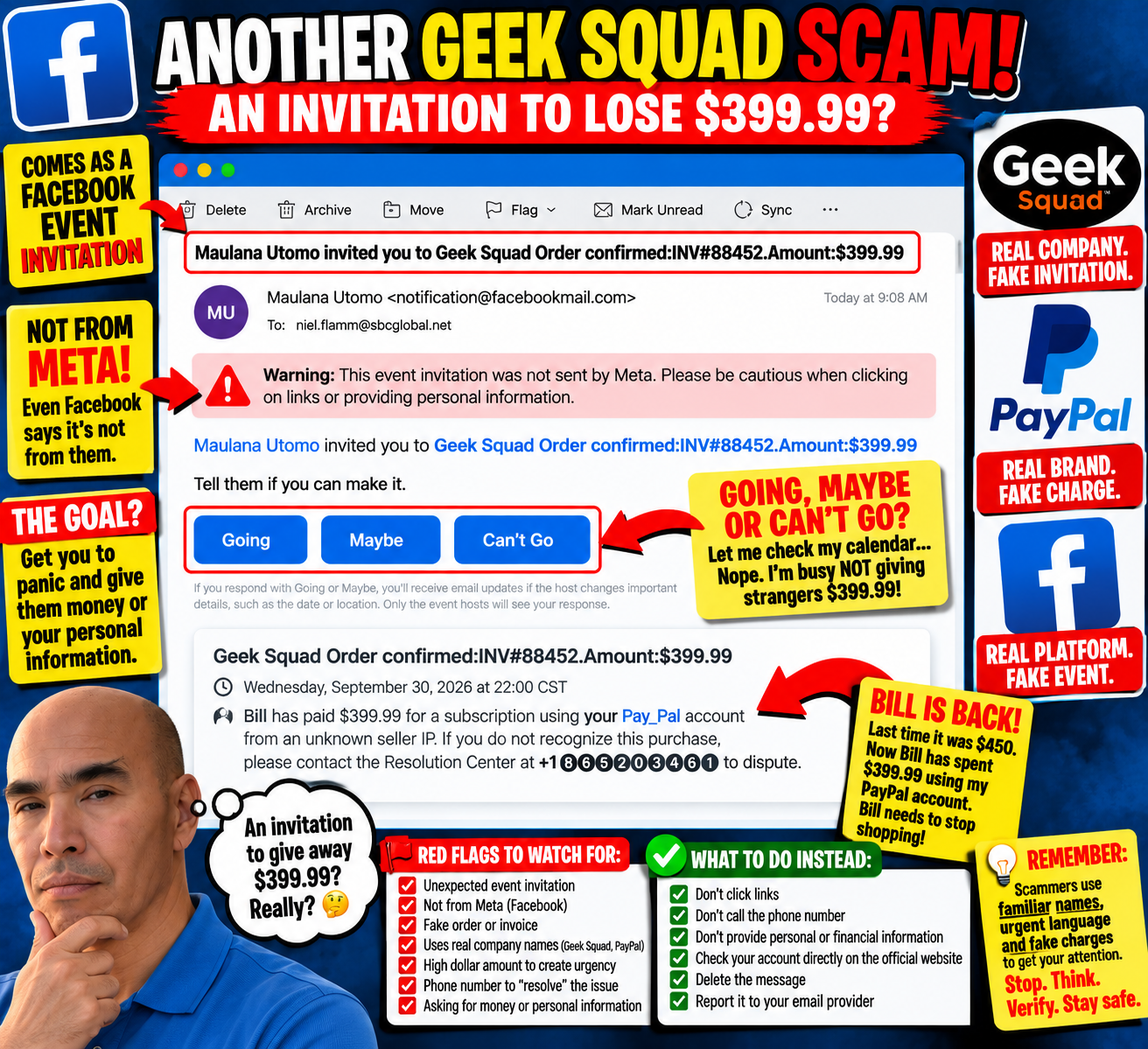
My inbox has once again extended a very generous invitation.
This time, Maulana Utomo has invited me to an event called:
“Geek Squad Order confirmed: INV#88452. Amount: $399.99”
How thoughtful.
Some people get invited to weddings.
Some people get invited to birthday parties.
Apparently, I get invited to give scammers money or personal information.
I really need a better social life.
Going, Maybe, or Can’t Go?
This is my favorite part of these fake Facebook event invitations.
According to the message, I supposedly have a $399.99 Geek Squad order.
Naturally, The Facebook gives me three options:
Going
Maybe
Can’t Go
Let me check my calendar...
Nope.
Unfortunately, I'm busy that evening, not giving strangers $399.99.
I'm going with Can’t Go.

Bill Is Back!
Then I read the description, and an old friend has apparently returned.
Bill.
The invitation says:
“Bill has paid $399.99 for a subscription using your Pay_Pal account from an unknown seller IP.”
Bill!
We've talked about this.
In one of my previous mystery-subscription emails, Bill supposedly spent $450 using my PayPal account.
Now he's back for another $399.99.
At this point, Bill has more subscriptions than I do.
Someone needs to take away his imaginary credit card.
Geek Squad, PayPal and Facebook Walk Into a Scam...
This one throws several recognizable names into the blender.
The event title references Geek Squad.
The description references PayPal—although creatively written as “Pay_Pal.”
The email itself comes from a Facebook event invitation.
And then there's a phone number supposedly belonging to a “Resolution Center.”
That's a lot of recognizable branding packed into one message.
But there's also something else sitting prominently near the top of the email:
“Warning: This event invitation was not sent by Meta. Please be cautious when clicking on links or providing personal information.”
That's probably the most useful sentence in the entire email.

What Exactly Am I Being Invited To?
That's what makes these messages funny to me.
The email literally says:
“Tell them if you can make it.”
Make it to what?
My $399.99 unauthorized transaction?
Is there going to be cake?
Should I bring a gift?
Do I need to RSVP?
Because from where I'm sitting, this looks like an invitation to worry about a fake charge, call the number provided, and potentially hand over money, account information, personal information—or some combination of the three.
That's one party I'm happy to miss.
The Urgency Is the Point
The $399.99 isn't there because someone necessarily charged me $399.99.
It's there to get my attention.
The recognizable company names get my attention.
The “unknown seller” creates concern.
The telephone number gives me an immediate action to take.
Put everything together, and the hope seems pretty obvious:
React first. Investigate later.
I'm doing the opposite.
If I ever receive a suspicious message claiming I've been charged by a company, I can check the account independently through the company's legitimate app or website rather than using the contact information in the suspicious message.
I don't need Bill's help.
Thanks for the Invitation
So, Maulana, thank you for thinking of me.
Unfortunately, I must respectfully decline your invitation to potentially hand over $399.99 and my personal information.
I already have plans.
I'm going to hit Delete.
And Bill?
Please stop shopping.
Have a Scam Story? Send It My Way
These messages keep coming, and I'll keep documenting them.
If you've received a strange scam email, fake invoice, suspicious Facebook invitation, mystery purchase, phishing text, or another creative attempt to get your money or information, send it to:
Send a screenshot and tell me what happened. Be sure to remove or cover any sensitive personal or financial information first.
Maybe your scammer can meet Bill.
They apparently have similar interests.

The Facebook Experiment Continues: Amy Messaged Me, and Now I Have More Questions
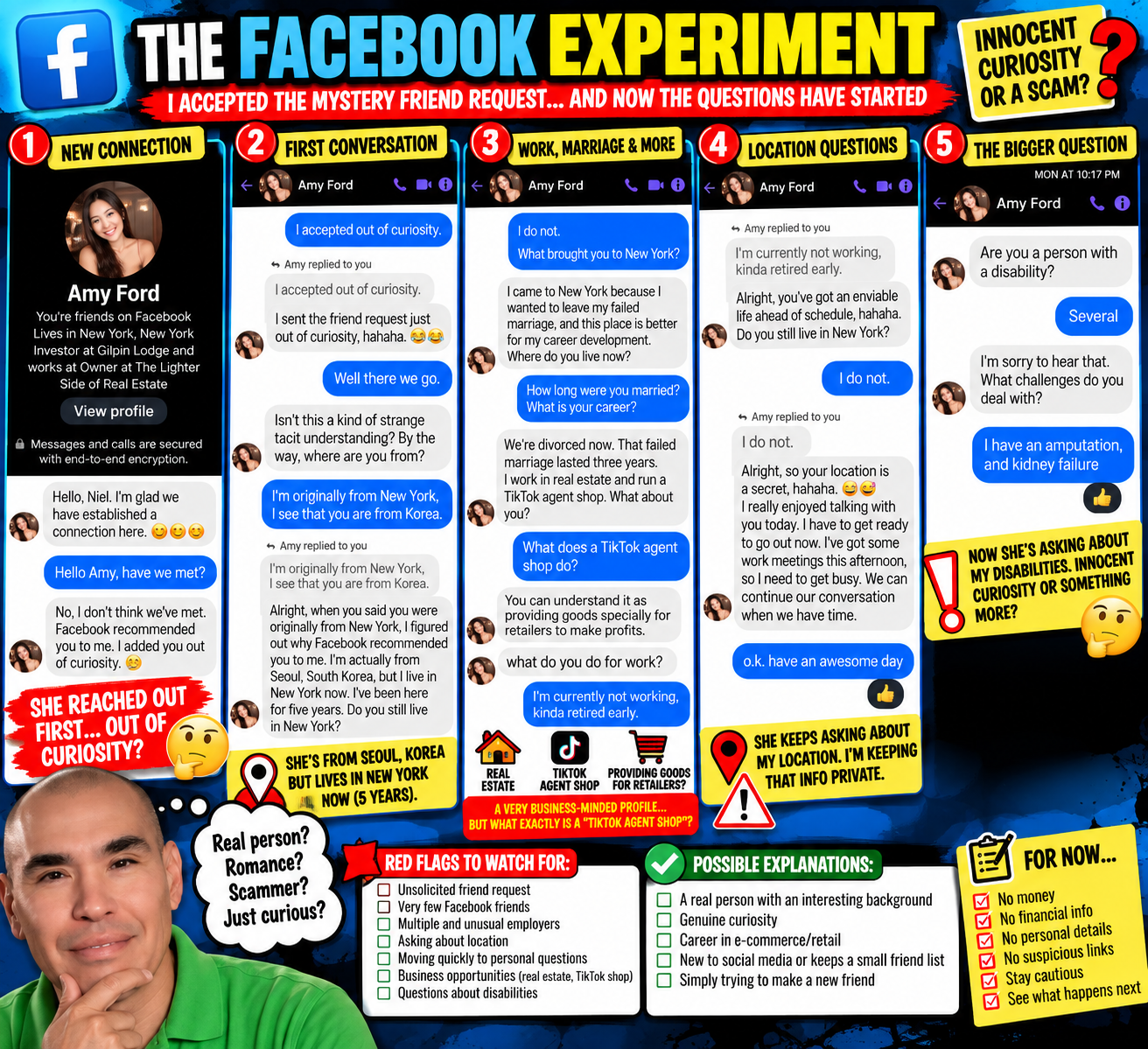
Well, that didn't take long.
In my last update, I shared that I finally accepted the mysterious friend request from Amy Ford on Facebook.
I didn't know Amy. We had one mutual friend. Her profile caught my attention for several reasons, including a rather impressive collection of jobs. Still, none of that proved anything was wrong with the account.
So curiosity won.
I accepted.
And shortly afterward, Amy messaged me.
“I Added You Out of Curiosity”
Amy opened with:
“Hello, Niel. I'm glad we have established a connection here.”
I asked the obvious question:
“Hello, Amy, have we met?”
Nope.
She said Facebook recommended me and that she added me “out of curiosity.”
That made me laugh because curiosity was exactly why I accepted her.
I told her:
“I accepted out of curiosity.”
Her response?
“I sent the friend request just out of curiosity, hahaha.”
Well, there we go.
Two strangers brought together by the powerful matchmaking algorithm of The Facebook—and apparently mutual curiosity.
What could go wrong?
Then Came the Questions
Amy asked where I was from.
I told her I was originally from New York and mentioned that I saw she was from Korea.
She explained that she's originally from Seoul, South Korea, has lived in New York for five years, and then asked whether I still lived in New York.
I said I didn't.
She asked where I live now.
I didn't answer.
Instead, I asked what brought her to New York.
According to Amy, she moved there after leaving a failed marriage because New York offered better career opportunities.
I asked how long she had been married and what she did for work.
She said the marriage lasted three years and told me:
“I work in real estate and run a TikTok agent shop.”
Now I had another question.
What's a TikTok Agent Shop?
Remember, her Facebook profile already showed several professional roles, including investor, real estate business owner, and an HR-related position.
Now I had a TikTok agent shop to add to the résumé.
So I asked what a TikTok agent shop does.
Her explanation was:
“You can understand it as providing goods specifically for retailers to make profits.”
Okay.
I still don’t entirely understand it.
Then the conversation turned back toward me.
She asked what I do for work.
I told her:
“I'm currently not working, kinda retired early.”
Her response caught my attention:
“Alright, you've got an enviable life ahead of schedule.”
Then she asked again:
“Do you still live in New York?”
I answered:
“I do not.”
And that was it.
No location.
Amy joked that my location was apparently a secret.
For now, it is.
Then the Conversation Took an Unexpected Turn
Amy said she had enjoyed talking with me but needed to get ready for some work meetings. We exchanged pleasantries, and the conversation ended.
Or so I thought.
Later that night, at 10:17 p.m., another message arrived:
“Are you a person with a disability?”
That's certainly a conversation starter.
I answered:
“Several.”
She asked what challenges I deal with.
I told her about my amputation and kidney failure.
And that's where the screenshots currently leave us.
So, Is This a Scam?
I still don't know.
And I think that's important to say.
Nothing in this conversation proves that Amy is running a scam or that the person behind the account isn't who they claim to be.
At the same time, I'm paying attention.
An unsolicited friend request from a stranger.
Very few Facebook friends.
Several different professional descriptions.
Questions about where I live.
Questions about my employment.
A business involving retailers making profits.
And now questions about my disabilities.
Each one can have a perfectly innocent explanation.
Taken together, they're enough for me to continue being cautious.
I'm Also Curious About Where This Goes
This has become a little social-media experiment for me.
I'm not sending money.
I'm not providing financial information.
I'm not sharing passwords or account information.
I'm not clicking mystery links.
And I'm not rushing to provide personal details simply because someone asks.
I'm having a conversation.
If Amy is simply a friendly person in New York who found my profile through Facebook recommendations, that may be all this ever is.
If the conversation eventually turns into:
“Niel, have you ever considered cryptocurrency?”
Well...
I may have another blog post to write.
For now, The Facebook Experiment continues.
And I have a feeling this story isn't finished yet.
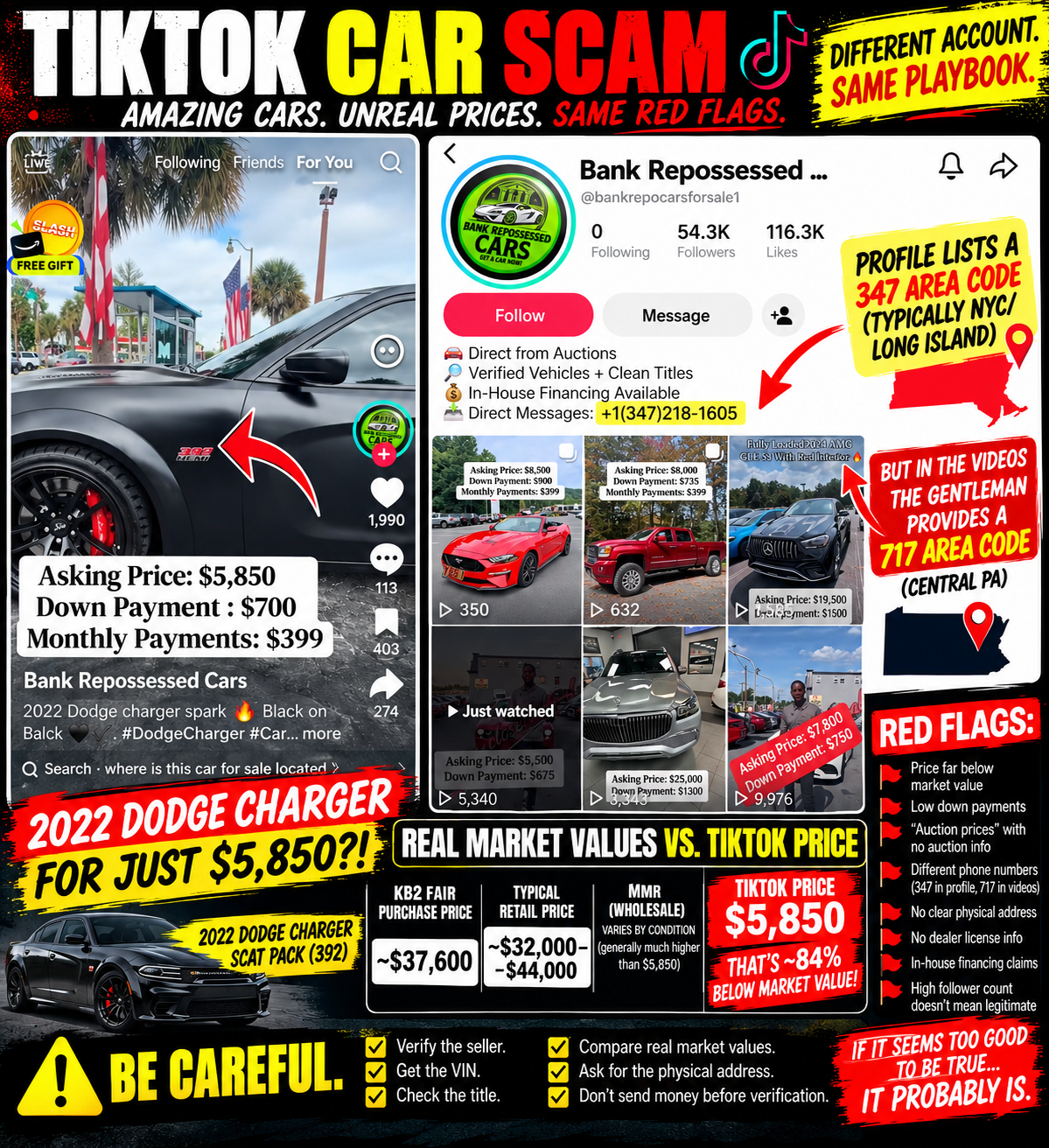
Another “Bank Repossessed” TikTok Car Deal — And the Phone Numbers Don’t Even Match
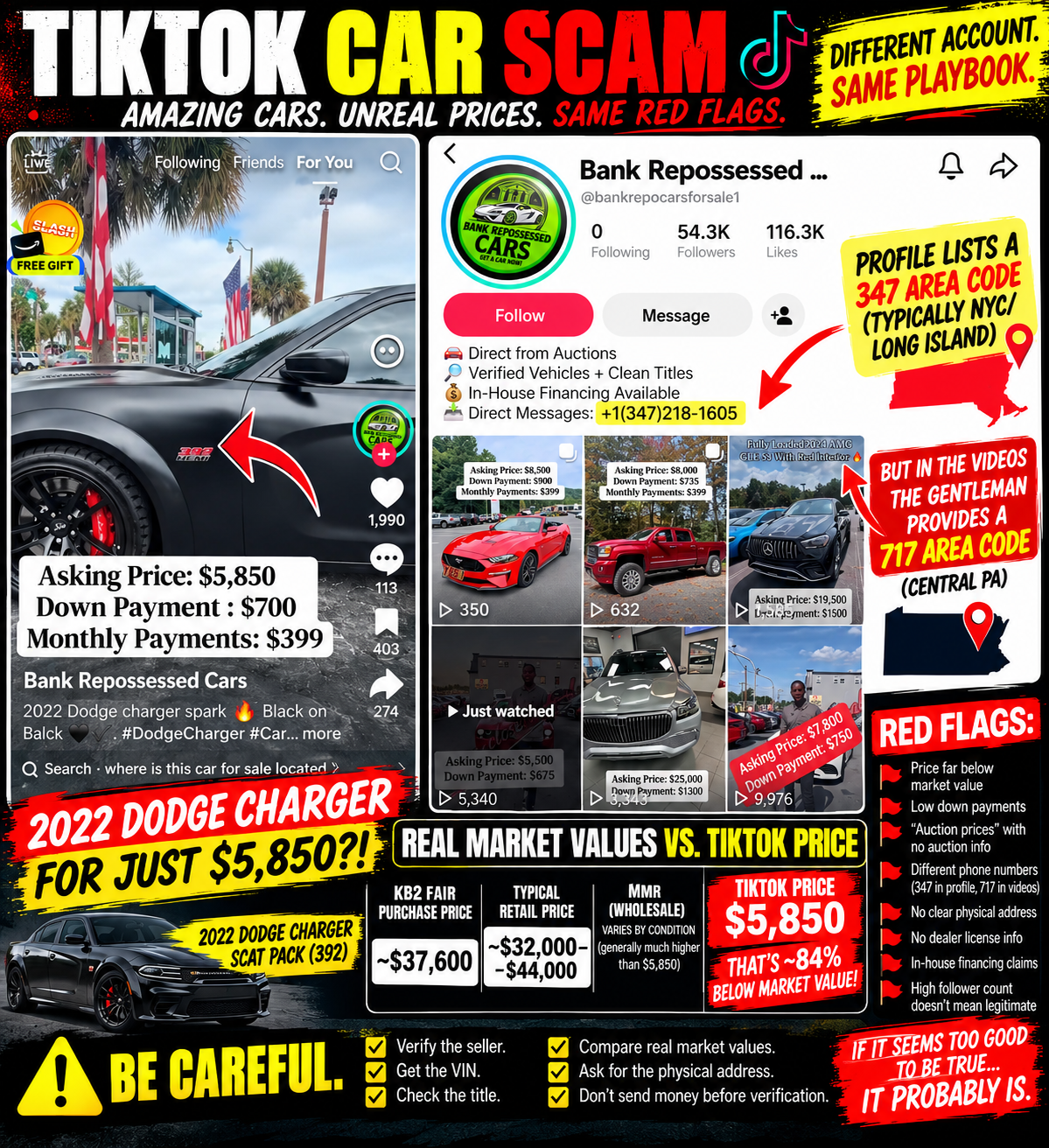
TikTok apparently still thinks I need a ridiculously inexpensive performance car.
The latest account to appear in my feed calls itself “Bank Repossessed Cars” and uses the handle @bankrepocarsforsale1.
At the time of my screenshot, the account had:
54,300 followers.
116,300 likes.
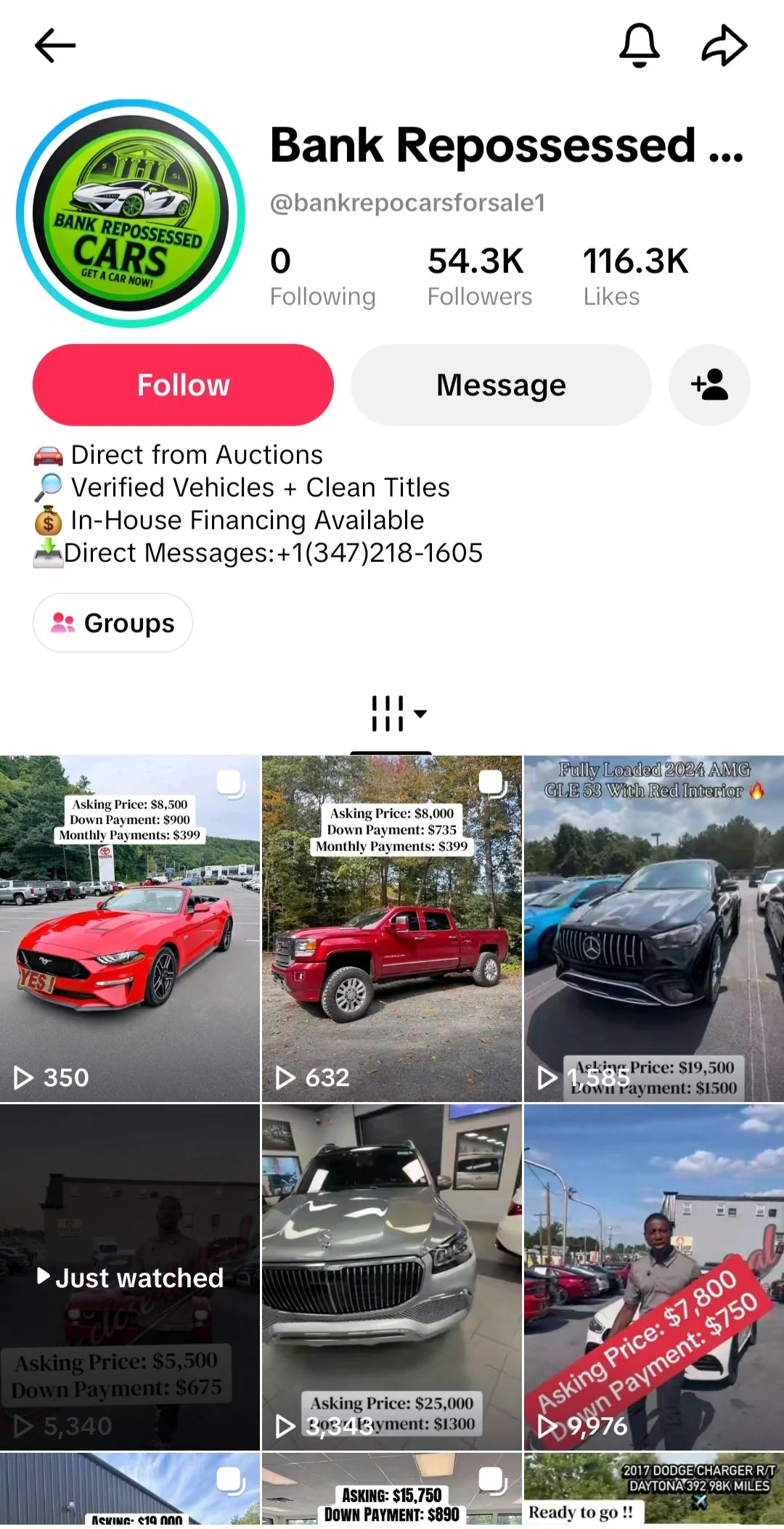
That's substantially larger than several of the questionable car accounts I've written about before.
The profile says:
🚗 Direct from Auctions
🔎 Verified Vehicles + Clean Titles
💰 In-House Financing Available
And then there's a telephone number for direct messages:
+1 (347) 218-1605
Sounds impressive.
Then I started watching the videos.
And once again, I have questions.
🚗 Today's Deal: A 2022 Dodge Charger for $5,850
The video that caught my attention shows what is described as a 2022 Dodge Charger with the following offer:
Asking Price: $5,850
Down Payment: $700
Monthly Payments: $399
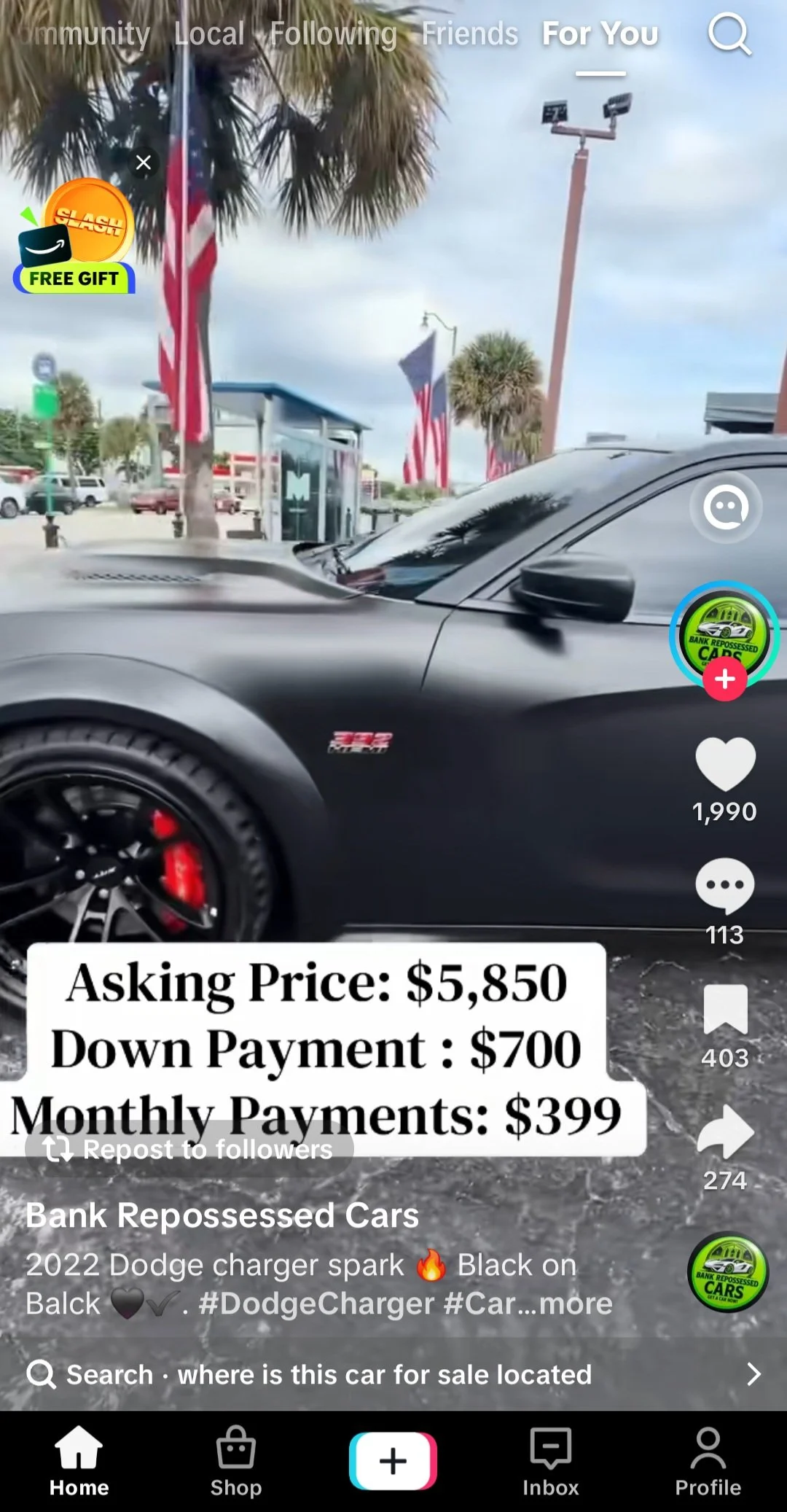
The caption describes it as a “2022 Dodge Charger spark”, although the vehicle shown appears to carry a 392 badge.
If this is actually a 2022 Charger Scat Pack/392, that $5,850 advertised price deserves a very close look.
Why?
Because the market numbers aren't even in the same neighborhood.
💰 Kelley Blue Book Says About $37,000 — Not $5,850
Kelley Blue Book currently puts the national Fair Purchase Price of a 2022 Dodge Charger Scat Pack around $37,600. KBB lists roughly $31,900 trade-in, $34,800 private-party, and $37,600 Fair Purchase Price for a good-condition example, while a Scat Pack Widebody is higher still at about $44,100 Fair Purchase Price. Exact values vary with mileage, condition, options, and location. Kbb.com
Edmunds tells a similar story: its current dealer-retail estimate for a regular 2022 Scat Pack ranges from roughly $32,300 in rough condition to $39,500 in outstanding condition. Edmunds
CARFAX's current listings put 2022 Charger Scat Packs at an average listing price of about $44,347, with its displayed range running roughly $36,747–$52,950. Carfax
TikTok?
$5,850.
That's roughly 84% below KBB's $37,600 Fair Purchase Price.
Maybe there's an explanation.
Fantastic.
I'd like to hear it.
🔨 But What About MMR and “Auction Prices”?
This account specifically promotes the vehicles as coming “Direct from Auctions.”
That's where the Manheim Market Report—or MMR—comes in.
MMR isn't the same thing as KBB retail value. Manheim describes MMR as a wholesale-market valuation based on actual vehicles sold through Manheim, with values that can be adjusted for factors such as odometer reading, selling region, condition grade and even color. Manheim
That's why I'm not going to invent an exact MMR for the Charger in this video.
I don't have its VIN.
I don't have verified mileage.
I don't have its condition report.
I don't have its auction location.
I don't have a current vehicle-specific Manheim report.
Without those things, saying, “The MMR is exactly $XX,XXX,” would be pretending to know something I don't.
But here's what we can compare.
KBB puts the Scat Pack's trade-in value around $31,900. JD Power estimates a trade-in base of around $31,250–$33,250, depending on condition. Those aren't MMR, but they're useful wholesale-side reference points. Kbb.com
So if this really is a clean-title 2022 Scat Pack being sold for $5,850, the question isn't simply:
“Is it cheaper because it came from an auction?”
The question is:
How did someone acquire a vehicle worth tens of thousands of dollars cheaply enough to retail it for $5,850?
“Auction” isn't a magic word that makes vehicle economics disappear.
📞 Then I Noticed the Phone Numbers
Here's where things became even more interesting.
The TikTok profile lists:
+1 (347) 218-1605
The 347 area code is associated with New York City, including the boroughs of Brooklyn, Queens, the Bronx and Staten Island. It's commonly encountered around the broader NYC/Long Island market, although an area code obviously doesn't establish where somebody currently lives or operates a business.
But I watched several of the account's videos.
The gentleman appearing in those videos provides a different telephone number—with a 717 area code.
The 717 area code serves south-central Pennsylvania, including Harrisburg, Lancaster, and York.
Again, people keep phone numbers after moving. Businesses can have multiple telephone numbers. VOIP numbers exist. None of this, by itself, proves anything improper.
But when I'm supposedly dealing with a business selling cars online, it's another question I'd want answered:
Why does the profile give me one phone number while the person in the videos gives me another?
And, more importantly:
What's the actual dealership?
Where is it physically located?
Which number belongs to that dealership?
Those should be remarkably easy questions for a legitimate automobile dealer to answer.
👀 And Look at the Rest of the Inventory
The Charger isn't alone.
The profile shows a Mustang advertised for:
$8,500 — $900 down — $399/month
A GMC pickup:
$8,000 — $735 down — $399/month
A Mercedes-AMG GLE 53 appears to be advertised around:
$19,500 — $1,500 down
Another vehicle:
$5,500 — $500 down
Another:
$7,800 — $750 down
There's even a vehicle shown around $25,000 with $1,300 down.
The scenery changes.
The dealerships and lots visible in the videos appear to change.
The vehicles range from ordinary transportation to expensive luxury and performance models.
Yet the formula remains remarkably familiar.
🚩 “Verified Vehicles + Clean Titles”
Great.
Verified by whom?
That's not sarcasm. That's an actual question I'd ask before buying.
If I'm buying one of these cars, give me the VIN.
Then I can verify the vehicle myself.
If it has a clean title, provide the documentation I need to confirm it independently.
If it came from an auction, tell me which auction.
If you're a licensed dealer, give me the legal business name, physical address, and dealer-license information.
If you're offering in-house financing, give me the written financing terms.
I don't need a green checkmark emoji.
I need documentation.
💳 $700 Down and $399 a Month — What's the Loan?
There's another mathematical problem worth examining.
The Charger is advertised at:
$5,850 purchase price
minus
$700 down
which leaves:
$5,150
If the payments really are $399 per month, $5,150 divided by $399 is only about 12.9 payments, before interest, taxes, fees, or anything else.
So what's the actual term?
What's the APR?
What's the amount financed?
What's the total of payments?
Who's extending the credit?
Are there additional fees?
If the actual vehicle costs $5,850, those should be straightforward questions.
If $5,850 isn't actually the total cash price, then I'd like to know what that number represents.
🚩 54,000 Followers Don't Answer Any of This
This account is bigger than many I've previously documented.
54,300 followers.
That's meaningful social proof.
Someone encountering the account might reasonably think:
They have 54,000 followers. They must be legitimate.
But we've been through this before.
Followers aren't a dealer license.
Likes aren't a title.
Views aren't a VIN.
A green checkmark emoji isn't vehicle verification.
And a real person standing beside a real automobile doesn't establish that the TikTok account displaying the footage owns that automobile or is authorized to sell it under the advertised terms.
🚗 A Real Car Still Doesn't Automatically Make the Offer Real
This has become a recurring theme in this series.
Some of these videos clearly contain actual cars.
Some appear to have been filmed at actual dealerships.
There are real salespeople.
Real parking lots.
Real transporters.
Real dealership signs.
That's persuasive imagery.
But the question isn't:
“Does the car in this video exist?”
It's:
“Does this TikTok account own or have authority to sell this exact vehicle for this exact price under these exact terms?”
Those are very different questions.
I'm not claiming the footage on this account was copied from somewhere else. I haven't established that.
But before sending a $700 deposit, I'd want to establish where the footage came from and whether the seller I'm communicating with is actually connected to that vehicle.
🏡 Be Careful — and Be a Good Neighbor
This is the part that matters most.
Imagine someone who has terrible credit.
Their car just died.
They need transportation Monday morning, or they risk losing their job.
Traditional dealerships have turned them down.
Then TikTok serves them:
2022 Dodge Charger
$5,850
$700 down
$399/month
In-house financing available
That doesn't necessarily look suspicious to someone in that situation.
It looks like hope.
That's why, if somebody you know is considering one of these deals, don't ridicule them.
Help them investigate.
Before sending money, get the VIN. Verify the title. Find the dealership's legal name and physical address independently. Verify the dealer license with the appropriate state regulator. Call a publicly listed number—not simply the number supplied in a TikTok profile. Get the complete financing agreement. Have the vehicle independently inspected. And compare the asking price with retail and realistic wholesale values.
If the seller won't let you do those things before sending a deposit?
Keep your $700.
Different Account. Same Questions.
I'm seeing this pattern often enough that I can practically write the checklist before opening the profile.
Extremely inexpensive desirable car.
Small down payment.
Low monthly payment.
“Direct from auction.”
“Clean title.”
“In-house financing.”
Private messages.
Phone numbers that raise additional questions.
And prices that appear wildly disconnected from ordinary retail values.
Maybe this account has a perfectly reasonable explanation for it all.
I'd be interested in hearing it.
Because based on the screenshot, a $5,850 2022 Charger that appears to be a 392, compared with a KBB Fair Purchase Price around $37,600 for a Scat Pack, is one heck of an explanation. Kbb.com
Until then:
Be careful. Verify everything. And don't let a $700 down payment make a $30,000 question disappear.
Follow the continuing series at NielFlamm.com/blog.