
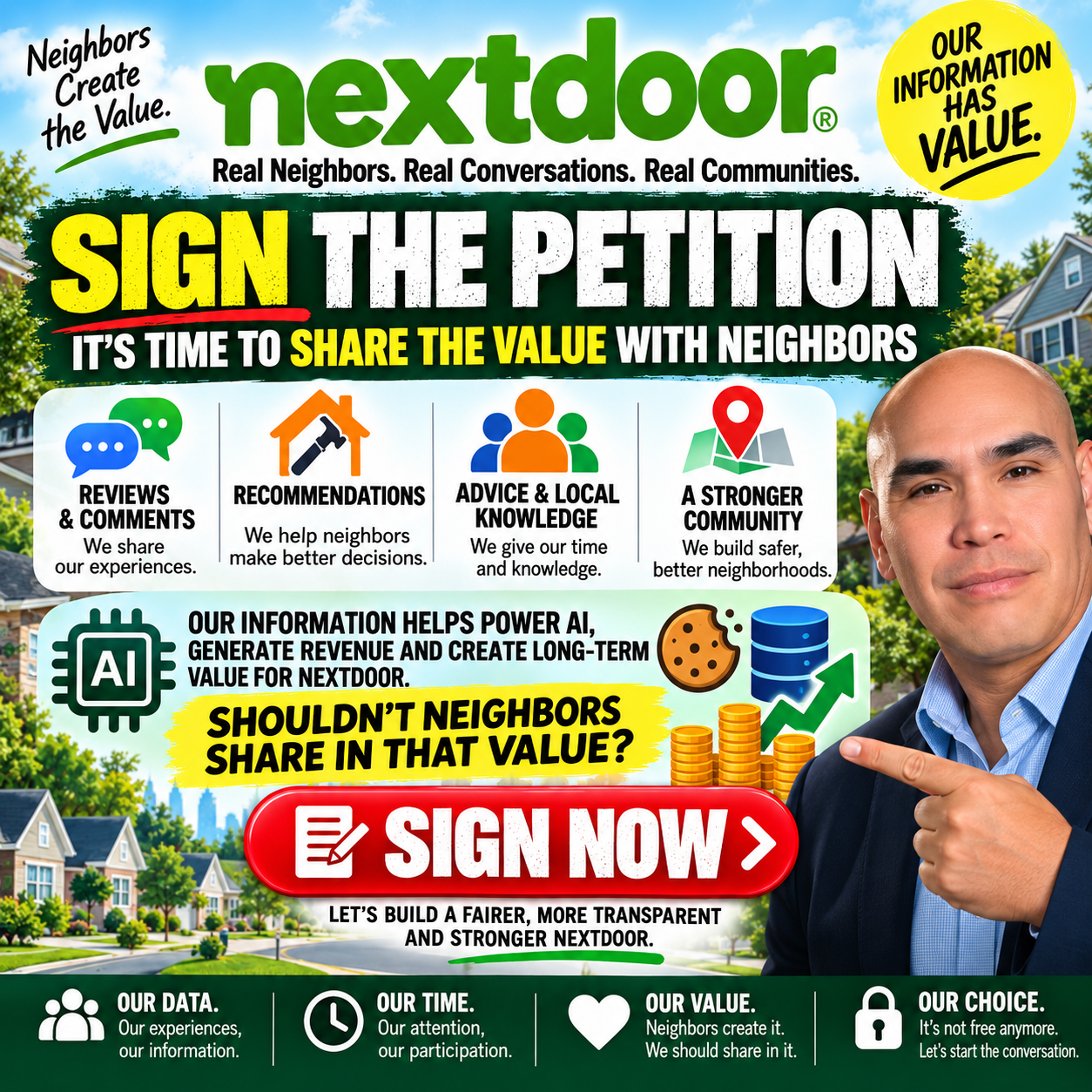
The Free Data Buffet Is Over: If Our Content Creates Value, We Should Share in It
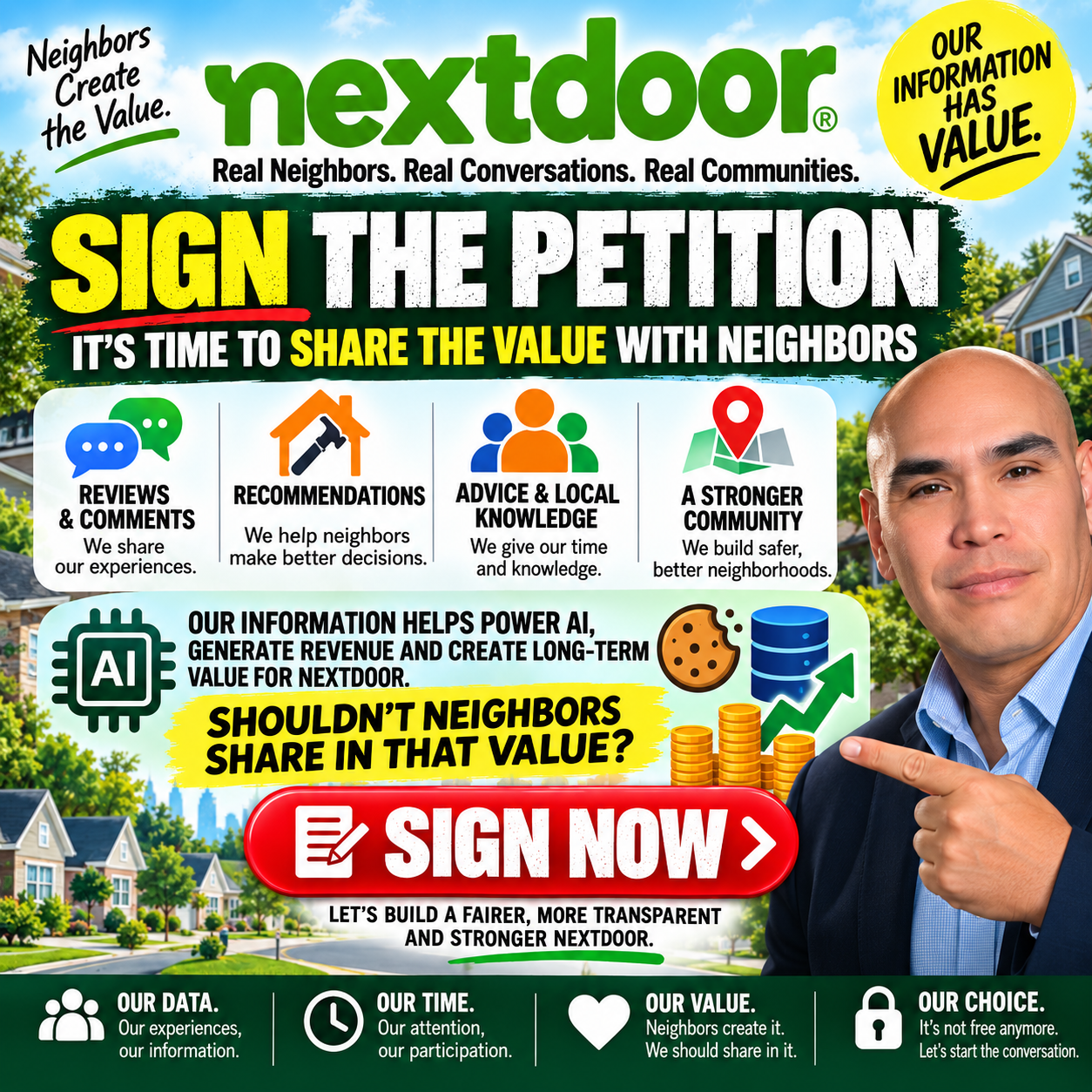
A while ago, I started a petition asking a fairly simple question:
If Nextdoor can create economic value from information neighbors provide, why shouldn't the neighbors who provide it participate in that value?
Today, I'm expanding the question.
This isn't only about Nextdoor anymore.
It's about social media platforms, websites, apps, advertising networks, and other digital businesses that collect information about what we read, click, search, recommend, review, discuss, and buy.
My message is becoming simpler:
Our information isn't free anymore.
At least, I don't think it should be.
We Keep Supplying the Raw Material
Think about what people give digital platforms every day.
We write reviews. We recommend restaurants. We tell neighbors which plumber showed up on time. We answer questions. We upload photographs. We comment. We click. We search. We like things. We tell platforms what interests us.
Then there's the less obvious information: cookies, device identifiers, IP addresses, browsing activity, clicks and other event data.
These aren't all legally or technically the same thing, and different privacy laws and platform agreements govern how different types of information may be collected and used. I'm not claiming that placing a cookie on my browser magically means somebody owes me a royalty check.
I'm making an argument about economic value.
Because individually, one click may be almost meaningless.
Multiply those clicks, posts, recommendations, and behavioral signals across millions of people, however, and suddenly we're talking about an extremely valuable resource.
Nextdoor Makes the Point Particularly Well
Nextdoor increasingly describes itself in terms of neighbor-generated knowledge. Its 2025 Transparency Report described the platform as containing “neighbor-generated content and locally relevant information,” while Nextdoor's newer AI-powered Ask product draws upon nearly 15 years of conversations among verified neighbors. Nextdoor
That's valuable.
And who created those conversations?
Neighbors did.
Nextdoor built the platform.
Nextdoor paid engineers.
Nextdoor created the infrastructure.
Nextdoor developed the advertising business.
Nextdoor has every right to try to build a profitable company from those investments.
But neighbors supplied an enormous amount of the raw material that makes the platform useful.
Nextdoor itself says almost 30% of its content consists of organic recommendations and has talked about tens of millions of “Faves” associated with millions of businesses. Nextdoor Blog
That's nothing.
Cookies Are Part of the Bigger Conversation
The same principle makes me think differently about tracking.
Nextdoor's own data-processing documentation identifies things such as cookie IDs or similar identifiers, IP addresses, user-agent information, and event data such as clicks or installs among categories of personal data involved in certain advertising-related processing. Nextdoor Legal
Again, this isn't uniquely a Nextdoor issue.
It's an internet issue.
We've spent years becoming accustomed to clicking:
ACCEPT ALL COOKIES
Maybe we should start thinking more carefully about what we're accepting and what companies receive in return.
If information about my behavior helps improve targeting, train recommendation systems, develop products, measure advertising, build audiences or otherwise contribute to commercial value, I think it's reasonable to have a larger conversation about what the person generating that information receives in return.
Welcome Back to My Very Lonely Petition 😂
My petition hasn't exactly become the Boston Tea Party of user-generated data.
Last time I checked, it had one signature.
Mine.
😂
I already know what that guy thinks.
But perhaps my original message was too focused on Nextdoor.
Because this question is much bigger.
My updated message isn't:
Destroy social media.
It isn't:
Stop using the internet.
And it certainly isn't:
Companies shouldn't make money.
It's this:
If our participation creates commercial value, let's start talking about sharing that value.
That could take many forms.
Direct compensation for opt-in research. Contribution credits. Subscription benefits. Revenue-sharing pools. Advertising credits. Payments for particularly valuable content. Rewards for reviews or recommendations that generate measurable commercial activity. Stronger controls over commercial reuse. Clear choices about whether content can be used to develop AI products.
I don't pretend to have the perfect economic model.
That's what the conversation is for.
Until Then, We Can Stop Supplying Some of the Commodity
That's the other part of my petition.
Participation is voluntary.
If I don't like the economic arrangement, I can reconsider what I voluntarily contribute.
That doesn't mean withholding information about a missing child, dangerous weather, a lost pet, a fire, an emergency, or something that could protect another person.
Human safety comes before my argument about data economics.
I'm talking about the routine commercial material platforms benefit from:
Which roofer should I hire?
What's the best restaurant nearby?
Who installed your HVAC system?
Would you recommend this dealership?
Which insurance company do you use?
Every answer adds another tiny piece to a valuable database.
Maybe we should stop automatically assuming that contribution costs $0.00.
The Internet Made Us the Product, the Customer and the Workforce
That's what fascinates me.
We can simultaneously be the audience viewing advertisements, the customer purchasing products, the creator producing content, and the source generating behavioral data.
That's an extraordinary business model.
For the companies.
Maybe it's time users become more conscious participants in the economics too.
And I'm not suggesting that users automatically have a legal right to payment for everything they post or every cookie generated. Platform terms, privacy laws, and individual choices matter.
I'm saying something much simpler:
We can ask for a different deal.
Nextdoor, You're Still My Test Case
Nextdoor remains particularly interesting to me because its product depends so heavily on what neighbors know.
Without neighbors, there are no neighbor recommendations.
Without neighbors, AI has no years of neighborhood conversations to search.
Without neighbors, there are no local experiences to organize.
Without neighbors, advertisers have far less reason to want access to those neighborhoods.
Nextdoor says it wants every voice to have value. Nextdoor Business
Great.
Let's talk about the economic value too.
Nextdoor built the container.
Neighbors keep filling it.
So I'm Updating the Invitation
To Nextdoor.
To social-media companies.
To websites.
To apps.
To companies collecting behavioral information.
And, most importantly, to the people creating all of it:
Stop thinking of your digital activity as automatically worthless simply because nobody has historically written you a check for it.
Ask what you're providing.
Ask how it's being used.
Read the privacy controls.
Decline unnecessary tracking when you prefer not to.
Think before voluntarily providing another commercially useful recommendation, review, or piece of content.
And if enough people decide the current exchange isn't good enough?
Companies will have an incentive to offer a better one.
My petition may still have only one signature.
That's okay.
Every movement has a first person willing to look slightly ridiculous standing there alone.
I'm already bald. I've survived worse. 😂
Our information has value.
Our content has value.
Our recommendations have value.
Our attention has value.
Our time has value.
The question isn't whether digital companies should be allowed to create value.
The question is whether the people supplying so much of the raw material should be part of it.
I think that's a conversation worth having.
👉 Sign the petition: https://c.org/GkNWmffgg9
👉 Follow the continuing case study: NielFlamm.com/blog

The Facebook Experiment Continues: Amy Messaged Me, and Now I Have More Questions
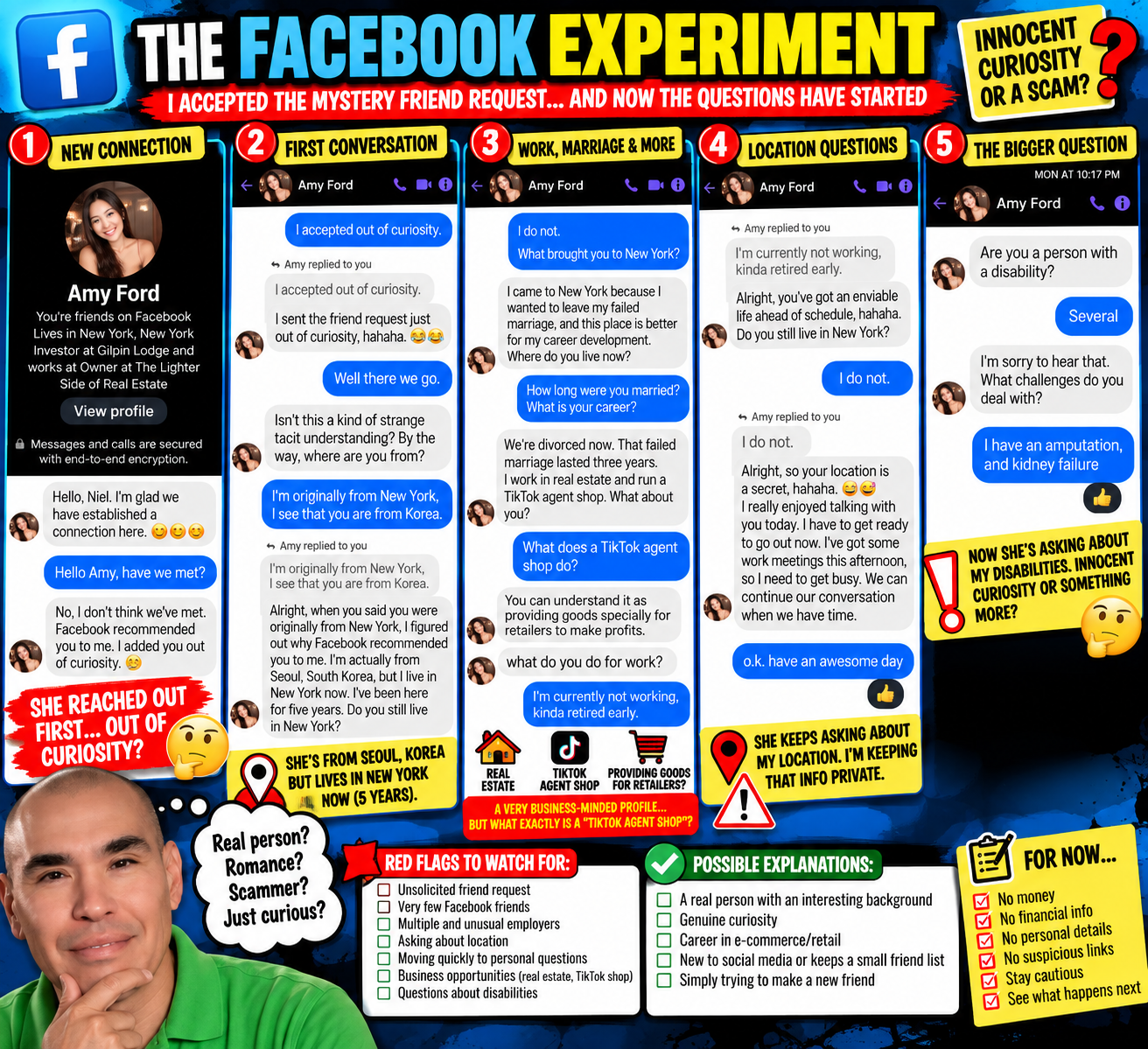
Well, that didn't take long.
In my last update, I shared that I finally accepted the mysterious friend request from Amy Ford on Facebook.
I didn't know Amy. We had one mutual friend. Her profile caught my attention for several reasons, including a rather impressive collection of jobs. Still, none of that proved anything was wrong with the account.
So curiosity won.
I accepted.
And shortly afterward, Amy messaged me.
“I Added You Out of Curiosity”
Amy opened with:
“Hello, Niel. I'm glad we have established a connection here.”
I asked the obvious question:
“Hello, Amy, have we met?”
Nope.
She said Facebook recommended me and that she added me “out of curiosity.”
That made me laugh because curiosity was exactly why I accepted her.
I told her:
“I accepted out of curiosity.”
Her response?
“I sent the friend request just out of curiosity, hahaha.”
Well, there we go.
Two strangers brought together by the powerful matchmaking algorithm of The Facebook—and apparently mutual curiosity.
What could go wrong?
Then Came the Questions
Amy asked where I was from.
I told her I was originally from New York and mentioned that I saw she was from Korea.
She explained that she's originally from Seoul, South Korea, has lived in New York for five years, and then asked whether I still lived in New York.
I said I didn't.
She asked where I live now.
I didn't answer.
Instead, I asked what brought her to New York.
According to Amy, she moved there after leaving a failed marriage because New York offered better career opportunities.
I asked how long she had been married and what she did for work.
She said the marriage lasted three years and told me:
“I work in real estate and run a TikTok agent shop.”
Now I had another question.
What's a TikTok Agent Shop?
Remember, her Facebook profile already showed several professional roles, including investor, real estate business owner, and an HR-related position.
Now I had a TikTok agent shop to add to the résumé.
So I asked what a TikTok agent shop does.
Her explanation was:
“You can understand it as providing goods specifically for retailers to make profits.”
Okay.
I still don’t entirely understand it.
Then the conversation turned back toward me.
She asked what I do for work.
I told her:
“I'm currently not working, kinda retired early.”
Her response caught my attention:
“Alright, you've got an enviable life ahead of schedule.”
Then she asked again:
“Do you still live in New York?”
I answered:
“I do not.”
And that was it.
No location.
Amy joked that my location was apparently a secret.
For now, it is.
Then the Conversation Took an Unexpected Turn
Amy said she had enjoyed talking with me but needed to get ready for some work meetings. We exchanged pleasantries, and the conversation ended.
Or so I thought.
Later that night, at 10:17 p.m., another message arrived:
“Are you a person with a disability?”
That's certainly a conversation starter.
I answered:
“Several.”
She asked what challenges I deal with.
I told her about my amputation and kidney failure.
And that's where the screenshots currently leave us.
So, Is This a Scam?
I still don't know.
And I think that's important to say.
Nothing in this conversation proves that Amy is running a scam or that the person behind the account isn't who they claim to be.
At the same time, I'm paying attention.
An unsolicited friend request from a stranger.
Very few Facebook friends.
Several different professional descriptions.
Questions about where I live.
Questions about my employment.
A business involving retailers making profits.
And now questions about my disabilities.
Each one can have a perfectly innocent explanation.
Taken together, they're enough for me to continue being cautious.
I'm Also Curious About Where This Goes
This has become a little social-media experiment for me.
I'm not sending money.
I'm not providing financial information.
I'm not sharing passwords or account information.
I'm not clicking mystery links.
And I'm not rushing to provide personal details simply because someone asks.
I'm having a conversation.
If Amy is simply a friendly person in New York who found my profile through Facebook recommendations, that may be all this ever is.
If the conversation eventually turns into:
“Niel, have you ever considered cryptocurrency?”
Well...
I may have another blog post to write.
For now, The Facebook Experiment continues.
And I have a feeling this story isn't finished yet.

Did It: I Accepted the Mystery Friend Request on The Facebook
Well, I did it.
Against the little voice in my head saying, “Niel, you know how these stories usually end,” I clicked Confirm.
Amy Ford and I are now officially friends on The Facebook.
I feel like I should update my relationship status.
For anyone who missed the first chapter, a few days ago I received a friend request from Amy. I had no clue who she was. We had one mutual friend, and her profile raised enough questions that I wrote an entire blog post asking whether I should accept the request or hit Delete.
Curiosity won.
Welcome to the experiment.
First Discovery: Amy Is Still Posting
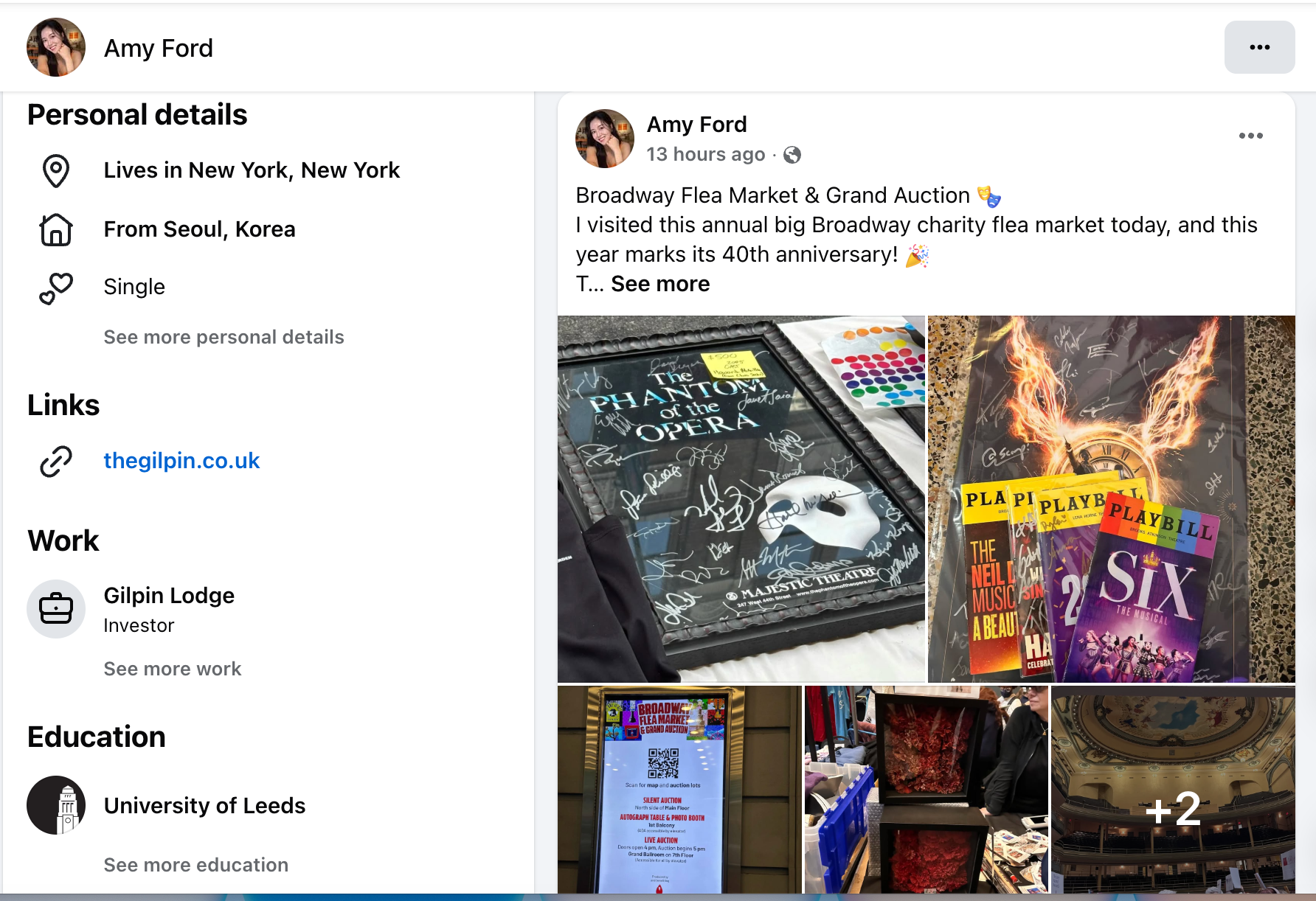
After accepting the request, I noticed a new post from today about the Broadway Flea Market & Grand Auction in New York.
There are pictures of Broadway memorabilia, Playbills, auction items, and the theater.
Okay.
That's certainly more interesting than immediately receiving:
“Hello dear, how are you today?”
Followed seven minutes later by an incredible cryptocurrency opportunity.
So far, so good.
But accepting the request also allowed me to see more of the profile.
And that's when I noticed Amy's résumé.
Amy Is Apparently Very Busy
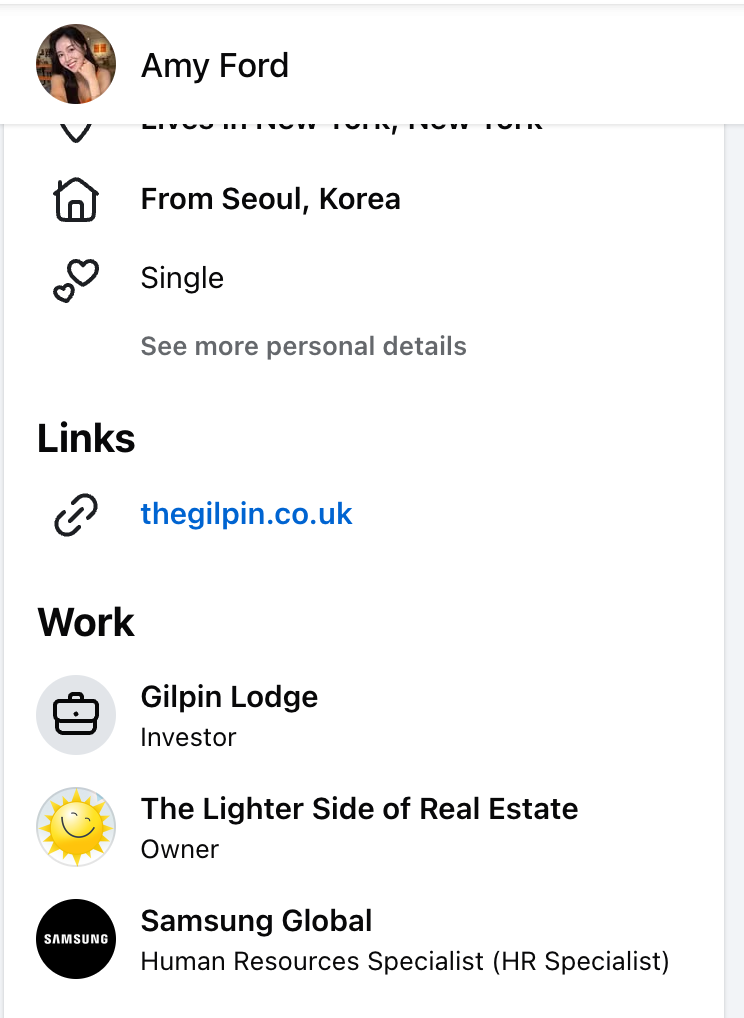
According to the profile, Amy has not one, not two, but three different employers listed.
She is apparently:
Investor — Gilpin Lodge
Owner — The Lighter Side of Real Estate
HR Specialist — Samsung Global
That's quite a career portfolio.
Investor.
Business owner.
Human Resources professional.
I'm tired just reading it.
And remember, the profile currently shows only 16 Facebook friends.
It seems Amy may have more jobs than friends on The Facebook.
I'm not judging.
Maybe she's simply very career-focused.
Maybe she's an extraordinarily successful multitasker.
Maybe LinkedIn wasn't challenging enough.
Then There's the Rest of the Profile
The information visible to me now says she:
Lives in New York, New York.
Is from Seoul, Korea.
Is single.
Went to the University of Leeds.
Works—or has worked—in those three very different roles.
And she's posting about New York attractions and events.
Does any one of those things prove anything suspicious?
No.
That's important.
People move. People change careers. People have multiple jobs. People don't always maintain large Facebook friend lists. People use English names. And successful people can certainly have unusual career paths.
But taken together with an unsolicited friend request from someone I don't know?
My eyebrow remains raised.
Possibly both eyebrows.
Now We Wait
I'm not messaging Amy.
I'm not asking for a phone number.
I'm not moving the conversation to WhatsApp or Telegram.
I'm certainly not discussing investments.
And if Amy happens to have an uncle who is a cryptocurrency genius who can turn $500 into $47,000 by Thursday...
I'm probably going to pass.
For now, I'm simply curious about what happens next.
Maybe nothing happens.
Maybe Amy is a perfectly real person who happened to send me a random friend request.
Maybe I'll eventually discover why she wanted to connect with me.
Or maybe the next chapter writes itself.
Either way, I clicked Confirm.
The experiment has officially begun.
And Amy, if you're real and eventually stumble across these posts:
Hi.
Please don't take it personally.
My inbox has trained me to be suspicious of everybody.
Especially people with more jobs than Facebook friends.
A Mystery Friend Request on The Facebook: Friend Her or Hit Delete?
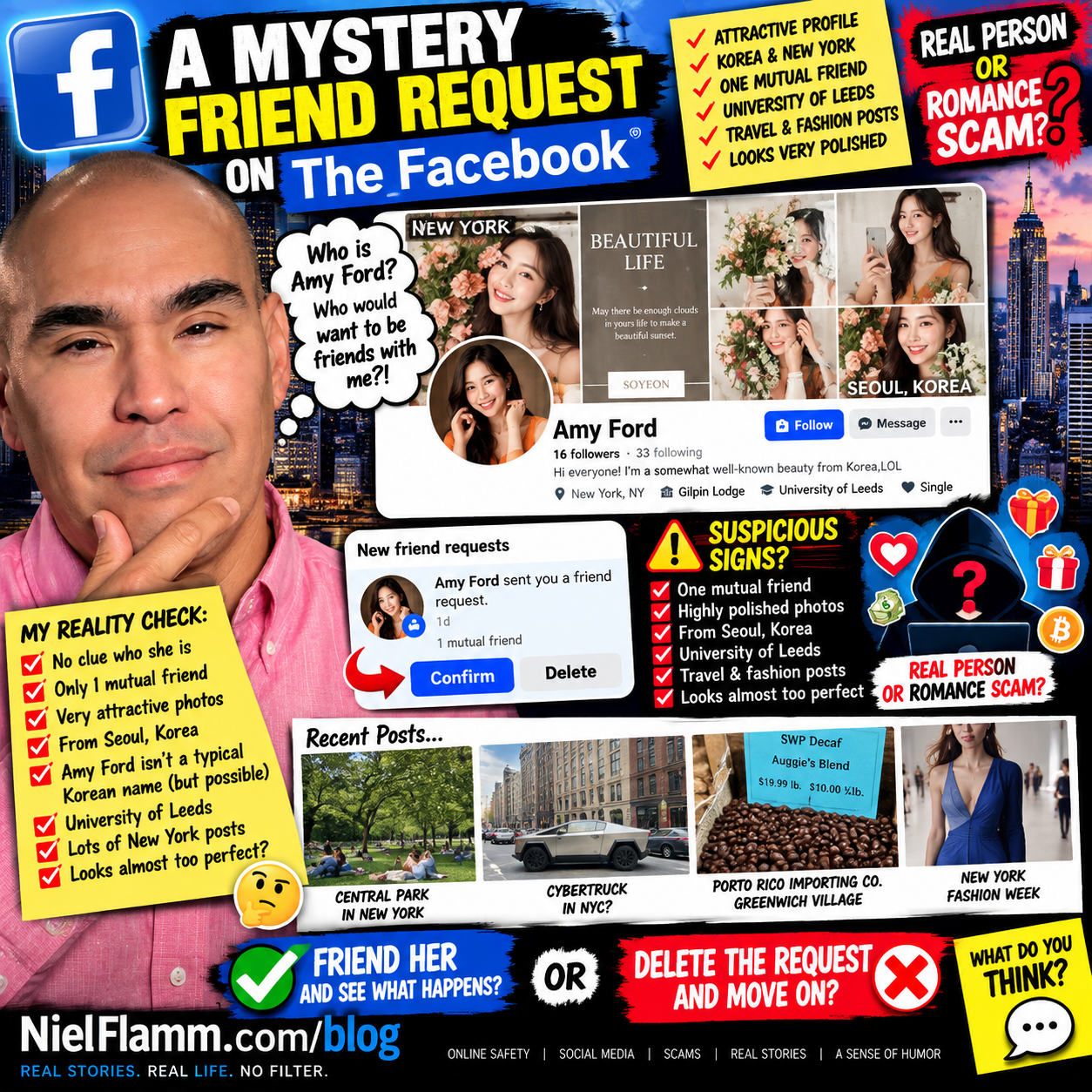
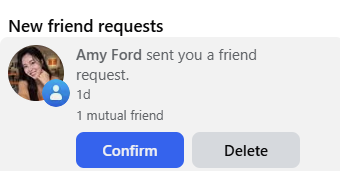
A few days ago, I received a friend request on The Facebook.
Yes, I’m calling it The Facebook.
The request came from Amy Ford.
My immediate reaction was pretty simple:
Who is Amy Ford?
I have absolutely no clue.
Then the second thought kicked in:
Who would randomly want to be friends with me?
And that's when a little insecurity started creeping in. I'm old. My kidneys are failing. I have one fully intact leg. My eyes aren't exactly operating at 4K resolution. I'm a little chubby.
Yet here comes this attractive stranger wanting to be my friend on The Facebook.
Okay.
What could go wrong?
One Mutual Friend
Before immediately hitting delete, I looked at the profile.
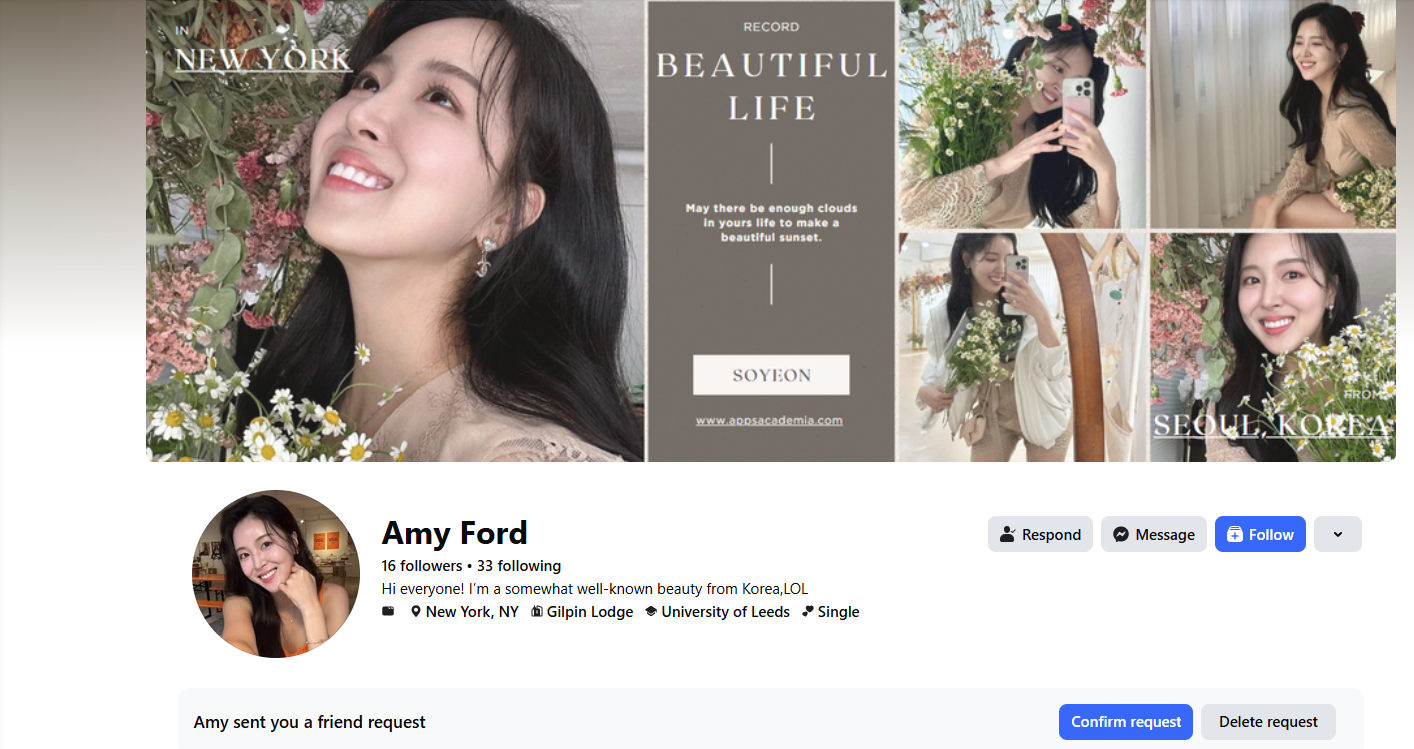
We have one mutual friend.
One.
That's enough to make me curious, but certainly not enough to make me think, Oh, of course! Amy!
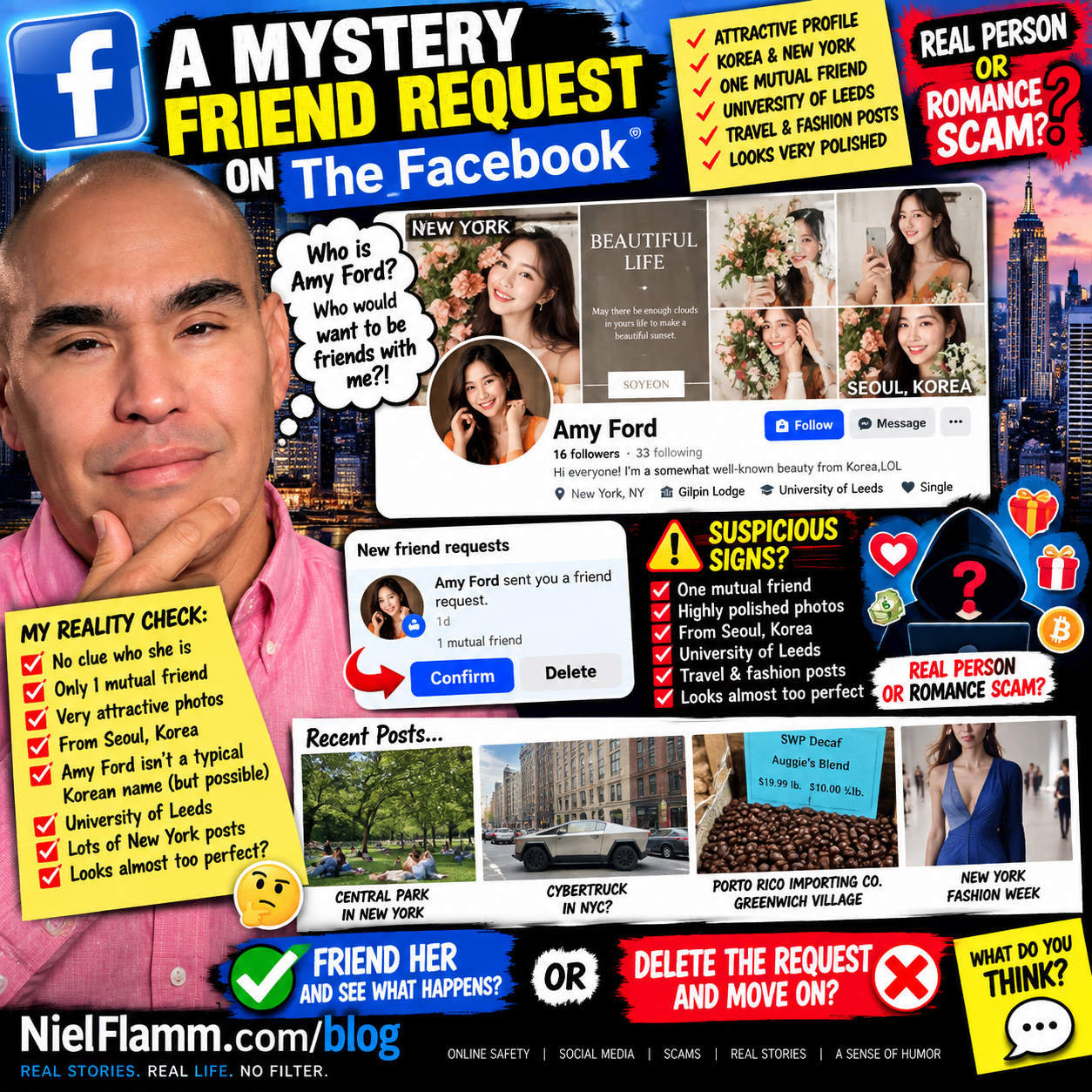
Her profile says she's in New York and references Korea, along with the University of Leeds. Her bio says:
“Hi everyone! I’m a somewhat well-known beauty from Korea, LOL.”
That's an interesting introduction.
And yes, the name Amy Ford initially caught my attention, along with the Korean references. Of course, someone from Korea can have an English or Western name, so the name by itself proves absolutely nothing.
But combined with everything else?
My curiosity started winning.
So I Started Digging
I looked through her public posts.
There are posts about New York.
Central Park.
Ballet.
A Cybertruck driving through Manhattan.
Porto Rico Importing Co. in Greenwich Village.
New York Fashion Week.
Plenty of photographs, locations, and little slices of New York life.
At first glance, it looks like someone documenting life in the city.
But then I started looking at the profile as a whole.
The account shows 16 followers and 33 following.
We share only that one mutual connection.
There are highly polished profile and cover images featuring the same woman, including a collage labeled “NEW YORK,” “BEAUTIFUL LIFE,” “SOYEON,” and “SEOUL, KOREA.”
Then there's the University of Leeds reference.
Maybe every bit of it is legitimate.
Maybe Amy is exactly who the profile says she is.
Or maybe this will become another chapter in my growing collection of strange things people send me online.
I don't know.
And that's precisely why I haven't hit Confirm.
I've Seen This Movie Before
After documenting recruiter scams, suspicious social media accounts, fake car sellers, PayPal scams, Geek Squad scams, mystery invoices, and the other nonsense that seems to find its way to me, I've learned something:
Curiosity is powerful.
It's also exactly what questionable accounts can rely on.
The temptation is obvious.
Accept the request.
Don't volunteer any personal information.
Don't click anything.
Don't send money.
And see what happens.
Will “Amy” send a perfectly normal message?
Will she never contact me at all?
Will we suddenly move from Hello to cryptocurrency investing in 14 minutes?
Will an uncle show up with an incredible investment opportunity?
Will WhatsApp or Telegram show up?
Maybe none of that happens.
That's what makes this interesting.
So I'm Putting It to You
I'm genuinely undecided.
There isn't enough here for me to declare that the person behind this account is a scammer. A profile that looks unusual to me isn't proof of anything, and neither is someone's name, appearance, nationality, school, number of friends, or posting style.
But there are enough things that don't immediately add up for me that I'm hesitant to click Confirm.
So, readers, I'm handing you the mouse.
What should I do?
👍 Accept the friend request and see what happens?
🗑️ Delete it and move along?
And more importantly: What do you look for when a stranger sends you a friend request on The Facebook?
I have a feeling the comments on this one could be more entertaining than the friend request.
Another TikTok Car Deal: A $4,000 Scat Pack With $500 Down? Here We Go Again
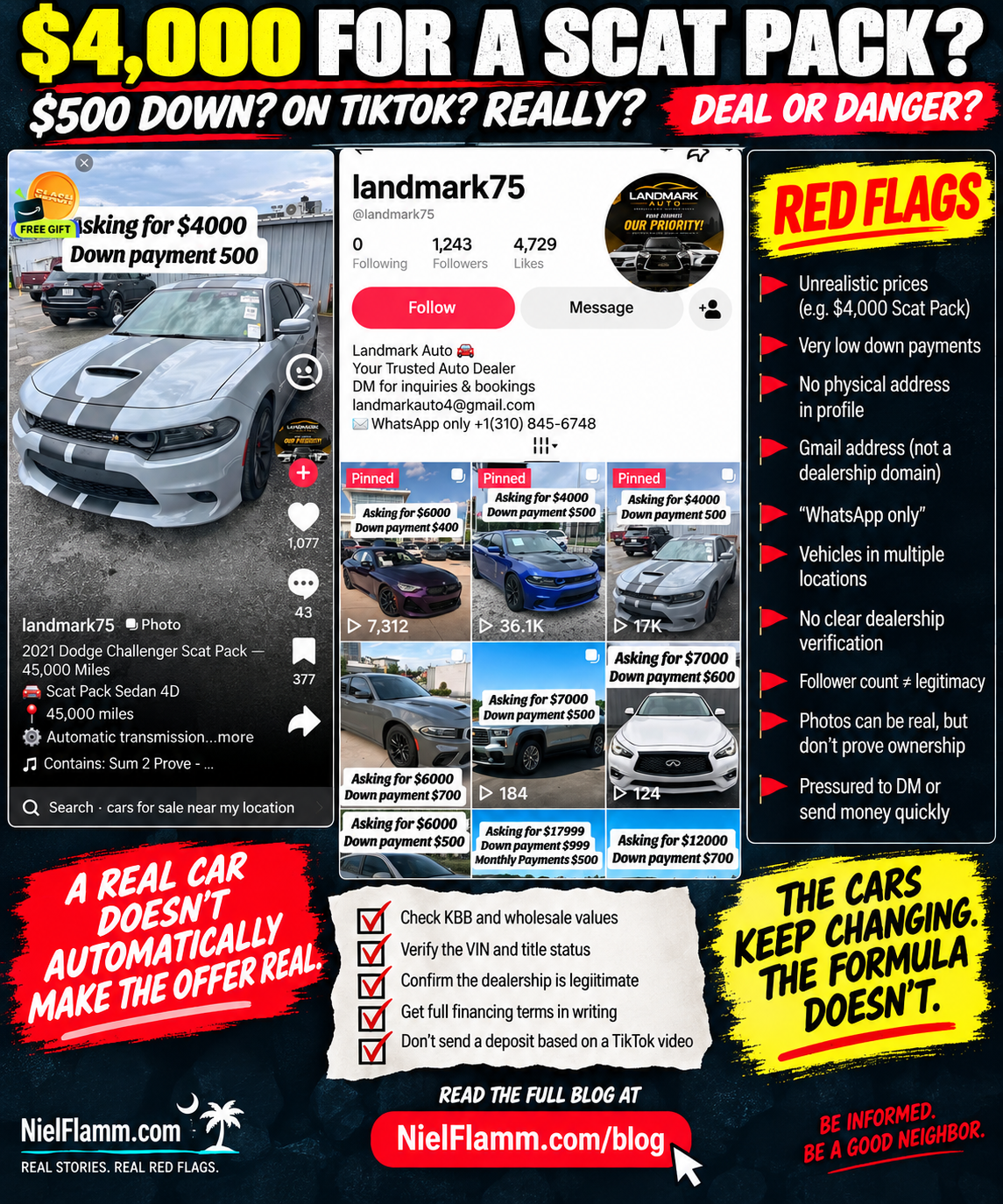
Apparently TikTok has decided that one questionable car account wasn't enough for me.
After looking at an account advertising everything from inexpensive transportation to Porsches with tiny down payments, another account appeared in my feed.
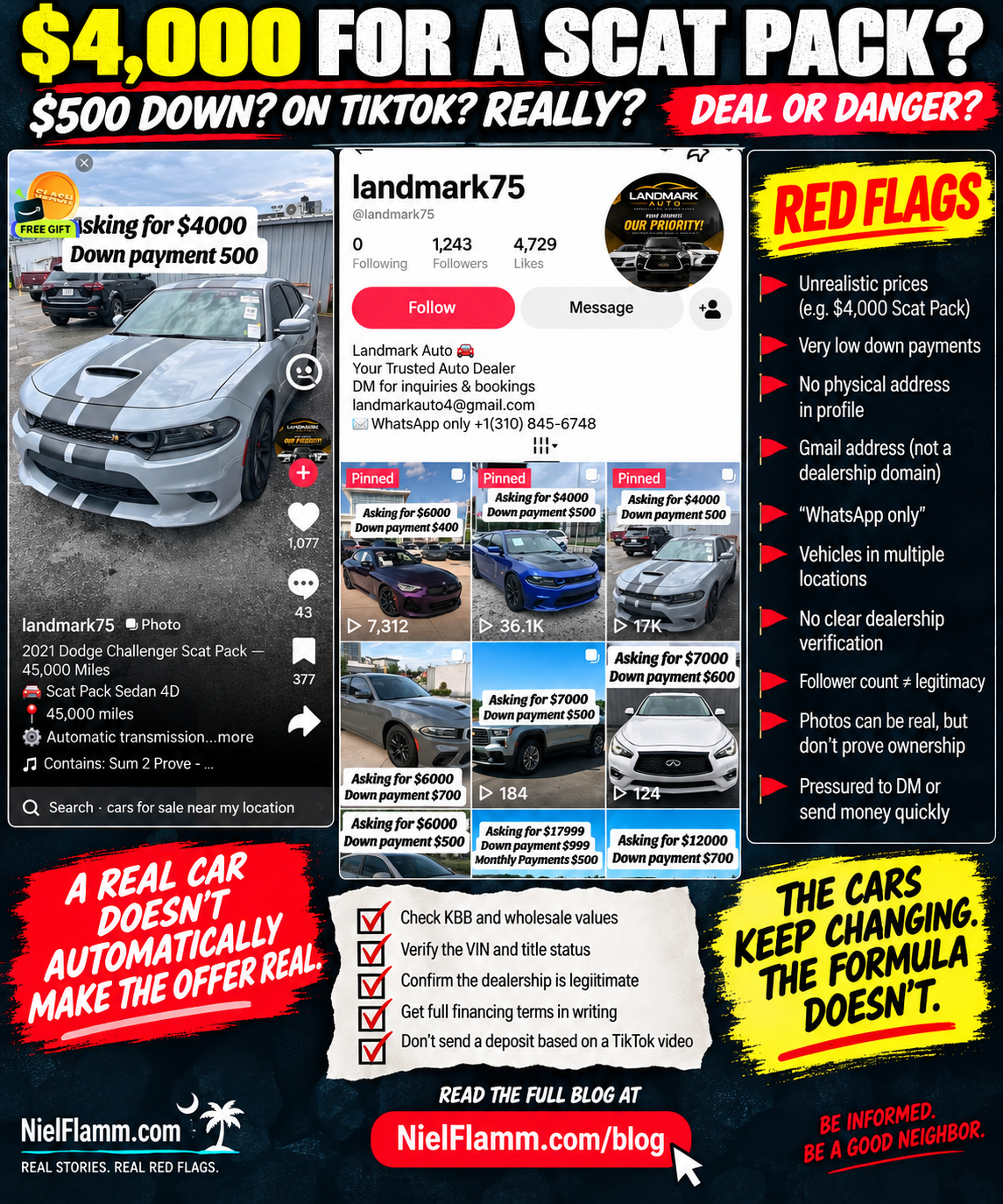
This one calls itself “landmark75.”
At the time of my screenshot, the profile showed more than 1,200 followers and 4,700 likes and described itself as:
“Landmark Auto 🚗
Your Trusted Auto Dealer
DM for inquiries & bookings”
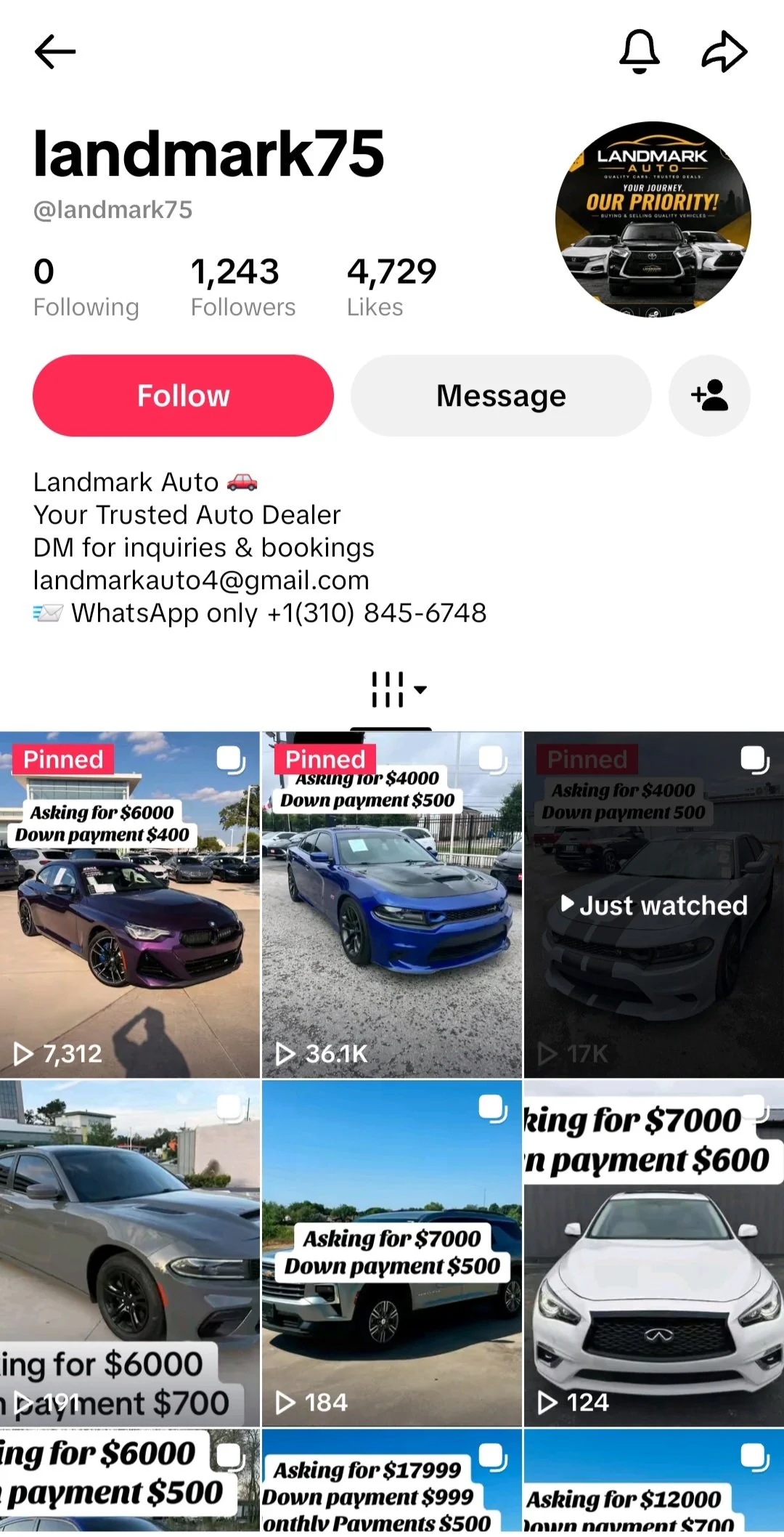
Then things get interesting.
The profile lists a Gmail address and says
“WhatsApp only”
The profile doesn't show a physical dealership address.
And the inventory?
Once again, apparently we're living in the magical land of extremely inexpensive automobiles.
🚗 Today's Special: A 2021 Dodge Charger Scat Pack for $4,000
One post advertises what it describes as a:
2021 Dodge Charger Scat Pack
45,000 miles
And across the top of the photograph:
“Asking for $4000
Down payment 500”
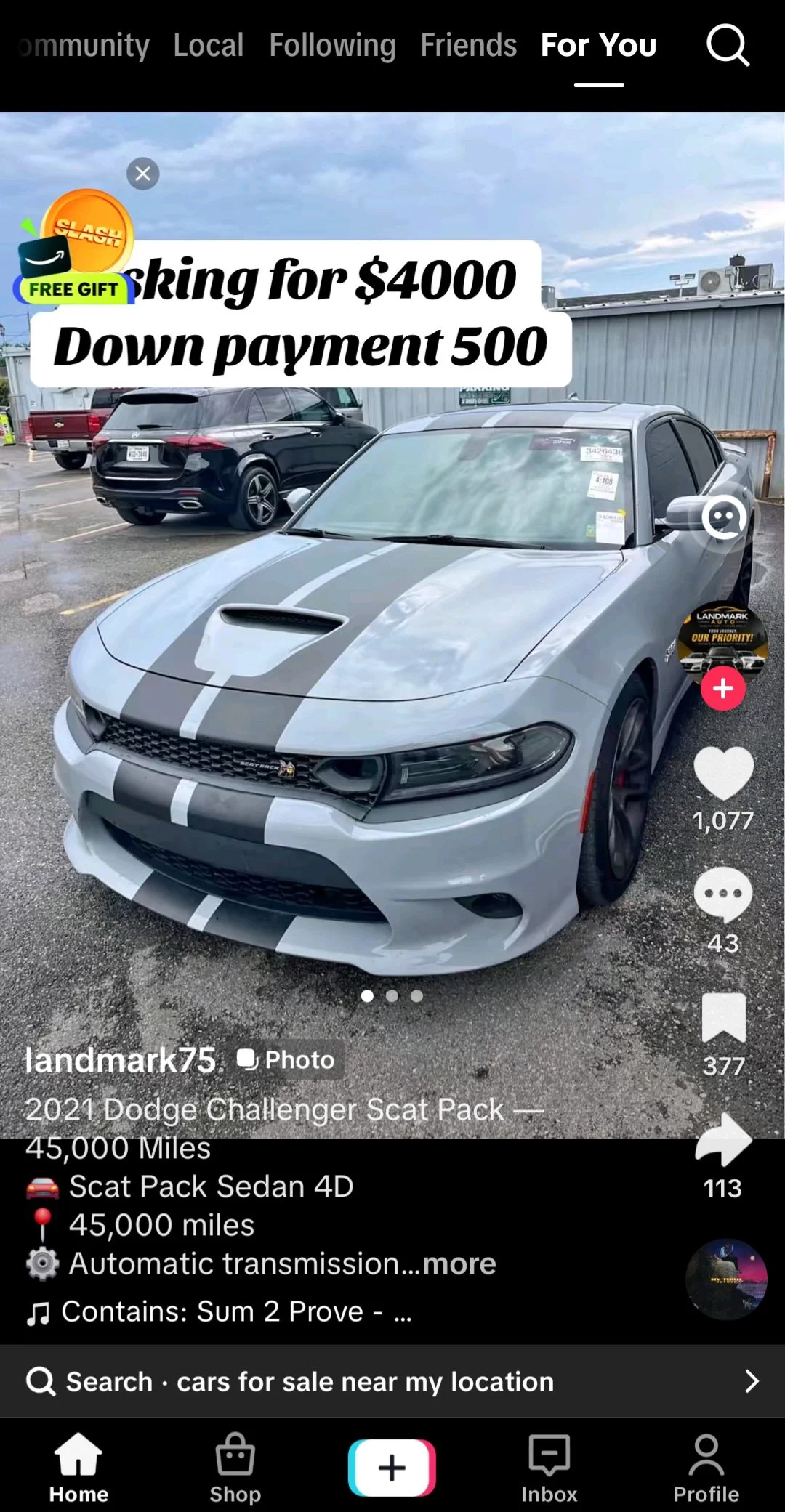
Wait.
$4,000?
For a 2021 Charger Scat Pack with 45,000 miles?
I thought the $500 down payment was supposed to be the unbelievable part.
This time it's the alleged asking price.
And this wasn't some obscure post nobody had seen. My screenshot showed more than 1,000 likes, along with dozens of comments and hundreds of saves.
💰 Let's Check Reality
A 2021 Dodge Charger Scat Pack wasn't inexpensive when new, and clean used examples haven't suddenly become $4,000 cars.
Current Kelley Blue Book values vary considerably by mileage, equipment, condition, and location, but a 2021 Charger Scat Pack remains worth many times the $4,000 advertised here.
Even before knowing the VIN, vehicle history, or exact condition, that's enough of a pricing discrepancy to make me stop.
Could a $4,000 Charger exist?
Sure.
Maybe it's wrecked.
Maybe it has a branded or salvage title.
Maybe it has catastrophic mechanical problems.
Maybe it's missing an engine.
Maybe there's some other legitimate explanation.
But none of those explanations appear in the TikTok post.
Instead, I'm seeing a shiny Scat Pack photographed on what appears to be a dealer or auction lot and an advertised price of:
$4,000
That's when I want documentation, not emojis.
🚩 And It's Not Just the Scat Pack
Then I looked at the rest of the profile.
One pinned post appears to advertise a BMW for:
Asking: $6,000
Down payment: $400
Another Charger:
Asking: $4,000
Down payment: $500
Another vehicle:
Asking: $6,000
Down payment: $700
Another:
Asking: $7,000
Down payment: $500
An Infiniti appears with:
Asking: $7,000
Down payment: $600
Farther down, there's another vehicle advertised at $17,999 with $999 down and $500 monthly payments.
It's the same pattern I've been seeing repeatedly.
Attractive vehicles.
Extremely attractive prices.
Tiny down payments.
And social media as the storefront.
🚩 But Look at the Charger Photo More Closely
Here's something else that caught my attention.
The Charger has multiple stickers on the windshield.
That makes the vehicle look more credible because we're clearly looking at an actual car.
But that's something I've been stressing throughout this series:
A real car doesn't automatically make the offer real.
A vehicle can exist without the person posting its photograph owning it.
A vehicle can sit on an auction lot without a TikTok account having authority to sell it.
A photograph can come from another dealership, auction, listing or social-media account.
I'm not saying that's necessarily what happened here.
I'm saying a photograph isn't proof of ownership.
Before I send someone $500, I'd want the VIN and I'd want to independently establish exactly who owns the vehicle and where it's physically located.
📱 “WhatsApp Only”
Then we get to one of the biggest things that would make me cautious.
The profile doesn't direct potential buyers to a recognizable dealership website or give a street address.
Instead:
DM for inquiries & bookings
and
WhatsApp only
WhatsApp itself isn't suspicious. Millions of legitimate businesses use it.
But if I'm supposedly purchasing a vehicle from an auto dealer, I want more than a social-media profile and messaging account.
I want:
The legal business name.
Physical dealership address.
Dealer license information.
VIN.
Title status.
Vehicle history.
Actual cash selling price.
Financing terms.
APR.
Length of loan.
Total of payments.
And I want to verify those things independently, not solely through information sent to me by the person asking for my money.
💵 $500 Down Doesn't Tell Me What the Car Costs
This is another distinction consumers need to understand.
A legitimate dealer absolutely can sell a $30,000 vehicle with only $500 down.
That doesn't mean the vehicle costs $500.
The remaining balance gets financed.
That's why a post screaming “ONLY $500 DOWN!” tells me very little without the rest of the transaction.
But this Charger post goes further.
It appears to say the asking price itself is $4,000.
If that's genuinely the total purchase price for a running, roadworthy 2021 Charger Scat Pack with 45,000 miles and a transferable title, I would want to understand exactly why it is being offered so dramatically below normal market value.
🚩 Followers Still Aren't Verified
We've seen this before.
This account has more than a thousand followers.
One of its videos has tens of thousands of views.
That creates social proof.
People think:
“Other people are following them.”
“The video has 36,000 views.”
“There are hundreds of likes.”
“The cars are real.”
Therefore:
“The seller must be legitimate.”
Those aren't the same thing.
A follower isn't a dealer license.
A like isn't a title.
A view isn't a VIN.
And 36,000 views don't turn a $4,000 Scat Pack into a normal market transaction.
🧮 The Numbers Have to Make Sense
This is where I keep returning to KBB and wholesale-market values.
A legitimate business generally needs to acquire inventory for less than it sells that inventory for.
That's the business model.
If the normal wholesale value of a vehicle is dramatically higher than the advertised retail price, I want to know how that transaction works economically.
Maybe there's a legitimate explanation.
Great.
Show me.
That's what due diligence is for.
I don't have the VIN or enough vehicle-specific information from this TikTok post to produce an exact Manheim Market Report value, and I'm not going to invent one.
MMR depends on factors including mileage, condition, trim, region and recent auction transactions.
But that's actually part of the problem.
The information necessary to properly evaluate these deals isn't prominently provided.
The extraordinary price is.
🏡 Don't Be Passive. Be a Good Neighbor.
Here's why I continue writing about these.
Imagine someone who needs a car desperately.
Their credit is damaged.
Their current car just died.
They have to get to work.
Traditional financing hasn't gone well.
Then TikTok serves them:
2021 CHARGER SCAT PACK
$4,000
$500 DOWN
That doesn't just look like a deal.
It can look like a solution to a serious problem.
Before someone you know sends $500 through an app because they're afraid another buyer will grab the car first, help them investigate.
Ask for the VIN.
Verify the VIN independently.
Find the physical dealership.
Verify its dealer license.
Call the dealership using a phone number you find independently.
Check the title.
Compare KBB retail value.
Compare wholesale value.
Ask for complete financing terms in writing.
And if somebody says you need to send money right now before you can do those things?
That answer tells you something too.
The Cars Keep Changing. The Formula Doesn't.
Over the past several posts, I've seen Toyotas, Hondas, BMWs, Audis, Camaros, Porsches and now Dodge Scat Packs advertised on social media with extraordinarily low prices or down payments.
Different accounts.
Different cars.
Different backgrounds.
But some remarkably familiar marketing:
Low price.
Tiny down payment.
DM me.
Quick approval.
Shipping available.
Send money.
I'm not sending $500 to find out what happens next.
I'll keep doing the free part:
Asking questions.
Because whether this particular offer has some explanation I can't see from the TikTok post or not, $4,000 for a 2021 Charger Scat Pack with 45,000 miles deserves a lot more than a swipe and a DM.
Follow along at NielFlamm.com/blog as I continue looking at questionable vehicle offers, suspicious emails, recruiting scams, and whatever the algorithm decides to throw at me next.