
Apparently, the Scammers Have Stopped Writing Emails
I've written quite a bit lately about scam emails, suspicious recruiters, mystery attachments, and people desperately trying to convince me to click something.
Apparently, we've now reached the minimalist phase of scamming.
Why bother writing an elaborate fake invoice when you can simply send me an attachment and hope I do the rest?
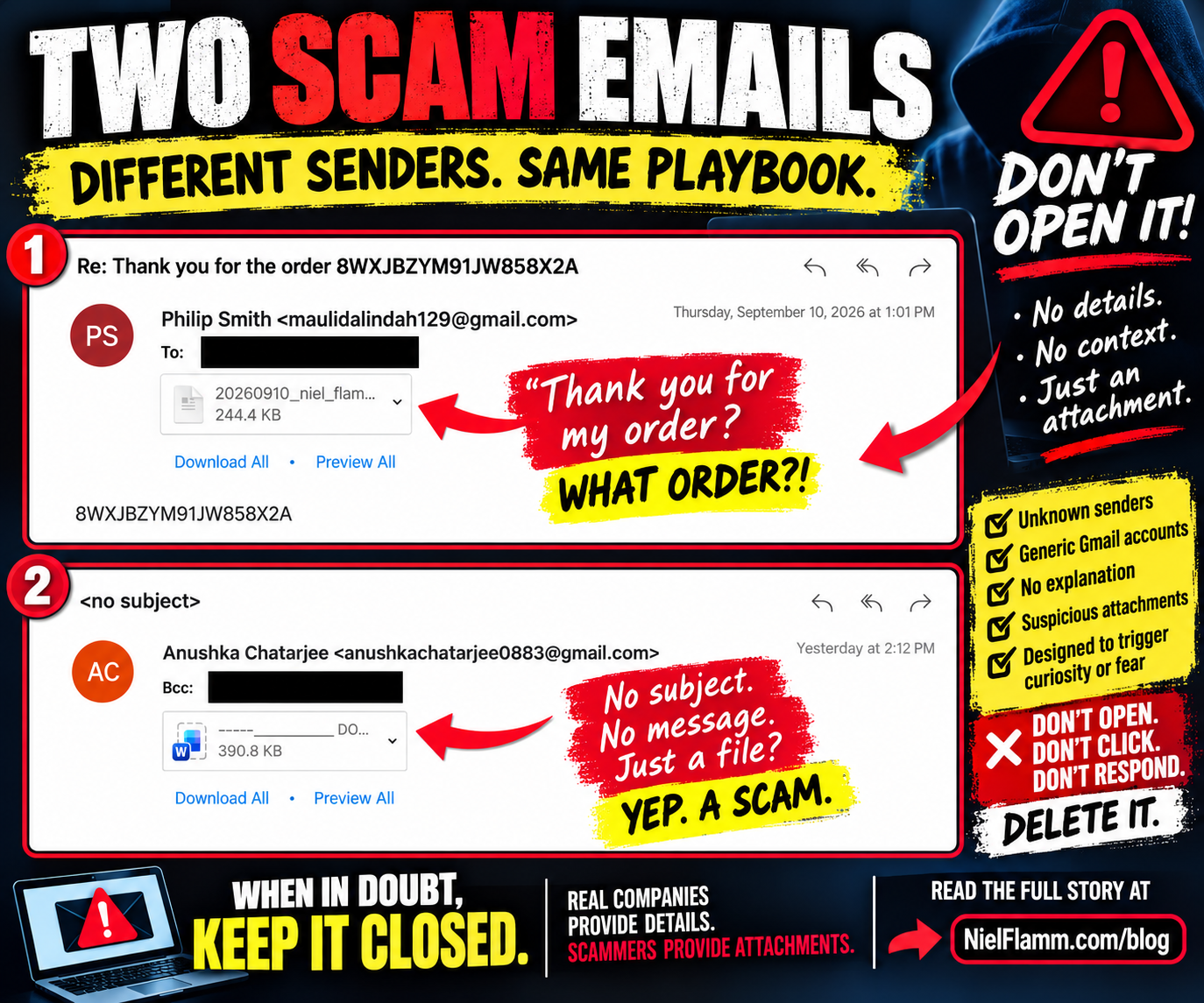
Over the past few days, I received two more emails that follow essentially the same strategy: almost no information, a mystery attachment, and curiosity as the bait.
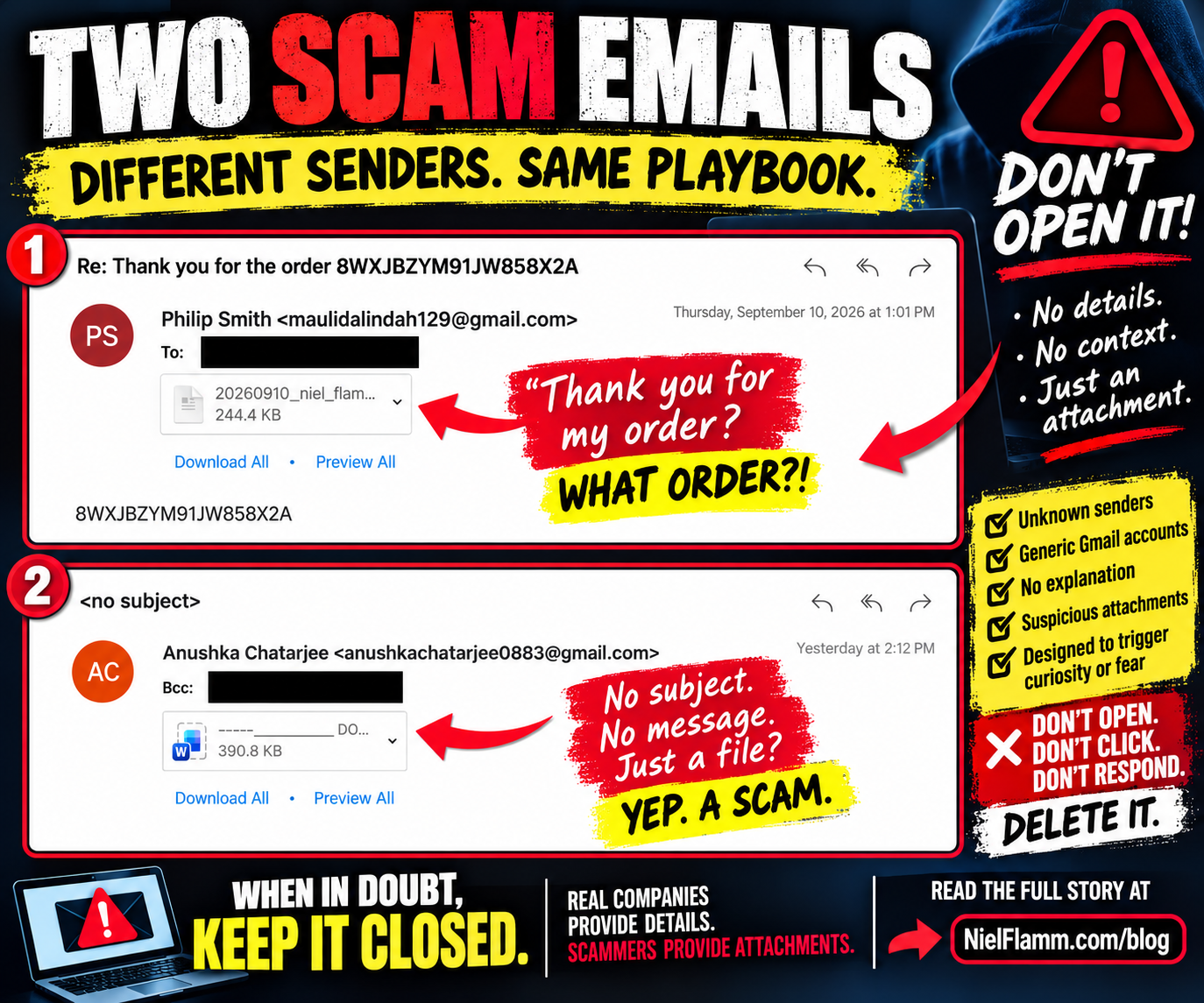
🚩 Scam Email #1: Thank You for the Order!
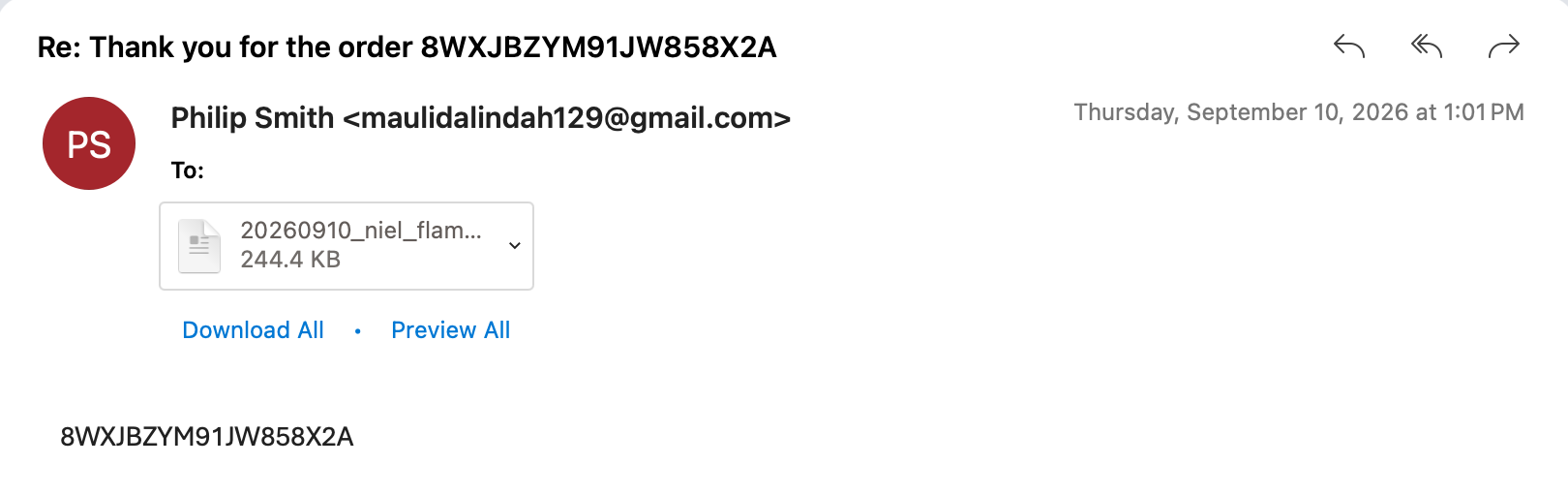
The first one came from someone identifying himself as Philip Smith, using a Gmail address.
The subject:
“Re: Thank you for the order 8WXJBZYM91JW858X2A”
Oh!
Thank you for my order!
There's just one tiny problem.
What order?
There's no company name.
No product.
No price.
No shipping information.
No recognizable merchant.
The body of the email contains essentially nothing except the same mysterious string:
8WXJBZYM91JW858X2A
And then there's an attachment.
A 244.4 KB file with a filename beginning with a date and my name.
That's a nice touch.
Putting someone's name in a filename can make the attachment feel personalized and legitimate.
But I'm supposed to believe I placed an order somewhere, received no explanation of what I purchased, and now need to open an unexplained attachment to discover what happened?
No thanks.
🚩 Scam Email #2: They Didn't Even Bother With a Subject
Then another masterpiece arrived.
Sender:
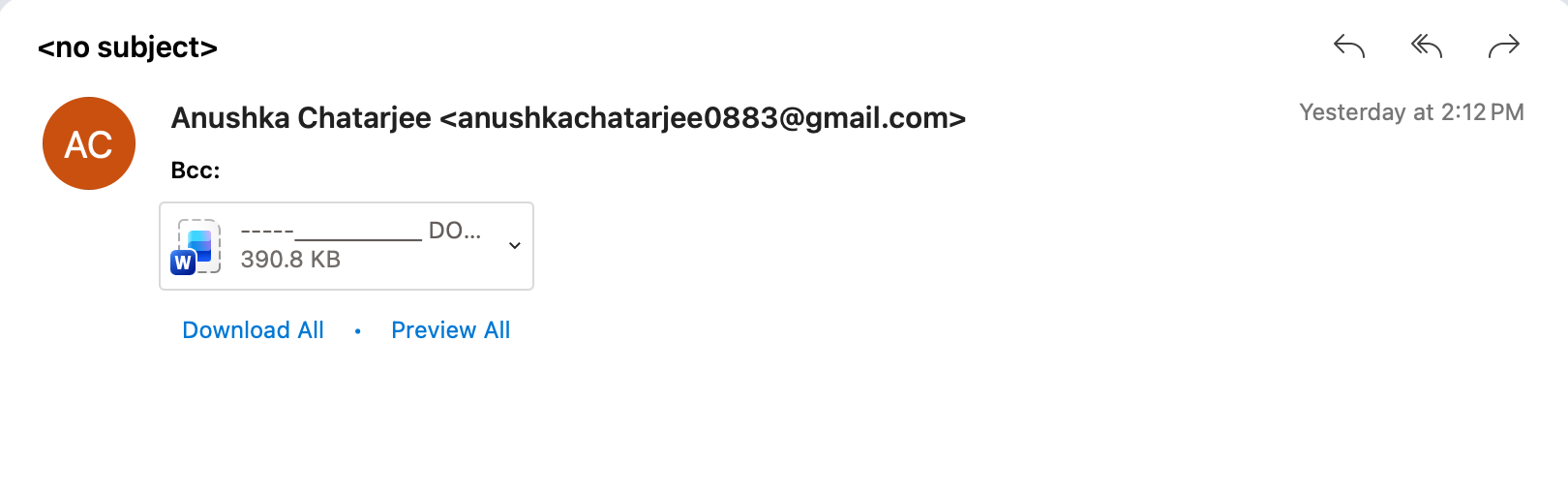
Anushka Chatarjee
Another Gmail account.
Subject:
<no subject>
The message was sent using BCC, suggesting I may simply be one of multiple recipients who received the same message.
And what's in the email?
Nothing useful.
But, naturally, there's a 390.8 KB Microsoft Word attachment.
So now the pitch has been reduced to:
Hi.
Actually, they didn't even say hi.
It's basically:
Here's a Word document. Open it.
That's the entire sales presentation.
The Attachment IS the Email
This is what people need to understand about messages like these.
The lack of information isn't necessarily a failure.
Curiosity can be the social-engineering technique.
The first email wants me wondering:
Did I accidentally order something?
Was my credit card compromised?
How much did they charge me?
What did I supposedly buy?
And where should I look for the answer?
Inside the attachment.
The second email is even more direct.
There's no story at all. Just a mysterious Word document.
The scammer doesn't necessarily need me to believe anything yet.
They just need me to open the file.
Why I Don't Open Them
I don't know what's inside either attachment because I didn't open them.
That's important.
I'm not going to claim these particular files contain malware, malicious links or credential-stealing software when I haven't analyzed them.
I also don't need to.
An unexpected attachment from an unknown Gmail account with no legitimate explanation for why I'm receiving it has already failed my trust test.
The safest question isn't:
“I wonder what's inside?”
It's:
“Why would I open this?”
And in both cases, I can't come up with a good answer.
The Fake Order Trick Is Particularly Clever
The fake-order approach adds another psychological ingredient:
Fear.
Imagine someone receives the first email and thinks:
I didn't order anything!
That's exactly when rational thinking can get replaced by urgency.
They want to find out whether someone used their credit card.
They want to know how much money was charged.
They want to cancel the transaction.
So they open the attachment.
That's why, if you receive a suspicious purchase confirmation, don't use the mystery attachment to investigate it.
Check your credit card or bank account independently.
Log into Amazon, Walmart, PayPal or whatever company supposedly processed the purchase by going directly to the service yourself—not through links or attachments supplied in the suspicious message.
If there's no transaction, there's nothing to cancel.
From “Pharmacy Office” to This
Just days ago, I received another email with the subject “Pharmacy Office.”
That one also contained mystery attachments with practically no explanation.
Now I've received a mysterious order confirmation and a completely blank email carrying a Word document.
There seems to be a theme developing:
The scammers want me to supply the curiosity.
Sorry.
I'm fresh out.
My New Attachment Policy Is Pretty Simple
Unknown sender?
Unexpected attachment?
No explanation?
Generic Gmail account?
Fake urgency?
Mystery purchase?
I'm not opening it.
If someone legitimately needs me to review a document, they can identify themselves, explain what they're sending, and give me a reason to expect it.
Until then, your mysterious 390.8 KB Word document can remain a mystery forever.
Sometimes the safest click is the one you never make.
Follow along at NielFlamm.com/blog for more scams, suspicious emails, questionable recruiters and the increasingly creative ways strangers on the internet try to get me to click things.
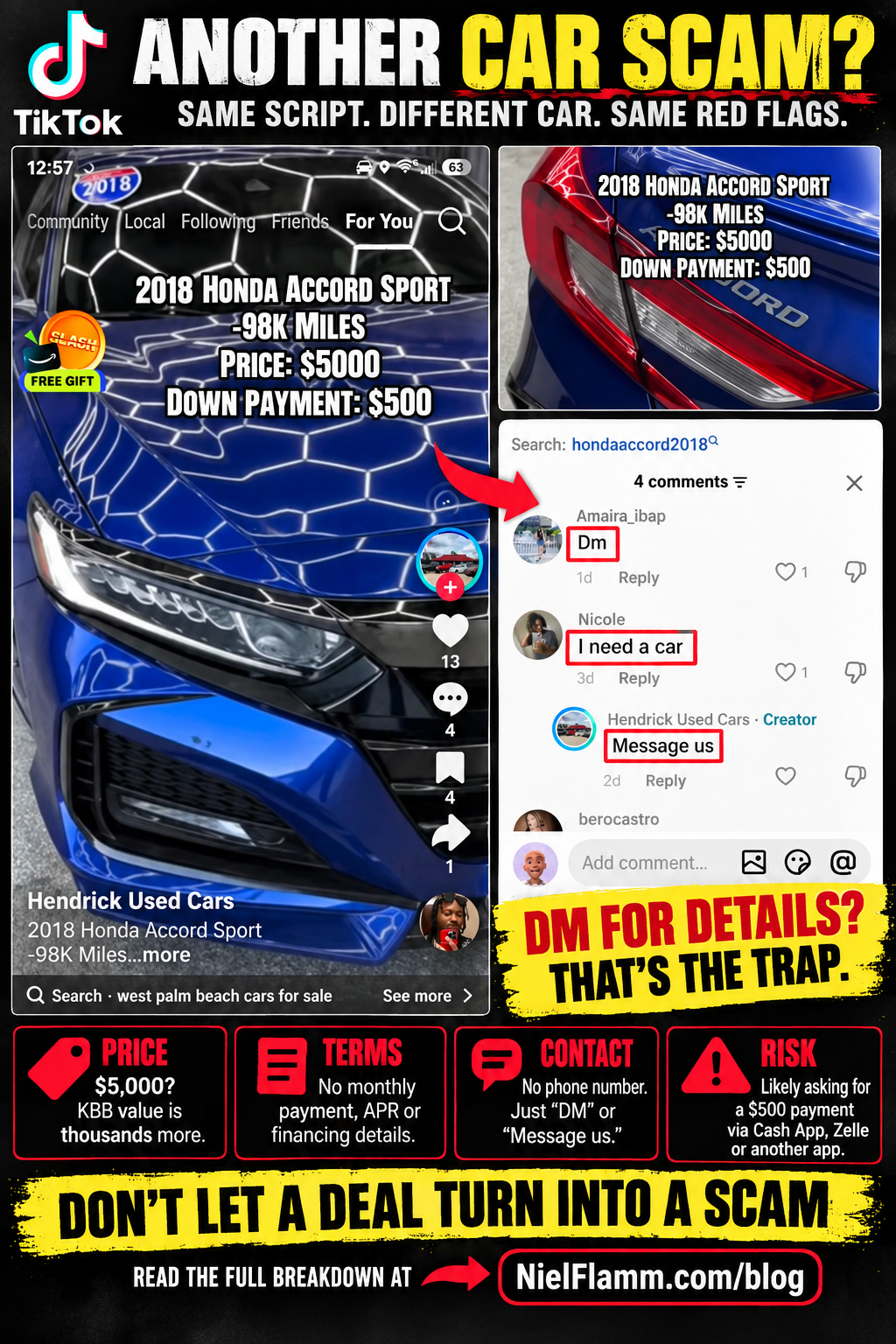
Another $500 Down TikTok Car? This Time It’s a $5,000 Honda Accord
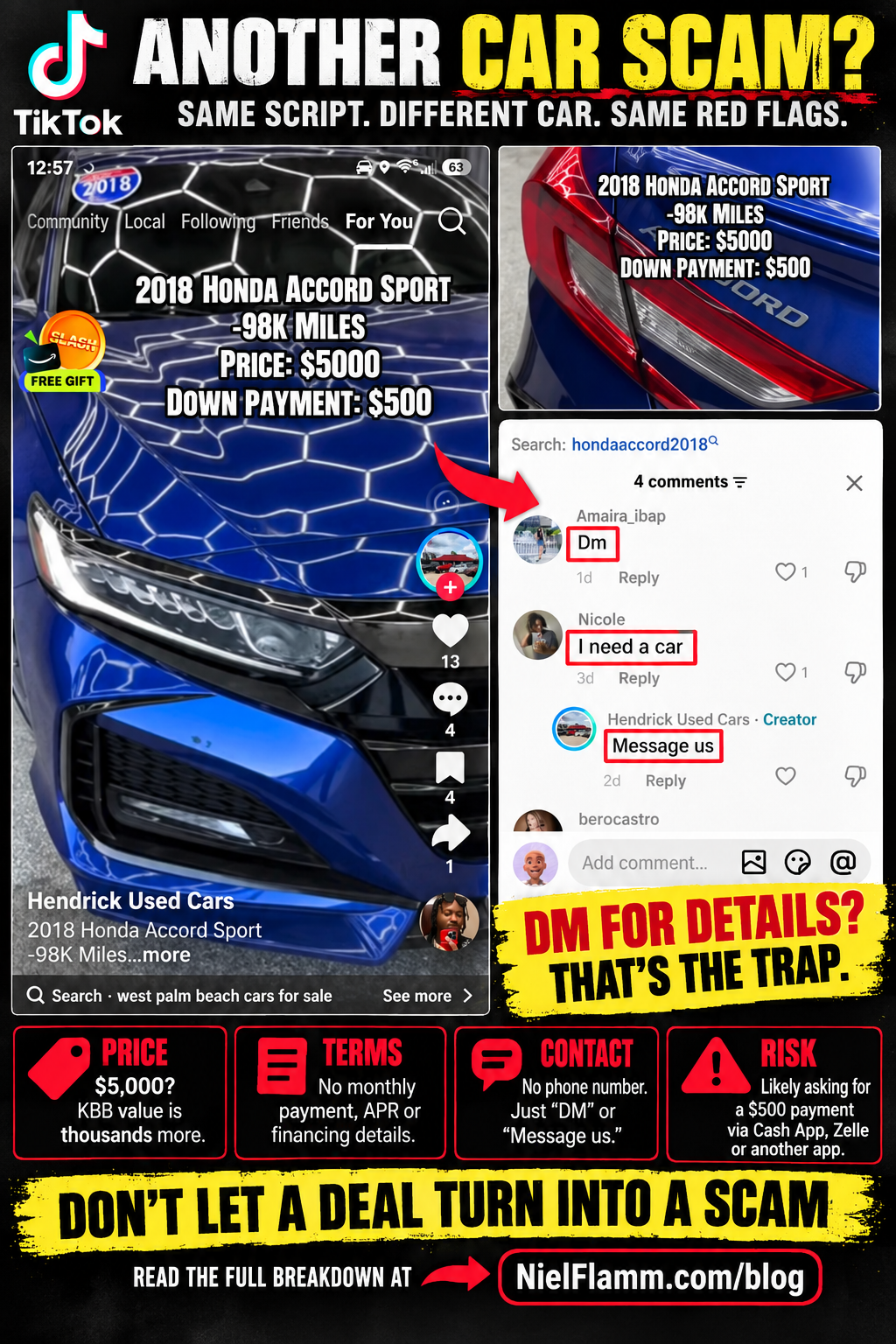
Apparently, TikTok has decided that since I stopped to investigate one suspicious used-car deal, I must want all of them.
And here we go again.
This time the video comes from an account calling itself “Hendrick Used Cars” and advertises:
2018 Honda Accord Sport
98,000 miles
Price: $5,000
Down payment: $500
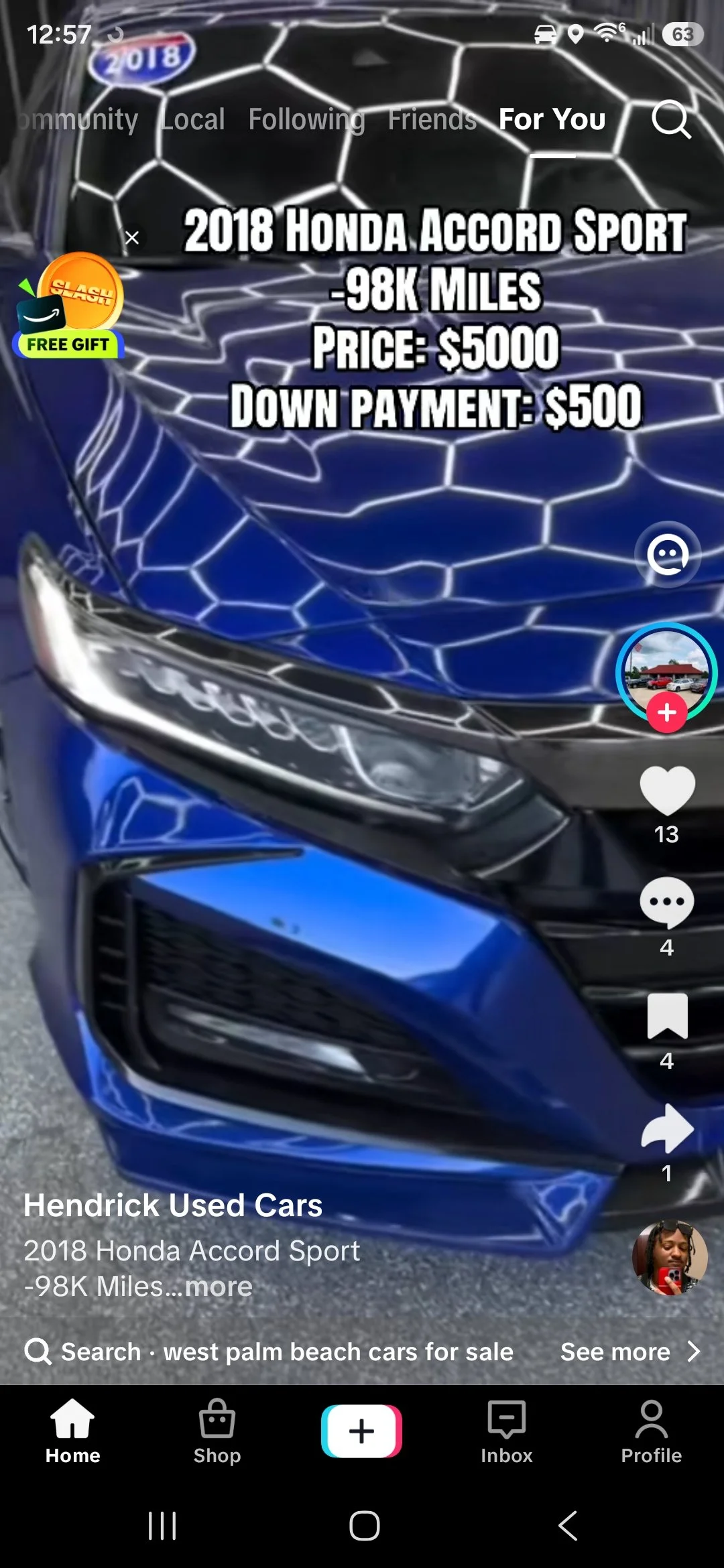
At first glance, this one might seem more believable than the $6,800 Camry I recently wrote about. After all, this Honda has almost 100,000 miles.
Maybe $5,000 really is possible.
So, once again, rather than simply yelling SCAM! at my phone, let's look at some actual numbers.
🚩 First Stop: Kelley Blue Book
Kelley Blue Book currently puts a 2018 Honda Accord Sport Sedan at roughly a $16,860 Fair Purchase Price. Depending on condition, KBB shows trade-in values of approximately $11,240 to $13,440 and private-party values of about $13,900 to $16,600. Kelley Blue Book
Those aren't a precise appraisal of the car in this TikTok. Mileage, condition, location, equipment, accident history and title status matter.
But we're talking about an advertised price of:
$5,000.
That's not merely a great deal compared with KBB.
That's a vehicle supposedly being offered for thousands less than its estimated trade-in value.
Why?
If this is a normal, clean-title, running 2018 Accord Sport, why wouldn't the seller simply sell it wholesale or trade it for substantially more than $5,000?
That's where this gets even more interesting.
🚩 What About the Auction Value?
Maybe this seller somehow acquired the car ridiculously cheap at auction.
Okay. Let's look there too.
Auction data does show 2018 Accords selling around the $5,000 range—but there's a gigantic catch.
An auction archive covering more than 13,000 recorded 2018 Accord sales at Copart and IAAI shows a median final bid of about $5,100. But these aren't necessarily clean, retail-ready cars. Front-end damage alone accounts for 47% of the recorded vehicles, and many examples have salvage titles or significant damage. FinalBid
Here's an especially interesting comparison.
A 2018 Honda Accord Sport with 98,151 miles—almost exactly the mileage advertised in this TikTok—sold at auction in March 2026 for:
$6,600.
It had front-end damage and a California salvage title. Its listed actual cash value was $18,006. DreamBid
Read that again.
A damaged, salvage-title 2018 Accord Sport with almost precisely 98,000 miles sold at auction for $6,600.
And TikTok wants me to believe this one is available for:
$5,000.
Interesting.
Another 2018 Accord with 87,408 miles sold at Copart in February for $6,200. CarFast
So even the wholesale/salvage-auction world doesn't automatically make this $5,000 advertisement make sense.
Could a 2018 Accord legitimately sell for $5,000? Of course. A vehicle can have severe damage, mechanical problems, a branded title, or any number of other issues.
But if that's why this particular Accord is $5,000, where's the disclosure?
🚩 And There’s Our Favorite Number Again: $500
Now we get to the part that really caught my attention.
The previous suspicious TikTok car I wrote about advertised:
$500 down.
This one?
$500 down.
What a coincidence.
But unlike the previous advertisement, this one doesn't even bother giving us a monthly payment.
Price: $5,000.
Down payment: $500.
And then...nothing.
What's the APR?
How long is the loan?
Who is financing it?
What are the payments?
What credit qualifications apply?
What's the total amount financed?
Nothing.
But don't worry.
Apparently, there's a solution.
🚩 “DM”
I opened the comments.
One person writes:
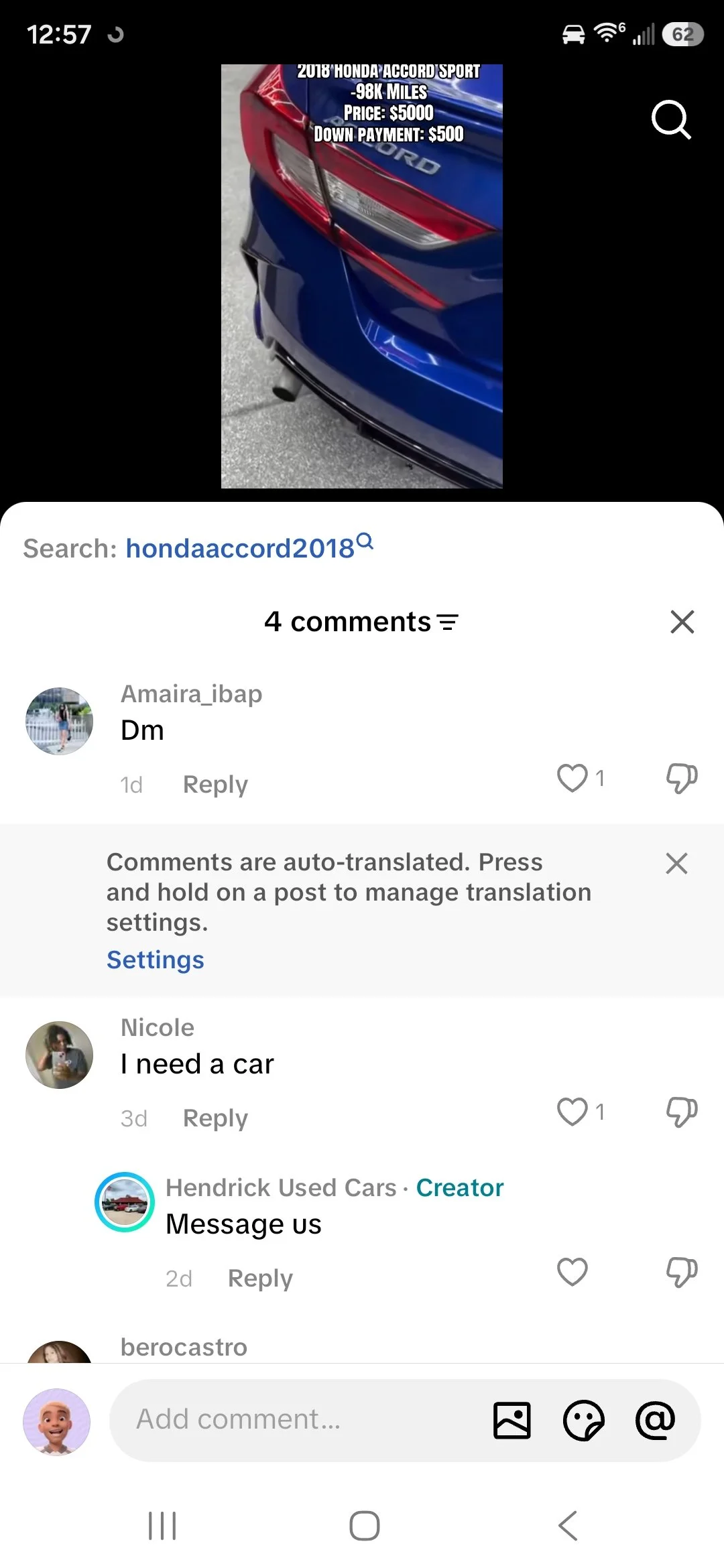
“Dm”
Another writes:
“I need a car”
And the account responds:
“Message us”
There it is.
The public advertisement gets your attention.
The suspiciously cheap car creates urgency.
The conveniently affordable $500 down payment establishes a number in your mind.
Then the actual transaction moves somewhere private.
DM us.
Or, as the kids say, slide into the DMs.
That's the point where I'd become extremely cautious.
🚩 What Happens After the DM?
I haven't messaged this account, so I'm not going to claim I know what they say privately.
But if I were investigating this further, I'd watch for a very specific progression.
The car is still available.
Lots of people are supposedly interested.
They can hold it for you.
All they need is...
$500.
Maybe through Cash App.
Maybe Zelle.
Maybe another peer-to-peer payment method.
And suddenly that harmless-looking “DOWN PAYMENT: $500” at the beginning of the video makes a lot more sense.
Again, I'm not saying that's what this account does. I haven't seen the private conversation.
But I absolutely would not send anyone $500 based on this TikTok.
🚩 There's Another Detail: “Hendrick Used Cars”
That name is interesting because Hendrick Automotive Group is a real, major automotive retailer.
That does not mean this TikTok account is affiliated with Hendrick Automotive Group.
And that's another thing consumers should verify.
Don't assume an account belongs to a legitimate company because its username, logo or description resembles a familiar business.
Go to the company's official website independently. Find its actual phone number. Call the dealership directly and ask whether the vehicle, social-media account, and offer are theirs.
Don't use the phone number or link somebody sends you in a DM to “verify” themselves.
That's not verification.
The Math Is the Best Scam Detector
This is now the second suspiciously cheap vehicle TikTok has served me.
And the pattern is remarkably similar.
An attractive used car.
A price far below conventional retail value.
A conveniently small $500 down payment.
Very little information.
And an invitation to take the conversation private.
Could there be a legitimate explanation?
Absolutely.
But that's exactly why you ask questions before sending money.
For this Accord, KBB's numbers put a normal example far above $5,000. Kelley Blue Book: Even a nearly identical-mileage damaged salvage example sold at auction for $6,600. DreamBid
And this one is supposedly yours for $5,000?
Maybe.
Show me the VIN.
Show me the title.
Show me the Carfax or AutoCheck.
Show me the dealership.
Let me independently call the business.
Let me inspect the car.
Let me verify that you actually own it.
Then we can talk about money.
Until then, my $500 is staying exactly where it is.
Because sometimes the most expensive $5,000 car you'll ever buy is the one that never existed.
Follow along at NielFlamm.com/blog for more questionable social-media deals, scams, recruiting adventures, and other things the algorithm apparently thinks I need in my life.
$6,800 for a 2020 Toyota Camry with 33,000 Miles? TikTok, We Need to Talk.
I was checking the engagement on one of my TikToks when TikTok did what TikTok does: “Oh, you're finished looking at your own stuff? Here, watch this.”
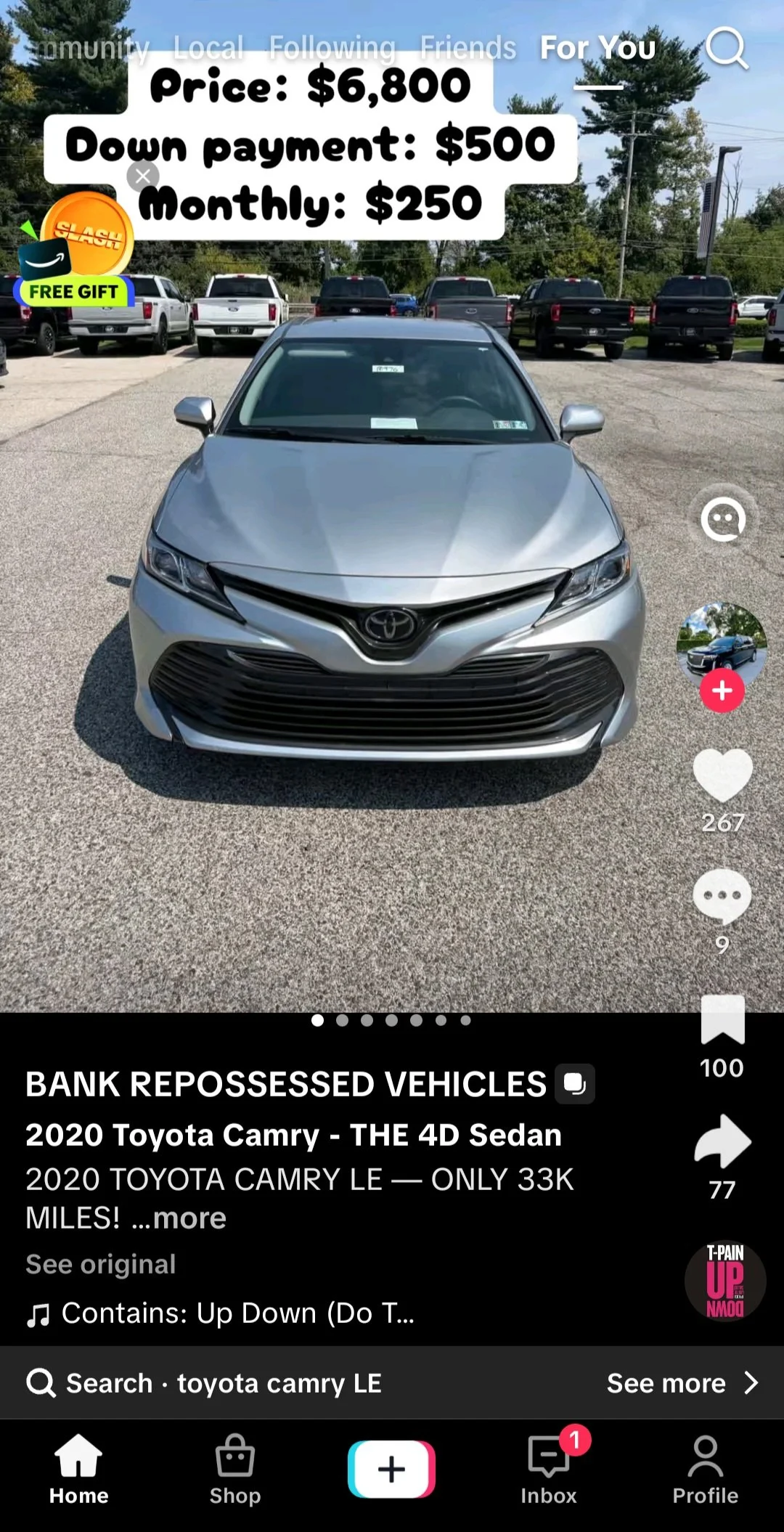
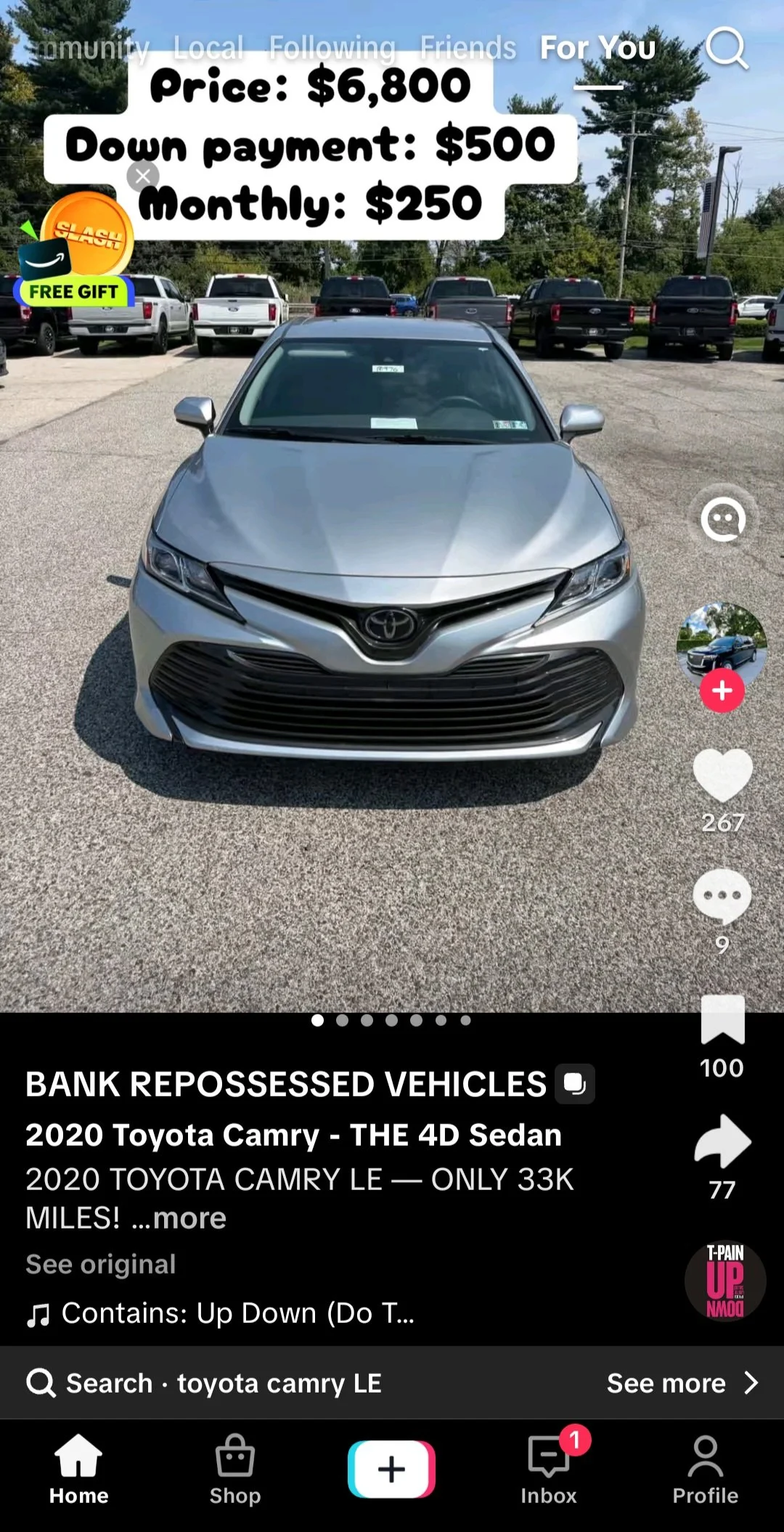
And up popped a 2020 Toyota Camry LE.
According to the post:
Price: $6,800
Down payment: $500
Monthly: $250
Mileage: ONLY 33K MILES!
It is supposedly a “BANK REPOSSESSED VEHICLE.”
Wow!
A six-year-old Camry with only 33,000 miles for $6,800?
Where do I sign?
Actually, don't answer that.
I've seen this movie before.
When I first started getting active again on social media, scams like this were rampant. It seemed like every other short-form video was offering some ridiculously inexpensive repossessed car. The details changed, but the formula didn't.
Cheap car.
Tiny down payment.
Low monthly payment.
And some way to contact the seller outside the platform.
They disappeared from my feed for a while.
Apparently, they're back.
So instead of sending anyone $500, let's go shopping for some red flags.
🚩 Red Flag #1: A $6,800 Camry That Should Cost HOW Much?
The first thing I checked was the price.
The TikTok claims this is a 2020 Toyota Camry LE with only 33,000 miles for $6,800.
I checked Kelley Blue Book.
As of September 9, 2026, KBB's national figures for a typical-mileage 2020 Camry LE in good condition show approximately:
Fair Purchase Price: $17,500
Private Party Value: $16,150
Trade-In Value: $14,650Kelley Blue Book
And KBB's condition-specific estimates put trade-in value between roughly $13,190 and $15,540, depending on condition. Kelley Blue Book
Those numbers aren't specifically adjusted to this advertised 33,000-mile example, and location, condition, accident history, title status, and options can move a vehicle's value. But that's almost beside the point.
They're advertising it for:
$6,800.
That's less than half of KBB's $14,650 trade-in figure.
Think about that.
If this is really a clean, running 2020 Camry LE with just 33,000 miles, why would someone need TikTok to find a stranger willing to buy it for $6,800?
A legitimate dealer could presumably buy it for substantially more.
But apparently the bank has decided:
"Forget thousands of additional dollars. Find us somebody scrolling TikTok."
How generous.
🚩 Red Flag #2: $250 a Month... For How Long?
This is the part I really enjoy.
The graphic says:
Down payment: $500
Monthly: $250
Okay.
How many months?
What's the interest rate?
What's the APR?
What's the amount financed?
What's the total of the payments?
Is there a balloon payment?
Are there financing qualifications?
Nothing.
Just:
MONTHLY: $250
That's not how legitimate credit advertising is supposed to work.
Under the federal Truth in Lending Act's Regulation Z, stating the amount of a down payment or amount of a payment in a credit advertisement triggers additional disclosure requirements. The advertisement generally must also disclose the down payment, the repayment terms over the full loan—including a balloon payment if applicable—and the annual percentage rate (APR). Consumer Financial Protection Bureau
The CFPB even specifically identifies statements such as “$25 weekly” as payment amounts that trigger the additional disclosure requirements. Consumer Financial Protection Bureau
So let's return to our TikTok.
Price: $6,800
Down payment: $500
Monthly: $250
And...
That's it.
For fun, let's ignore interest, taxes, and fees entirely.
$6,800 minus $500 leaves $6,300.
At $250 per month, that's 25.2 months.
But the ad doesn't tell me that's the deal.
Maybe it's 36 payments.
Maybe it's 48.
Maybe there's interest.
Maybe there's a gigantic final payment.
Maybe the financing doesn't exist at all.
The monthly payment is the shiny object. The actual financing terms are missing.
🚩 Red Flag #3: How Exactly Do I Buy This Magical Camry?
Here's another interesting part of the post.
I don't see a phone number.
I don't see the name of a recognizable dealership.
I don't see a physical dealership address.
I don't see financing information.
I don't see a lender.
In previous versions of these ads that crossed my feed, there was often a WhatsApp number, WeChat account, or another internet-based messaging service waiting to take the conversation somewhere less visible.
This one doesn't even bother with that.
And yet people are engaging with it.
That makes me wonder whether the next step happens privately.
My Guess: Welcome to the DMs
To be clear, I haven't messaged this account, so I don't know what this particular account tells interested people privately.
But based on the pattern, here's what I'd be watching for.
Someone comments:
“Interested!”
Then a direct message arrives.
Maybe the car is still available.
Maybe lots of other people supposedly want it.
Maybe you need to act immediately.
And perhaps that $500 down payment suddenly needs to be sent electronically to “hold” the car.
Cash App.
Zelle.
PayPal.
Crypto.
Or another payment method where recovering money can be difficult once you've voluntarily sent it.
How convenient that the advertisement has already planted the number $500 in your head.
I'm not claiming that's what this particular account does without seeing the private messages. I'm saying that if the conversation moves toward an upfront payment before you've independently verified the vehicle, seller, title, and transaction, I'd be hitting the brakes harder than this Camry ever has.
But It Says “Bank Repossessed Vehicles!”
That's another psychological hook.
“Repossessed” provides a convenient explanation for the impossible price.
Why is the $17,000-ish car only $6,800?
BANK REPO!
It sounds plausible enough to stop someone from asking the next question.
But calling something a repossession doesn't magically erase its market value.’
Banks generally aren't in the business of intentionally giving away thousands of dollars because someone watched a TikTok.
The Scam Doesn't Need Everyone
That's what makes posts like this effective.
Most people can look at $6,800 for a low-mileage Camry and immediately think:
No way.
The scammer doesn't need most people.
They need the person who thinks:
“What if it's real?”
That tiny bit of doubt is worth $500 if you can persuade someone to send a deposit before investigating.
And the deal is deliberately attractive enough to encourage urgency.
Someone else is interested.
We can't hold it.
Send the deposit now.
Suddenly, there isn't enough time to look up the car's value, verify a VIN, call the bank supposedly selling it or physically inspect the vehicle.
Funny how that works.
A $17,500 Reality Check
This is why I love doing something incredibly sophisticated when I see an unbelievable deal online:
I Google it.
Kelley Blue Book says roughly $17,500 Fair Purchase Price for a typical 2020 Camry LE.
The TikTok says:
$6,800.
KBB says roughly $14,650 trade-in.
The TikTok still says:
$6,800.
Before worrying about whether I've discovered the automotive deal of the century, I'm going to ask why someone is willing to sell me a vehicle for thousands less than they could potentially get elsewhere.
Sometimes a deal really is a deal.
But when the price doesn't make economic sense, the financing details are conspicuously absent, the seller is vague and the entire transaction begins with a social-media video...
Don't let $6,800 make you forget to ask $17,500 worth of questions.
And please don't send the mysterious $500.
Follow along at NielFlamm.com/blog for more scams, questionable offers, suspicious recruiters, and other adventures from the stranger corners of the internet.

Pharmacy Office? Sure. Let Me Open These Mystery Attachments…
Another day, another email apparently hoping curiosity will overpower common sense.
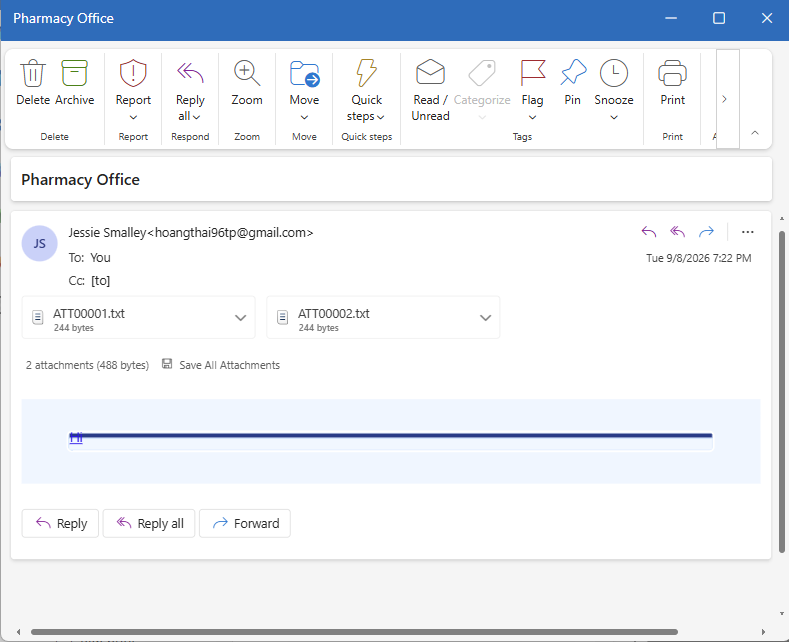
This one arrived with the wonderfully official-sounding subject line:
“Pharmacy Office”
Oh, good. The Pharmacy Office!
Which pharmacy?
What office?
Why are they contacting me?
Apparently, those are minor details.
The sender identifies herself as “Jessie Smalley,” but the email address displayed with the name is a random-looking Gmail account:
hoangthai96tp@gmail.com
Nothing screams official pharmacy correspondence quite like that.
But the best part?
There is essentially no message.
No:
“Hello Niel.”
No:
“We're contacting you regarding your prescription.”
No explanation of who they are, why they're contacting me, or what I'm supposed to do.
Instead, I get two attachments:
ATT00001.txt
ATT00002.txt
Each is only 244 bytes.
And there they sit, practically whispering:
Come on, Niel. Open us.
We're probably important.
Maybe one of us contains information about your extended car warranty.
Nice try.
The Attachment Is the Bait
This is one of the simplest tricks in the scammer toolbox.
They don't necessarily need to write an elaborate story if they can get you curious enough to interact with an attachment.
The vague subject creates just enough uncertainty.
Pharmacy Office?
Did my pharmacy send something?
Is there a prescription problem?
Is this about insurance?
Do I owe money?
And that's precisely why I didn't open the attachments.
I don't know the sender. I wasn't expecting the email. The sender's address doesn't connect to a pharmacy, and the email provides no context for the attachments.
That's not a reason to investigate the files.
That's a reason to investigate the email.
Congratulations, You Have Failed the Trust Test
If my actual pharmacy needs me, they presumably have several better ways to communicate than:
PHARMACY OFFICE
Two mystery files attached.
Good luck.
Even if an unexpected attachment looks harmless—whether it's a TXT, PDF, Word document, ZIP file, or something else—I won’t open it just because somebody successfully delivered it to my inbox.
And scammers don't always need the attachment itself to infect a computer immediately. An attachment or document can also be part of a larger social-engineering chain intended to send someone to a malicious website, request credentials, provide instructions for contacting someone, or move the conversation somewhere else.
The objective is simple:
Get you to take the next step.
Curiosity Isn't a Security Strategy
These particular files may contain nothing malicious.
I'm not going to open them to find out.
That's an important distinction.
I don't need to prove something is malicious before deciding I shouldn't interact with it. An unsolicited email with no meaningful message, an unknown sender, and two mystery attachments give me absolutely no reason to trust it.
If something supposedly comes from your pharmacy, bank, employer, insurance company, delivery service, or another organization you actually use, don't rely on the contact information conveniently supplied by the suspicious message.
Please visit the organization's website or app, or contact them through a number you already know is legitimate.
Scammers, You Can Do Better
We've had fake recruiters.
Fake job opportunities.
Career-service pitches disguised as recruiting.
And now apparently I've reached the mystery pharmacy attachment chapter of the adventure.
At least put some effort into it.
Please let me know when my prescription for unicorn medication is ready.
Tell me Walgreens accidentally filled 700 gallons of cough syrup in my name.
Give me something.
Instead, I received two tiny text files and the expectation that curiosity would do the rest.
It didn't.
Delete. Report. Move on.
And, most importantly:
Don't open mystery attachments just because somebody was clever enough to put “Pharmacy Office” in the subject line.
Follow along at NielFlamm.com/blog for more scams, suspicious recruiting adventures, and other examples of people on the internet desperately trying to get me to click things I shouldn't.
Another LinkedIn “Recruiter.” Another Scam Pattern.
Apparently, my LinkedIn profile has become a magnet for people who need to work on their scam scripts.
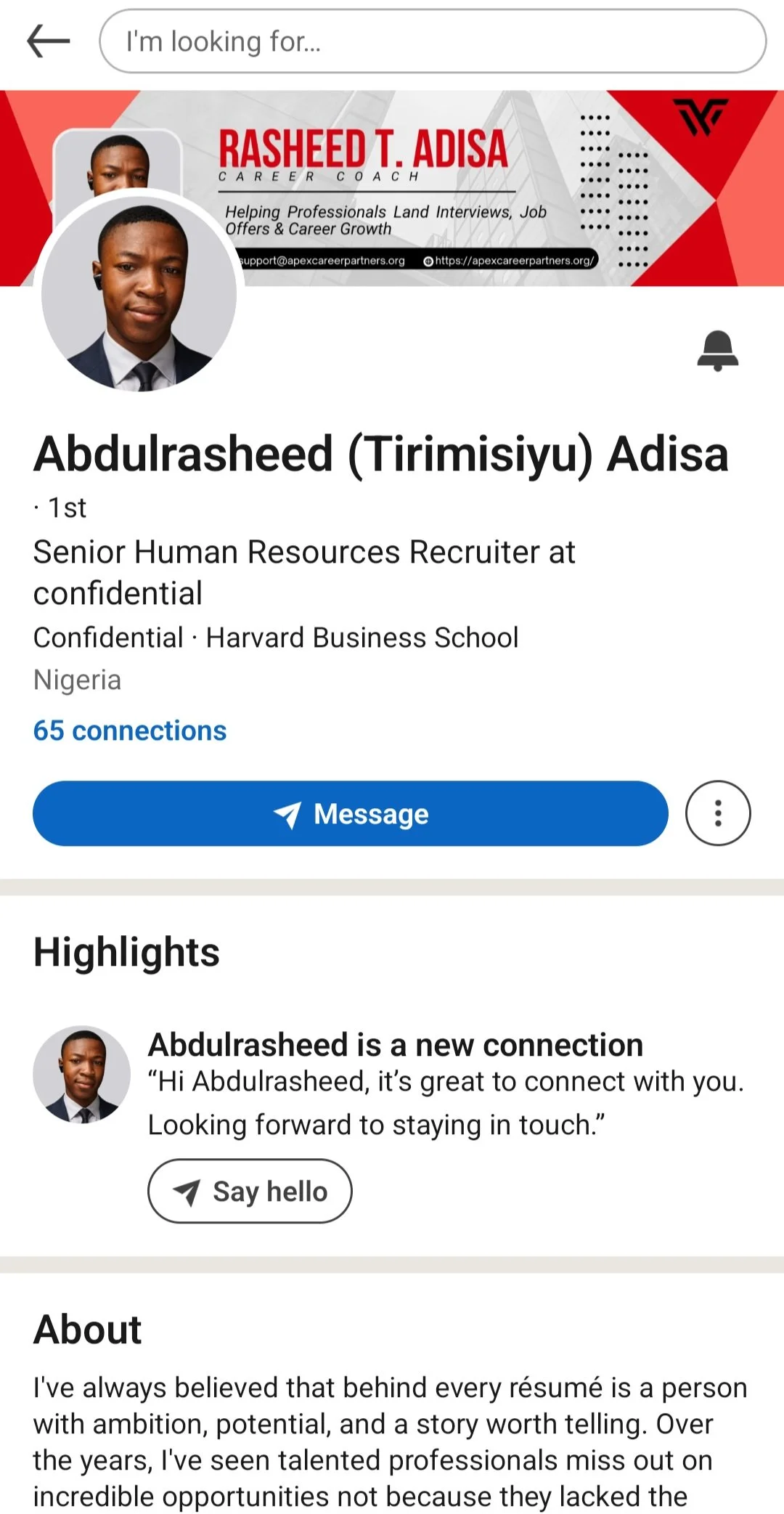
This morning, I received a connection request from someone presenting himself as Abdulrasheed (Tirimisiyu) Adisa, a “Senior Human Resources Recruiter at Confidential.” I accepted it.
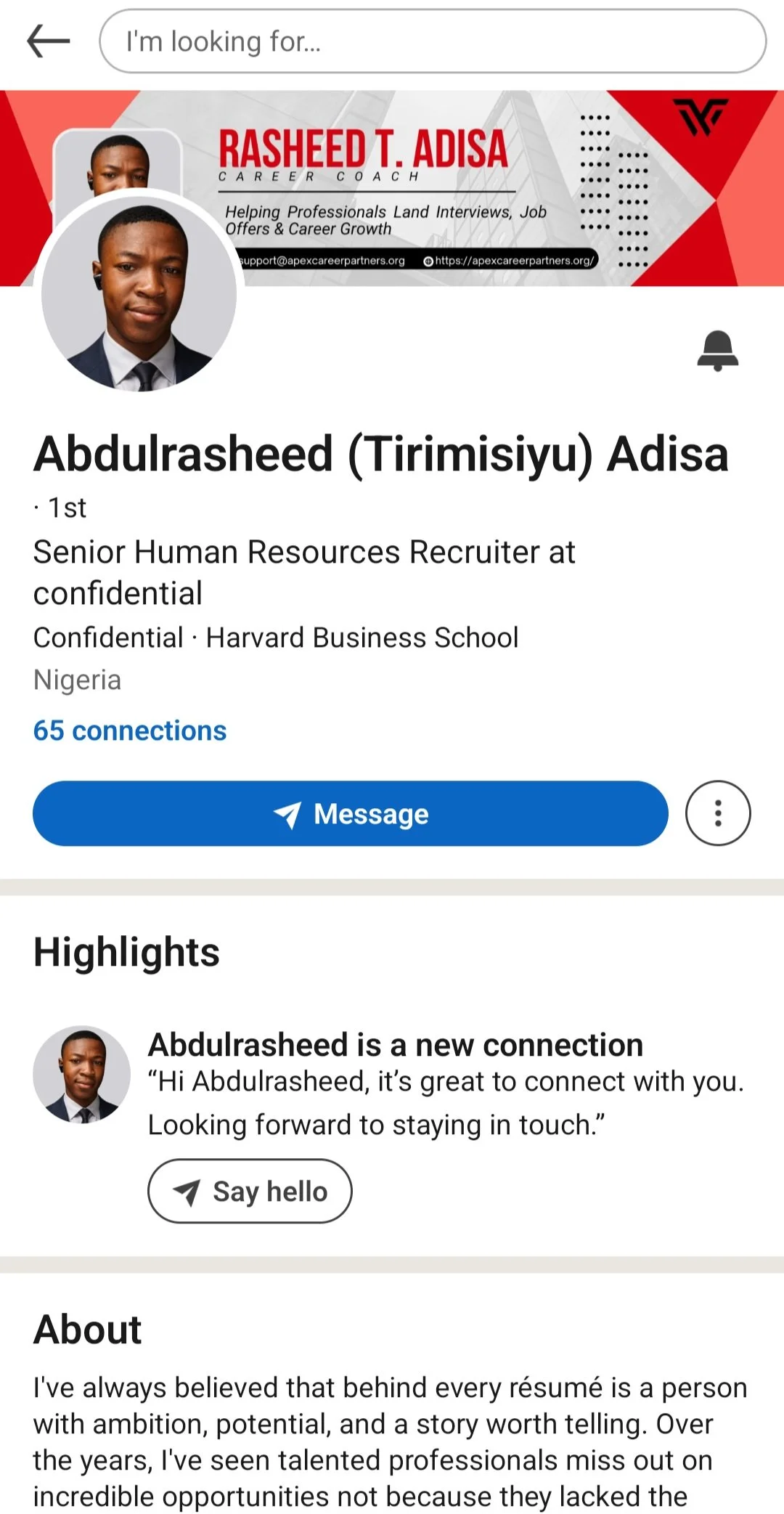
Almost immediately, he messaged me about my “career transition” and asked what types of positions I was targeting.
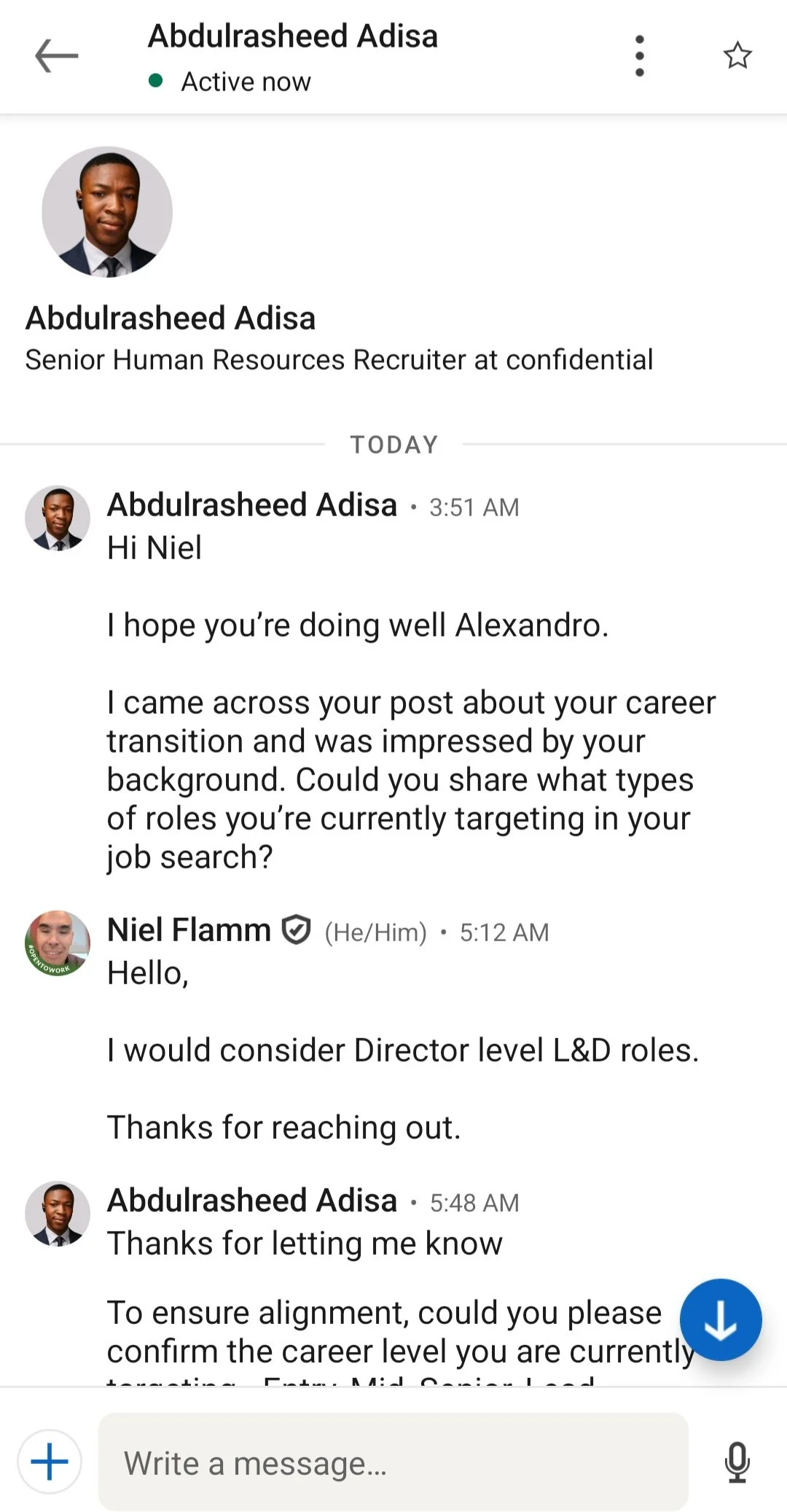
I told him: Director-level Learning & Development roles.
Then he asked what career level I wanted—despite my having just told him Director—and my salary expectations.
I answered: Director, minimum $180K.
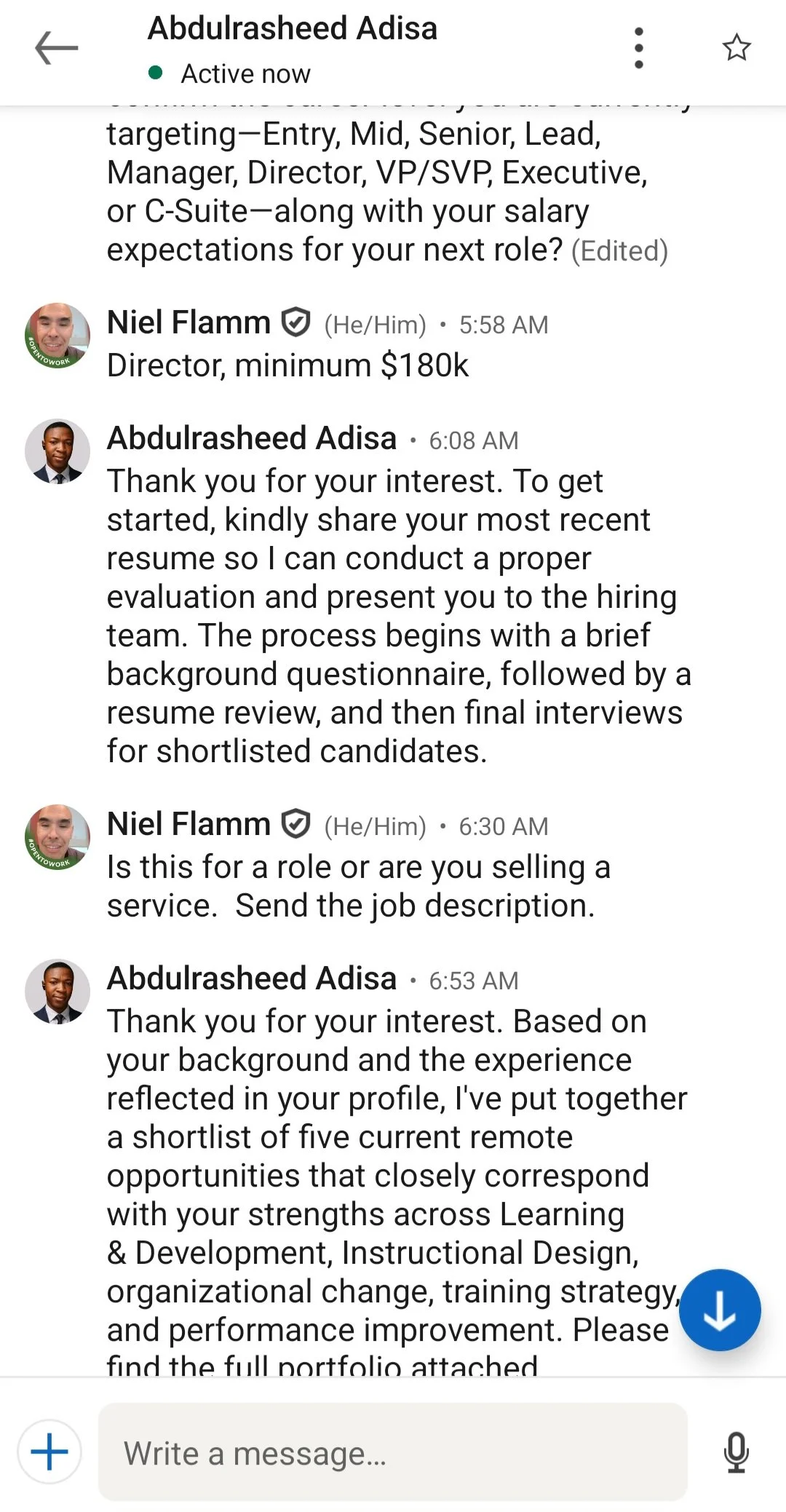
Then came the familiar request:
“Kindly share your most recent resume so I can conduct a proper evaluation and present you to the hiring team.”
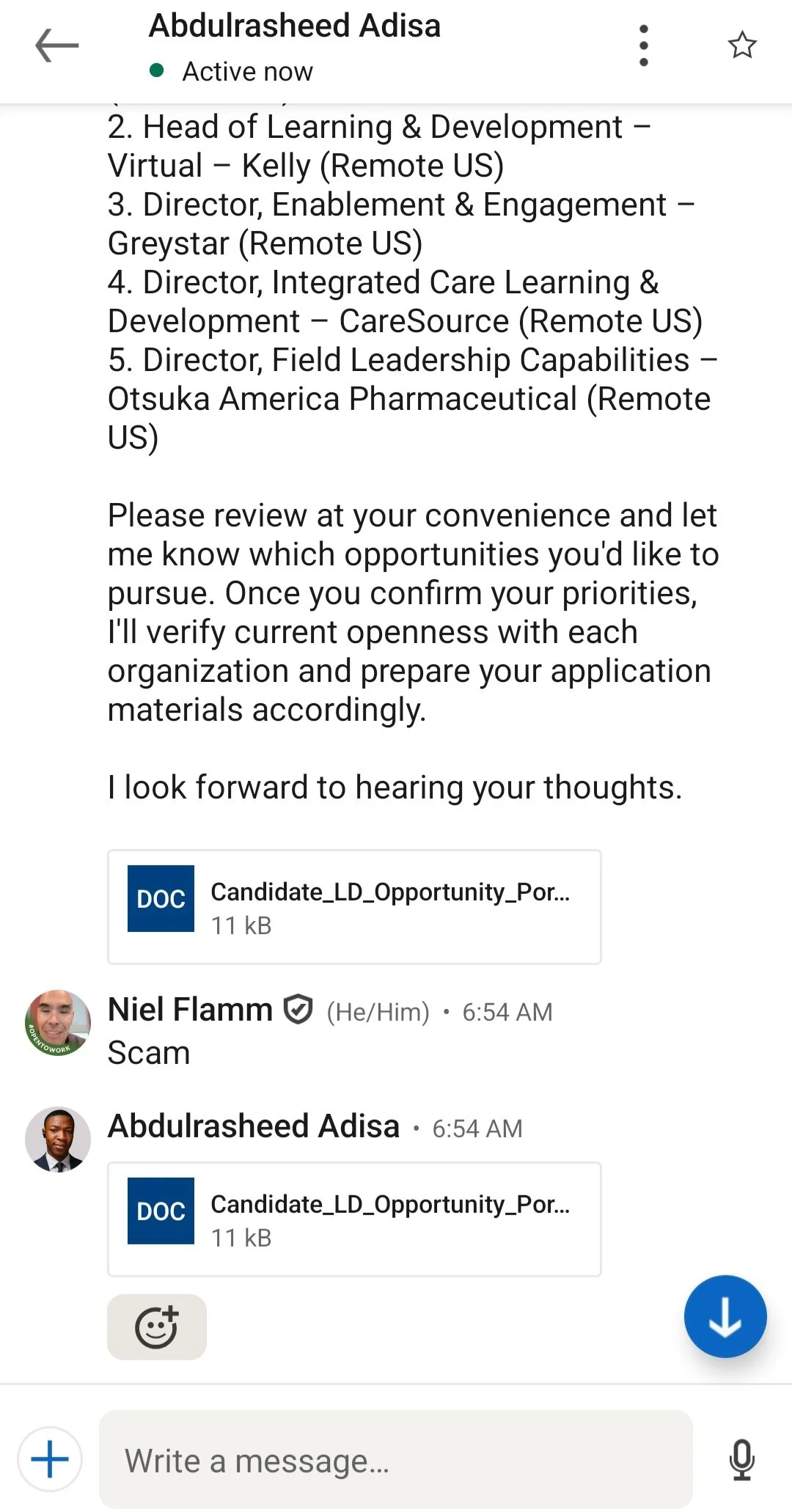
🚩 And here we go again.
I already suspected this was a scam very early in the conversation because I looked at his profile.
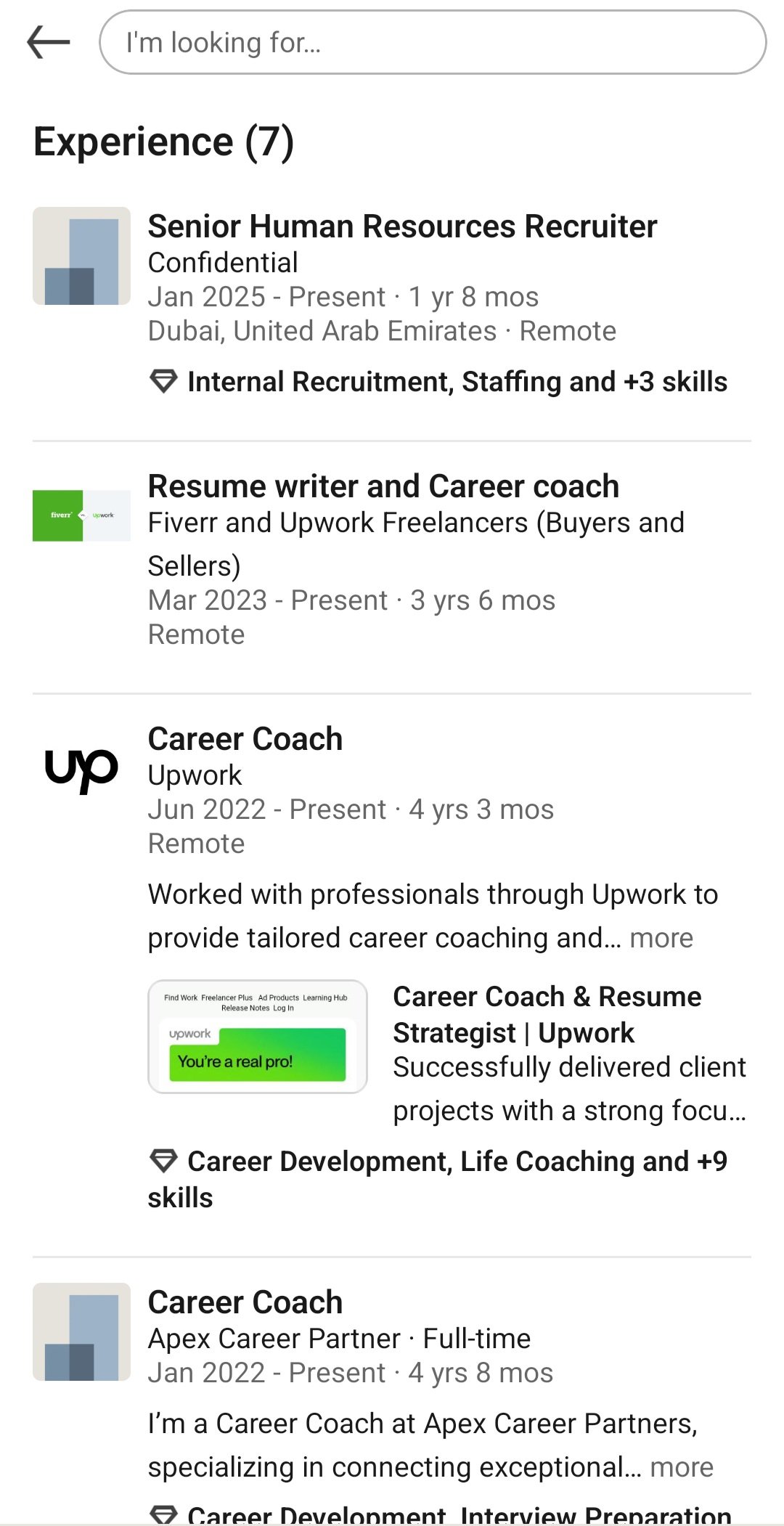
His experience shows several supposedly concurrent positions:
Senior Human Resources Recruiter at “Confidential”
Resume Writer and Career Coach through Fiverr and Upwork
Career Coach at Upwork
Career Coach at Apex Career Partner
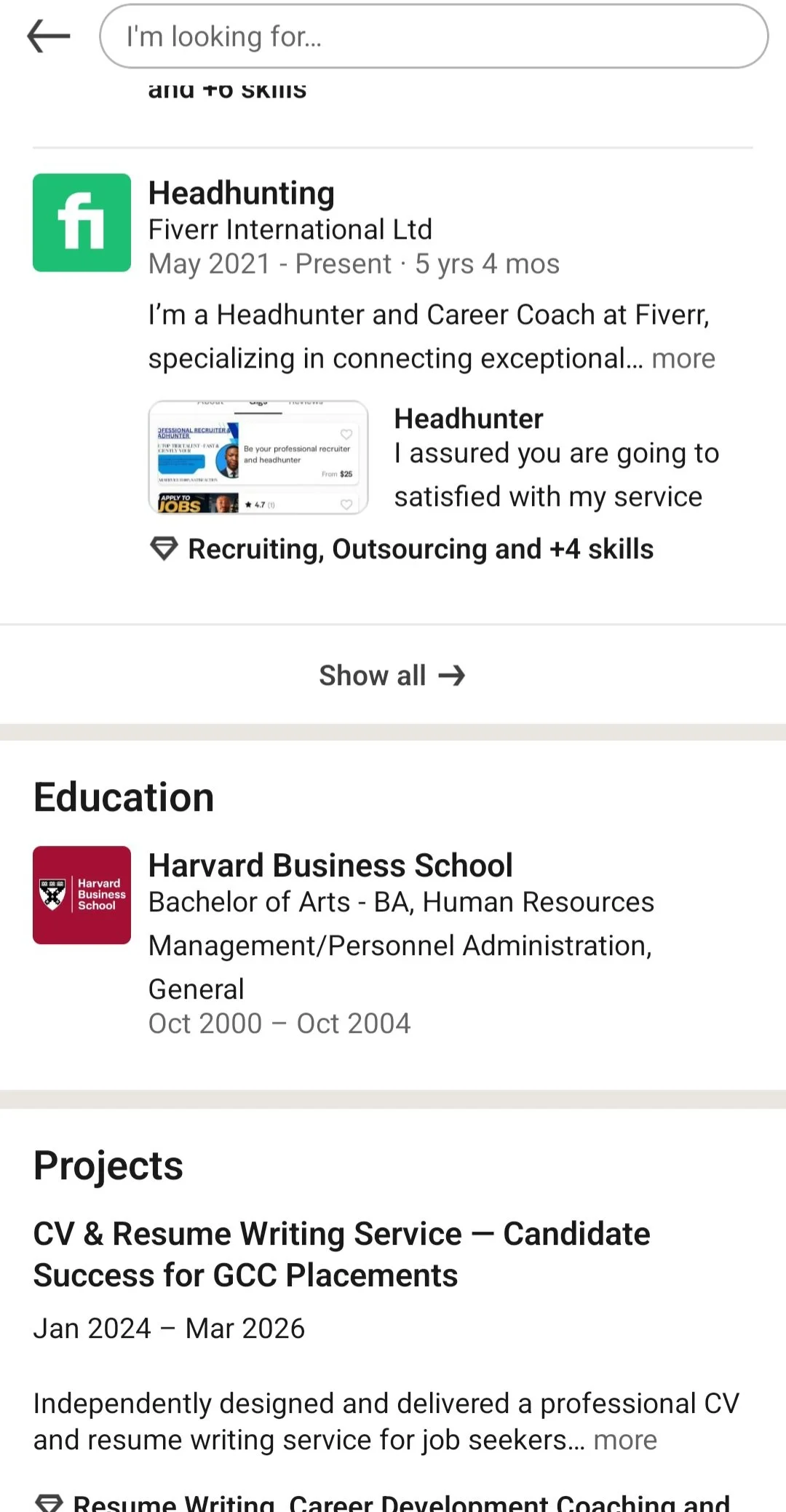
Headhunting through Fiverr
These positions overlap each other extensively.
Then there's an alleged Bachelor of Arts in Human Resources Management from Harvard Business School, which raised another rather large eyebrow.
So I asked a very simple question:
“Is this for a role or are you selling a service? Send the job description.”
Instead of answering the question directly, I suddenly received a list of five remote positions supposedly matching my background, along with an attached Word document.
And here's another interesting detail: the message said he would “verify current openness with each organization”after I selected the positions I wanted to pursue.
Wait.
You're recruiting me for jobs, but you haven't verified that the jobs are actually open?
🤔
I responded with one word:
“Scam.”
And wouldn't you know it?
Almost immediately, the connection disappeared. His name in my LinkedIn inbox became “LinkedIn Member.”
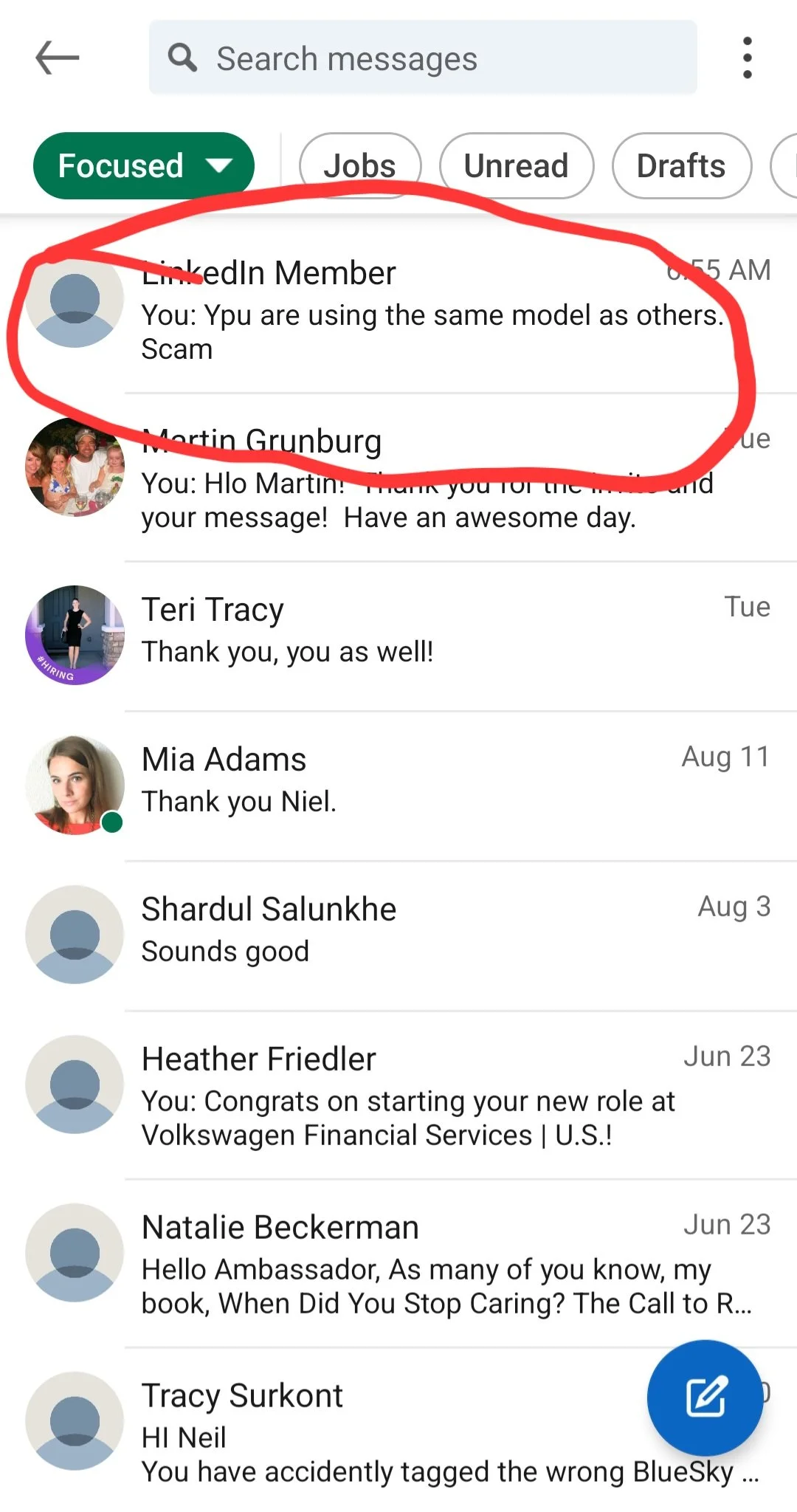
That was fast.
The lesson isn't that every recruiter who contacts you is a scammer. Plenty of legitimate recruiters reach out to candidates every day.
The lesson is to look before you leap.
Check the person's employment history. Look for overlapping jobs that don't make sense. Look at their education. Ask for the actual job description. Ask which company is hiring. Don't unthinkingly send your resume, personal information, or money simply because someone says they have the perfect opportunity.
And when somebody supposedly recruiting for a Director-level position can't even get your name right—his opening message said, “I hope you're doing well Alexandro”—perhaps that's another clue.
Alexandro, wherever you are, apparently we both have an exciting career opportunity.
😂
Follow along at NielFlamm.com/blog for more adventures from the increasingly bizarre world of online recruiting.