
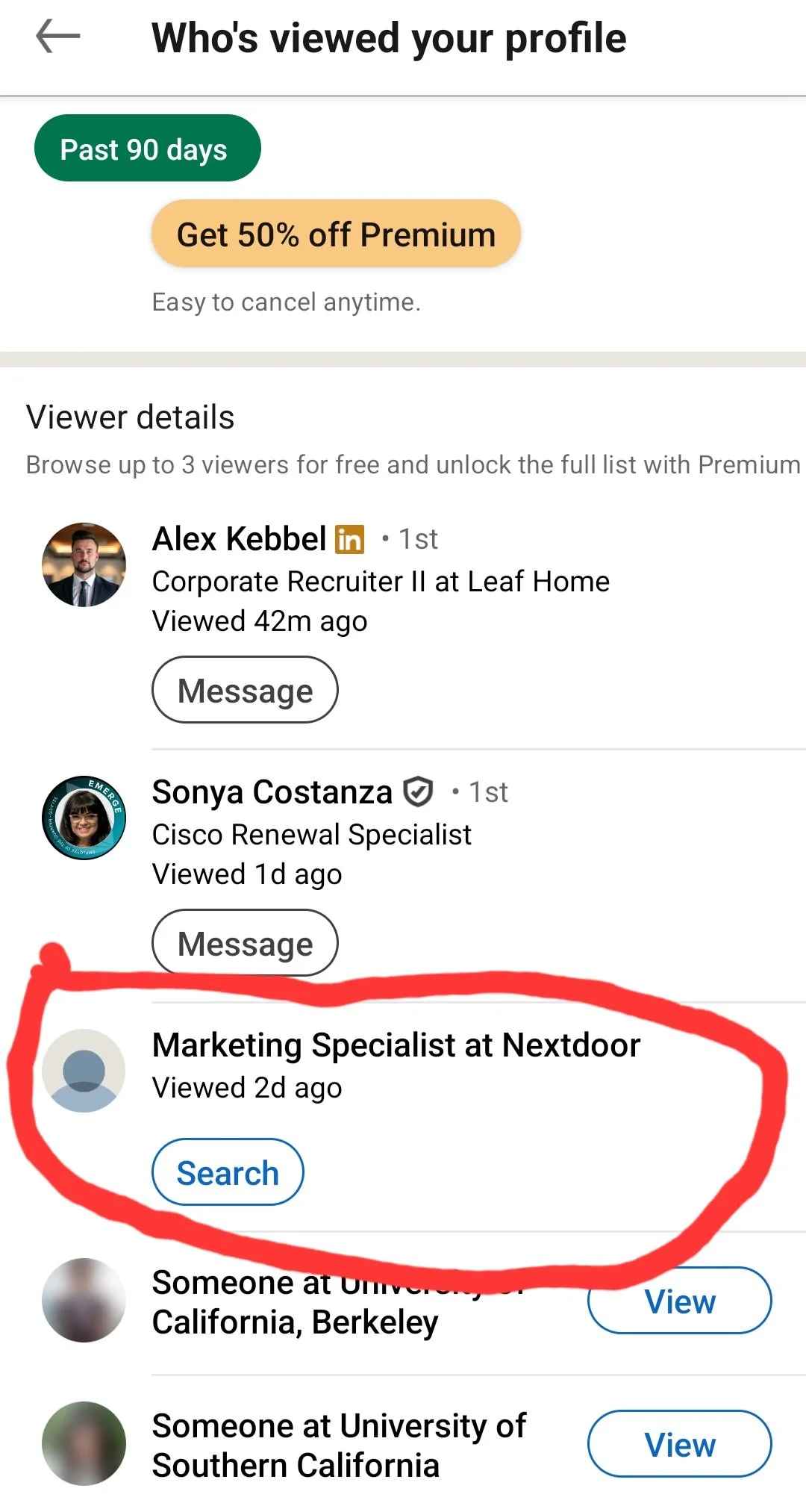
Why Would a Nextdoor Employee View My Profile — But Hide Their Name?
I noticed recently that a Nextdoor employee viewed my LinkedIn profile, yet chose to keep their name hidden. And it raises several important questions:
Why keep the identity hidden?
Transparency should be a basic standard — especially for a platform that claims to connect neighbors and build trust.
Why visit my profile in the first place?
If someone from Nextdoor is following my posts, concerns, or questions, then there is clearly awareness at the company level.
And most importantly: Why hasn’t this person reached out?
If the goal is truly to strengthen communities and foster dialogue, then open communication should be the first step — not anonymous viewing from the shadows.
I’ve been vocal about transparency, data integrity, unpaid moderators, vague suspension policies, and the need for accountability within Nextdoor. If someone on their team is monitoring these discussions, I welcome a real conversation.
My contact information is public. My messages are open. And my questions have always been sincere.
Nextdoor — if you’re watching, I hope someone reaches out. Let’s have an honest dialogue.
#Nextdoor #TransparencyMatters #CorporateAccountability #Leadership #DigitalEthics #CommunityTrust
Why I Volunteer as an Amputee “Lab Participant” at MUSC — And Why It Matters for Developing Talent
Today marked my third year volunteering at MUSC’s Physical Therapy program as a real-world case study for students learning to work with amputees. I jokingly call myself their “lab rat,” (apologies, PETA) but the impact is real—for them and for me.
How This Connects to Business & L&D
As someone in Learning & Development, I see the value of experiential learning firsthand:
✔ Turning lived experience into insight
I share what helped me progress, what didn’t, and the best practices clinicians used with me—like customer-driven feedback loops used in business to improve outcomes.
✔ Building future-ready professionals
These students will treat thousands of patients throughout their careers. Helping them gain confidence now is an investment in better long-term care and stronger communities.
✔ Modeling human-centered training
Real people > simulations. Authentic scenarios build actual competence, emotional intelligence, and communication skills—key traits in any professional environment.
And yes, I still bring humor. It breaks tension, encourages engagement, and creates a safe learning space. The same principle applies in corporate training rooms everywhere.
What Students Gain
Real-world complexity instead of textbook scenarios
Immediate feedback that they can apply instantly
Confidence working with amputees for the first time
Insights from my story, challenges, and successes
Volunteering at MUSC is a reminder that the best learning happens through real experience, honest feedback, and human connection. I’ll keep showing up—with my prosthetic, my story, and a few good jokes.
#MUSC #PhysicalTherapy #ExperientialLearning #LearningAndDevelopment #HealthcareEducation #PatientExperience #CommunityImpact #ProfessionalDevelopment #LeadershipInLearning #PTStudents #RealWorldLearning #InstructionalDesign #EmpathyInPractice
Three Years a “Lab Rat”: Why I Keep Going Back to MUSC to Help Train the Next Generation of Physical Therapists
Every year, I make the familiar drive to the Medical University of South Carolina in Charleston to take part in one of my favorite annual traditions: serving as a “lab rat” for physical therapy students learning to work with amputees. This year marks my third year of volunteering, and each time I leave the campus, I’m reminded why this experience is so meaningful—not just for the students, but for me too.
And yes… I call myself a “lab rat” with pride.
Why I Do It: The Benefits for Me
Volunteering as an amputee model gives me far more than a few hours of stretching, balance testing, or gait analysis. It gives me purpose. Here’s what I walk away with each year:
1. I Get to Share My Journey
Losing a limb changes more than your physical abilities; it changes how I see the world, navigate challenges, and approach life. By sharing my experiences openly with future physical therapists, I get to turn my story into something that helps others. That’s powerful.
2. I Learn Too
Every session exposes me to new techniques, approaches, and even technologies that students are learning. In a way, I get a free yearly tune-up—tips on movement, posture, muscle balance, and little insights that help me improve my own mobility.
3. It Gives Me a Chance to Advocate
Amputees are often misunderstood, even unintentionally. Misconceptions about mobility, pain, prosthetics, and limitations come up all the time in the real world. By participating, I get the chance to break down those myths early in these students’ careers.
4. Laughter Is Good Medicine
I always come armed with jokes. Call it stress relief, call it emotional bonding—either way, humor lifts the room. I tell stories, crack lines about “missing parts,” and use laughter to erase the awkwardness students sometimes feel when working with an amputee for the first time. Humor builds trust, and trust builds better clinicians.
Benefits for the Students
This isn’t just helpful for me—this is hands-on experience that physical therapy programs can’t replicate with mannequins or textbooks.
1. Real-World Complexity
Every amputee is different. Limb length, tissue sensitivity, gait, balance, and muscle compensation can’t be entirely taught in a lecture. Students get to assess a real person with real adaptations and challenges.
2. Communication Skills They Can’t Learn from a Book
They quickly learn that working with patients isn’t just about anatomy, it’s about empathy, conversation, body language, and listening. When I share what helps and what doesn’t, they get practical insights they’ll carry throughout their careers.
3. Exposure to Lived Experience
I talk openly about my own process—what physical therapy did for me, the frustrations, the breakthroughs, the hilarious moments no one warns you about, and the best practices I’ve learned along the way. Students always tell me how valuable that honesty is.
4. Building Confidence
For many students, I’m the first amputee they’ve ever worked with. That initial uncertainty disappears quickly once we start talking, laughing, and working through the exercises. I watch them grow more confident right in front of me.
The Power of Shared Humanity
Each visit to MUSC is a reminder that education is not a one-way street. I show up to help them learn, but I also walk out feeling stronger, more connected, and more grounded in my own journey.
Through jokes, demonstrations, practice drills, and honest conversations, we build a bridge between lived experience and clinical understanding. These future physical therapists will go on to help thousands of patients over their careers—and knowing I played even a small role in shaping their skills feels incredibly rewarding.
So yes, I may be the “lab rat,” but this annual tradition is one of the most human, meaningful, and empowering things I do. And as long as MUSC keeps inviting me back, I’ll keep showing up—with my prosthetic, my story, and my sense of humor in tow.
When the Promise of Engagement Isn’t the Reality
An article like “Why share to #Nextdoor” from Newspack outlines how the platform’s integration enables publishers to reach verified neighbors and drive meaningful local engagement.
https://help.newspack.com/share-posts-to-nextdoor/
Yet what I’ve observed tells a very different story: on the very platform that promotes connection, my posts raising questions about transparency and accountability are repeatedly suppressed, engagement functions are removed, and meaningful dialogue is blocked.
If you claim a mission of “connecting neighbors” and offering true local reach, then silencing conversation and moderating through unpaid moderators under a vague suspension policy doesn’t just contradict your words — it undermines your entire value proposition.
Engagement isn’t a feature to be turned off when the conversation gets hard. It’s the foundation of trust, community, and credibility.
NielFlamm.com
#Nextdoor #CommunityTrust #DigitalTransparency #EngagementMatters #CorporateAccountability
When Mission Means Action — and What Happens When It Doesn’t
The recent article on Spokane Helpers Network highlights something powerful: volunteers stepping into real need, building genuine neighbor-to-neighbor connection, and acting when hunger hits. The nonprofit delivers over 120 meal kits each week and fills a gap for those left behind by traditional systems.
https://www.spokanejournal.com/articles/17627-spokane-helpers-network-bridges-gap-to-feed-the-hungry
Contrast that with #Nextdoor, a platform whose published mission is to “connect neighbors” and empower communities. Yet in practice, I see the opposite:
Engagement on #Nextdoor’s own posts is silenced or removed.
Moderation often relies on unpaid, untrained moderators under a vague suspension policy.
Transparency around data, analytics, and “reach” is missing.
While communities face real issues—like food insecurity during a federal shutdown—#Nextdoor seems silent.
The Spokane Helpers Network isn’t just about words — it’s about action. When a platform claims to be community-first yet spends resources managing narrative rather than helping neighbors, the mission becomes hollow.
Suppose #Nextdoor truly wants to be about connection. In that case, it should embrace open dialogue, prioritize community support, and hold its analytics and moderation practices to the same standard as nonprofits doing real work. Otherwise, advertisers, investors, and neighbors alike must ask: Is this platform really built for community, or for control?
I remain open to honest discussion — and I look forward to #Nextdoor reaching out to address these concerns directly.
NielFlamm.com
#Nextdoor #CommunityTrust #DigitalTransparency #NonprofitImpact #DataIntegrity #CorporateAccountability #NeighborhoodSupport