
When Neighbors Show Up—and the Platform Needs to Catch Up
Late January’s winter storms left millions dealing with dangerous cold, power outages, and impassable roads. On Nextdoor, something genuinely good happened.
Through #StayWarm and #StormHelp, neighbors turned toward each other. A church group in North Carolina mobilized four-wheel drives. A contractor in Massachusetts offered his equipment—free—to help elderly and disabled neighbors. A woman in Florida opened her guest rooms to seniors who needed a warm, safe place. One post—a simple offer to shovel, give rides, or pick up groceries for seniors—earned 147 reactions. Fourteen neighbors stepped up to help someone in a wheelchair attach faucet covers before the freeze. These weren’t extraordinary people. They were neighbors who saw a need and acted.
Read their stories here: https://lnkd.in/ga2drEjz.
And this is where the conversation has to get more honest. Yes, the platform can be used for good. But there’s a strict line that must be followed—and it matters who gets excluded when that line is enforced. What happens to the seniors who were suspended and can’t reach out via Nextdoor? What happens when the very people who need help the most can’t use the platform to ask for it?
Now add the market context from the same day:
- Dow: up 0.53%
- NASDAQ: down 1.51%
- Nextdoor: down ~5%, landing at $1.81/share
I don’t believe in coincidences.
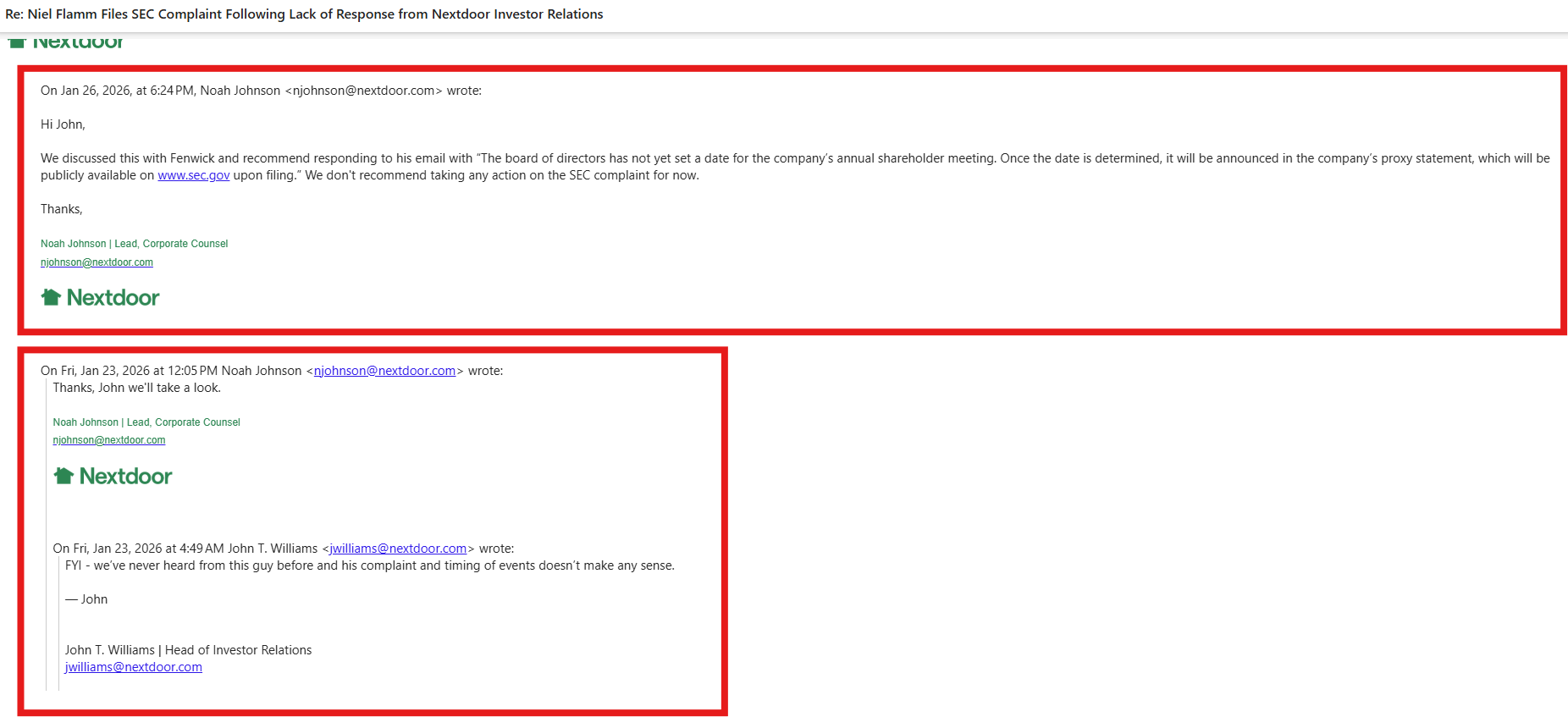
Today, I received an email that included a thread from John T. Williams, Head of Investor Relations. The thread included a note saying, “we’ve never heard from this guy before,” and was then forwarded, along with a response to Noah Johnson, Lead Corporate Counsel, along with a recommendation from Fenwick, perhaps via a consulting firm representing Nextdoor.
Two things:
Forwarding the entire email chain is a rookie mistake. (You’ll probably get a “happy gram” from #NiravTolia.)
I’ve been emailing Nextdoor for months. This wasn’t first contact. It took over a month—from January 2, 2026—to receive a response. That’s… fast neighborly action.
Platforms love to showcase the best of the community when it’s convenient. But community isn’t a marketing moment—it’s a responsibility. If we celebrate neighbors helping neighbors, we also have to protect access for those who rely on it most.
Be better.
Read more and subscribe to NielFlamm.com
#Community #NeighborsHelpingNeighbors #Leadership #PlatformResponsibility #Inclusion #Seniors #Accessibility #CorporateGovernance #Nextdoor

Iron Lung: Something Feels Wrong
I watched Iron Lung, and it’s the kind of movie that quietly crawls under your skin. Tight quarters. Long silences. A growing sense that whatever’s coming… isn’t good.
I won’t spoil what I felt or where it lands—but it definitely left me thinking, and a little uneasy.
🎥 Watch the video to hear my full thoughts on NielFlamm.com → Videos → Movie Reviews
#IronLung #MovieReview #HorrorMovies #AtmosphericHorror #PsychologicalHorror #IndieHorror #NielFlamm
A Dialysis Pet Peeve
Dialysis is already exhausting. Being stuck in a chair for hours means every little distraction feels bigger than it should.
There’s one behavior I see regularly that really wears on me — and it’s not about the machines or the treatment itself.
I break it down in a short video and explain why it matters more than people realize.
👉 Watch on NielFlamm.com → Videos → End Stage Renal Failure
#DialysisLife #EndStageRenalFailure #PatientPerspective #HealthJourney
Big Claims, Small Samples: Questions About Nextdoor’s ISP Switching Study
Nextdoor recently shared a stat-heavy article claiming that 42% of neighbors plan to change their home internet plan in the next six months, based on a survey of 850 U.S. adults. On the surface, that sounds like valuable insight for advertisers and ISPs.
But if we pause for just a moment, the methodology raises some serious questions.
Nextdoor regularly highlights that it has 100M+ verified neighbors across 345,000+ neighborhoods. If that’s the scale and trust Nextdoor is asking advertisers and investors to believe in, then a sample size of 850 adults feels… thin.
Here’s what doesn’t add up for me:
Why 850 adults when the platform claims 100M+ verified users?
Who selected the sample, and from which neighborhoods?
What’s the margin of error on this data?
Were respondents evenly distributed across regions, income levels, and urban vs. rural areas?
If “1 in 3 users rely on Nextdoor” (per Nextdoor’s own site), why wasn’t the sample meaningfully larger or more transparent?
Can this sample truly predict ISP-switching behavior at the national or neighborhood scale?
To be clear: I’m not disputing that people care about reliability and value or that many households are open to switching providers. That’s intuitive.
What I am questioning is whether this study, as presented, is robust enough to support the confidence Nextdoor is asking advertisers to place in it.
When research is used to sell reach, influence buying decisions, or justify ad spend, methodology matters as much as the headline. Without clarity on sampling, error rates, and demographic spread, the data risks being more marketing than measurement.
If Nextdoor wants to lead with scale, it also needs to lead with rigor.
Big numbers invite big questions.
#Nextdoor #DataTransparency #MarketResearch #AdvertisingMetrics #PlatformGovernance #DigitalTrust #ResearchMethodology #AdTech #ConsumerInsights
Transparency Is a Metric Too: A Shareholder’s Questions Ahead of Nextdoor’s Earnings Call
As a shareholder, I pay attention to two things that ultimately determine long-term value: trust and metrics. They’re inseparable. When one is unclear, the other becomes questionable.
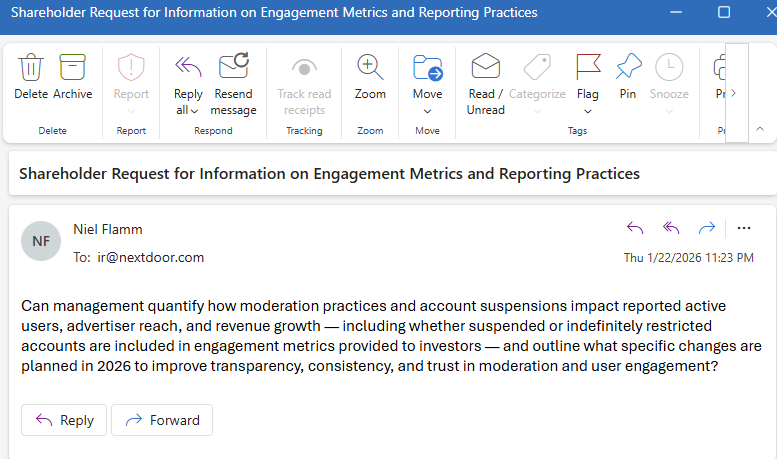
Recently, I submitted a formal shareholder inquiry to Nextdoor, asking management to clarify how moderation practices and account suspensions affect the numbers reported to investors—specifically, active users, advertiser reach, and revenue growth. I asked this to be answered at the Q4 and Full-Year 2025 earnings call on February 18, 2026.
This call will provide an update on progress and share plans. Earnings calls are where confidence is built—or eroded—based on how clearly companies explain not just what the numbers are, but how they’re calculated.
The Core Question Investors Deserve Answered
If Nextdoor reports operating with 100M+ verified neighbors, investors should understand what that figure actually includes. My inquiry asked management to quantify and disclose:
- How many accounts are temporarily suspended
- How many are indefinitely restricted
- Whether suspended accounts are included in reported engagement metrics
- What percentage of appeals are overturned
- What quality assurance exists for moderator decisions—especially when moderators are unpaid and anonymous
These aren’t edge cases. They directly affect:
- Advertiser confidence (reach and brand safety)
- Revenue credibility
- Investor trust in reported engagement
Why This Matters At the Earnings Call
Moderation and enforcement aren’t just community issues—they’re financial inputs. If engagement metrics include users who cannot engage, the signal investors rely on becomes distorted. If appeal outcomes and moderator accuracy aren’t measured or disclosed, governance risk increases. None of this slows a company down. In fact, transparency tends to do the opposite:
- It strengthens advertiser relationships
- It reduces speculation
- It aligns leadership, users, and investors around the same reality
What I’m Listening For on February 18
As a shareholder, I’m not looking for spin. I’m looking for clarity:
- How engagement is defined
- How enforcement affects reported numbers
- What changes are planned in 2026 to improve consistency, transparency, and trust
Nextdoor has an opportunity to lead—not just with scale, but with governance that investors can model, advertisers can trust, and users can believe in. Because in the end, transparency isn’t a risk. It’s a competitive advantage.
Read more and subscribe to NielFlamm.com.
#NiravTolia #Nextdoor #EarningsCall #ShareholderPerspective #PlatformGovernance #Transparency #InvestorRelations #DigitalTrust #MetricsMatter #Accountability