
Leadership Is More Than Looking Back
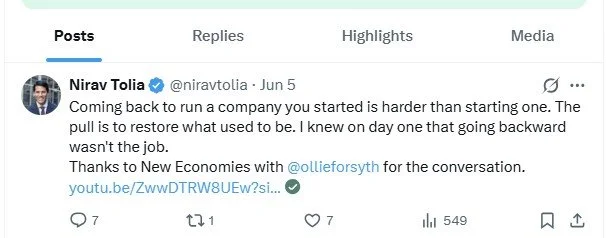
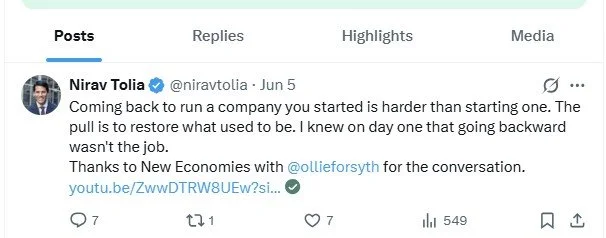
I came across a recent post on X from Nextdoor CEO Nirav Tolia reflecting on the challenges of returning to lead a company he founded. My reaction? It reads more as frustration than inspiration.
Running a public company is difficult, and every CEO faces pressure. But leadership is about setting the tone for employees, shareholders, customers, and the broader community. Looking backward can be part of the journey, but people also want to hear a vision for moving forward.
I've also seen current and former employees post online about what they describe as a difficult workplace culture. Those are their opinions and experiences, not mine, but they reinforce the importance of leadership messaging.
In a previous blog, I also commented on a March 3, 2026 X post that began with the phrase, "I'll be honest…" I believe communicators should avoid that expression because it can unintentionally invite readers to question whether previous statements were equally candid.
Which brings me to another question: Does Nextdoor have a public relations strategy that helps shape these messages? The company has a Media Relations team, but strong executive communications require more than media outreach.
If you need additional communications expertise, firms like JMac PR, led by John McCartney and known for technology and media campaigns, can provide strategic messaging support to help organizations better connect with stakeholders.
Leadership isn't just about what you say—it's about the confidence and clarity people take away after hearing it.
Subscribe to NielFlamm.com.
Empathy or Automation? The $1,000,000 Nextdoor Question
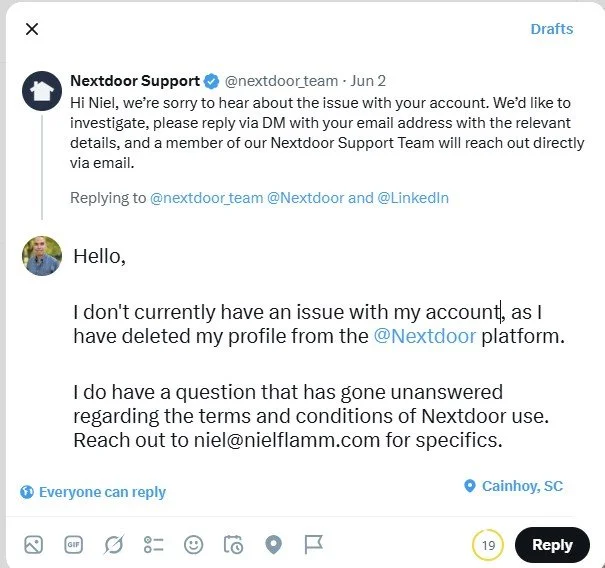
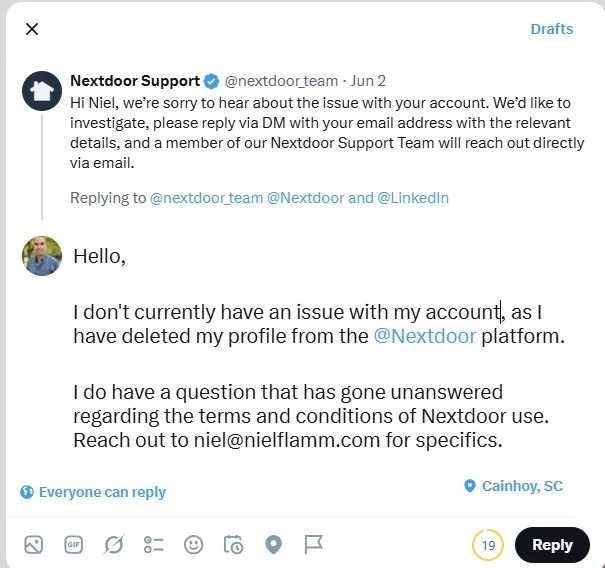
I recently received what appears to be a familiar, canned response from Nextdoor Support after posting on X. The message said they were sorry to hear about my issue and wanted to investigate, asking me to send my email address so someone from the Support Team could reach out directly.
So I replied.
I explained that I no longer have an account, but I have an unanswered question regarding Nextdoor's Terms and Conditions, and I invited them to contact me by email.
Now comes the $1,000,000 question:
Will someone actually follow through?
It's easy to express empathy with a template. It's much harder to demonstrate it through action. The appearance of caring and actually caring are two very different things.
That reminds me of Natalie Beckerman's new book, When Did You Stop Caring?, now available June 23, 2026, through Amazon and Barnes & Noble. I'm also looking forward to her presentation at Customer Contact Week (CCW) in Las Vegas, June 22–25, 2026, where I hope the conference delivers an enormous conversation around empathy, leadership, and customer experience.
The title makes me wonder:
When did Nextdoor stop caring enough to see conversations through to completion?
I'll gladly update everyone if an email arrives.
Does Dynamic Pricing Build Community or Divide It?
I recently read Nextdoor's latest travel insights report, "Who Are Nextdoor's Summer Travelers? New Data Shows a High-Value, High-Intent Audience," which highlights that neighbors plan to spend significantly more on travel this summer and offers guidance on how advertisers can capitalize on these spending patterns.
I encourage everyone to review the full report and draw their own conclusions.
One section gave me pause.
In a previous post, I questioned whether moderators or platform personnel have access to verified address information. If any individual with inappropriate intent had access to that information and could also infer travel plans, it raises obvious privacy and security questions that deserve discussion. Strong governance and safeguards are essential for any community platform.
I also noticed the report is based on an internal Nextdoor survey conducted in April 2026. Yet, many of the detailed survey methodologies and statistical metrics are not publicly provided alongside the findings. Greater transparency around methodology can help readers better evaluate research conclusions.
Finally, the report discusses opportunities for advertisers to target neighbors based on spending behaviors and travel intent. Dynamic pricing models have become common across industries—from airlines to rideshare services and technology products—but I question whether encouraging businesses to maximize pricing based on demand truly strengthens neighborhood relationships or creates additional financial pressure for families trying to enjoy time together.
Community platforms should strive to connect neighbors, not simply optimize monetization opportunities.
Read the complete report and decide for yourself.
Subscribe to NielFlamm.com.

Customer Contact Week, Nextdoor, and an Invitation to Talk

I'm putting the finishing touches on an updated video about Customer Contact Week in Las Vegas and why I believe it could be the perfect place for meaningful conversations about improving the Nextdoor experience.
Could AI help strengthen communities while creating a better experience for neighbors and advertisers alike?
Watch the video and let me know what you think.
If You Feel Strongly Enough, Step Into the Light
I understand what it's like to receive feedback that stings.
Over the past several months, I've shared my experiences with Nextdoor, its policies, and CEO Nirav Tolia after what I believe was inconsistent moderation. That's not today's topic.
Recently, a current Nextdoor user from Hollywood, Florida contacted me about her frustrations with the platform. She sent examples and concerns and asked me to look at them.
I reviewed what she provided and explained something important:
Her experience is her experience.
My experience is my experience.
If I start publishing someone else's allegations, complaints, and stories as if they were my own, it starts to look like hearsay. More importantly, it risks my credibility.
I've spent a lot of time documenting my own experiences, screenshots, correspondence, and interactions. That's a foundation I can stand on.
I offered alternatives.
I suggested a podcast conversation where she could tell her story in her own words.
I suggested commenting on one of my blog posts or social media discussions.
I suggested participating publicly.
She declined.
She explained that she is a private person and did not want to be publicly associated with the issue.
That's her choice.
But if someone wants change while remaining completely anonymous, refusing to speak publicly, refusing to comment, refusing to appear on a podcast, and expecting someone else to carry the entire message, that's a difficult assignment.
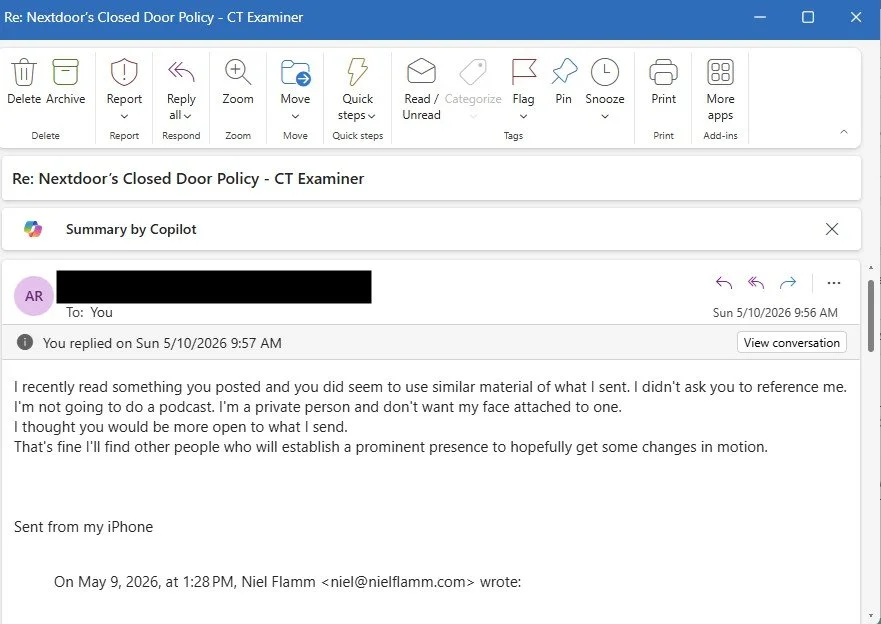
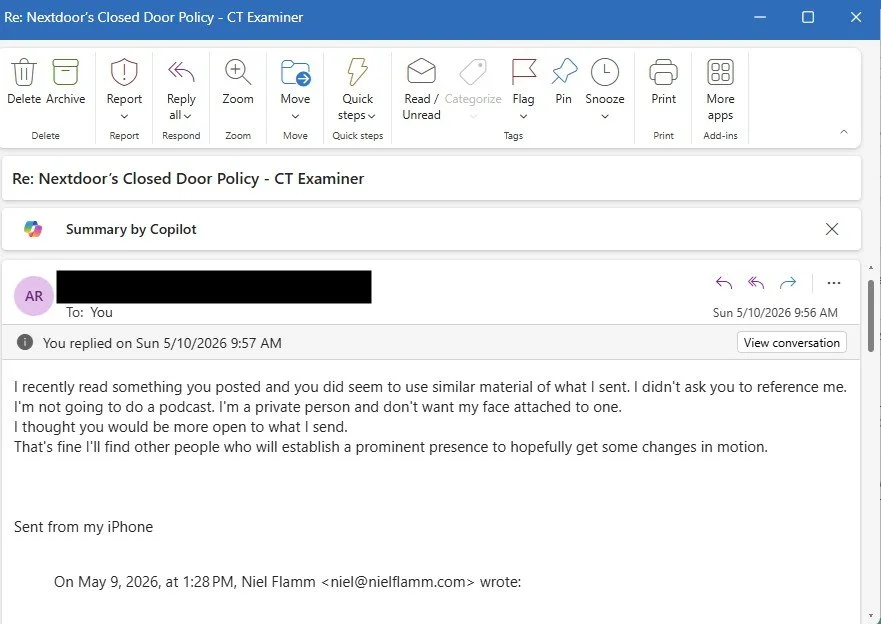
Then came the response email.
Let's just say the tone seemed to change once I declined to become her personal Nextdoor representative.
Apparently, I was useful when I was expected to do the work.
Less useful when I suggested she join the conversation herself.
Funny how that works.
I don't work for Nextdoor.
I don't work against Nextdoor.
And I certainly don't work as a free public relations agency for anonymous complaints.
I'm a blogger and podcaster.
Not Sidney Korshak.
Not Johnny Rosselli.
Not Ori Spado.
If people feel strongly enough about an issue, sometimes they have to step into the light and own their story.
Otherwise, they're asking someone else to buy the ticket, drive the car, fight the battle, and write the ending.
At that point, I'm not a content creator.
I'm an unpaid Uber for grievances.
Subscribe to NielFlamm.com.