
Shareholders Deserve Questions—Not Just Talking Points
As a shareholder, I’ve watched Nirav Tolia appear on podcasts, conference stages, and interviews discussing the future of AI, verified neighbors, and the company’s vision.
Yet I rarely see the difficult questions being asked.
Where are the interviews that examine why Nextdoor has yet to achieve sustained profitability after roughly 15 years as a company?
Where are the questions about capital allocation? If the company has resources for initiatives such as a new Dallas office, how does management evaluate those investments alongside creating long-term value for shareholders?
I’ve also written about my own experience creating a new account using information that I believe raises questions about the effectiveness of the platform’s “verified neighbors” concept. I’d welcome a public discussion of those concerns.
Rather than another interview focused on optimistic talking points, I’d like to see a respected business or technology media outlet host a moderated conversation between Nirav, me, and other concerned shareholders. Open dialogue benefits everyone—management, investors, employees, and the community.
As I write this on July 2, the company’s official social media activity appears to have slowed ahead of the Independence Day holiday. There’s nothing wrong with taking time off, but shareholders also expect consistent execution and accountability for the capital they’ve entrusted to the company.
The best companies don’t shy away from difficult questions—they answer them.
Whistleblowers Welcome: Help Shine a Light on Leadership and Workplace Culture
Every organization has room to improve. Some embrace feedback. Others silence it.
If you are a current or former employee who is concerned about workplace culture, leadership, management practices, accountability, or organizational performance, I’d like to hear your perspective.
If you choose to reach out, I will take reasonable steps to redact identifying information before discussing your experience publicly. Please do not send confidential, proprietary, or legally protected information. I’m interested in your experiences, observations, and opinions—not trade secrets.
Poor performance should not be rewarded.
Ineffective leadership should be examined, not ignored.
A toxic culture rarely appears overnight. It often starts at the top and spreads throughout an organization until someone has the courage to confront it.
One of my favorite leadership principles is simple:
You tolerate what you allow.
If leaders allow dysfunction, it becomes the culture.
If employees remain silent out of fear, meaningful change becomes even more difficult.
Constructive transparency and accountability make organizations stronger—not weaker.
If there are stories that deserve to be heard, let’s have that conversation.

Taylor Swift, Madison Square Garden, and the Wedding Rumor That Doesn’t Make Sense

There’s a rumor making the rounds that Taylor Swift and Travis Kelce could be getting married this weekend at New York City’s legendary Madison Square Garden.
Let me emphasize something important: it’s a rumor. I have no idea whether it’s true, and I genuinely hope it isn’t.
As someone born in Queens and raised around New York, Madison Square Garden—“MSG” to us natives—isn’t just another venue. It’s one of the most famous arenas in the world. It has hosted championship boxing, iconic concerts, political events, unforgettable sporting moments, and is home to the newly crowned NBA Champion New York Knicks. I’ve even had the opportunity to see Billy Joel perform there three different times.
It’s an incredible place.
It’s also an incredibly odd place for a wedding.
Taylor Swift has built an image of carefully protecting her private life. She fills her music with Easter eggs, hidden meanings, and subtle clues while surrounding herself with significant security—which is understandable. Unfortunately, there are people in the world who become far too obsessed with celebrities.
So if privacy is truly the goal, why choose one of the most recognizable entertainment venues on Earth?
Madison Square Garden can hold tens of thousands of people, depending on the event configuration. Is the guest list really going to be that large? Does a wedding become another exclusive event where only the entertainment and business elite receive an invitation? Would any of the fans who helped build Taylor Swift into one of the biggest artists on the planet be there?
Those are interesting questions.
There’s also the practical side.
Anyone who’s spent time in Manhattan knows what happens whenever a major event comes to MSG. I remember the traffic when President Donald Trump attended a Knicks Finals game—it was absolute gridlock. Add worldwide media, celebrity guests, security, and curious fans to the mix, and it’s difficult to imagine a more chaotic setting for what is supposed to be one of life’s most personal moments.
Maybe that’s the point. Maybe the rumor is so unbelievable that nobody should believe it.
Personally, I hope that’s exactly the case.
If Taylor Swift and Travis Kelce decide to get married, I hope they do it somewhere intimate, meaningful, and far away from flashing cameras and helicopters. Somewhere that belongs to them—not to social media, not to television, and not to the 24-hour entertainment news cycle.
Who knows? Maybe somewhere in the middle of Antarctica.
Cold.
Dark.
Peaceful.
And perhaps someday we’ll get a song about it that has all of us wondering whether life imitated art—or whether it was just another perfectly placed Easter egg.
Until there’s an official announcement, that’s all this remains: a rumor.
If the Model Is Working, Why Isn’t the Business?
One thought keeps coming back to me during my ongoing Nextdoor experiment.
I’ve often heard that local moderators know their neighborhoods best, and that’s why a decentralized, unpaid moderator model works.
Perhaps that’s true.
But what if the real motivation isn’t simply local knowledge?
What if it’s about scaling the business while keeping operating costs low?
Using unpaid moderators significantly reduces labor costs. From a business perspective, that’s understandable.
The question is whether the strategy is producing results.
Nextdoor has been around for roughly 15 years.
Despite relying on an unpaid moderation workforce for much of that time, the company has struggled to achieve sustained profitability, and its financial performance and stock price continue to raise questions among investors.
For comparison, Meta reportedly reached profitability in about five years. Every company is different, but shareholders naturally ask whether the current strategy is delivering the outcomes leadership promised.
If a low-cost moderation model hasn’t translated into consistent profitability or stronger shareholder returns after 15 years, is it time to reevaluate the strategy?
This isn’t simply about moderators.
It’s about whether the company’s leadership, operating model, and capital allocation are producing measurable results.
As a shareholder, I believe that’s a fair question for the Board of Directors to ask.
Leadership should be measured not only by vision, but by execution and results.
Join the discussion on NielFlamm.com.
If AI Can Watch My Groceries, Why Can’t It Help Moderate Nextdoor?
One of Nirav Tolia’s favorite topics on the speaking circuit is AI.
That got me thinking.
If AI is such a core part of Nextdoor’s strategy, why isn’t it being used more effectively to improve moderation?
AI isn’t new. I’ve watched it evolve over the past 25 years, and today it’s part of my everyday life.
Take a trip to my local Harris Teeter.
I walk through self-checkout, scan my groceries, bag my items, and leave. Cameras, sensors, and AI are constantly evaluating what’s happening. When something falls outside an expected pattern or decision matrix, the system alerts a human associate to step in.
It’s AI first.
Human review second.
That’s a scalable model.
Now compare that to what I continue to observe on Nextdoor.
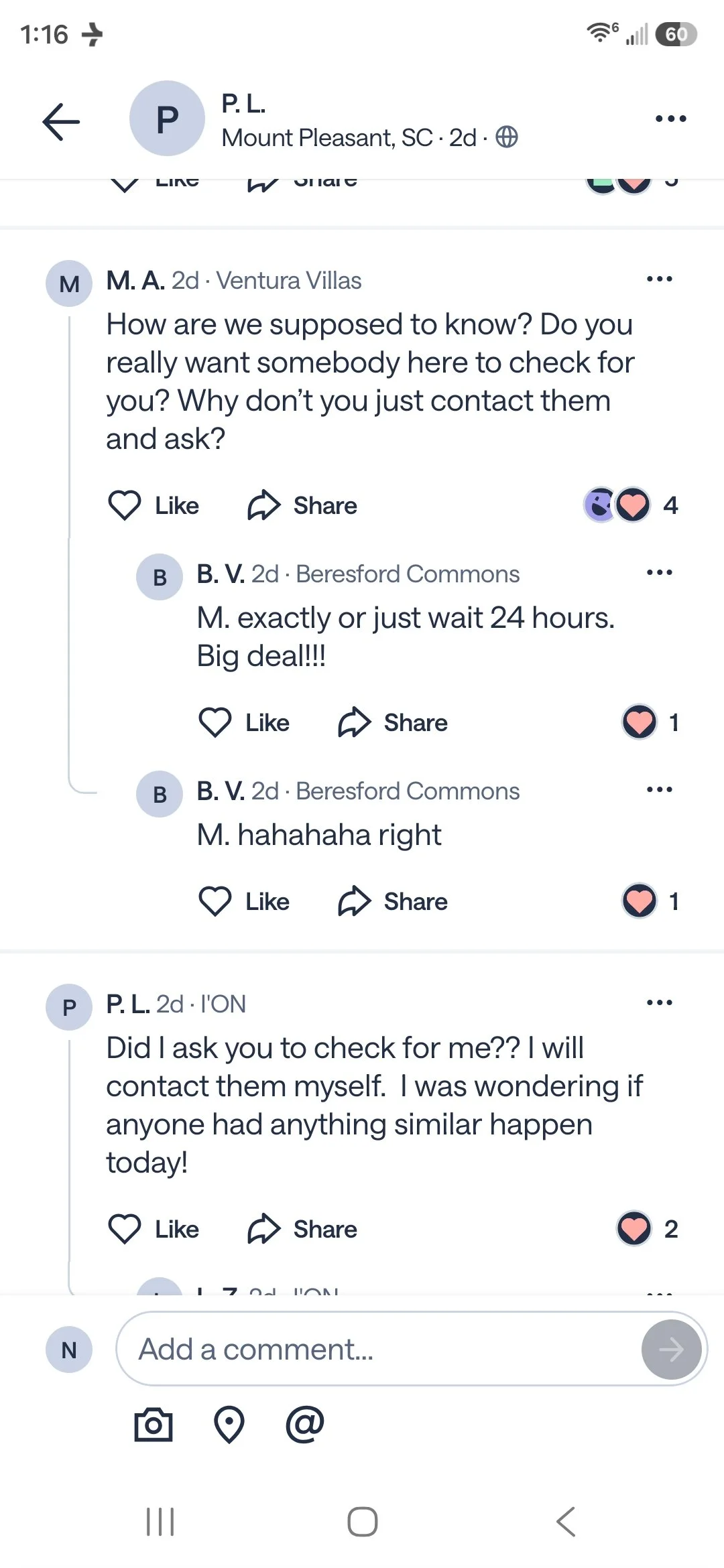
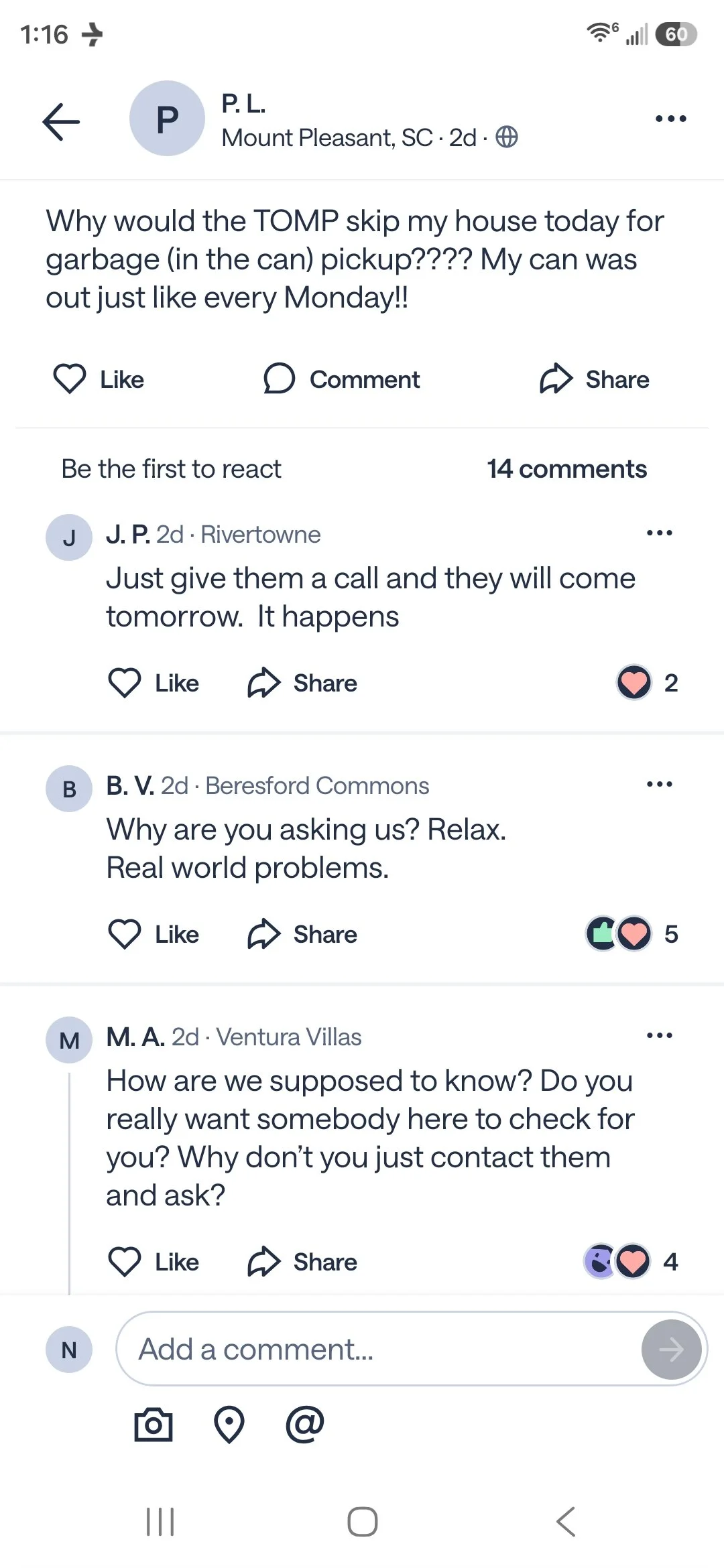
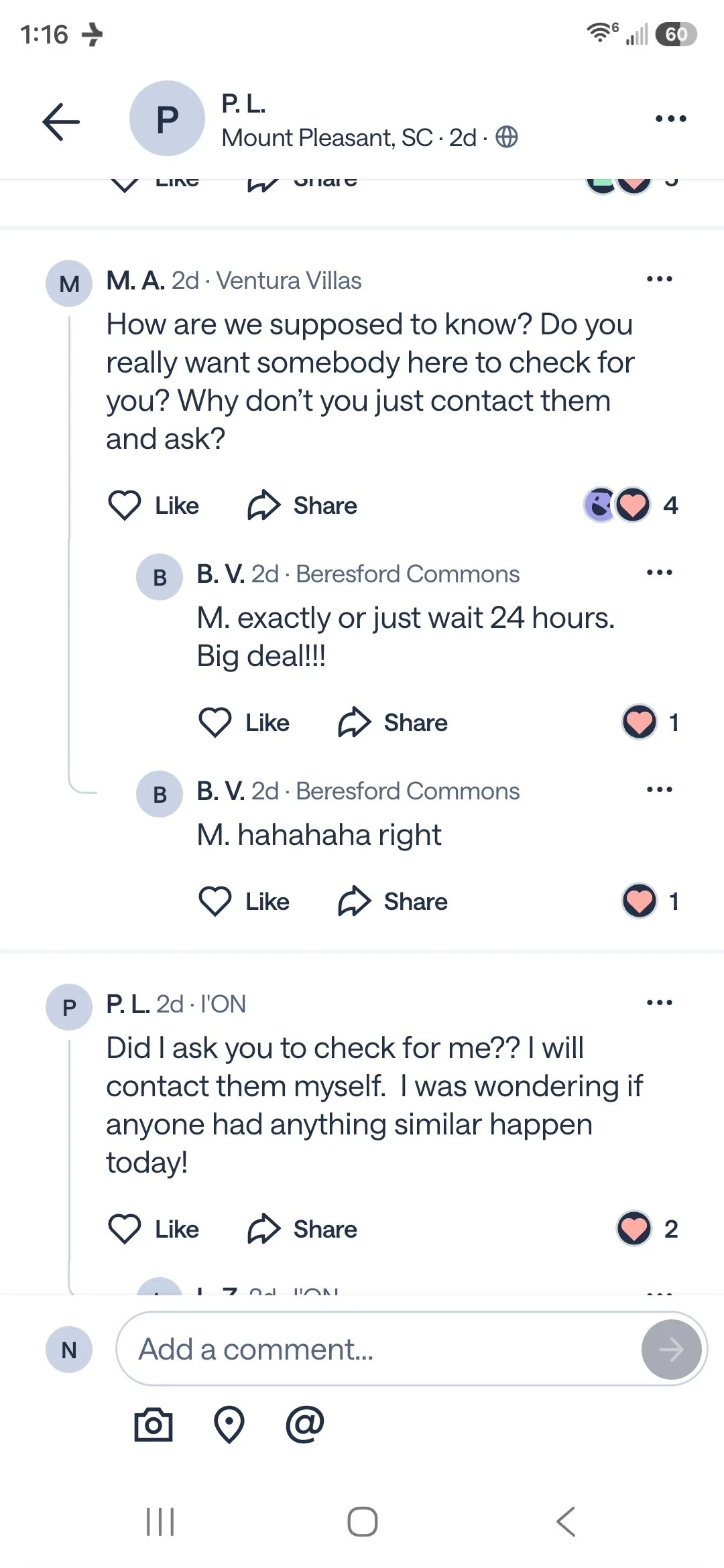
The attached example contains snarky comments that remained visible two days after they were posted. This isn’t an isolated example; it’s part of a pattern I’ve documented during my ongoing Nextdoor experiment.
Why isn’t AI identifying conversations that are escalating into personal attacks or unconstructive exchanges and routing them to trained reviewers?
Instead, Nextdoor continues to rely heavily on a decentralized network of unpaid moderators. While many volunteer with good intentions, any moderation system benefits from consistent standards, quality assurance, and ongoing coaching.
To me, the current model feels like the inmates running the prison while the warden sits in the office, removed from the chaos.
If AI can help prevent mistakes at a grocery store checkout, surely it can help create a more consistent and constructive online community.
Join the discussion on NielFlamm.com.