

Day 44: Change Is Immediate. Results Take Time.

This morning started at 5:00 a.m.
First order of business? Checking my fraternity's Powerball pool tickets.
The result?
We won $8...
...on a $130 buy-in.
Let's say the return on investment wasn't exactly Wall Street material.
While I was scanning the tickets with the South Carolina Education Lottery app, I had to laugh. I remember the days when checking lottery tickets meant comparing every number by hand, trying to memorize the winning combinations. Technology really can be a wonderful thing.
I also had another thought.
Before I scanned the tickets, I checked my email.
Part of me hoped I'd wake up to a message from Jacob Chavis.
I didn't.
Today marks another day without receiving the study or even an acknowledgment.
As I thought about that, my mind wandered to a conversation that may have taken place somewhere within Nextdoor.
I don't know who was involved.
Maybe it was between Nirav Tolia and Jacob Chavis.
It may have involved someone else in the leadership chain.
Maybe no such conversation happened at all.
But I couldn't help wondering whether someone, somewhere, said:
"Don't engage."
Or...
"Don't respond."
Or...
"Let's wait."
I don't know.
What I do know is that, from the outside looking in, continued silence raises questions.
Am I the only person who thinks something feels off about that?
I don't believe I am.
One of the most encouraging parts of this journey has been the people who've taken the time to react to my posts, leave thoughtful comments, challenge my perspective, or click the thumbs-up or heart button.
Those interactions matter.
They remind me that people are reading.
People are thinking.
People care.
They remind me that this effort isn't for nothing.
Recently, I heard a short video that said:
"Change is immediate. Results take time."
That line stuck with me.
Real change often begins the moment someone decides to speak up.
The visible results usually come much later.
Whether it's improving communication, questioning corporate culture, or encouraging accountability, meaningful progress rarely happens overnight.
So I'll keep asking respectful questions.
I'll keep listening to different viewpoints.
And I'll keep running the race.
Because while results take time...
The decision to pursue change happens today.
Join the discussion at NielFlamm.com/blog. Leave some feedback—I'd love to hear from you.

A Great Story—But Culture Is Built Every Day

I genuinely enjoyed reading this Nextdoor story about Spud, a shelter dog who found his forever home after being featured in Broward County Animal Care's "Paws and Protectors" campaign alongside members of the Broward Sheriff's Office (BSO).
Read the full story here:
https://wsvn.com/news/local/broward/new-paws-and-protectors-campaign-helps-broward-shelter-dogs-find-new-homes/
This is exactly the kind of positive, hyperlocal story that can bring a community together.
A dog found a home.
Law enforcement partnered with Animal Care.
Neighbors responded.
Everyone wins.
I applaud everyone involved.
Where I continue to struggle is reconciling stories like this with my own experience as a shareholder and user of the platform.
Today marks Day 43 since I requested a Nextdoor study from Jacob Chavis.
Over the weekend, I sent another email to Jacob Chavis, CEO Nirav Tolia, Investor Relations, Communications, and other company representatives.
As of today, I still haven't received the study, an acknowledgment, or a response.
That disconnect is difficult for me to ignore.
Nextdoor often speaks about building community, communication, and connecting neighbors. Those are admirable goals.
But culture isn't defined only by the success stories a company shares.
It's also reflected in how people are treated when they ask difficult questions, offer constructive feedback, or request information.
I also continue to have concerns about moderation. In my own experience, my neighborhood feed often contains complaints about almost everything imaginable, while moderation appears inconsistent and lacks visible quality assurance. At the same time, I've found it difficult to have meaningful conversations with the company itself.
That leads me back to the same question I've been asking for more than six weeks:
How is this culture acceptable?
The platform has tremendous potential. Not with the current regime.
Stories like Spud's remind us of what Nextdoor can be at its best.
Now I'd like to see that same commitment to community reflected in communication, transparency, consistency, and accountability.
Join the discussion at NielFlamm.com/blog. Leave some feedback—I'd love to hear from you.
Another Voice Raises Questions About Nextdoor Moderation
Over the past 42 days, I've written extensively about my experiences with Nextdoor. Much of what I've discussed has centered on three recurring themes:
- Corporate culture
- Communication
- The moderation model
This weekend, I came across an article from @CNBNews that immediately caught my attention:
"Nextdoor's Indefinite Ban on CNBNews Raises Serious Questions About Fairness and Transparency."
Read the article here:
Reading it felt familiar.
According to the article, CNBNews received an indefinite suspension after posting what it says were excerpts from government press releases. The article also states that an appeal was denied without identifying which Community Guideline had been violated.
Whether you agree with CNBNews' conclusions or not, the article raises important questions.
For me, it validates many of the concerns I've been writing about.
In my previous blog post, I described finding a week-old discussion on Nextdoor that drifted from a local topic into national politics, world politics, and religion—even though Nextdoor describes its focus as neighborhood or "hyperlocal" conversations.
Now I read that a local news organization reported it was indefinitely suspended.
Different situations.
The same question:
If one discussion remains visible while another account is indefinitely suspended, what standards are being applied?
Who reviews those decisions?
How is quality assurance performed?
What checks exist to ensure moderation is consistent?
Those are governance questions.
Another part of the CNBNews story stood out to me.
The article says Nextdoor initially worked with CNBNews as it expanded locally, seeking to grow neighborhood engagement. According to the article, that relationship later ended with an indefinite suspension.
That makes this situation particularly noteworthy.
I'm not writing to determine who is right or wrong.
I'm asking whether the moderation process is transparent, consistent, and fair.
As a shareholder, I want Nextdoor to succeed.
I believe success comes from listening to feedback, communicating openly, and applying policies consistently.
When users, publishers, shareholders, and community members begin asking similar questions about moderation, transparency, and communication, those questions deserve thoughtful discussion—not silence.
If this article resonates with you, or you've had your own experience with Nextdoor moderation, I'd like to hear it.
Please help spread the word by sharing this post, tagging someone who uses Nextdoor, and sharing it on your own page.
Leave some feedback—I'd love to hear from you.
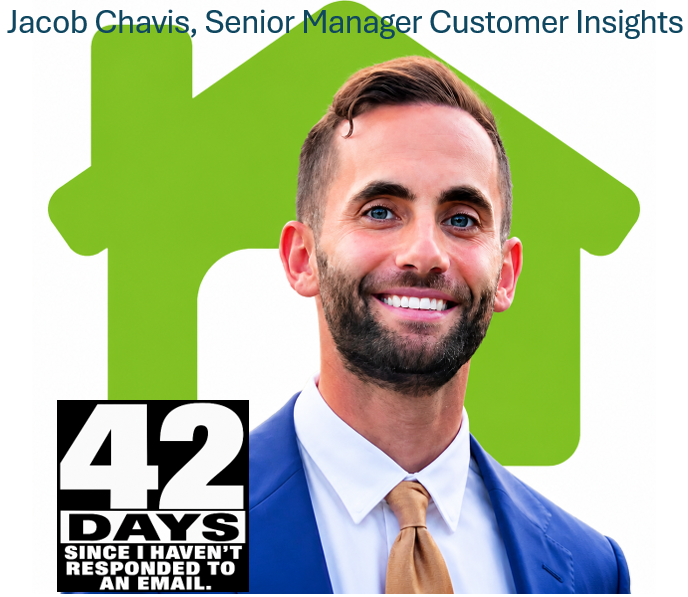
Day 42: Culture, Moderation, and the Courage to Have Difficult Conversations
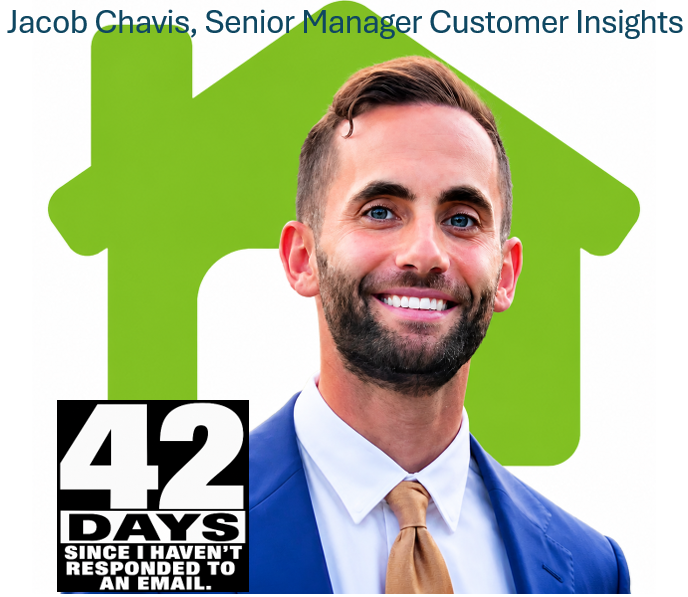
Today marks Day 42 since I requested a Nextdoor study from Jacob Chavis.
Forty-two days later, I still haven't received the study, an acknowledgment, or a response.
Over the past six weeks, my observations about Nextdoor have largely centered around three themes:
1. Culture
2. The moderation model
3. Communication
Let's start with moderation.
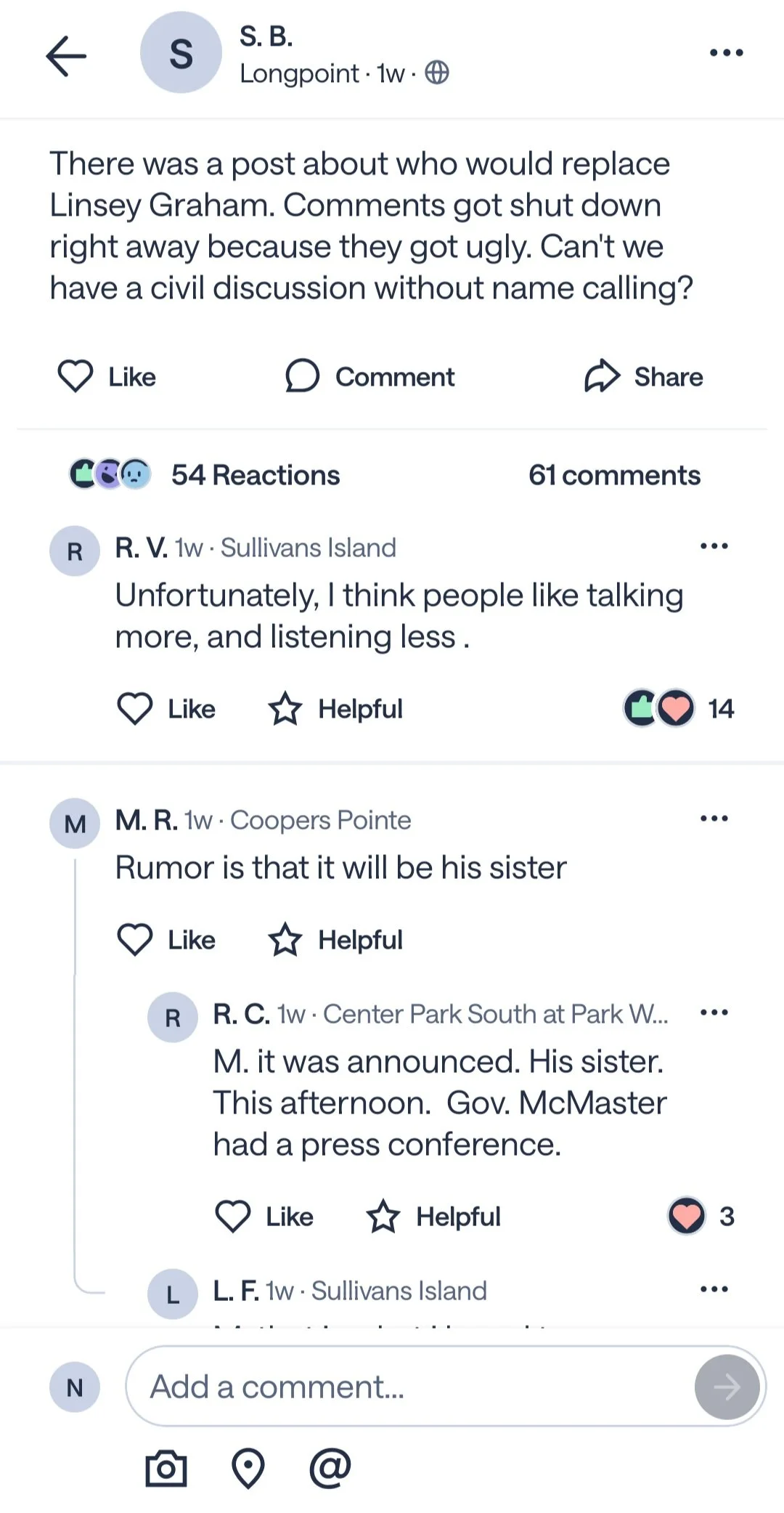
After a late night of blogging and recording videos for NielFlamm.com, I did what most people probably wouldn't do before bed—I spent some time browsing Nextdoor.
Yes, I know... I need better hobbies.
I came across a discussion that began about a week ago concerning who would temporarily fill the U.S. Senate seat vacated after Senator Lindsey Graham's death.
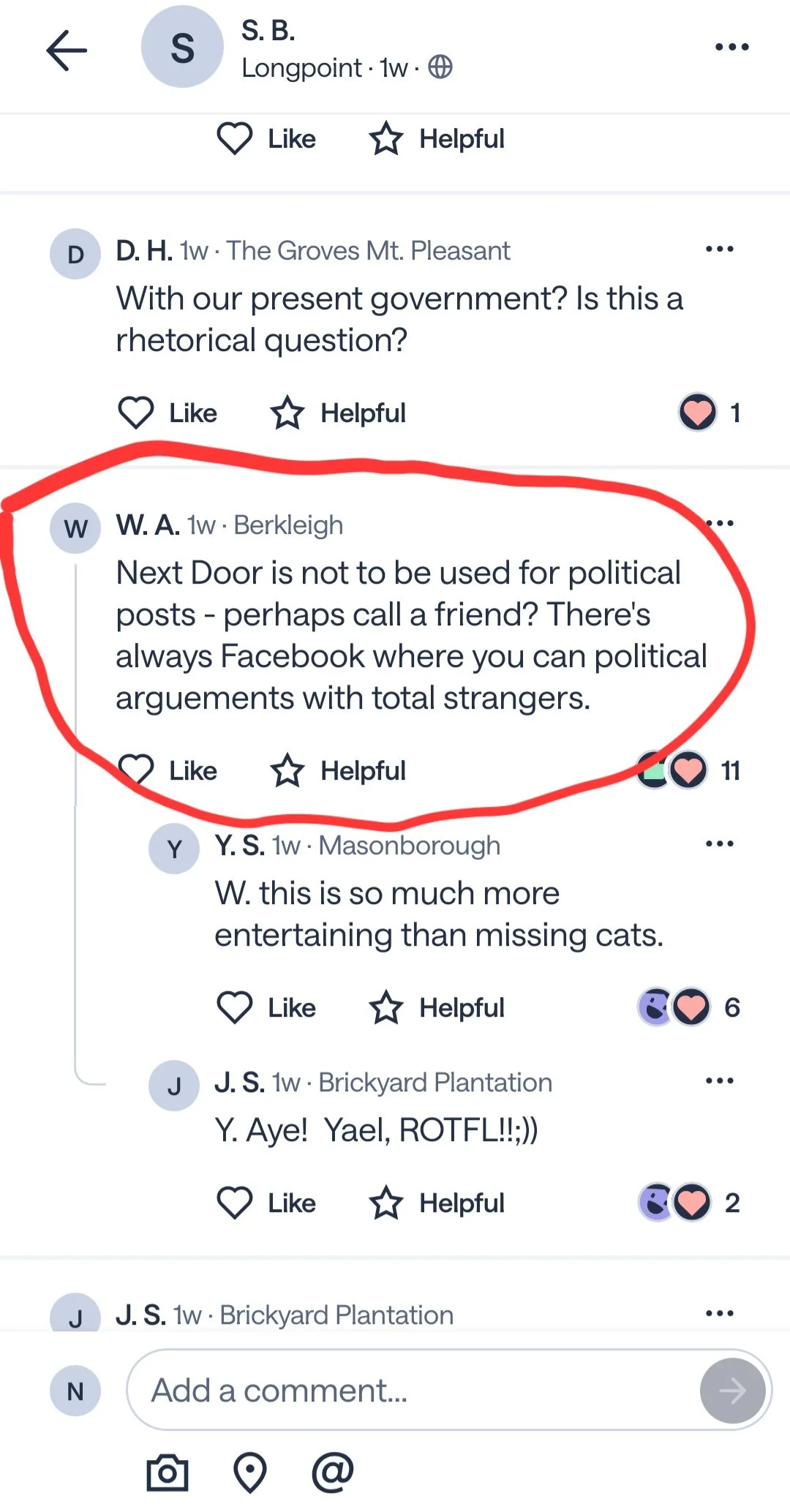
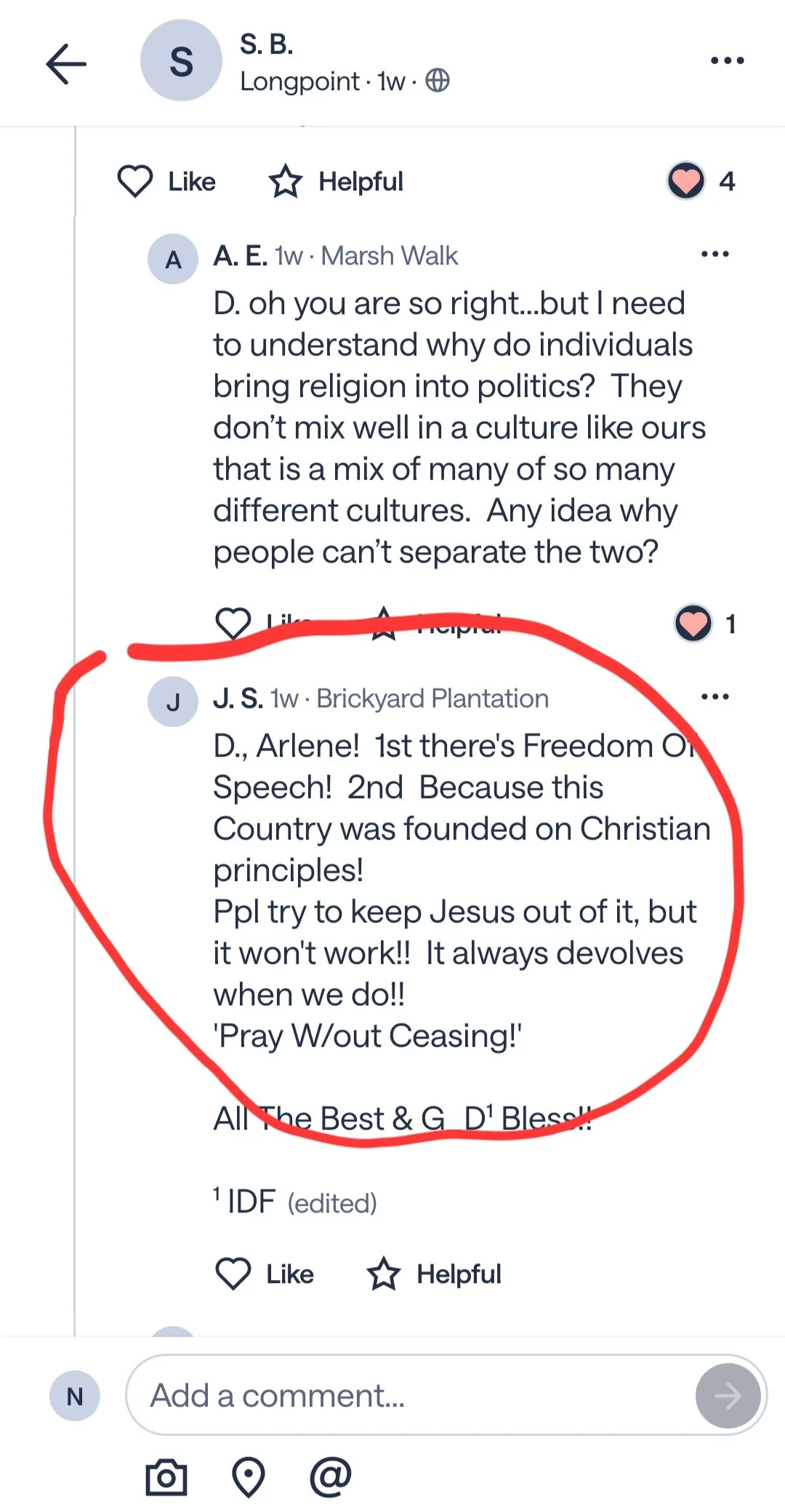
Yet, as I read through the thread, the conversation expanded well beyond the local topic into national politics, world politics, and religion.
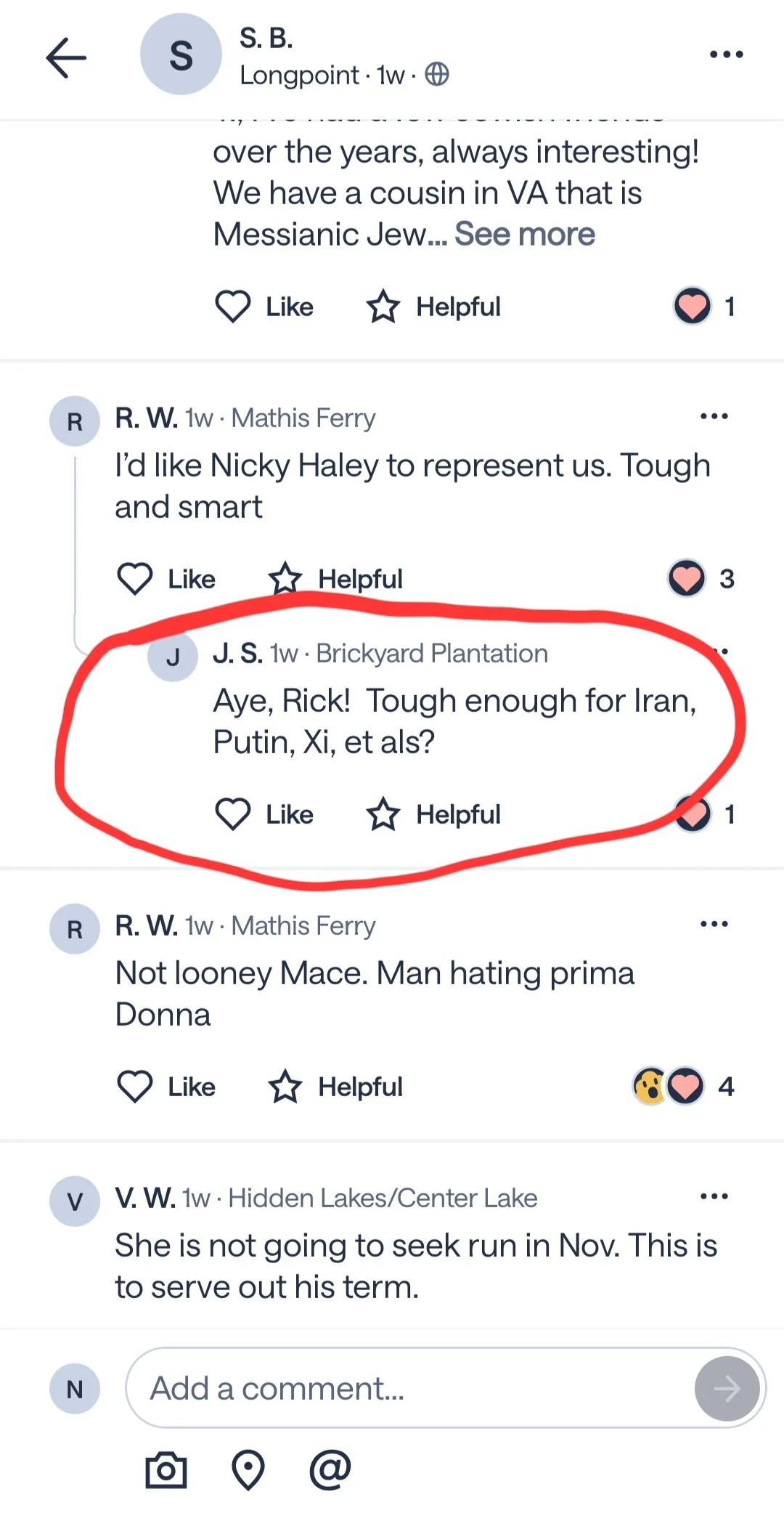
Ironically, one participant even pointed out that the platform wasn't intended for national political discussions.
Yet the discussion remained.
A week later.
That raises questions.
Was the thread never reviewed?
Was it reviewed and intentionally left up?
Were reports submitted?
If so, what standards were applied?
These are the kinds of questions that naturally arise when moderation appears inconsistent.
Consistency builds trust.
Inconsistency creates confusion.
The second thought that struck me this morning came from a Facebook Reel by Polina Mireau, a former COO, operations consultant, and leadership coach.
She talks about something many leaders struggle with: avoiding difficult conversations.
You can watch it here:
https://www.facebook.com/reel/2764410343955450
Her point is simple.
Ignoring a problem rarely makes it disappear.
People often hope difficult situations will resolve themselves.
Most don't.
Leadership means having the uncomfortable conversation.
That message resonated with me because it's exactly what I've been asking of Nextdoor leadership.
Not agreement.
Not applause.
Just a conversation.
Whether it's CEO Nirav Tolia, Jacob Chavis, Investor Relations, Communications, or anyone else at the company, my request remains the same:
Let's have the difficult conversation.
If the answer is no, say no.
If the study can't be shared, explain why.
If I've misunderstood something, tell me.
Communication—even difficult communication—is almost always better than silence.
That's what builds trust.
That's what builds culture.
And after 42 days, I believe the conversation is long overdue.
Join the discussion at NielFlamm.com/blog. Leave some feedback—I'd love to hear from you.
The Lotto Dudes Return: A Masterclass in Financial Mismanagement 😂💸
The Lotto Dudes are back.
Mostly because apparently none of us learned our lesson.
Let's review our recent investment history.
Round 1
The pool had a $200 buy-in covering both Mega Millions and Powerball.
We won...
🥁🥁🥁
$40.
That works out to about $4 per guy.
That's an 80% loss on our investment.
Most people would have taken the $4, bought a cup of coffee, and reflected on their life choices.
Not us.
We're visionaries.
Round 2
We rolled the entire $40 into Powerball.
The results?
We won...
$12.
Which means we somehow managed to lose another $28, a 70% loss on the rollover.
If you look at the whole adventure...
We turned $200 into $12.
That's a grand total return of...
-94%.
If this were a mutual fund, the SEC would politely ask us to stop.
If it were a hedge fund, CNBC would interview us just to ask, "How?"
If it were cryptocurrency, someone would still call it "a buying opportunity."
The best part?
Nobody has won the jackpots yet.
So naturally...
WE'RE DOING IT AGAIN.
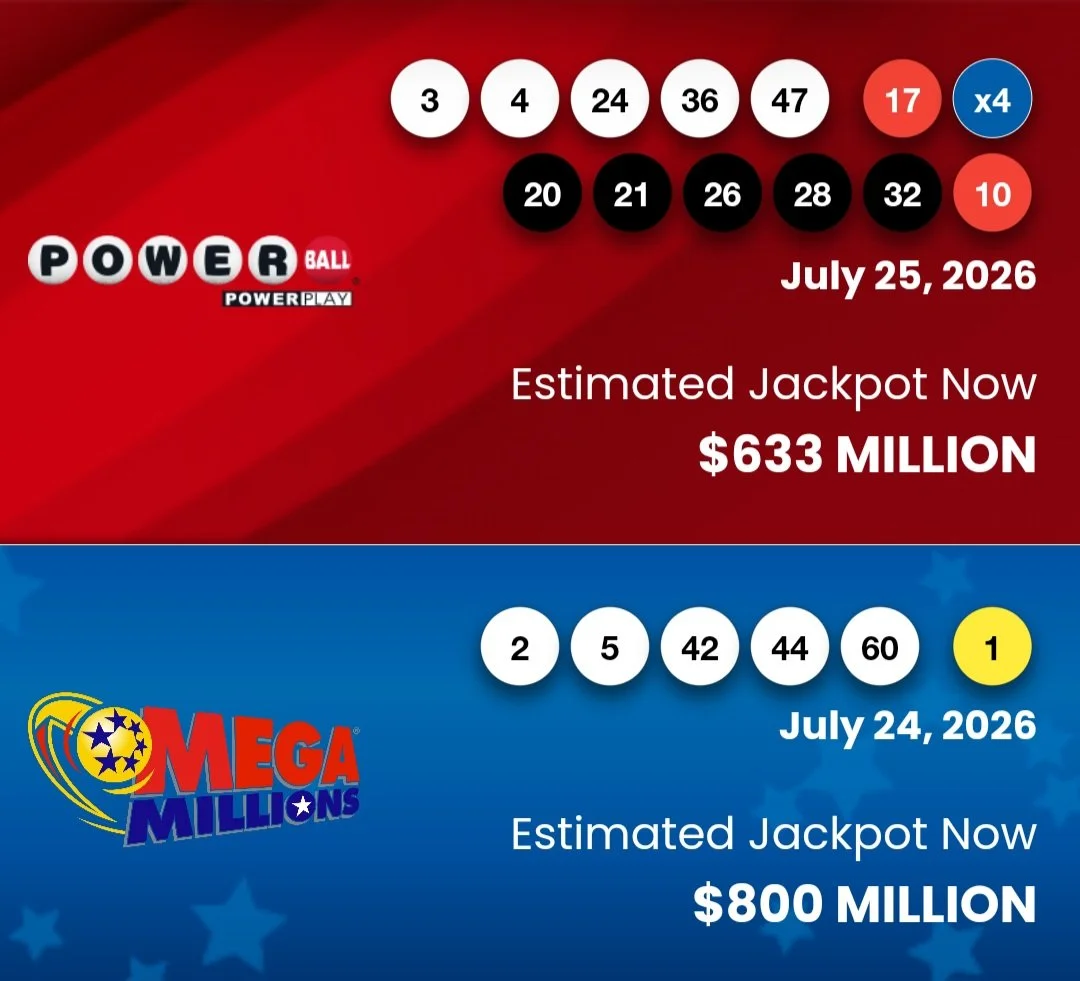
Current jackpots:
💰 Mega Millions (Tuesday): $800 million
💰 Powerball (Monday): $663 million
Because clearly the definition of insanity is buying lottery tickets and expecting... well... actually, somebody has to win eventually.
The buy-in is $20.
Now here's where it gets funny.
Every lottery pool has them.
The guys who suddenly become lottery experts.
"You should buy more Quick Picks."
"No, all birthdays."
"Only odd numbers."
"Only even numbers."
"Buy them at this store."
"Don't buy them at that store."
"Get the ticket at 9:17 p.m. because Mercury is in retrograde."
Meanwhile...
When it's time to collect the money...
🦗🦗🦗
When it's time to drive to the store...
🦗🦗🦗
When it's time to organize the tickets...
🦗🦗🦗
Everyone wants to be CEO.
Nobody wants to be Operations.
Well...
I've put my only foot down.
If I'm running the pool, I'm running the pool.
You can absolutely offer suggestions...
...right after you volunteer to collect everyone's money, chase down the guys who forgot to pay, buy the tickets, scan the winners, keep the records, and explain to twelve grown men why their share of the winnings is approximately enough to buy a value-menu cheeseburger.
Until then...
Sit back.
Relax.
Trust the process.
It's only failed spectacularly every single drawing.
Good luck to all the Lotto Dudes!
One of these days we're going to hit it big...
...or we'll be writing another blog post about turning $200 into enough money to split a family-size bag of chips.