
Plot Twist: It Was Probably the Tetanus Shot
Friday evening, around 7:00 PM EDT, I was at a recovery meeting when my neck started feeling tight.
Nothing dramatic. Just tight.
Friday is also a dialysis day, so aches, fatigue, and generally feeling like I've been run over by something aren't exactly unfamiliar territory. I had taken some time during the day to sleep and recover, so my first thought was simple:
I probably slept wrong.
Mystery solved.
Or so I thought.
I got home around 8:30 PM. There had been a group conscience/business meeting, I wrote my latest Nextdoor post, and then I hopped onto Zoom with the Fraternity guys.
Basically, a perfectly normal Friday night in my world.
As the Zoom went on, however, things started going downhill.
I was getting achier.
I was getting cold.
And then the thought entered my head:
OMG. Did I pick up ANOTHER flu or virus?
Because apparently my immune system has decided that 2026 is the year we're going to collect illnesses like they're Pokémon.
By around 11:00 PM, I gave up and went to bed.
I'm writing this now at around 6:00 AM EDT after what can generously be described as a terrible night's sleep.
My left arm hurts. I'm achy. I'm pretty sure I have a fever. I feel miserable, and most importantly, I know my body well enough to recognize that this isn't my normal post-dialysis "I've had better days" feeling.
Then, sometime during the night, my brain finally decided to provide one very important piece of information:
Thursday morning, I got a tetanus shot.
Oh.
Yeah.
That.
Mystery possibly solved.
I'm not an anti-vaxxer. I got the original three COVID shots early on, and I've been offered additional boosters since.
But here's the problem:
Every COVID shot made me feel absolutely miserable for almost exactly 36 hours.
Apparently my immune system doesn't quietly process a vaccine.
It holds a staff meeting.
There are committees.
There are breakout sessions.
Someone orders lunch.
And apparently the entire organization needs about 36 hours to discuss what just entered the building.
I understand why it happens. Vaccines are designed to get the immune system ready to recognize and respond to a particular threat. Fever, fatigue, aches, chills, and a sore arm can happen afterward.
Knowing why I feel miserable, however, doesn't make me feel any less miserable.
Which brings me to the vaccine I've been successfully avoiding:
Shingles.
I've been told I should get the shingles vaccine. I'm diabetic. I'm on dialysis. I've had chickenpox. There are plenty of reasons for me to take shingles seriously.
And yet…
I keep putting the vaccine off.
It's not because I think vaccines are bad.
It's because I know the conversation that's going to happen in my head:
Responsible Niel: "You should get the shingles vaccine."
Other Niel: "Remember the COVID shots?"
Responsible Niel: "Yes."
Other Niel: "Remember the tetanus shot?"
Responsible Niel: "Unfortunately."
Other Niel: "Let's revisit this next month."
So here I am, Saturday morning, achy, feverish, sleep-deprived, with a sore arm, writing a blog post at 6:00 AM because apparently sleeping wasn't on the schedule.
The good news?
I probably didn't pick up another random virus.
The bad news?
My immune system appears to be holding another all-hands meeting.
Given how I feel right now, attendance is mandatory.

Nextdoor Is Burning Less Cash. Great. Now Show Shareholders the Rest of the Story.

Credit where credit is due.
As a Nextdoor shareholder, I have no problem acknowledging good news.
Since going public, Nextdoor has made significant progress reducing its operating cash burn. The company's financial performance appears to be moving in the right direction.
In Q1 2026, CEO Nirav Tolia highlighted several encouraging metrics:
Revenue increased 14% year over year to $62 million.
Weekly Active Users reached 22.3 million.
Net loss fell from $22 million to $11 million.
Jennifer Conrad discussed these results in her May 11, 2026, Inc. article:
🔗 Is Nextdoor's Positive Earnings Call the Sign of a Turnaround?
Then came Q2 2026:
✅ Revenue increased to $75 million, up 15% year over year.
✅ Platform WAU reached 22.9 million.
✅ Net loss narrowed to $2 million, compared with $15 million a year earlier.
✅ Adjusted EBITDA improved to $10 million, versus a $2 million loss a year earlier.
Those improvements deserve recognition.
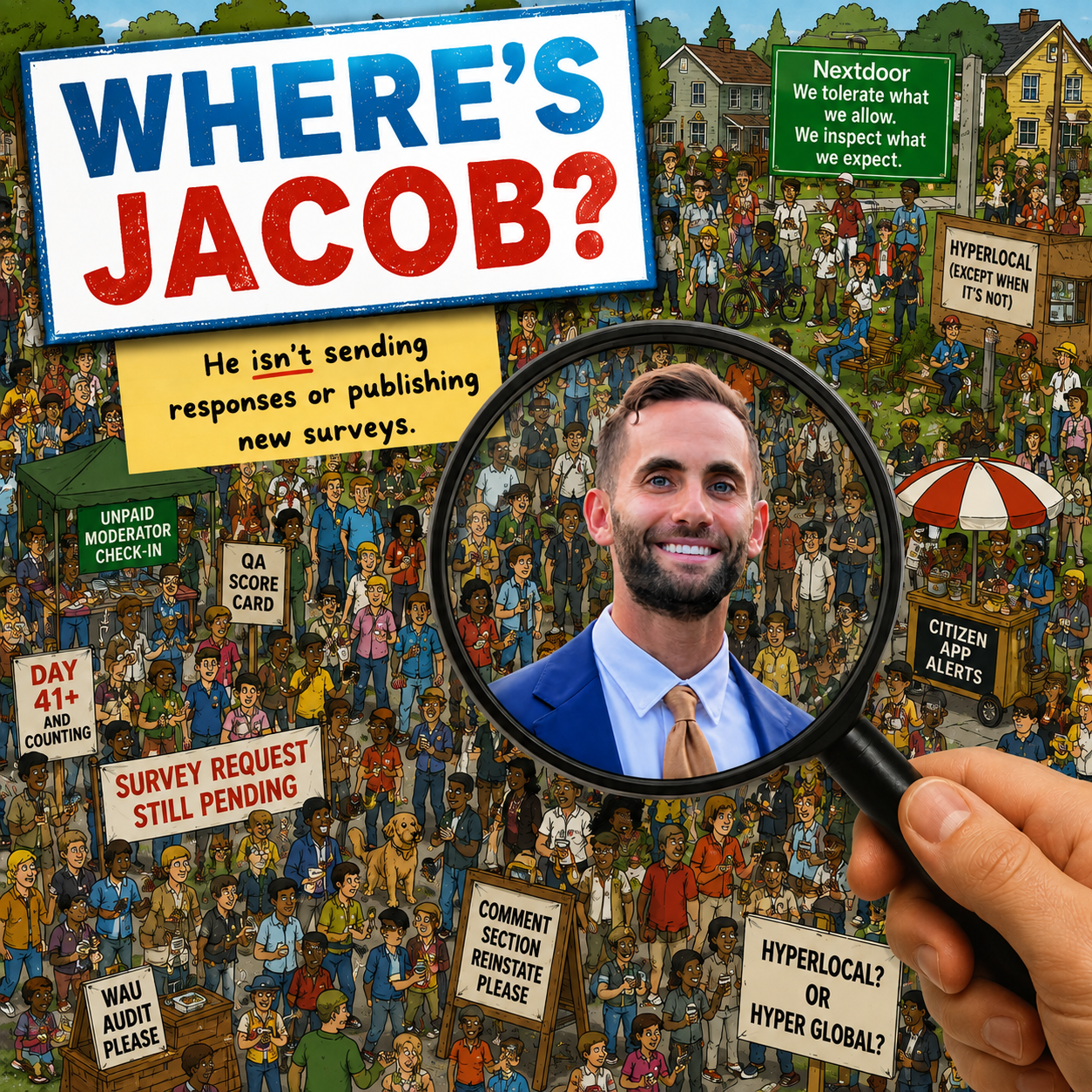
But one figure also stood out.
While revenue increased, losses narrowed, and Adjusted EBITDA turned positive, cash, cash equivalents, and marketable securities declined from approximately $404.8 million at year-end 2025 to $378 million on June 30, 2026.
That's a $26.8 million decrease in six months.
That isn't necessarily negative. Companies deploy cash for legitimate reasons. But as a shareholder, I'd like to understand what specifically drove the decline while the reported operating metrics improved.
Growth investments? Working capital? Capital expenditures? Something else?
I'd also like to understand how much of the revenue improvement is attributable to charging local businesses to comment on neighborhood posts and solicit business.
If that's generating meaningful incremental revenue, tell shareholders.
If it isn't, what is?
And I'd still welcome an independent audit of Weekly Active Users (WAU).
WAU is one of Nextdoor's headline performance metrics. Independent validation would strengthen confidence in the number and give shareholders a clearer picture of the platform's health.
I've also raised questions about moderation, governance, appeals, platform integrity, and the evolving business model. Improving financial results don't make those questions disappear.
Revenue is growing.
Losses are shrinking.
Adjusted EBITDA is positive.
Yet cash on hand decreased by $26.8 million in six months.
The numbers are getting better. Now give shareholders greater transparency into why they're getting better, where the cash is going, and what is actually driving the growth.
The strongest public companies don't simply report better numbers.
They explain them.
Join the discussion on NielFlamm.com/blog.
The Powerball Department Is Now Open: 120 Tickets, 12 Brothers, and the Niel Tax™
I put together a lot more than just buying 120 Powerball tickets this week.
Somewhere between spreadsheets, probability calculations, payout estimates, tax assumptions, and trying to explain to a group of fraternity brothers why $4 divided by 12 doesn't make anyone rich, I may have accidentally become the Chief Financial Officer of the Tau Epsilon Phi Lottery Department.
The easy part is collecting everyone's $20.
The hard part is answering the important questions.
“What are our odds?”
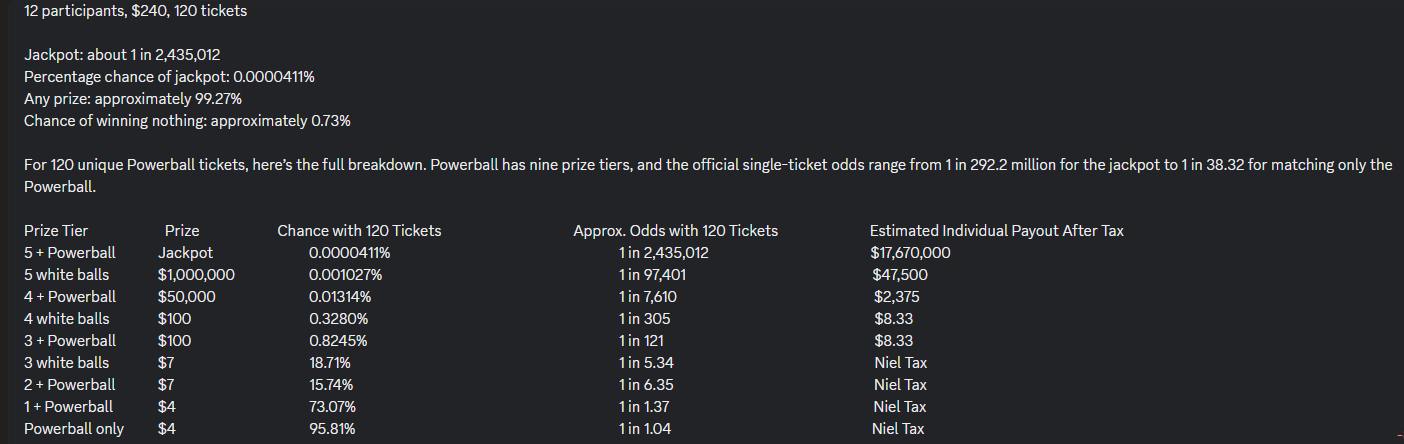
With 120 unique tickets:
Jackpot: about 1 in 2,435,012
Percentage chance: 0.0000411%
Any prize: approximately 99.27%
Chance of winning nothing: approximately 0.73%
Then came the inevitable follow-up.
“What happens if we actually win?”
Now we're talking.
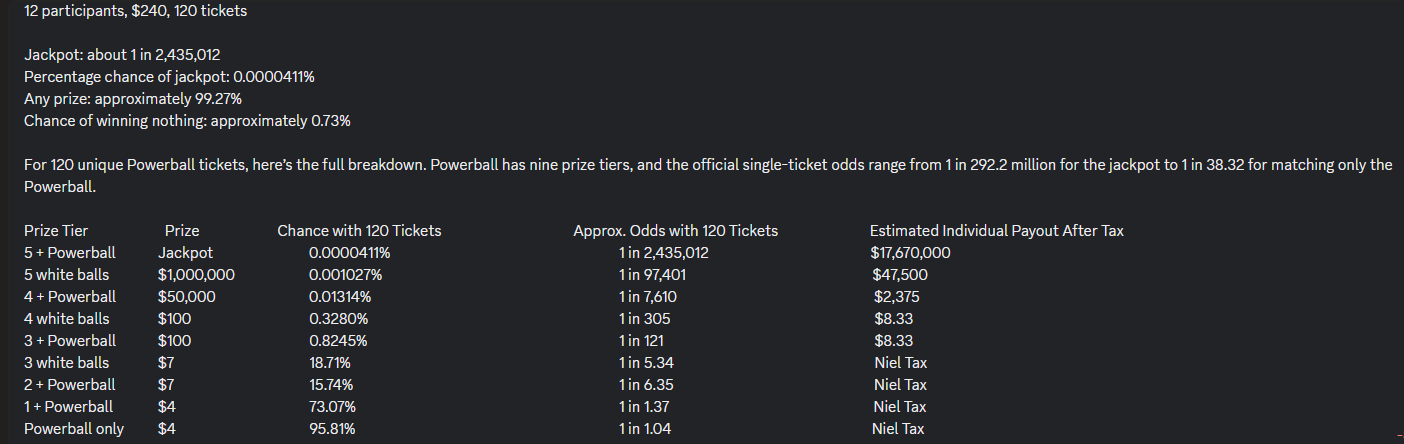
Using the current estimated $856 million advertised jackpot and an estimated $372 million cash option, with 12 brothers, everyone would receive approximately:
Prize Estimated Take-Home Per Brother
Jackpot $17.67 million
$1,000,000 $47,500
$50,000 $2,375
$100 $4.75
Then I looked at the remaining prize tiers.
A $7 prize split twelve ways is...
58 cents.
A $4 prize?
33 cents.
Unfortunately, Zelle has one tiny flaw in its business model:
It won't let me send you 33 cents.
Therefore, after careful consultation with absolutely nobody, I have created what will forever be known as...
The Niel Tax™
Any prize that works out to less than $1 per participant will be retained by the Lottery Commissioner — me — as a convenience fee for:
Collecting everyone's money
Buying the tickets
Tracking the numbers
Calculating the odds
Estimating federal and South Carolina taxes
Explaining for the fifteenth time that “1 in 2.4 million” is actually pretty good compared to one ticket
And, perhaps most importantly, avoiding the embarrassment of sending eleven separate Zelle payments for 33 cents
Think of it as an administrative processing fee.
Or a beverage fund.
Or reimbursement for the gas it takes to drive to Harris Teeter while getting strange looks from the cashier after buying what appears to be enough lottery tickets to finance a small nation.
If we win the jackpot, I promise to waive the Niel Tax.
If we win $4...
Well...
Congratulations.
I just earned another Coke Zero.
Good luck, Lotto Dudes.
Somebody has to win.
The Stories We Need... and the Stories We Keep Getting
Let's agree these are great things.
🐾 Lost pets reunited with their families.
💍 Returning a treasured heirloom, wedding ring, or keepsake.
❤️ Checking on a neighbor after a loss, illness, or surgery.
🍔 Discovering a hidden local restaurant or coffee shop.
🏃 Neighbors exercising together.
👥 Clubs and groups bringing people together.
🛍️ Supporting local small businesses.
🎃 Reminding people to stay safe during holidays.
⛈️ Preparing for severe weather.
We also know:
Loud neighbors at 2 a.m. aren't considerate.
Cancer and other life-altering diseases are heartbreaking.
Kindness matters.
I could keep going.
So what's my point?
It's not that these stories aren't important.
They absolutely are.
My concern is that they're the same kinds of stories I repeatedly see promoted on LinkedIn, X, and the Nextdoor blog.
Feel-good stories have their place.
But I'd also like to see some journalism about the platform itself.
I want to read about:
How the unpaid moderator program actually works.
Interviews with moderators about their experiences.
How appeals are reviewed.
What quality assurance exists.
How moderation consistency is measured.
What metrics leadership uses to determine whether the current model is succeeding.
Those stories would help users, advertisers, and shareholders better understand the platform.
Those are conversations worth having.
Then, after we've explored how the platform works behind the scenes...
Let's absolutely celebrate the dogs finding homes, neighbors helping neighbors, and hidden gems around town.
There's room for both.
Join the discussion at NielFlamm.com/blog. Leave some feedback—I'd love to hear from you.
August 12, 2026: The Universe Is Showing Off
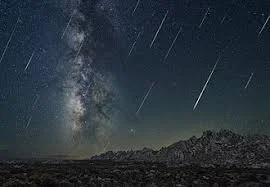
If you have plans for Wednesday, August 12, 2026, please consider canceling them.
Unless your plans involve sitting in a lawn chair, looking up, and pretending you understand astrophysics.
The universe has decided to put on a double feature.
During the afternoon, much of the East Coast of the United States will be treated to a partial solar eclipse. For most of the East Coast, the eclipse will begin around 1:00–1:40 p.m. EDT, reach its maximum around 1:50–2:00 p.m., and wrap up between 2:15 and 2:50 p.m., depending on exactly where you live. Here in the Charleston, South Carolina area, the action is expected to run from about 1:38 p.m. to 2:18 p.m., with the maximum eclipse at approximately 1:58 p.m. EDT.
No, don't stare directly at the Sun. This isn't one of those "life hack" videos where the ending involves a trip to the emergency room. Grab a pair of certified eclipse glasses and enjoy nature's version of someone taking a tiny bite out of the Sun.
Then, after the Sun clocks out for the day, look up again because the Perseid Meteor Shower (not the Leonids—they don't show up until November) reaches its peak under wonderfully dark skies thanks to the new moon.
This year's show could produce 50 to 100 meteors per hour under ideal conditions. The best viewing time is after midnight, with the peak between about 2:00 a.m. and 5:00 a.m. on Thursday morning, August 13. The darker your location, the more you'll see. If you're in the middle of a city, you'll probably spend more time counting streetlights than shooting stars.
Think about it.
The Moon spends the afternoon photobombing the Sun...
...then spends the evening getting out of the way so meteors can steal the spotlight.
That's teamwork.
Of course, if you're like me, you'll probably spend the day checking the weather every 15 minutes, only for one lonely cloud to park itself directly over your house at the exact wrong moment.
It's astronomy's version of buffering.
So here's the game plan:
* Eclipse glasses? ✔️
* Lawn chair? ✔️
* Bug spray? ✔️
* Snacks? Preferably enough to survive until the meteor shower starts. ✔️
* Coffee? You'll probably need it if you're staying up until 5:00 a.m.
* Ability to control the weather? Still unavailable.
Whether you're an astronomy enthusiast or someone who likes free entertainment, August 12 is shaping up to be one of the coolest days of the year.
The best part?
Unlike concert tickets, the sky doesn't charge admission.
Just don't forget the eclipse glasses. The Sun doesn't accept "I was curious" as an excuse.
Join the sky watching on NielFlamm.com/blog.
#Astronomy #SolarEclipse #PartialSolarEclipse #PerseidMeteorShower #MeteorShower #ShootingStars #NightSky #Space #Skywatching #Science #EastCoast #LookUp #NielFlamm