

Day 57: The Stock Is Talking—But I Still Want to Hear From the People

It's Day 57.
Today, I want to put a different twist on this.
As I'm writing this, NXDR is up 4.12%, trading at approximately $2.66 per share.
As a shareholder, that's good news. I own the stock. I'd like the number to increase.
I've been bearish on Nextdoor, but bearish doesn't mean I'm rooting for failure—quite the opposite. I want to see the company create sustainable value for users, advertisers, employees, and shareholders.
The market appears pleased right now.
But stock price and corporate culture are two different measurements.
Which brings me to someone I haven't discussed nearly as much:
Sarah Leary, Co-Founder of Nextdoor.
I've noticed Sarah appears to have been absent from X for some time—unless she's posting from another account I'm unaware of.
And that makes me genuinely curious about her perspective.
Sarah helped build this company.
She watched Nextdoor grow from an idea into a publicly traded company serving millions of users.
So I'd be interested to know:
What does Sarah Leary think about what's happening now?
What does she think about the current moderation model?
The increasing monetization of interactions between businesses and neighbors?
The company's approach to accepting—or limiting—feedback?
And yes, what does she think about a shareholder reaching Day 57 without receiving the requested study or even an acknowledgment?
I'm not asking Sarah to agree with me.
Actually, I'd be interested if she disagreed with me.
Tell me why.
That's a conversation.
Perhaps she believes the current strategy is exactly right.
Perhaps she thinks changes are necessary.
Perhaps she hasn't followed any of this.
I don't know.
But that's precisely why I'd like to hear her perspective.
I've spent 57 days talking about Nirav Tolia, Jacob Chavis, Investor Relations, Communications, moderation, culture, and accountability.
Maybe it's time to hear from one of the people who helped create Nextdoor in the first place.
The stock is speaking today.
NXDR: $2.66, up 4.12%.
Now I'd like to hear some of the people behind it speak, too.
Sarah, what's your take?
Join the discussion at NielFlamm.com/blog. Leave some feedback—I'd love to hear your perspective.
When the Process Fails, Don’t Forget There Are People on the Plane
I came across this Facebook Reel, and I genuinely feel for this parent trying to do the best she can for her family:
https://www.facebook.com/share/v/1GUxjuMGvT/
Watching it reminded me of something that companies sometimes forget when operations go sideways: a process failure is rarely just a process failure to the customer.
I’ve been in the situation where my flight has been canceled. It’s no fun.
You’re standing in an airport trying to figure out what happens next. Where am I sleeping? When am I getting home? What happens to my luggage? What about the hotel, rental car, work, kids, medications, connections, or whatever else was waiting for me at the other end?
Now imagine trying to manage all of that while also taking care of your family.
That’s where I think JetBlue missed something important.
Airlines have incredibly complicated operations. Weather happens. Mechanical problems happen. Crews time out. Aircraft end up in the wrong cities. Sometimes a flight cannot operate.
I understand that.
But the operational problem and the customer experience are two different things.
JetBlue may transport cargo in the belly of an aircraft, but the people sitting above it aren't cargo.
They have feelings.
They have emotions.
They have families.
They have somewhere they were expecting to be.
And when the process fails, that is when customer experience matters the most.
A great customer experience isn't demonstrated when everything works perfectly. That's the easy part.
It's demonstrated when something goes completely wrong, and the company says:
“We know this disrupted your life. Let us help you figure out what happens next.”
Policies are necessary. Procedures are necessary. Systems are necessary.
But there has to be enough flexibility—or enough humanity built into those systems—to recognize when somebody needs more than a scripted answer.
Because the passenger standing at the counter isn't thinking about aircraft utilization, crew scheduling, or operational efficiency.
They're thinking:
“How am I going to get my family home?”
Sometimes fixing the customer experience doesn't mean fixing the airplane.
It means remembering the people who were supposed to be sitting inside it.
For more of my thoughts on customer experience, the good, the bad, and sometimes the completely ridiculous, follow along on my blog:
https://NielFlamm.com/blog

Day 56: At This Point, the Silence Is a Decision

It's Day 56.
I've been following up on why Jacob Chavis hasn't sent the study I requested.
I've asked why Nirav Tolia, Investor Relations, and Communications haven't acknowledged the situation.
I've emailed.
I've followed up.
I've posted publicly.
I've documented the experience at NielFlamm.com/blog.
So today, I'm looking at this differently.
Maybe the lack of communication is the communication.
After 56 days, it's becoming increasingly difficult for me to view this as an overlooked email or something that fell through the cracks.
Maybe someone made a decision not to engage.
Maybe nobody wants ownership.
Maybe Nextdoor believes responding will encourage more questions.
Maybe the study can't—or won't—be provided.
I don't know.
But that's exactly the problem.
Silence creates its own narrative.
And here's where this gets bigger than my study.
Nextdoor's entire value proposition revolves around neighbors communicating with neighbors.
CEO Nirav Tolia frequently talks about community and connection.
Yet my experience as a shareholder has been the opposite:
56 days without a conversation.
Think about that from a customer-experience perspective.
If I were designing training around this scenario, I wouldn't focus primarily on whether the customer—or shareholder—was right.
I'd ask:
How did something this simple reach Day 56?
Where was the escalation?
Who owned the request?
When did someone recognize that the lack of a response had become a bigger problem than the original question?
And perhaps most importantly:
What does the organization learn from it?
That's what accountability should ultimately accomplish.
Not blame.
Not defensiveness.
Learning followed by change.
I've written before that we inspect what we expect.
So I'm inspecting.
I'm watching the moderation model.
I'm watching the increasing monetization of small-business interactions.
I'm watching the financial results.
I'm watching corporate communication.
And I'm watching how Nextdoor handles a shareholder who keeps asking a question it apparently doesn't want to answer.
Maybe someone inside Nextdoor believes I'll eventually get tired of asking.
After 56 days, that seems like an increasingly questionable strategy.
Because the longer this continues, the less interesting the original study becomes.
The case study is becoming Nextdoor itself.
Join the discussion at NielFlamm.com/blog.
What does 56 days without an answer tell you? Leave some feedback—I'd love to hear your perspective.

One Night Only: The Purge Meets Valentine's Day

Imagine a future where the government gives unmarried people 12 hours to hook up—and when the clock runs out, it's back to being illegal.
That's the wonderfully strange setup for One Night Only, a dystopian romantic comedy I knew absolutely nothing about before walking into the theater. And I'm glad I didn't.
It's part The Purge, part Valentine's Day, with chance encounters, government tracking, romance, some familiar faces, and a good guy trying to get the girl.
Does he?
I'm not telling.
🎬 Watch my full review at NielFlamm.com/videos/moviereviews
Is Nextdoor Building a Pay-to-Participate Community?
Something dawned on me shortly after publishing my Day 55 posts.
Maybe Nextdoor's latest business pricing strategy shouldn't surprise me.
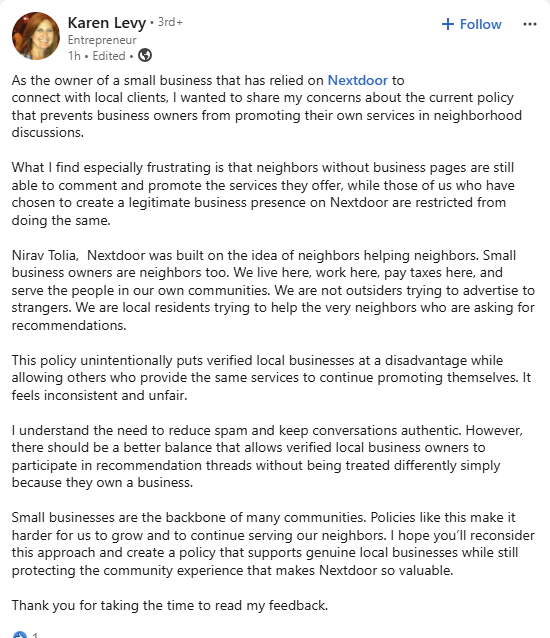
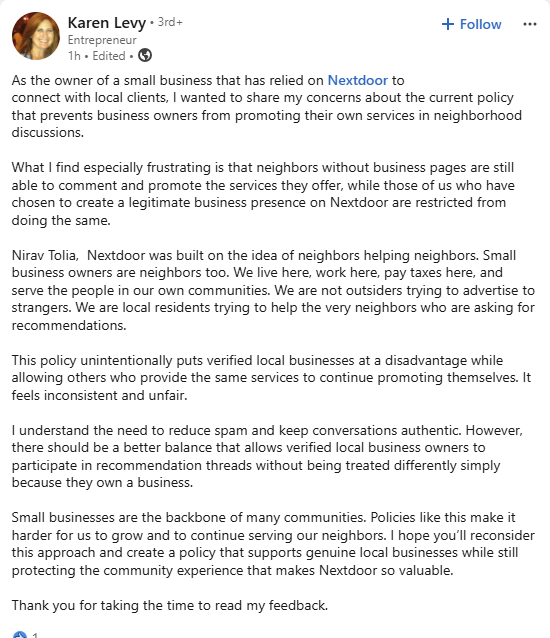
I recently saw a LinkedIn post from Karen Levy discussing Nextdoor's new pay-to-play system for businesses. Business accounts are reporting that they must pay an additional fee to respond to certain neighbor posts as potential sales leads.
That got me thinking:
What does this potentially do to WAU among businesses?
Nextdoor reports Platform Weekly Active Users (WAU) as an important metric. If participating in valuable conversations becomes more expensive—particularly for small businesses with limited marketing budgets—what happens to engagement?
Do they pay?
Or decide:
This isn't worth it anymore?
That's interesting because, from my perspective, Nextdoor has increasingly created an environment where conversation feels restricted.
Nextdoor doesn't allow comments on its blog.
Nextdoor Communications doesn't allow comments on its LinkedIn posts.
CEO Nirav Tolia blocked me on LinkedIn.
And now, according to business owners, participating in certain conversations with potential customers comes with another price tag.
Are these separate decisions—or examples of the same philosophy?
Control the conversation. Monetize the conversation. But how much are you actually encouraging the conversation?
I also want to be transparent.
I understand the "buck stops with me" approach to leadership.
Someone has to make decisions.
On a ridiculously smaller scale, I organize a lottery pool for my fraternity chapter brothers. My rules for today's pool were simple:
$20. Cash option when we obviously win—payment through Zelle by 2:00 p.m. EDT on 8/8/26.
Those are my rules.
I'm unapologetic about them.
But here's the difference:
I communicated them.
If someone asks why, I answer.
I don't pretend the question wasn't asked.
That's what keeps bringing me back to Nextdoor.
I'm on Day 55 and haven't received the study or a response.
I've continued emailing, posting, and commenting publicly on X. I've also seen multiple Nextdoor employees viewing my LinkedIn profile.
Yet nobody will answer.
I previously received a read receipt from John T. Williams in Investor Relations. I haven't received one from Nirav, but after 55 days and numerous attempts at communication, the silence raises questions.
So, Nirav:
The buck stops somewhere. You're the CEO. What gives?
You don't have to agree with me.
You don't have to like my posts.
You don't even have to send me the study.
But after 55 days, why can't someone communicate the answer?
Join the discussion at NielFlamm.com/blog. I'd genuinely like your perspective.