
When a Communication Strategy Becomes a Communication Problem
I've spent 61 days documenting what I see as a fundamental communication failure at Nextdoor.
At this point, it's no longer one unanswered request.
Look at the pattern I've experienced:
Nirav Tolia blocked me on LinkedIn.
Comments are routinely turned off on Nextdoor's LinkedIn posts.
I've sent direct emails to Jacob Chavis, Nirav Tolia, Sarah Leary, Communications, and Investor Relations, but have not received a substantive response to my request.
And now there's another example involving Sarah Leary.
I had been commenting on an older X post she reposted about a Massachusetts community—if I remember correctly, Beacon Hill—preparing for significant snowfall and other neighborhood happenings.
The post eventually accumulated approximately 180 comments.
I'd estimate at least 75% were mine, documenting my ongoing Nextdoor experience.
Then the post disappeared.
To be clear: I don't know why it was deleted or whether my comments had anything to do with the decision.
But it got me thinking.
Yes, there may have been steam coming from my ears. 💨
If Nextdoor had an effective communication strategy for handling critical feedback, would any of this be happening?
That's when I started thinking about Kelsey Grady, Executive Vice President of Communications at Nextdoor.
I looked at the typical responsibilities associated with an executive communications role. At that level, we're talking about responsibility for an organization's internal and external messaging, brand reputation, public relations, crisis response, and advising executive leadership on communication strategy.
Which raises some fascinating questions.
Is ignoring my emails an intentional communications strategy?
Was blocking me on LinkedIn part of a strategy?
Is routinely disabling comments part of it?
Did anyone advise Sarah to remove that X post?
Or are executives individually deciding how—or whether—to engage?
I don't know.
I'm deliberately asking rather than pretending I know what happens inside Nextdoor.
But that's precisely why communication matters.
A coordinated communications strategy shouldn't leave outsiders spending 61 days trying to determine whether there even is a strategy.
And ultimately, responsibility travels upward.
Kelsey Grady may oversee Communications, but Nirav Tolia is CEO.
The buck eventually stops there.
One of the most important responsibilities of executive communications is crisis management.
Now, I'm certainly not suggesting one small shareholder asking for a study constitutes a corporate crisis.
But something that could have been resolved with a simple email has now generated 61 consecutive days of public commentary about Nextdoor's leadership, moderation, culture, investor relations, verification, business strategy and communication.
That's the part I find remarkable.
My grade for handling this particular situation?
Crisis Management: F.
Not because Nextdoor hasn't given me the answer I want.
Because after 61 days, Nextdoor still hasn't given me an answer.
Perhaps the most useful question isn't "Why does this shareholder keep posting?"
Maybe it's:
"How did we allow a simple request to become a 61-day public case study in communication?"
I'd genuinely like to hear Kelsey Grady's perspective on that one.
Join the discussion at NielFlamm.com/blog. Leave some feedback—I'd love to hear your perspective.
Sarah, Where Did the Post Go?
I've been documenting my experience with Nextdoor for more than 60 days.
I've posted on LinkedIn, Bluesky Social, X, and NielFlamm.com/blog. I've emailed Nextdoor and posted replies on accounts associated with the company—including co-founder Sarah Leary.
Why?
Exposure and reach.
One place I haven't had the same conversation is, ironically, Nextdoor itself. From my experience, negative feedback about the platform isn't exactly welcomed there.
Then There Was Sarah's X Post
Sarah isn't a big poster on @X. Her most recent post, as far as I can tell, is from March 19, 2026, and discusses a Hertz failure at FLL.
Oh, the irony.
There was also an older post involving a Boston neighborhood—possibly Beacon Hill—snow, and some neighborhood observations.
That became one place where I regularly posted updates about my dissatisfaction with Nextdoor.
The last time I looked, it had at least 175 replies.
I'd estimate 150 or more were mine.
Yes, that's a lot.
I posted about the unanswered study request, moderation, communication, leadership, corporate culture, verification, and shareholder value.
Then yesterday I noticed:
The post was gone.
Did Sarah delete it?
Did X remove it?
Was it simply an old post she decided to delete?
Or did 150+ replies from one dissatisfied shareholder become inconvenient?
I don't know.
That's why I'm asking.
So, I Found Another Post
Since that post disappeared, I've moved along.
I'm now leaving updates on another post on Sarah's X account from January 28, 2025.
Is it ideal?
Nope.
It's a repost from Nirav Tolia about X/Twitter and his apparently being on the platform for 20 years.
Congratulations, Nirav.
I'll get you a ribbon. 🎀
This isn't related to my questions, but when feedback places disappear, I'll work with what's available.
Now I'm curious:
How long will this post remain on Sarah's page?
If that one disappears too, I'll notice.
And I'll probably write about it.
Sarah, Why Did the Post Disappear?
If Sarah deleted it herself, I'd genuinely like to know why.
Was it because of my replies?
Was it simply because the post was old?
Was it completely unrelated to me?
There's a perfectly reasonable answer:
I don't know.
But that's been the recurring theme of this Nextdoor experience.
When leaders don't communicate, people are left trying to understand the reasons.
Deleting a post doesn't delete the questions.
Blocking someone doesn't eliminate feedback.
Disabling comments doesn't create agreement.
And refusing to engage doesn't make the conversation disappear.
It just moves somewhere else.
This time, it moved to Sarah's January 28, 2025 post.
And it continues here.
So, Sarah:
Why did the original post disappear?
And now...
How long will this one stay?
Comments and feedback are welcome here.
Join the discussion at NielFlamm.com/blog.

Day 61: A Rising Stock Doesn't Erase the Questions

It's Day 61.
While NXDR is up for the week, as I'm writing this it's down approximately $0.02 today.
Perhaps some short-term players are taking profits. Perhaps it's ordinary market movement. I don't pretend to know why someone else presses sell.
But I'm watching.
While I've been bearish on Nextdoor, I'm also a shareholder. I benefit when NXDR rises. I'd rather be writing about a company delivering undeniable value than explaining why I continue questioning its direction.
My concerns aren't based on one red trading day—or one unanswered email.
They're cumulative.
From my perspective, several leadership decisions under CEO Nirav Tolia deserve scrutiny.
I've questioned the investment in an elaborate new Dallas headquarters while the company continues reporting a GAAP net loss.
I've questioned a strategy that appears to ask some small businesses to pay additional money to respond to potential customer leads.
I've questioned a moderation model dependent on unpaid neighbors while seeing examples that make me wonder about consistency and quality control.
I've questioned a platform built around community and conversation while Nextdoor's corporate LinkedIn presence doesn't permit comments and Nirav has blocked me on LinkedIn.
I've tested Nextdoor's identity/address verification myself and raised questions about whether reality matches the rhetoric surrounding "trust."
And, of course...
It's Day 61 since I requested a study from Jacob Chavis.
No study.
No explanation.
No acknowledgment.
That has become less about Jacob and more about leadership.
I've contacted Nirav Tolia, Sarah Leary, Investor Relations, Communications, and others.
At some point, accountability travels upward.
A CEO doesn't personally answer every email, moderate every neighborhood, or respond to every shareholder.
I understand that.
But a CEO does own the culture and direction of the organization.
That's the distinction.
I don't know what's happening internally at Nextdoor, and I won't pretend I do.
I'm documenting what I can observe and asking whether these decisions create sustainable value.
NXDR can rise 5%, fall 2%, or trade sideways tomorrow.
The ticker tells us what the market thinks the company is worth at a particular moment.
It doesn't tell us whether today's leadership decisions are right for the next five years.
That's the conversation I'm interested in.
I'm watching leadership, execution, culture, communication, moderation, monetization, and shareholder value much more closely than today's ticker.
Day 61. Still watching. Still asking.
Join the discussion at NielFlamm.com/blog.
Leave some feedback—I'd genuinely like to hear what you think.

Day 60: At What Point Does Ignoring One Shareholder Become a Corporate Strategy?

Day 60.
Yes, I marked the occasion with some spectacular signage. If we're going to reach a milestone this ridiculous, it deserves appropriate recognition.
But underneath the humor, I'm genuinely wondering:
Where is Jacob Chavis?
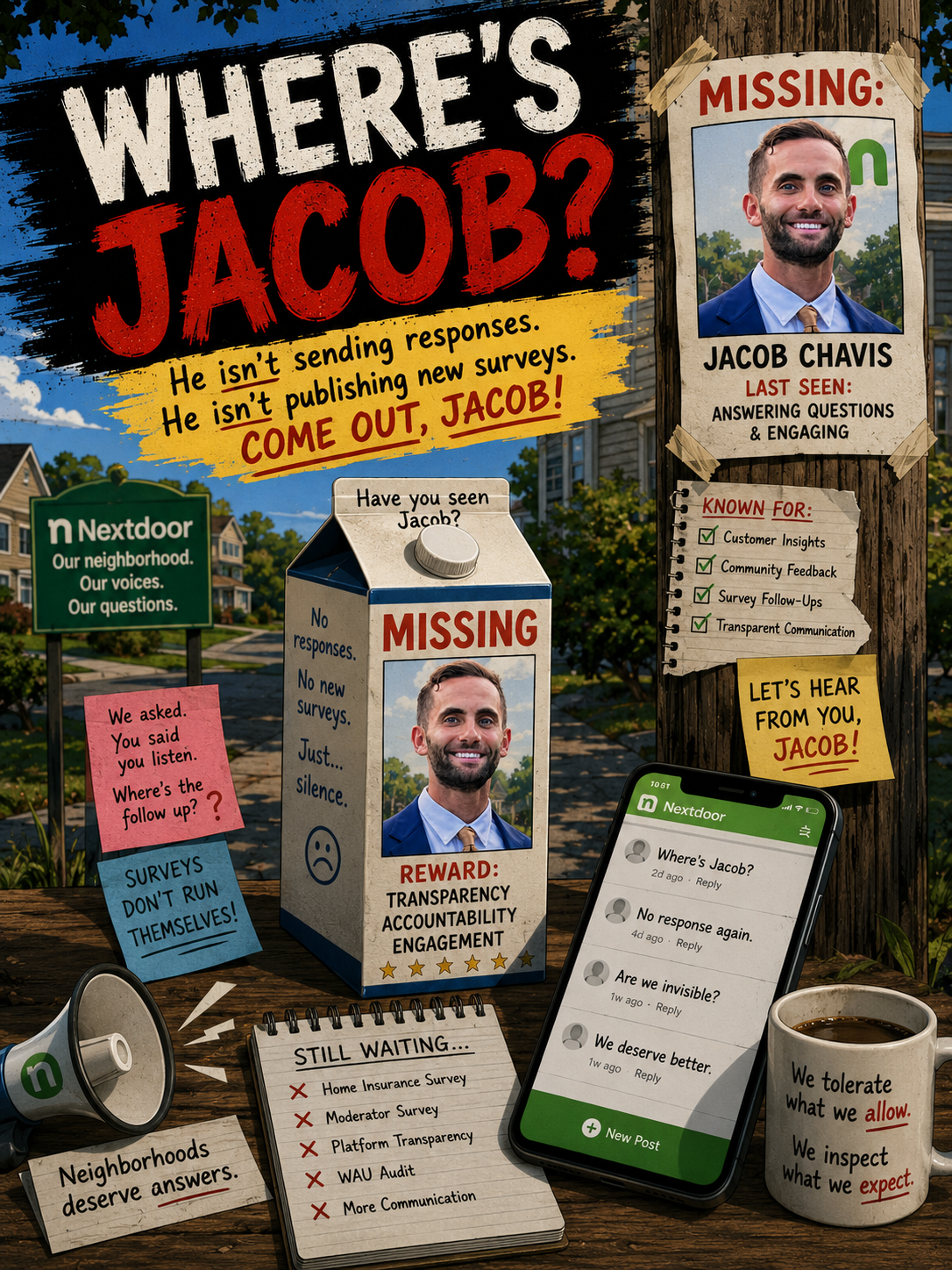
Today, Nextdoor published a LinkedIn post featuring content from Groundworks:
The Hidden Cost of "I'll Deal With It Later"
🔗 Read the post/article:
https://www.groundworks.com/resources/the-hidden-cost-of-ill-deal-with-it-later/
The irony of that title isn't lost on me.
The article, credited to Leah Leitow as Content Writer, focuses on the costs homeowners can face when they postpone addressing problems.
"I'll deal with it later."
Really?
Because I've been asking Nextdoor to deal with something for 60 days.
What caught my attention is that this type of business-oriented content feels like exactly the kind of material where, historically, I might have expected to see research, insights, or someone such as Jacob Chavis referenced.
Instead, nothing.
I've previously noted that I haven't seen a new Nextdoor Insights post since July 6.
I haven't received the study.
I haven't received an email from Jacob.
And now we're at Day 60.
Maybe these things are completely unrelated.
Maybe Jacob is working on something entirely different.
Maybe Nextdoor reorganized responsibilities.
Maybe the company's research strategy changed.
I don't know—and that's precisely the point.
Nextdoor could clear up 60 days of speculation with a remarkably simple act:
Communicate.
Which leads me to a question that I find almost absurd to ask:
Can one individual shareholder with a relatively small position really create this much reluctance to engage at a multimillion-dollar public company?
I don't believe I have that kind of power.
So why does it feel like engaging with me has become harder than simply answering the original question?
I'm not asking for a board seat.
I'm not asking to approve the quarterly earnings.
I'm not asking Nirav Tolia to hand me the keys to headquarters.
I asked for a study.
If the answer is no, say no.
If it can't be distributed, please let me know.
If the study no longer exists, explain that.
If Jacob's responsibilities have changed, say so.
Sixty days later, the unanswered request has become far more interesting to me than the document itself.
And perhaps today's Groundworks headline provides the best leadership lesson of this entire experience:
There can be a hidden cost to "I'll deal with it later."
The longer an organization avoids a small issue, the greater the chance that the response—or lack of one—becomes the bigger story.
So, Nextdoor:
It's Day 60. Who wants to spill the tea? ☕
Join the discussion at NielFlamm.com/blog.
Leave some feedback. What is your perspective?

Ice Cream Man: Come for the Ice Cream, Stay for the Carnage 🍦🔪

li Roth's Ice Cream Man has an old-school '80s horror vibe, demonic ice cream, murderous kids, revenge, some great jokes... and a few moments where I was hoping the movie would just end.
So, is it worth watching—or should you wait until it hits streaming?
I give you my spoiler-filled take in the latest Junk Cast movie review.
🎬 Watch the full review:
NielFlamm.com/videos/moviereviews
Just maybe don't bring the kids out for ice cream afterward.