

Day 62: What Do Nextdoor’s Partners Think?

It's Day 62.
I'm not surprised.
And somehow, I'm still surprised.
Sixty-two days since I requested a study from Jacob Chavis without receiving the study—or a response.
62 days. Unbelievable.
Yesterday I wrote about Nextdoor reposting content from Groundworks Commercial. Since Jacob seems to have vanished from the Insights landscape—perhaps abducted by aliens 👽—I've started watching what Nextdoor is publishing.
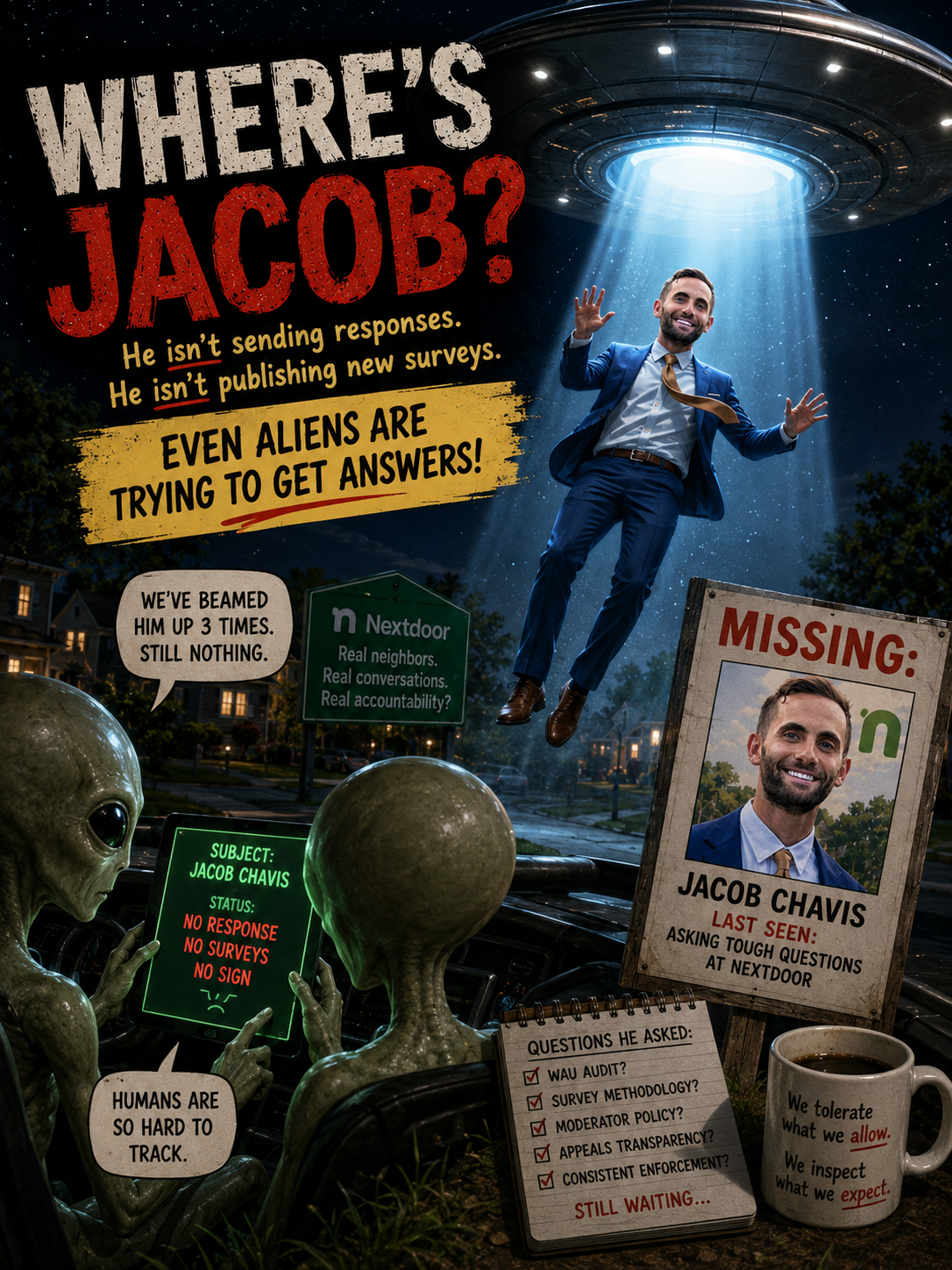
Something is interesting about reposts.
When Nextdoor publishes its own LinkedIn content, comments are typically disabled.
When Nextdoor reposts someone else's content, the original post's comments may remain available.
And, well...
I do what I do.
I commented on the Groundworks Commercial post about my experience with Nextdoor.
Then last night, I noticed Josh Jones from Groundworks Commercial viewed my LinkedIn profile.
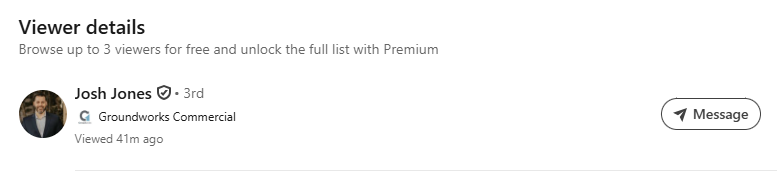
Hello, Josh. 👋
I'm genuinely curious:
What do you think about all of this?
Not just Josh, either.
That has me thinking about Nextdoor's broader network of partners.
Nextdoor works with businesses, advertisers, local organizations, news outlets, government agencies, and other companies.
Those organizations lend something besides money or content.
They lend their names.
So what are decision-makers at these organizations seeing?
Do they look only at Nextdoor's WAU, advertising opportunities and neighborhood reach?
Do they examine the moderation controversies?
Do they look at how critical feedback is handled?
Do they notice comments are disabled on corporate posts?
Do they examine how small businesses experience the platform?
Do they care how shareholders are treated?
And does corporate culture factor into deciding whether another organization wants its brand associated with Nextdoor?
I'm not suggesting Groundworks Commercial—or any Nextdoor partner—agrees with my views.
I have no idea what Josh thinks.
That's why I'm asking.
But partnerships work both ways.
When two brands associate publicly, each company's reputation becomes part of the other's equation.
I've spent 62 days asking questions on Nextdoor.
Maybe there's another group worth asking:
What do Nextdoor's partners think?
Local news organizations.
Small businesses.
Advertisers.
Corporate partners.
Public agencies.
What are their experiences behind the scenes?
After 62 days, I'm increasingly interested not only in what Nextdoor says about itself...
but what organizations doing business with Nextdoor say about Nextdoor.
Josh, since you stopped by my profile, I'd welcome your perspective.
And if anyone from another Nextdoor partner is reading this, yours too.
Day 62. The conversation keeps getting bigger, even if Nextdoor isn't participating.
Join the discussion at NielFlamm.com/blog.
Leave some feedback—I'd love to hear your perspective.
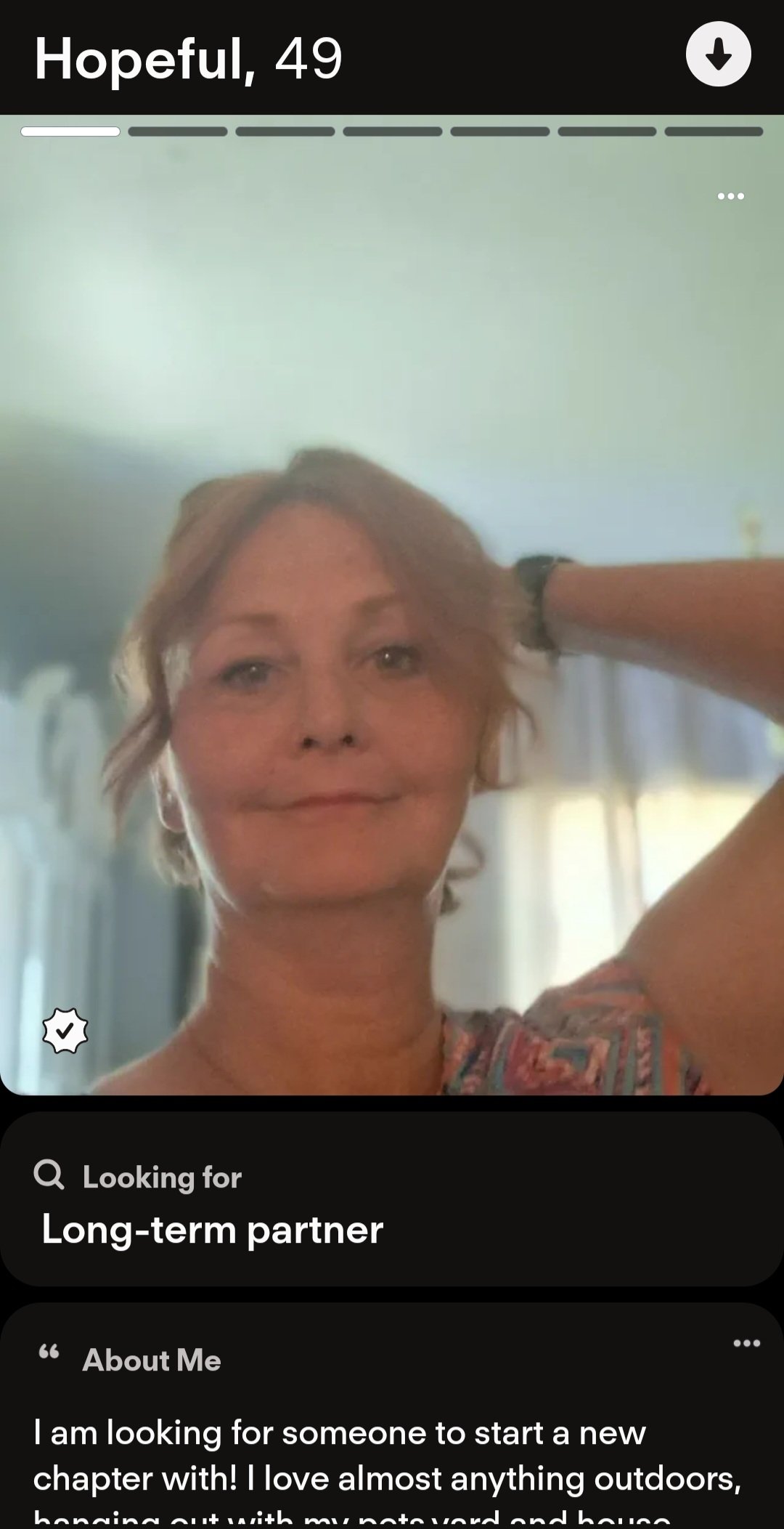
I Thought I Was Supposed to Be My True Self? Another Adventure on The Tinder
After approximately 2 billion swipes left (nope) and right (why not?), I finally got another match on the Tinder.
Her profile name?
"Hopeful."
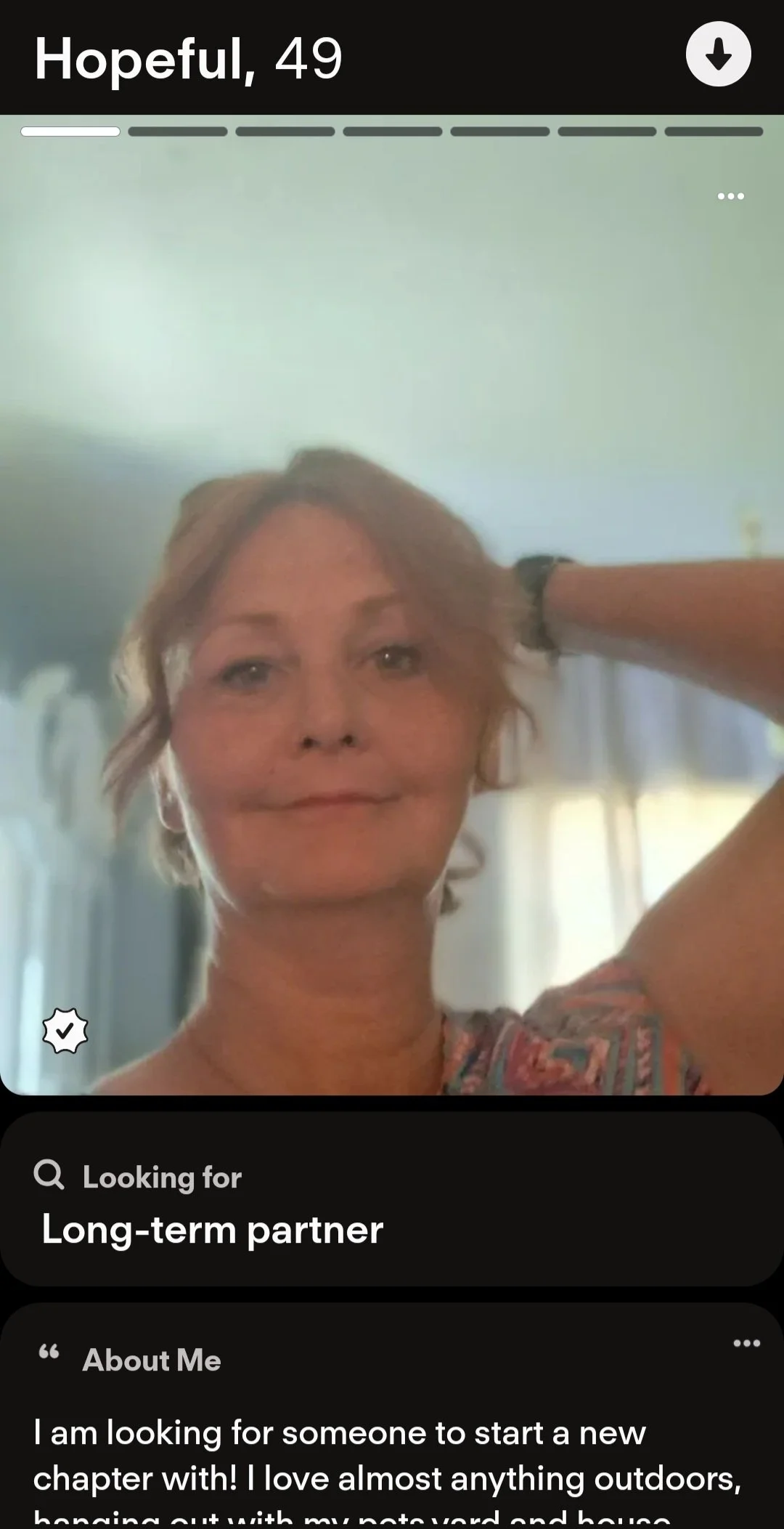
Well, that's already one more hopeful person than I expected to find on the Tinder.
Hopeful is a straight, 5'8" woman who describes herself as:
"Down to earth, laid back woman that is looking for something real..."
Excellent.
She also wants:
"Someone that can be just there true self, no lies, no games no drama just your true self no matter what and I will be the same!"
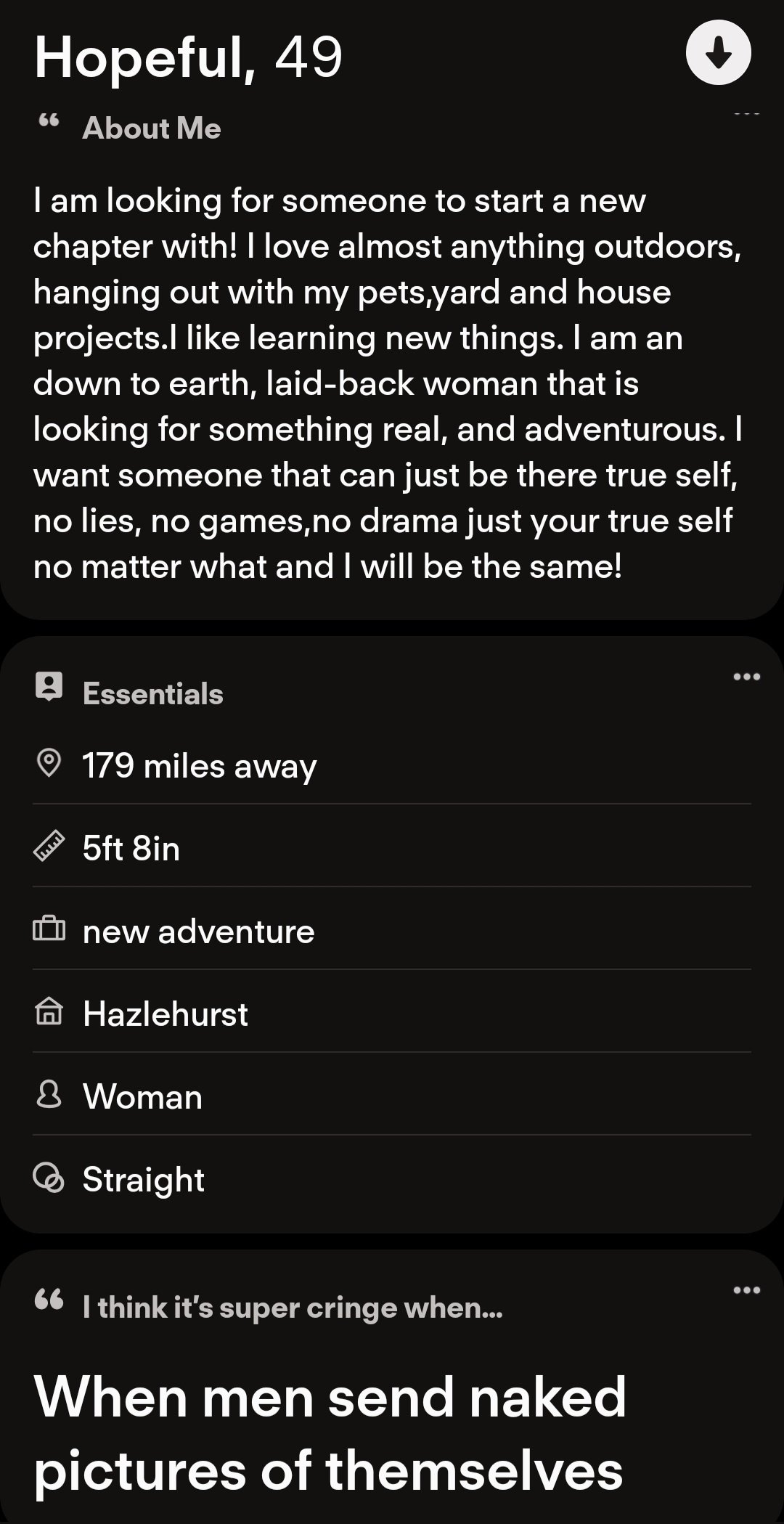
First, I believe we're looking for their true self.
But this is the Tinder, not the SATs. I'm not grading anyone.
More importantly:
Great! Imma be my true self.
Because I don't know how to be Matt Damon.
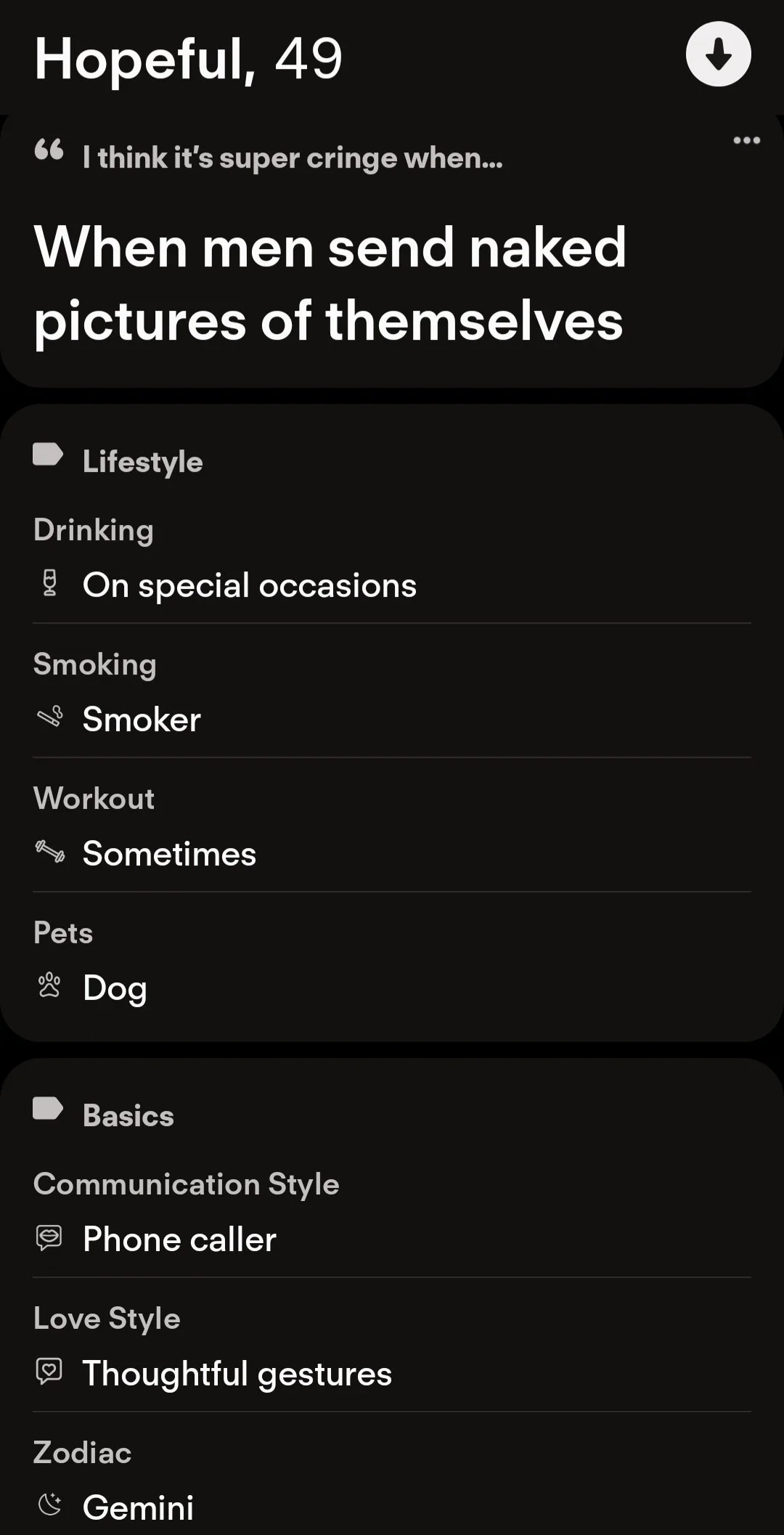
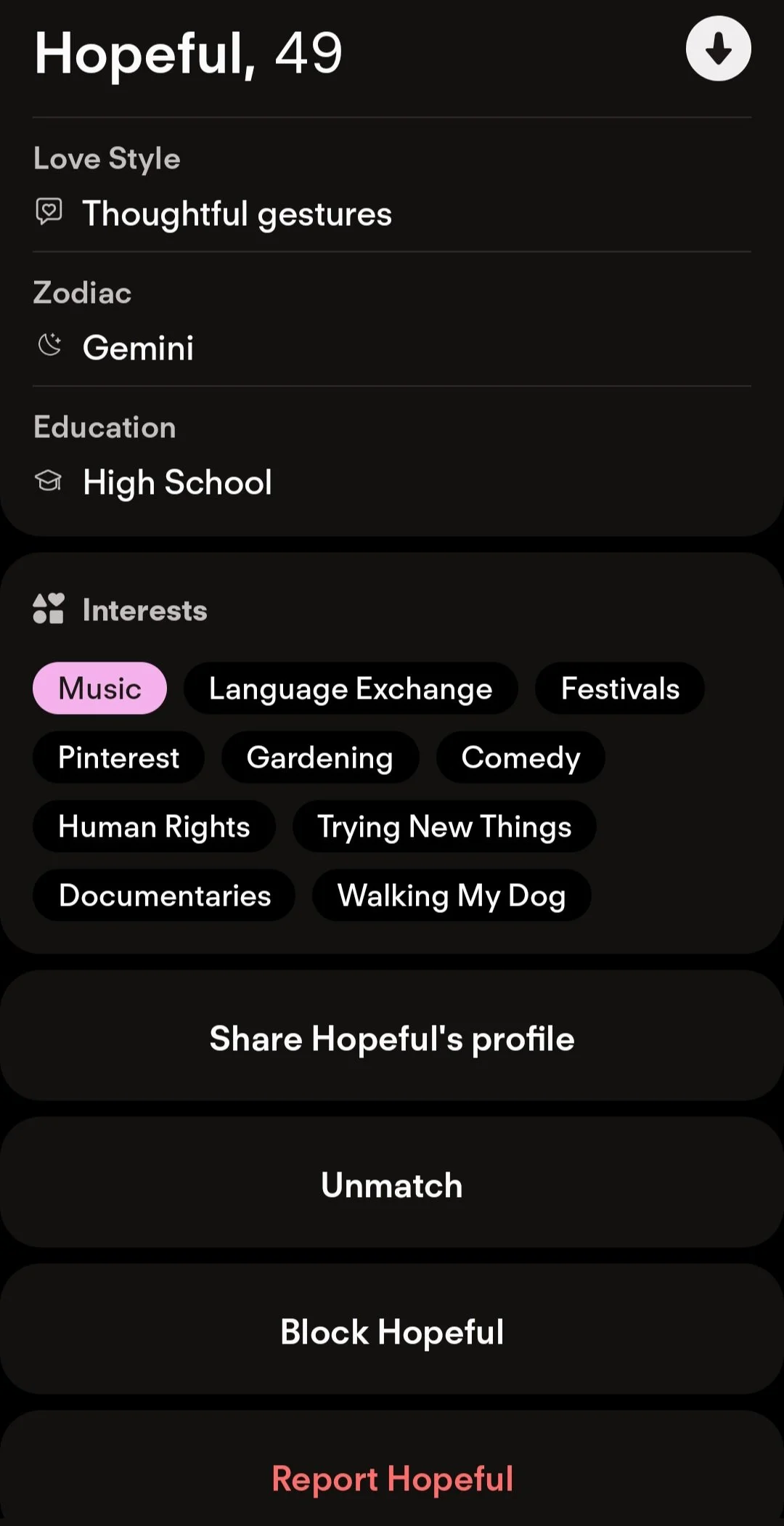
Her profile also provides some important intelligence. She doesn't like receiving nude selfies—which seems like an extremely reasonable policy—works out sometimes, smokes, which I don't, and drinks on special occasions.
Fine.
So I start the conversation:
"Good evening, Hopeful!"
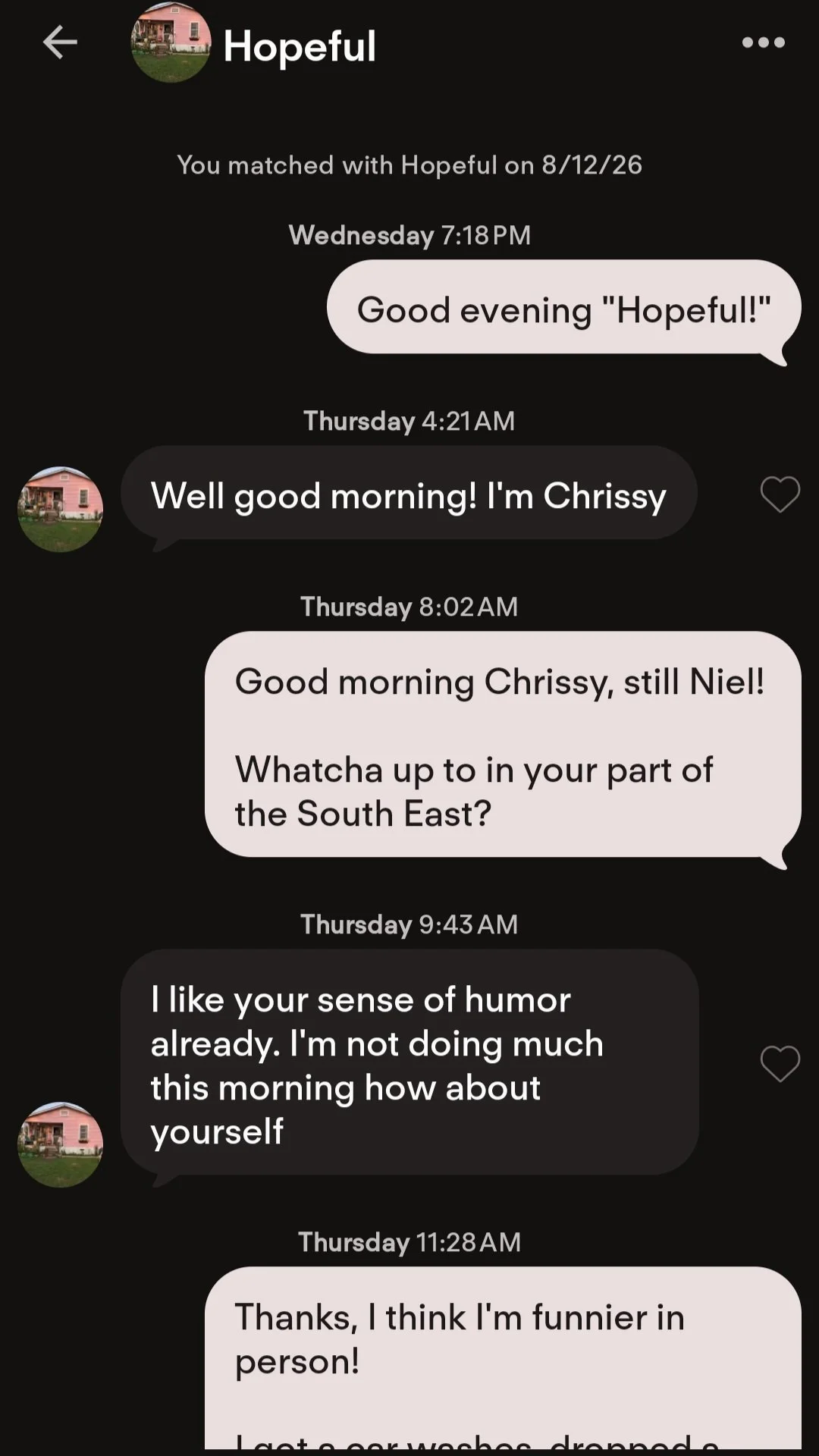
I had a sneaking suspicion her parents didn't look at their newborn daughter and say, "She's beautiful. Let's name her Hopeful."
Turns out I was correct.
Her name is Chrissy.
We start chatting. I throw in some humor. She seems to like it.
Excellent.
I tell her that I think I'm actually funnier in person.
Also excellent.
We're talking about what we're doing Thursday. I mention some completely innocuous stuff about my day. Nobody has attempted to sell cryptocurrency to anyone. Nobody claims to be conducting "market research" in Augusta.
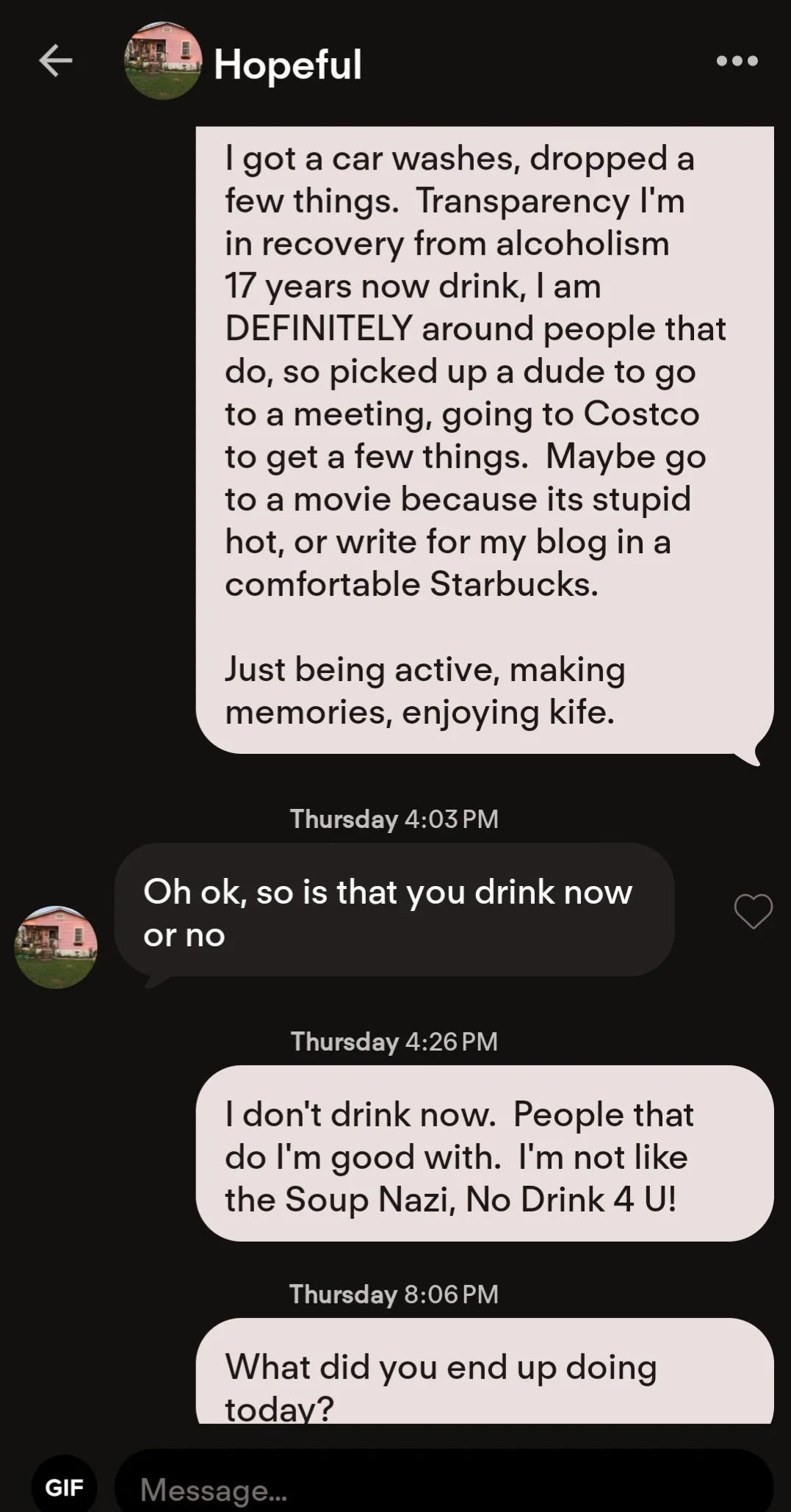
We're making progress!
Then I mention my sobriety.
Record scratch.
The conversation takes a turn.
She asks:
"So is that you drink now or no"
I explain that no, I don't drink. I've been sober for a little over 17 years.
But I also explain that I don't care if other people drink—as long as they're responsible about it.
I'm sober.
I'm not the Soup Nazi.
NO CHARDONNAY FOR YOU!
Drink your wine. Have your cocktail. Order a beer.
I'm not going to leap across the table and slap a margarita out of your hand.
This conversation happened Thursday at around 4:30 p.m.
I sent a few more messages afterward.
I even asked if she'd like to talk on the phone, since her profile said that's her preferred method of communication.
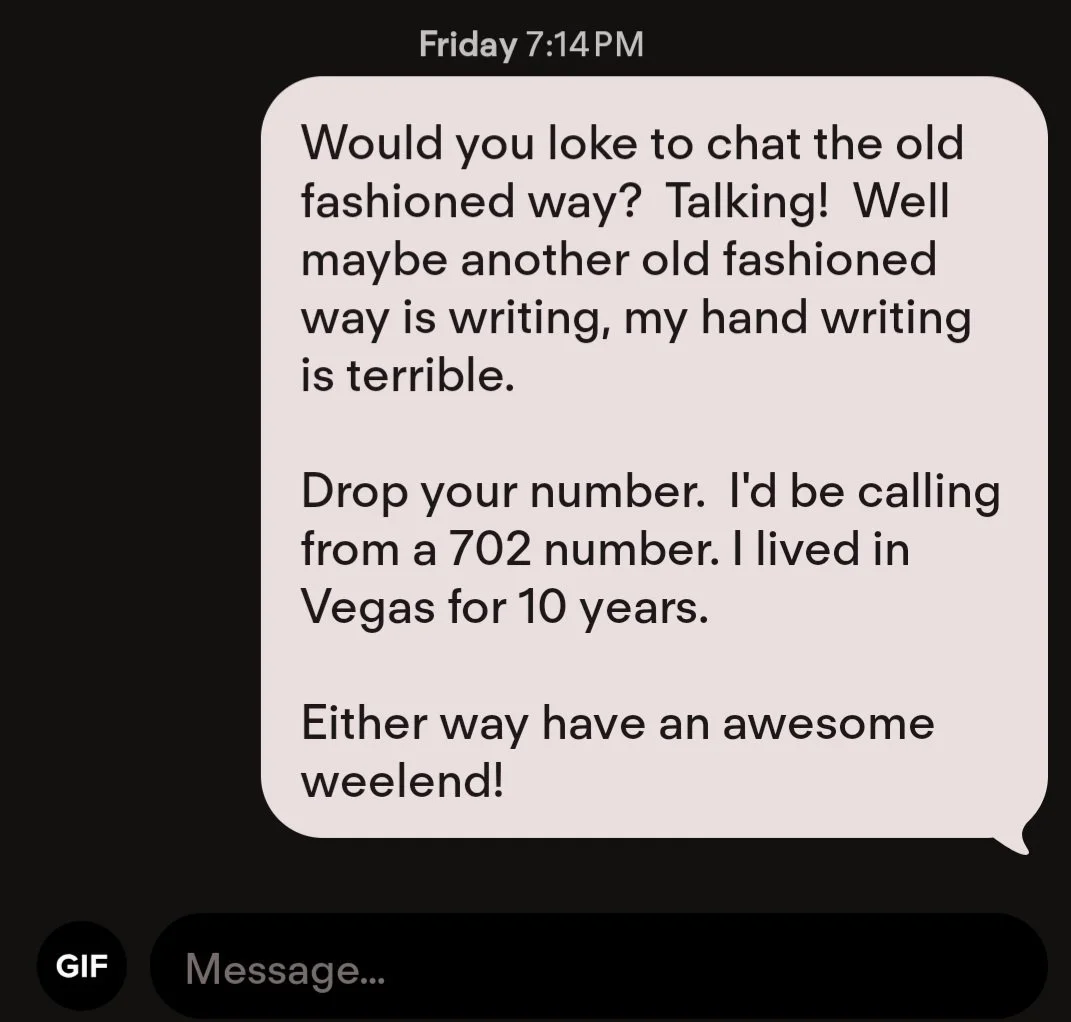
And then...
Crickets.
Not even Tinder crickets.
Those crickets have probably unmatched me too.
Which leaves me slightly confused.
Wait a minute, Chrissy.
I thought you wanted someone who could be:
"Just their true self."
That's exactly what I did!
I didn't lie.
I didn't play games.
I didn't create drama.
I didn't pretend to drink.
I didn't pretend to be Matt Damon.
I showed up as my true self, just like the advertisement requested.
Apparently there were terms and conditions.
And here's what really makes me laugh:
Her profile says she drinks "on special occasions."
Is having someone who drinks booze really that important when you only drink sometimes yourself?
Maybe there's an annual Cabernet Festival I don't know about.
Maybe Valentine's Day requires tequila.
Maybe I'm supposed to hold the wine glass while she drinks it.
I have questions.
Of course, maybe she just got busy. Maybe she'll respond eventually. Maybe she met somebody else. That's dating.
But if the sobriety conversation is what killed it, that's pretty funny.
Because after dealing with fake profiles, scammers, crypto investors, mysterious 6'6" women named Hamit, and everything else I've encountered on the Tinder, I finally did exactly what a profile asked:
I was my true self.
And apparently my true self got left on read.
Maybe next time I'll try being Matt Damon.
When a Communication Strategy Becomes a Communication Problem
I've spent 61 days documenting what I see as a fundamental communication failure at Nextdoor.
At this point, it's no longer one unanswered request.
Look at the pattern I've experienced:
Nirav Tolia blocked me on LinkedIn.
Comments are routinely turned off on Nextdoor's LinkedIn posts.
I've sent direct emails to Jacob Chavis, Nirav Tolia, Sarah Leary, Communications, and Investor Relations, but have not received a substantive response to my request.
And now there's another example involving Sarah Leary.
I had been commenting on an older X post she reposted about a Massachusetts community—if I remember correctly, Beacon Hill—preparing for significant snowfall and other neighborhood happenings.
The post eventually accumulated approximately 180 comments.
I'd estimate at least 75% were mine, documenting my ongoing Nextdoor experience.
Then the post disappeared.
To be clear: I don't know why it was deleted or whether my comments had anything to do with the decision.
But it got me thinking.
Yes, there may have been steam coming from my ears. 💨
If Nextdoor had an effective communication strategy for handling critical feedback, would any of this be happening?
That's when I started thinking about Kelsey Grady, Executive Vice President of Communications at Nextdoor.
I looked at the typical responsibilities associated with an executive communications role. At that level, we're talking about responsibility for an organization's internal and external messaging, brand reputation, public relations, crisis response, and advising executive leadership on communication strategy.
Which raises some fascinating questions.
Is ignoring my emails an intentional communications strategy?
Was blocking me on LinkedIn part of a strategy?
Is routinely disabling comments part of it?
Did anyone advise Sarah to remove that X post?
Or are executives individually deciding how—or whether—to engage?
I don't know.
I'm deliberately asking rather than pretending I know what happens inside Nextdoor.
But that's precisely why communication matters.
A coordinated communications strategy shouldn't leave outsiders spending 61 days trying to determine whether there even is a strategy.
And ultimately, responsibility travels upward.
Kelsey Grady may oversee Communications, but Nirav Tolia is CEO.
The buck eventually stops there.
One of the most important responsibilities of executive communications is crisis management.
Now, I'm certainly not suggesting one small shareholder asking for a study constitutes a corporate crisis.
But something that could have been resolved with a simple email has now generated 61 consecutive days of public commentary about Nextdoor's leadership, moderation, culture, investor relations, verification, business strategy and communication.
That's the part I find remarkable.
My grade for handling this particular situation?
Crisis Management: F.
Not because Nextdoor hasn't given me the answer I want.
Because after 61 days, Nextdoor still hasn't given me an answer.
Perhaps the most useful question isn't "Why does this shareholder keep posting?"
Maybe it's:
"How did we allow a simple request to become a 61-day public case study in communication?"
I'd genuinely like to hear Kelsey Grady's perspective on that one.
Join the discussion at NielFlamm.com/blog. Leave some feedback—I'd love to hear your perspective.
Sarah, Where Did the Post Go?
I've been documenting my experience with Nextdoor for more than 60 days.
I've posted on LinkedIn, Bluesky Social, X, and NielFlamm.com/blog. I've emailed Nextdoor and posted replies on accounts associated with the company—including co-founder Sarah Leary.
Why?
Exposure and reach.
One place I haven't had the same conversation is, ironically, Nextdoor itself. From my experience, negative feedback about the platform isn't exactly welcomed there.
Then There Was Sarah's X Post
Sarah isn't a big poster on @X. Her most recent post, as far as I can tell, is from March 19, 2026, and discusses a Hertz failure at FLL.
Oh, the irony.
There was also an older post involving a Boston neighborhood—possibly Beacon Hill—snow, and some neighborhood observations.
That became one place where I regularly posted updates about my dissatisfaction with Nextdoor.
The last time I looked, it had at least 175 replies.
I'd estimate 150 or more were mine.
Yes, that's a lot.
I posted about the unanswered study request, moderation, communication, leadership, corporate culture, verification, and shareholder value.
Then yesterday I noticed:
The post was gone.
Did Sarah delete it?
Did X remove it?
Was it simply an old post she decided to delete?
Or did 150+ replies from one dissatisfied shareholder become inconvenient?
I don't know.
That's why I'm asking.
So, I Found Another Post
Since that post disappeared, I've moved along.
I'm now leaving updates on another post on Sarah's X account from January 28, 2025.
Is it ideal?
Nope.
It's a repost from Nirav Tolia about X/Twitter and his apparently being on the platform for 20 years.
Congratulations, Nirav.
I'll get you a ribbon. 🎀
This isn't related to my questions, but when feedback places disappear, I'll work with what's available.
Now I'm curious:
How long will this post remain on Sarah's page?
If that one disappears too, I'll notice.
And I'll probably write about it.
Sarah, Why Did the Post Disappear?
If Sarah deleted it herself, I'd genuinely like to know why.
Was it because of my replies?
Was it simply because the post was old?
Was it completely unrelated to me?
There's a perfectly reasonable answer:
I don't know.
But that's been the recurring theme of this Nextdoor experience.
When leaders don't communicate, people are left trying to understand the reasons.
Deleting a post doesn't delete the questions.
Blocking someone doesn't eliminate feedback.
Disabling comments doesn't create agreement.
And refusing to engage doesn't make the conversation disappear.
It just moves somewhere else.
This time, it moved to Sarah's January 28, 2025 post.
And it continues here.
So, Sarah:
Why did the original post disappear?
And now...
How long will this one stay?
Comments and feedback are welcome here.
Join the discussion at NielFlamm.com/blog.

Day 61: A Rising Stock Doesn't Erase the Questions

It's Day 61.
While NXDR is up for the week, as I'm writing this it's down approximately $0.02 today.
Perhaps some short-term players are taking profits. Perhaps it's ordinary market movement. I don't pretend to know why someone else presses sell.
But I'm watching.
While I've been bearish on Nextdoor, I'm also a shareholder. I benefit when NXDR rises. I'd rather be writing about a company delivering undeniable value than explaining why I continue questioning its direction.
My concerns aren't based on one red trading day—or one unanswered email.
They're cumulative.
From my perspective, several leadership decisions under CEO Nirav Tolia deserve scrutiny.
I've questioned the investment in an elaborate new Dallas headquarters while the company continues reporting a GAAP net loss.
I've questioned a strategy that appears to ask some small businesses to pay additional money to respond to potential customer leads.
I've questioned a moderation model dependent on unpaid neighbors while seeing examples that make me wonder about consistency and quality control.
I've questioned a platform built around community and conversation while Nextdoor's corporate LinkedIn presence doesn't permit comments and Nirav has blocked me on LinkedIn.
I've tested Nextdoor's identity/address verification myself and raised questions about whether reality matches the rhetoric surrounding "trust."
And, of course...
It's Day 61 since I requested a study from Jacob Chavis.
No study.
No explanation.
No acknowledgment.
That has become less about Jacob and more about leadership.
I've contacted Nirav Tolia, Sarah Leary, Investor Relations, Communications, and others.
At some point, accountability travels upward.
A CEO doesn't personally answer every email, moderate every neighborhood, or respond to every shareholder.
I understand that.
But a CEO does own the culture and direction of the organization.
That's the distinction.
I don't know what's happening internally at Nextdoor, and I won't pretend I do.
I'm documenting what I can observe and asking whether these decisions create sustainable value.
NXDR can rise 5%, fall 2%, or trade sideways tomorrow.
The ticker tells us what the market thinks the company is worth at a particular moment.
It doesn't tell us whether today's leadership decisions are right for the next five years.
That's the conversation I'm interested in.
I'm watching leadership, execution, culture, communication, moderation, monetization, and shareholder value much more closely than today's ticker.
Day 61. Still watching. Still asking.
Join the discussion at NielFlamm.com/blog.
Leave some feedback—I'd genuinely like to hear what you think.