
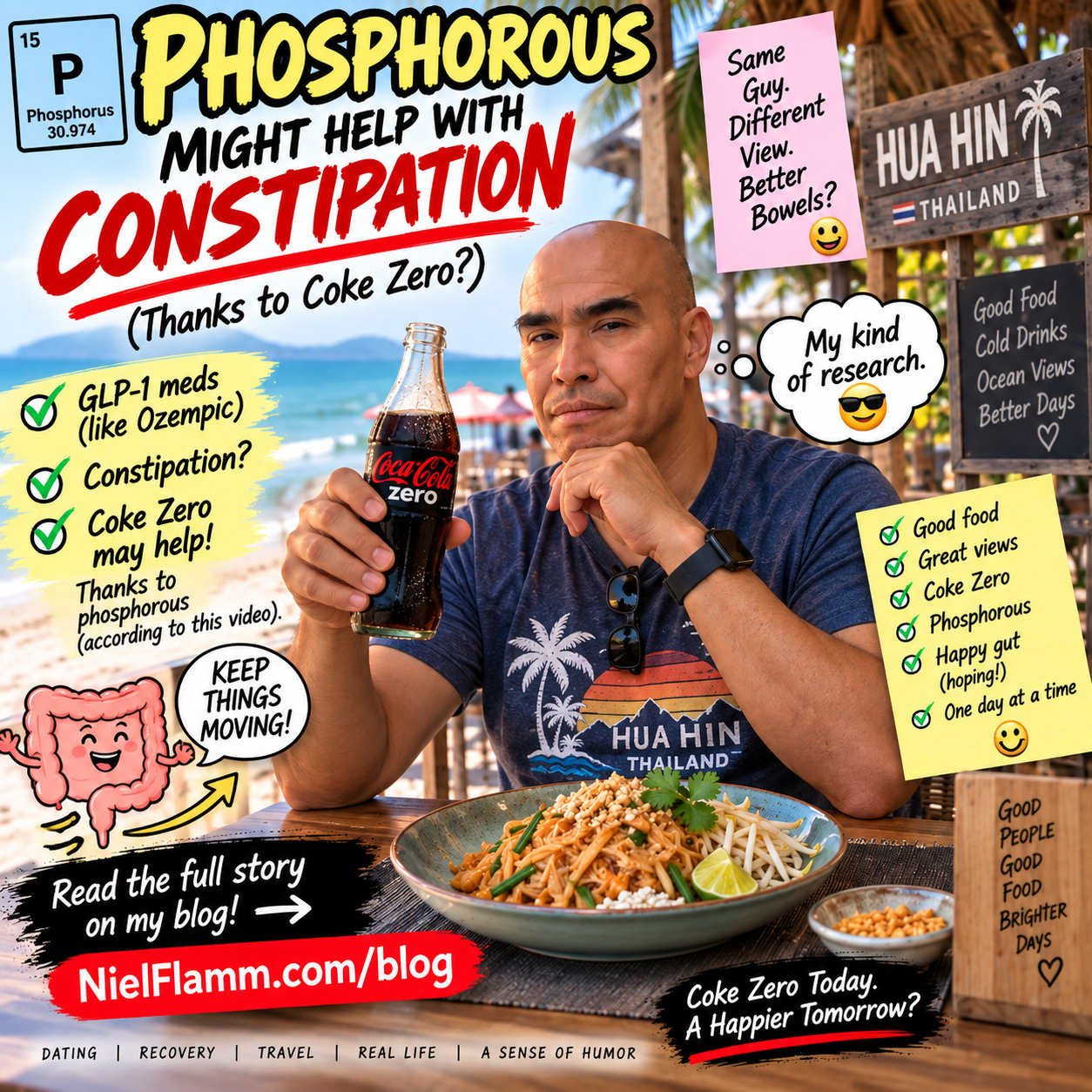
Wait… Coke Zero Is Health Food Now?
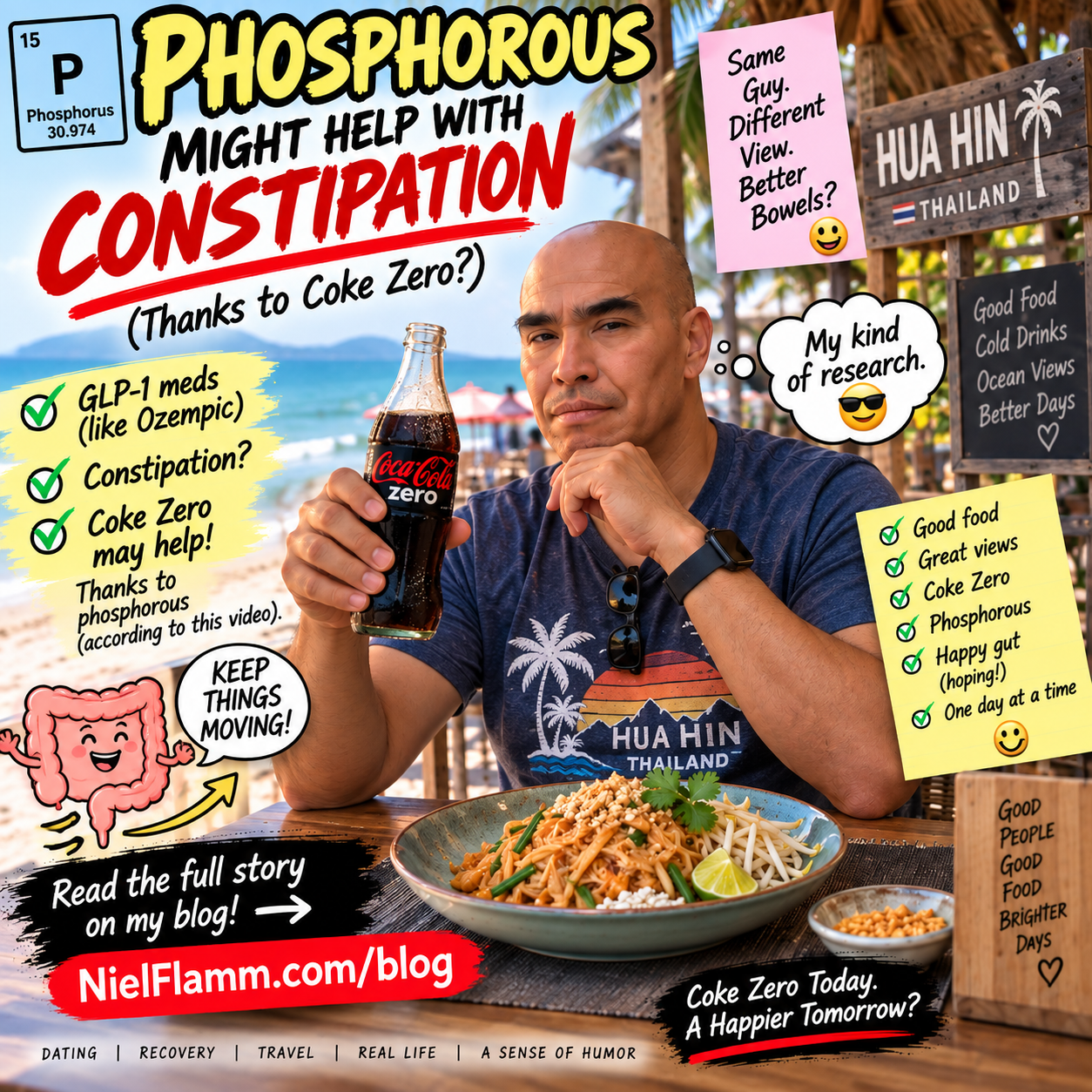
I recently came across a Facebook video with what might be the best medical advice I’ve ever heard.
The video says one way to help with constipation from GLP-1 medications is to drink Coke Zero, and the nutritionist attributes the effect to phosphorus.
My immediate reaction:
FANTASTIC!
Finally, something I’ve been training for my entire life.
Coke Zero is already one of my staple foods. I take Ozempic, and constipation can be one of the side effects.
So when somebody tells me my Coke Zero habit might actually have a purpose, naturally I'm thinking:
Doctor, should I increase my prescription from Large to Extra Large?
And somewhere at Coca-Cola headquarters, an executive just felt a disturbance in the Force.
There Is One Tiny Problem…
I couldn't independently verify the video's claim that the phosphorus in Coke Zero is an established treatment for GLP-1 constipation.
So, sadly, I'm not declaring Coke Zero a medication.
I'm merely saying that if future scientific research concludes that it is...
I was an early adopter.
And yes, before anyone reminds me about phosphorus and kidney disease—thank you for the reminder.
With my kidney situation, I already have to pay attention to phosphorus. I use a phosphate binder to hopefully help keep my phosphorus levels in line.
So this is definitely not me recommending that anyone start pounding Coke Zero as a medical treatment.
This is me discovering a video that seemingly gave my existing Coke Zero habit a scientific-sounding excuse and thinking:
FINALLY. MY MOMENT HAS ARRIVED.
Until then, I'll continue enjoying Coke Zero for the same reason I always have:
I just really like Coke Zero.
And if my consumption happens to help The Coca-Cola Company stock along the way?
You're welcome, shareholders.
I'm doing my part. One bottle at a time. 😂🥤
Mom Needed a Bathroom. We Needed a Solution.
My mother is now in a skilled nursing facility. She had a stroke at the end of June 2026 and a second one about three weeks ago. This is her fourth hospital or medical facility in the last three months.
That is a lot of moving, adjusting, and starting over. I get it. I’ve been there.
Part of the longer-term plan involves her wish not to return home once she gets back to where she was before the second stroke. That is a story for another time.
Today’s story is about something much more immediate: Mom needed to use the bathroom.
She arrived at the facility this afternoon, and her evaluations weren’t complete yet. Because physical therapy hadn’t evaluated her, there was uncertainty about how she could safely get to the bathroom—or whether she could get there at all.
I understood the concern. Nobody wanted her to fall or get hurt.
But her need to go wouldn’t wait for an evaluation.
I heard the explanation from three different people, delivered almost the same way each time. What I didn’t hear was a solution.
Mom and I asked for a bedpan.
We were told the facility doesn’t use bedpans.
Okay. So what do we do now?
This was also the point when I started feeling increasingly confident about my decision not to pursue a career in healthcare. As I wrote recently, patience is not one of my strengths. Hearing the same explanation repeatedly while my mother still needed help was putting that to the test.
I asked again: We need to find a solution. She can’t simply not go.
Eventually, someone made the executive decision to find a bedpan. I assume someone dug it out of the nonexistent basement.
Crisis averted.
I appreciate the need for evaluations and safe procedures. I also appreciate the person who finally found a way to help. But there needs to be an answer for what happens while a new resident is waiting for those evaluations.
From our side of the conversation, we had a basic, immediate need and several explanations of why it was complicated.
What would have helped was hearing: “We haven’t assessed her mobility yet. Here is how we can help her safely in the meantime.”
That would have given Mom some reassurance and both of us a plan.
Today, we eventually got there. It just took three explanations and a supposedly unavailable bedpan.
Why I Realized I Wasn’t Cut Out for Healthcare
When I started college, I thought I wanted to be a physician.
I was a student at the Sophie B. Davis biomedical program at the City College of New York, part of the City University of New York system, in historic Harlem. It was an accelerated path: five years followed by two years of medical school, instead of the traditional four plus four.
That was the plan. My reasons for pursuing it deserve honesty.
I didn’t want to become a doctor because I felt called to help people. I wasn’t driven to make an impact or cure a disease. I wanted to be wealthy and live comfortably.
That may sound shallow. Looking back, I think it was. But those were my motivations, and pretending otherwise would make this a different story.
There is nothing wrong with wanting financial security. The problem was choosing a profession without thinking enough about whether I wanted to do the actual work.
Recently, watching my mother receive care reinforced how poorly that career would have fit me.
Seeing the Work Up Close
My mother has had two strokes in about two months. She has been in the emergency room, in the ICU, and is now back in a physical rehabilitation unit.
Through all of it, I have watched healthcare workers at every level provide care, comfort, and concern for her.
I think of them as heroes. That word comes from watching their work: attending to someone who needs help, responding to uncertainty, and bringing patience to situations that can be difficult for both patients and families.
I am grateful.
As someone who once planned to enter their profession, I am also very clear: I am not equipped to do what they do.
Knowing What I Couldn’t Give
It isn’t the sight of blood, bodily fluids, or body parts that would get to me. Although I will admit that vomit is something I find disgusting.
What I would struggle with is sustaining focus while providing care. The patience. The compassion. The ability to keep responding thoughtfully when someone needs more and is already tired.
I care about my mother deeply. But caring about someone and being prepared to care for patients throughout a demanding shift require different things.
I don’t believe I have the patience or the capacity to provide that kind of care consistently. That is uncomfortable to admit, especially while watching people give it to someone who means so much to me. I also need to be honest about that.
Patients deserve care from people who can meet those demands. A desire for a comfortable lifestyle would not have prepared me for them.
The Lifestyle I Hadn’t Thought Through
Then there are the hours.
The long shifts, particularly during residency, would have been another major challenge for me. When I think about the time and responsibility involved, the compensation during training hardly resembles the comfortable life I had imagined.
I had focused on the possible financial rewards of becoming a physician without fully considering the years of demanding work required—or whether the daily work would suit me even after training.
My picture of the profession was incomplete.
Watching my mother’s care has made the part I overlooked much harder to miss.
Gratitude and a Clearer Understanding
I am not suggesting that healthcare workers must be selfless every minute or that they shouldn’t want good pay and comfortable lives. They deserve both. I can appreciate their dedication while recognizing how much the work asks of them.
What I understand now is that my reasons for wanting to become a physician would not have been enough.
There is value in recognizing that a profession does not fit you, even one you once imagined as your future. I can respect this work deeply and acknowledge that I would have struggled to do it well.
To everyone who has cared for my mother—in the emergency room, the ICU, and rehabilitation—thank you for the care, comfort, and concern you have shown her.
Years ago, I imagined what being a physician might give me. Watching you, I see much more clearly what the work would have required of me.