

Day 114: Nextdoor Finally Found a Way to Sell What It Knows

Nextdoor just launched Neighborhood Intelligence, and I think it could be one of the most important developments I've seen in this 114-day case study.
The basic idea is pretty simple: Nextdoor has spent 15 years building a massive collection of neighborhood-level information. Now it's turning that information into an advertiser product.
Nextdoor says its Neighborhood Intelligence platform maps roughly 350,000 neighborhoods and analyzes signals including neighbor activity, household information, and neighborhood-level activity. It gives advertisers a much more granular view than traditional ZIP-code targeting. Nextdoor Business
That's potentially valuable.
And it brings me back to something I've been saying for a while:
The Data Has Value
For years, neighbors have supplied the conversations, recommendations, reviews, opinions, and local knowledge that make Nextdoor useful.
Now Nextdoor is packaging neighborhood intelligence into something advertisers can use.
That's business.
But here's my question:
Why did it take 15 years?
Nextdoor has been around since 2011. It went public in 2021. Yet it has never achieved GAAP profitability. Even after the recent improvement, Q2 2026 produced a $2 million net loss, although revenue reached a record $75 million and adjusted EBITDA was $10 million. Securities and Exchange Commission
That's a long time to possess a potentially unique asset without figuring out how to turn it into sustainable profits.
Don't Blame Just the Current CEO
It's tempting to point the finger at Nirav Tolia.
He returned as CEO in 2024 and has been tasked with turning the company around.
But that's too easy.
Nirav founded Nextdoor and ran it for years before leaving the CEO role. He then returned.
So this isn't simply:
“The new CEO hasn't figured it out.”
The company has had 15 years to find its niche, monetize its advantages and create sustainable shareholder value.
Now, perhaps, we're seeing a clearer path.
The Neighborhood May Be the Niche
That's what interests me about Neighborhood Intelligence.
Nextdoor doesn't have to beat Google at everything.
It doesn't have to beat Meta at everything.
It doesn't have to become another generic social-media platform.
Maybe the opportunity is much narrower:
Own neighborhood-level intelligence.
Nextdoor says its neighborhood graph provides roughly 12 times the geographic granularity of ZIP-code targeting in covered areas, and its pilot campaigns showed lifts in brand awareness, ad recall and favorability compared with ZIP-code targeting. Investing.com
If advertisers will pay for that advantage, now we're talking.
That's the kind of niche I want Nextdoor to own.
And Then There's the Dividend
I'm not saying Nextdoor should pay a dividend tomorrow.
The company needs to continue investing, improve profitability, and determine the best use of its capital.
But eventually, that's the shareholder question:
Can this company consistently generate enough cash to reward the people who invested in it?
A $100 million share-repurchase authorization already shows that returning capital to shareholders is part of the conversation. Simply Wall St
I'd like to see the next step be sustainable profitability.
Then, someday, perhaps a dividend.
Because revenue isn't the finish line.
Profitability is.

Day 114
Here's the irony.
I've spent 114 days asking Nextdoor for detailed information about its Insights research.
Now Nextdoor is announcing a product that essentially says:
Our neighborhood data is valuable.
I agree.
I've been saying that.
The difference is that Nextdoor is now trying to prove it in the marketplace.
Good.
Now show me that this isn't just another interesting product.
Show me that Nextdoor can turn 15 years of neighborhood intelligence into a sustainable, profitable business.
Because that's what shareholders ultimately need.
Not just data.
Results.
And maybe—finally—Nextdoor has found the niche.
👉 NielFlamm.com/blog

Day 112: Still Waiting

Day 112.
The request hasn't changed.
I'm still asking Nextdoor for the detailed Insights research that its own posts said was available.
I've emailed. I've followed up. I've expanded the audience. I've offered to talk by phone, video, or virtual coffee.
I've received a response, but it doesn't include the complete detailed reports I originally requested.
At this point, the answer doesn't need to be complicated:
Send the reports.
Tell me they're unavailable.
Explain any restrictions.
Or please let me know who can provide them.
Any one of those would end the countdown.
Nextdoor's own recent research emphasizes the importance of trust and communication.
I agree.
So let's communicate.
112 days. One unresolved request.
Maybe Day 113 will be the day.
I've been wrong 112 times so far. 😂
👉 NielFlamm.com/blog

Day 111: Nextdoor Congratulates Elisa Steele on Governance Excellence. I Have a Governance Question.

Today I saw a Nextdoor post congratulating Elisa Steele on being named to the 2026 NACD Directorship 100 by the National Association of Corporate Directors.
My first reaction was: Congratulations.
My second reaction was: What exactly does someone have to do to make the NACD Directorship 100?
So, naturally, I looked it up.
And this is where things got interesting.
First, Credit to NACD: They Actually Show Their Work
One thing immediately stood out.
While I keep asking how Nextdoor selects its Good Neighbor Award recipients, NACD publishes substantial information about what the award represents, its criteria, and its selection process.
The 2026 Directorship 100 recognizes 100 directors and governance professionals who, according to NACD, exemplify the knowledge, leadership, and excellence it promotes. Elisa Steele is indeed listed among the 2026 director honorees.
Even better, NACD publishes a nomination guide.
Imagine that.
Criteria. In writing. Available to the public.
As someone who has repeatedly asked Nextdoor for greater transparency around its own awards and research, I appreciate being able to see how the sausage is made.
Read NACD's 2026 nomination criteria.
Then I Read the Criteria
This is where my eyebrows went up.
For directors, NACD looks for recent board-level contributions that materially strengthen governance oversight, strategy, or organizational resilience. It also evaluates governance influence, modernization, ethical leadership, judgment, and credibility.
Among the examples NACD provides are directors who demonstrate:
“courage and leadership under duress”
while doing what's best for the corporation and shareholders when facing pressures inside or outside the boardroom.
There's more.
NACD points to directors who contribute to consistent long-term profitability, pursue important business opportunities, improve shareholder returns, or navigate crises and major changes effectively.
And then there's this one:
“Valuing board and team performance over individual performance, keeping ego in check.”
Oh boy.
You knew where I was going with this.
😂

Elisa, I Think We Need to Talk About Nirav
Here's why this caught my attention.
Elisa isn't just someone on Nextdoor's board.
Nextdoor's own governance page currently identifies her as its Lead Independent Director. She also serves on the Audit and Risk Committee and chairs the Nominating, Corporate Governance and Corporate Responsibility Committee.
In other words:
Governance is quite literally part of the job.
That's why I'm having difficulty separating this recognition from the case study I've now been documenting for 111 days.
For months, I've been asking questions about Nextdoor.
I've questioned research transparency.
I've questioned communication.
I've questioned the company's Good Neighbor Award selection process.
I've questioned how Nextdoor responds to feedback.
I've questioned whether neighbors should participate economically when their information and contributions become valuable commercial assets.
I’ve repeatedly offered to have a conversation rather than keep typing about it.
Then Nextdoor CEO Nirav Tolia blocked me on X.
Again.
Let Me Be Fair About the Block
Nirav is entitled to block me.
Being CEO of a public company doesn't mean he has to follow me, answer every post I make, or spend Saturday night debating a shareholder on social media.
I also cannot tell you why he blocked me.
Only Nirav knows that.
So I'm not going to say he blocked me because he “felt pressure.” I can't know that.
I can discuss what leadership should look like when pressure, criticism, or uncomfortable questions arrive.
And, conveniently, NACD just gave me some vocabulary.
Courage under duress.
Doing what's best for the corporation and its shareholders despite pressure.
Keeping ego in check.
Those aren't my standards.
Those are examples contained in NACD's 2026 director nomination criteria.
Elisa, Here's My Challenge
Congratulations on the recognition.
Seriously.
NACD says its Directorship 100 is intended to recognize people shaping the boardroom agenda and demonstrating governance leadership. Being selected is something worth celebrating.
But recognition also creates an opportunity.
Use it.
Have a conversation with Nirav.
Not specifically because I'm special. I'm not.
And not because a CEO must personally respond to every shareholder complaint.
But because how leadership responds to uncomfortable feedback is a governance question.
If the CEO disagrees with someone, disagree.
If the criticism is wrong, explain why it's wrong.
If a question belongs with another executive, delegate it.
If information won’t be provided, say so.
If someone becomes abusive, threatening, or crosses a reasonable boundary, absolutely establish boundaries.
But when the issue is simply persistent questioning, I'd much rather see leadership demonstrate the kind of confidence that says:
Ask the question. Let's deal with it.
That's leadership I can respect even when the answer isn't the one I wanted.
Governance Isn't Just What Happens at a Board Meeting
This may be the biggest lesson I took from reading NACD's criteria.
Governance isn't simply approving minutes, sitting on committees, and attending quarterly meetings.
NACD's criteria cover oversight, resilience, emerging risks, executive compensation, CEO succession, board culture, strategic transformation, shareholder returns, and decision-making.
It even talks about directors demonstrating courage when pressures exist outside the boardroom.
That's important.
Because customers, neighbors, and shareholders aren't sitting inside the boardroom.
We're outside it.
Sometimes we're the pressure.
Sometimes we're annoying.
Sometimes we're wrong.
Sometimes we identify something worth examining.
A strong governance structure should be able to figure out which is which.
And This Is Why I Like Published Criteria
There's also a lesson here for Nextdoor's Good Neighbor Awards.
I can look at NACD's website and see what the organization says it values.
I can read its nomination criteria.
I can understand eligibility.
I want to learn about how candidates are evaluated.
NACD says candidates are vetted and scored using qualitative and quantitative criteria, escalated through senior leadership, and selected honorees ultimately go to the NACD board for final review.
That doesn't mean I know everything about every selection.
I don't.
But transparency gives me something to evaluate the process against.
That's precisely why I've asked Nextdoor to provide greater transparency around its own Good Neighbor Awards.
Don't just tell me the winners are wonderful people.
Show me the process.
NACD does.
Congratulations, Elisa. Now Comes the Fun Part.
So I'll finish where I started.
Congratulations to Elisa Steele.
Being included in the NACD Directorship 100 is a significant professional recognition.
But after reading NACD's own criteria, I don't think the appropriate shareholder response is merely applause.
It's also accountability.
NACD talks about courage.
It talks about leadership under pressure.
It talks about shareholders.
It talks about governance credibility.
It talks about keeping ego in check.
Those are excellent standards.
Let's apply them.
Elisa, have the conversation with Nirav.
Encourage a leadership culture that doesn't shy away from uncomfortable questions.
Encourage people inside Nextdoor to answer them—even when the answer is no.
Please let the CEO know that when a shareholder with too much time on his hands keeps asking questions, the block button doesn't make them disappear.
😂
Because after 111 days, I'm still here.
I'm still a shareholder.
I still want Nextdoor to succeed.
And I'm still asking questions.
Congratulations on the governance award.
Now let's see the governance.
👉 NielFlamm.com/blog
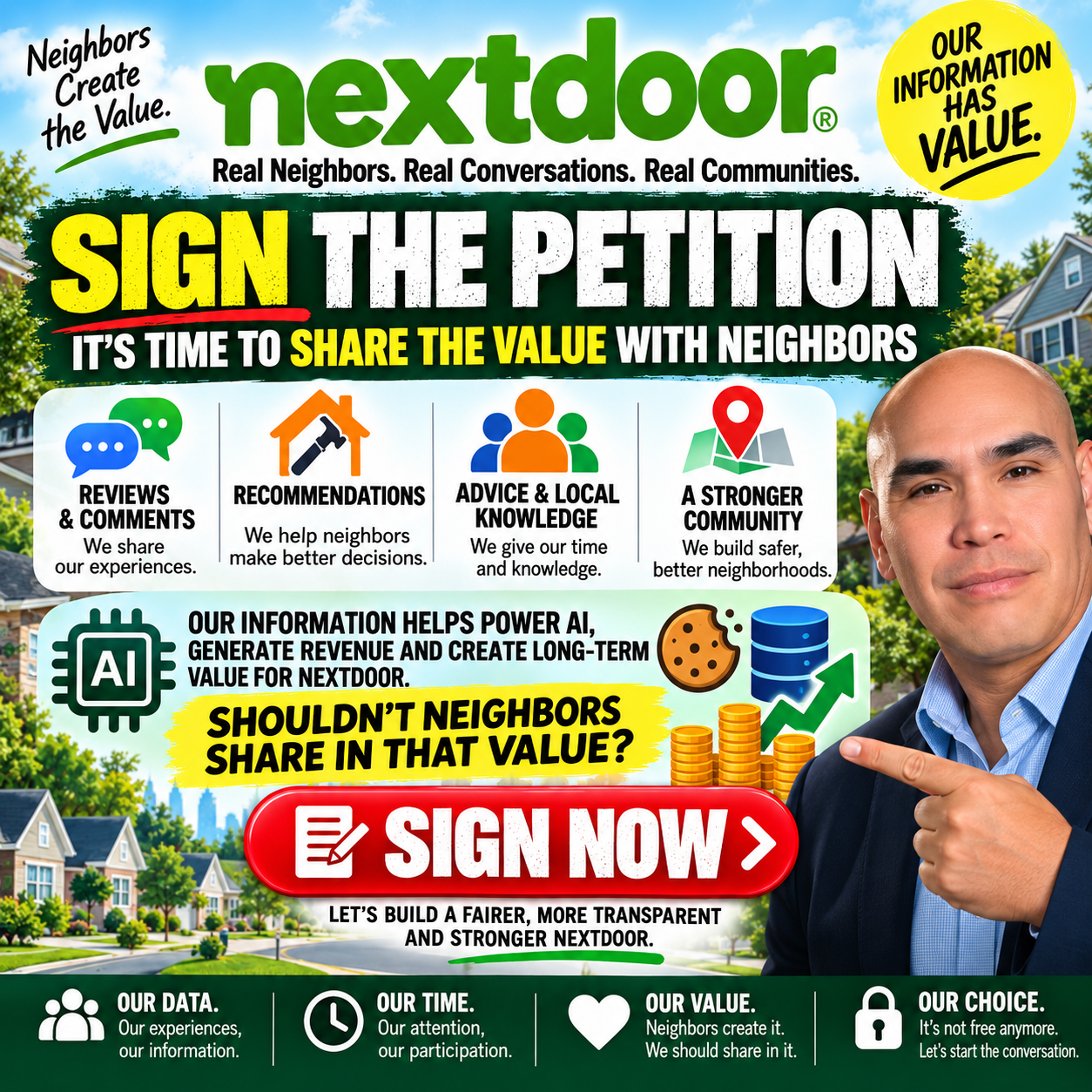
The Free Data Buffet Is Over: If Our Content Creates Value, We Should Share in It
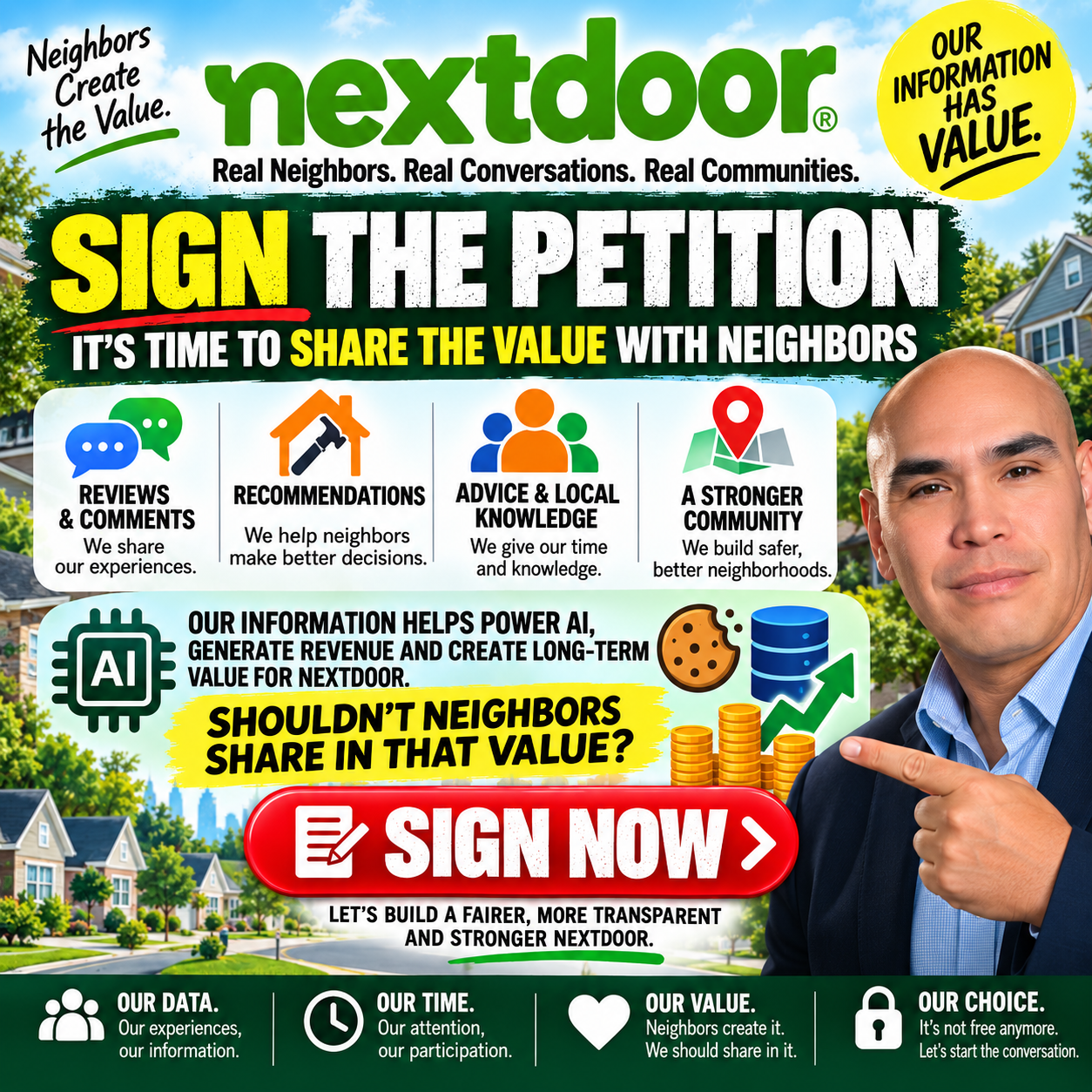
A while ago, I started a petition asking a fairly simple question:
If Nextdoor can create economic value from information neighbors provide, why shouldn't the neighbors who provide it participate in that value?
Today, I'm expanding the question.
This isn't only about Nextdoor anymore.
It's about social media platforms, websites, apps, advertising networks, and other digital businesses that collect information about what we read, click, search, recommend, review, discuss, and buy.
My message is becoming simpler:
Our information isn't free anymore.
At least, I don't think it should be.
We Keep Supplying the Raw Material
Think about what people give digital platforms every day.
We write reviews. We recommend restaurants. We tell neighbors which plumber showed up on time. We answer questions. We upload photographs. We comment. We click. We search. We like things. We tell platforms what interests us.
Then there's the less obvious information: cookies, device identifiers, IP addresses, browsing activity, clicks and other event data.
These aren't all legally or technically the same thing, and different privacy laws and platform agreements govern how different types of information may be collected and used. I'm not claiming that placing a cookie on my browser magically means somebody owes me a royalty check.
I'm making an argument about economic value.
Because individually, one click may be almost meaningless.
Multiply those clicks, posts, recommendations, and behavioral signals across millions of people, however, and suddenly we're talking about an extremely valuable resource.
Nextdoor Makes the Point Particularly Well
Nextdoor increasingly describes itself in terms of neighbor-generated knowledge. Its 2025 Transparency Report described the platform as containing “neighbor-generated content and locally relevant information,” while Nextdoor's newer AI-powered Ask product draws upon nearly 15 years of conversations among verified neighbors. Nextdoor
That's valuable.
And who created those conversations?
Neighbors did.
Nextdoor built the platform.
Nextdoor paid engineers.
Nextdoor created the infrastructure.
Nextdoor developed the advertising business.
Nextdoor has every right to try to build a profitable company from those investments.
But neighbors supplied an enormous amount of the raw material that makes the platform useful.
Nextdoor itself says almost 30% of its content consists of organic recommendations and has talked about tens of millions of “Faves” associated with millions of businesses. Nextdoor Blog
That's nothing.

Cookies Are Part of the Bigger Conversation
The same principle makes me think differently about tracking.
Nextdoor's own data-processing documentation identifies things such as cookie IDs or similar identifiers, IP addresses, user-agent information, and event data such as clicks or installs among categories of personal data involved in certain advertising-related processing. Nextdoor Legal
Again, this isn't uniquely a Nextdoor issue.
It's an internet issue.
We've spent years becoming accustomed to clicking:
ACCEPT ALL COOKIES
Maybe we should start thinking more carefully about what we're accepting and what companies receive in return.
If information about my behavior helps improve targeting, train recommendation systems, develop products, measure advertising, build audiences or otherwise contribute to commercial value, I think it's reasonable to have a larger conversation about what the person generating that information receives in return.
Welcome Back to My Very Lonely Petition 😂
My petition hasn't exactly become the Boston Tea Party of user-generated data.
Last time I checked, it had one signature.
Mine.
😂
I already know what that guy thinks.
But perhaps my original message was too focused on Nextdoor.
Because this question is much bigger.
My updated message isn't:
Destroy social media.
It isn't:
Stop using the internet.
And it certainly isn't:
Companies shouldn't make money.
It's this:
If our participation creates commercial value, let's start talking about sharing that value.
That could take many forms.
Direct compensation for opt-in research. Contribution credits. Subscription benefits. Revenue-sharing pools. Advertising credits. Payments for particularly valuable content. Rewards for reviews or recommendations that generate measurable commercial activity. Stronger controls over commercial reuse. Clear choices about whether content can be used to develop AI products.
I don't pretend to have the perfect economic model.
That's what the conversation is for.
Until Then, We Can Stop Supplying Some of the Commodity
That's the other part of my petition.
Participation is voluntary.
If I don't like the economic arrangement, I can reconsider what I voluntarily contribute.
That doesn't mean withholding information about a missing child, dangerous weather, a lost pet, a fire, an emergency, or something that could protect another person.
Human safety comes before my argument about data economics.
I'm talking about the routine commercial material platforms benefit from:
Which roofer should I hire?
What's the best restaurant nearby?
Who installed your HVAC system?
Would you recommend this dealership?
Which insurance company do you use?
Every answer adds another tiny piece to a valuable database.
Maybe we should stop automatically assuming that contribution costs $0.00.
The Internet Made Us the Product, the Customer and the Workforce
That's what fascinates me.
We can simultaneously be the audience viewing advertisements, the customer purchasing products, the creator producing content, and the source generating behavioral data.
That's an extraordinary business model.
For the companies.
Maybe it's time users become more conscious participants in the economics too.
And I'm not suggesting that users automatically have a legal right to payment for everything they post or every cookie generated. Platform terms, privacy laws, and individual choices matter.
I'm saying something much simpler:
We can ask for a different deal.

Nextdoor, You're Still My Test Case
Nextdoor remains particularly interesting to me because its product depends so heavily on what neighbors know.
Without neighbors, there are no neighbor recommendations.
Without neighbors, AI has no years of neighborhood conversations to search.
Without neighbors, there are no local experiences to organize.
Without neighbors, advertisers have far less reason to want access to those neighborhoods.
Nextdoor says it wants every voice to have value. Nextdoor Business
Great.
Let's talk about the economic value too.
Nextdoor built the container.
Neighbors keep filling it.
So I'm Updating the Invitation
To Nextdoor.
To social-media companies.
To websites.
To apps.
To companies collecting behavioral information.
And, most importantly, to the people creating all of it:
Stop thinking of your digital activity as automatically worthless simply because nobody has historically written you a check for it.
Ask what you're providing.
Ask how it's being used.
Read the privacy controls.
Decline unnecessary tracking when you prefer not to.
Think before voluntarily providing another commercially useful recommendation, review, or piece of content.
And if enough people decide the current exchange isn't good enough?
Companies will have an incentive to offer a better one.
My petition may still have only one signature.
That's okay.
Every movement has a first person willing to look slightly ridiculous standing there alone.
I'm already bald. I've survived worse. 😂
Our information has value.
Our content has value.
Our recommendations have value.
Our attention has value.
Our time has value.
The question isn't whether digital companies should be allowed to create value.
The question is whether the people supplying so much of the raw material should be part of it.
I think that's a conversation worth having.
👉 Sign the petition: https://c.org/GkNWmffgg9
👉 Follow the continuing case study: NielFlamm.com/blog
Day 109: Nextdoor Honored Five Great Neighbors. Only One Story Really Needed Nextdoor.

Day 109.
I'm still asking Nextdoor for the detailed data behind the original two Insights studies I requested.
But before getting into today's observation, let me give Nextdoor some credit.
You're welcome. 😂
I've spent 109 days publicly asking for the research Nextdoor said readers could request.
And recently, Nextdoor published a new study on neighborhood trust with substantially more methodology and research information than I've been asking to see.
I liked it.
I said so.
So, Nextdoor, you're welcome for the free accountability service.
Please let me know where the first two detailed reports I originally requested are.
I'm not asking for another summary.
Could you share the underlying research that started this 109-day project?
Now, About Those Good Neighbors
Nextdoor recently published its 2026 Good Neighbor Day honoree roll call.
And I genuinely like these stories.
They selected five honorees from more than 1,300 nominations, representing five regions of the country.
These are people doing exactly what good neighbors should do.
They're feeding people.
Helping someone recovering from a hospital stay.
Taking out trash cans.
Plowing driveways.
Maintaining neighborhoods.
Helping people when they need it.
Bravo.
But while reading Nextdoor's own descriptions of the five honorees, something jumped out at me.
Of the five individual stories, only one explicitly describes Nextdoor as part of how the actual good-neighbor work operates.
That would be Dorea in Raleigh, North Carolina.
Nextdoor says Dorea cooks free dinners for roughly 100 neighbors every Wednesday and that the operation “runs on Nextdoor.” By late September, the project had served more than 2,800 meals.
That's fantastic.
And that, to me, is exactly where Nextdoor makes sense.
A neighbor has a need.
Another neighbor wants to help.
Nextdoor becomes the conduit connecting them.
Simple.
Useful.
Local.
Neighborly.
Then I Read the Other Four Stories
The other four honorees are equally deserving.
But something is different.
Bhagwat Gupta spent years helping rebuild and improve his Texas neighborhood.
Dan Schaefer organized meals and continued helping a neighbor recovering alone.
Dan Brinsky plowed a neighbor's driveway throughout the winter so she could visit her husband in the hospital.
Karl and Debbie Word helped neighbors during a medical emergency and kept up their property while they dealt with it.
Wonderful stories.
But in Nextdoor's descriptions of those four acts, Nextdoor isn't presented as the mechanism that made the help happen.
The neighbors are the story.
Which got me thinking again about something I've been saying for months.
What Exactly Is Nextdoor?
Is Nextdoor a social-media platform?
Is it a neighborhood communication platform?
Is it a recommendation platform?
Is it a business-review platform?
Is it an advertising platform?
Is it a local-services marketplace?
Is it a research and consumer-insights company?
Is it a lead-generation platform for businesses?
Is it all of them?
Because maybe that's part of the problem.
Too many lanes.
I've questioned whether Nextdoor is trying to be so many things that its clearest value proposition gets buried underneath everything else.
And ironically, Nextdoor's own Good Neighbor stories may illustrate the question better than I ever could.
Dorea's Story Shows Me the Nextdoor I Understand
Dorea's story is incredibly easy for me to understand.
Someone cooks meals.
Other people need meals.
Neighbors volunteer.
People donate.
People help deliver.
Nextdoor helps connect them.
Boom.
There's the product.
There's the value.
That’s the reason the platform exists.
Nextdoor doesn't have to be the hero.
Dorea is the hero.
Nextdoor helps the hero find the people who need her—and helps other neighbors find a way to participate.
That's a powerful role.
In fact, I think it's more powerful than trying to make Nextdoor the center of every story.
Maybe the Best Version of Nextdoor Is the Conduit
This is where I keep coming back.
Nextdoor doesn't necessarily need to be the neighborhood.
The neighbors already are the neighborhood.
It doesn't need to create neighborliness.
People were helping the person next door long before there was an app for it.
Technology can make those connections easier.
Someone needs help.
Someone else can provide it.
Someone needs a recommendation.
Someone nearby has experience.
Someone lost a dog.
Someone three streets away just saw it.
Someone needs a plumber.
Someone nearby knows one.
Someone has extra food.
Someone else needs dinner.
Connect them.
That's a value proposition I can understand immediately.
But Then Come All the Other Lanes
Reviews.
Recommendations.
Advertising.
Business Pages.
Paid opportunities.
Consumer research.
Insights reports.
Social feeds.
Local discussions.
Business discovery.
Content.
AI.
And somewhere inside all of that is the original idea:
Neighbors connecting with neighbors.
Maybe all of those other businesses ultimately support that mission.
That's certainly a possible strategy.
But I think Nextdoor's own Good Neighbor post raises a worthwhile strategic question:
Has Nextdoor added so many lanes that the simplest reason for using Nextdoor has become harder to see?
The Good Neighbor stories don't prove the answer is yes.
But they certainly made me ask the question again.

Five Honorees. One Particularly Clear Platform Story.
That's what stood out to me.
Not because the other four honorees somehow matter less.
Quite the opposite.
Their actions are the entire point.
But Dorea's story gives me something the others don't:
A crystal-clear example of what Nextdoor itself contributed.
Nextdoor connected people.
That's it.
And that's enough.
Maybe Nextdoor doesn't need another lane.
Maybe it needs to become exceptionally good at the lane its own name has been describing all along.
Next. Door.
Neighbors helping neighbors.
Technology making the connection easier.
The people do the rest.
And now, back to Day 109
I gave Nextdoor credit for the latest research report.
I gave Nextdoor credit for recognizing these five neighbors.
And I'll continue giving the company credit when I think it gets something right.
Now let's finish some unfinished business.
Where are the detailed reports from the first two studies I requested?
It's Day 109.
You showed with the latest research that greater transparency is possible.
Great.
Now let's close the loop on the first two.
Then we'll be square.
Read Nextdoor's 2026 Good Neighbor Day honorees here:
Announcing Nextdoor's 2026 Good Neighbor Day honorees
👉 NielFlamm.com/blog