
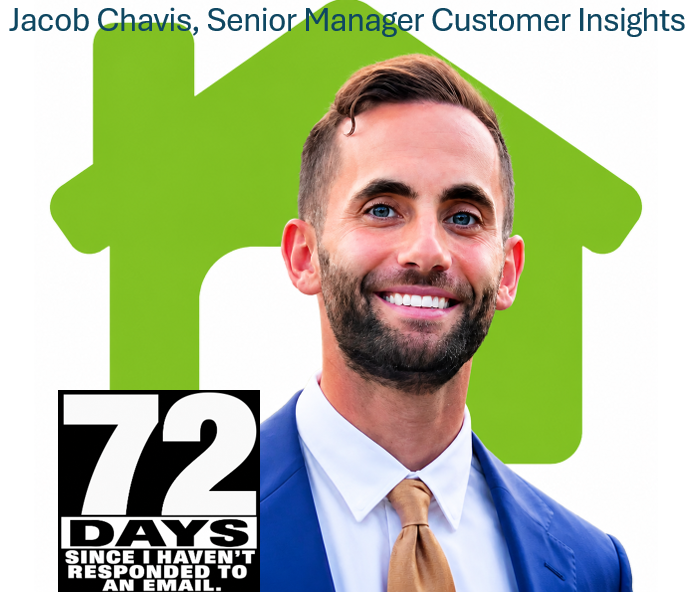
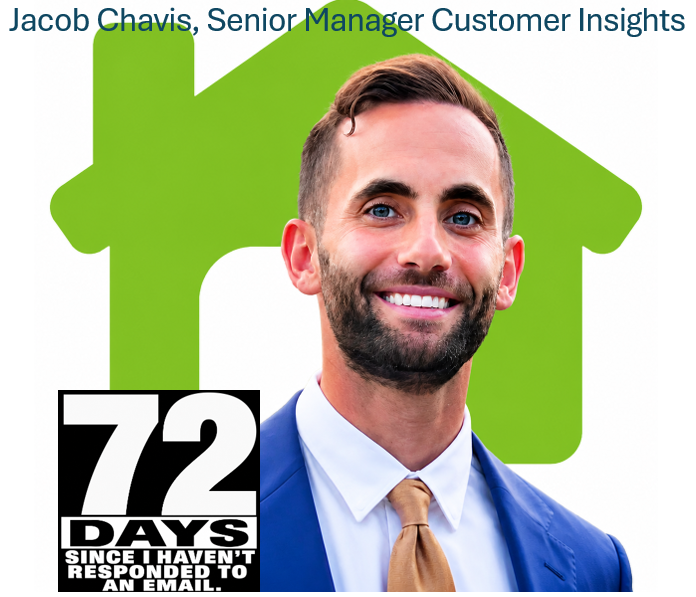
Day 72: “We Cannot Lose Our Humanness.” Are You Kidding, Nextdoor?
I saw Nirav Tolia is back on the podcast circuit, this time with Scott D. Clary on Success Story.
The title certainly got my attention:
“The Man Who Connected 100 Million Neighbors Says AI Is About to Make Us All Lonelier.”
Podcast:
https://lnkd.in/d6ncXhpj
Video:
https://lnkd.in/dY9AazUx
One of the first statements from Nirav highlighted in the LinkedIn post was:
“We cannot lose our humanness.”
I read that and thought:
He's kidding, right?
Not because I disagree with the statement.
Actually, I completely agree with it.
My issue is the disconnect between the rhetoric and what I've been observing and experiencing with Nextdoor.
What Does “Humanness” Actually Require?
Being human isn't simply having conversations about the dangers of AI.
To me, humanness includes:
Listening.
Empathy.
Accountability.
Acknowledging someone even when the conversation is uncomfortable.
And that's where Nirav's statement becomes fascinating when compared with what's happening at the company he leads.
It's Day 72 since I requested the detailed Home Insurance Insights research.
Enough said about that.
But this isn't only about me.
What About Nextdoor's Small Businesses?
I've been watching the reaction to Nextdoor's new pay-to-play approach, where businesses may have to pay to comment as businesses when a neighbor posts looking for a service.
And I've seen small-business owners who are not happy.
These aren't giant corporations with unlimited marketing budgets.
They're plumbers.
Landscapers.
Contractors.
Cleaners.
Handymen.
Local service providers.
Many operate on razor-thin margins.
They're also part of the small-business economy that helps keep communities—and the United States—running.
So while Nirav is discussing preserving our humanness in an AI-driven world, I'd like to know:
Who's listening to them?
Was someone sitting with Nirav when this monetization strategy was discussed asking:
“What does this mean for the small businesses that helped build engagement on our platform?”
Was there a focus group?
A beta?
Did anyone calculate the impact beyond Nextdoor's potential revenue?
Was there an effort to create buy-in?
Did anyone practice the very human behavior of listening before acting?
Maybe there was.
If so, please tell us about it.
Another Chapter in the White Paper on Rhetoric
That's increasingly what I find fascinating about studying Nextdoor.
The external messaging sounds terrific.
Community.
Connection.
Neighbors.
Humanness.
Then I compare those words with what I'm observing.
A shareholder waiting 72 days for detailed research he's repeatedly requested.
Small businesses questioning a new monetization model.
Corporate LinkedIn posts where comments are frequently unavailable.
Communication that, from my perspective, too often feels one-directional.
That's not an AI problem.
That's a human communication problem.
Nirav is right about one thing:
We cannot lose our humanness.
But perhaps the first place to demonstrate that philosophy isn't another podcast.
Maybe it's inside Nextdoor.
Listen.
Respond.
Show empathy.
Explain difficult decisions.
Engage with people who disagree.
Be accountable.
Otherwise, this becomes another fascinating chapter in my growing white paper on the difference between corporate rhetoric and corporate behavior.
And AI didn't create that problem.
Humans did.
Day 72.
Follow the continuing Nextdoor study at NielFlamm.com/blog.
Please subscribe at NielFlamm.com so you don't miss a post if the platform where you're reading this decides not to show you the next one.
Nextdoor's Biggest Opportunity Isn't AI—It's Trust
I didn't start writing about Nirav Tolia until he blocked me on LinkedIn.
My "offense" was providing feedback about Nextdoor's moderation model and user experience. Instead of engaging with criticism that could improve the platform, he removed the feedback from his view.
I recently listened to Nirav's June 3, 2026 appearance on the New Economies podcast with Ollie Forsyth:
https://www.neweconomies.co/p/nirav-tolia
Throughout the conversation, Nirav discusses AI, local commerce, and what matters to neighbors today. To me, much of it sounds like lip service because the most pressing issue facing Nextdoor isn't AI—it's trust.
What really matters to people today is a consistent moderation program with transparency from the moment a post is submitted through the final moderation decision and the metrics behind those decisions.
Nextdoor's model is built around real names and verified addresses. That's a tremendous amount of trust that users place in the company. Yet I have repeatedly asked a simple question:
What vetting is performed to ensure a volunteer neighbor moderator cannot retaliate against another neighbor?
I've asked several times and haven't received a meaningful response.
During the podcast, Nirav also discusses the value of the information that Nextdoor possesses. That data is clearly a valuable corporate asset and part of the company's monetization strategy.
But if users are expected to trust the platform with their identities, addresses, neighborhoods, and conversations, then transparency around moderation should be every bit as important as monetizing that data.
The future of Nextdoor won't be determined by AI features alone. It will be determined by whether neighbors believe the platform is fair, consistent, and accountable.
Empathy or Automation? The $1,000,000 Nextdoor Question
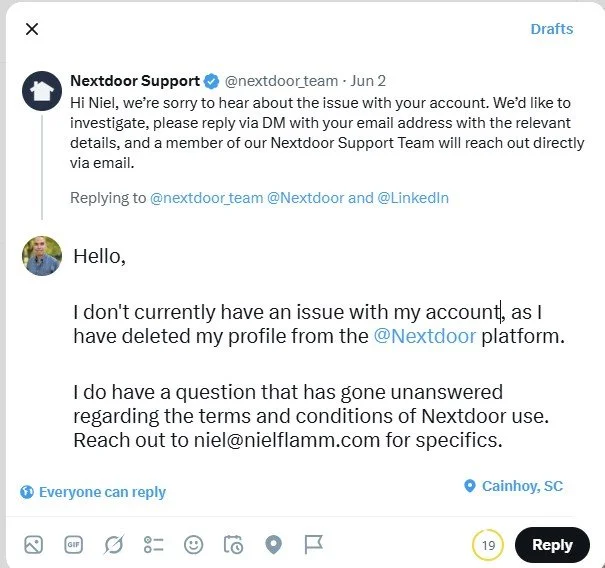
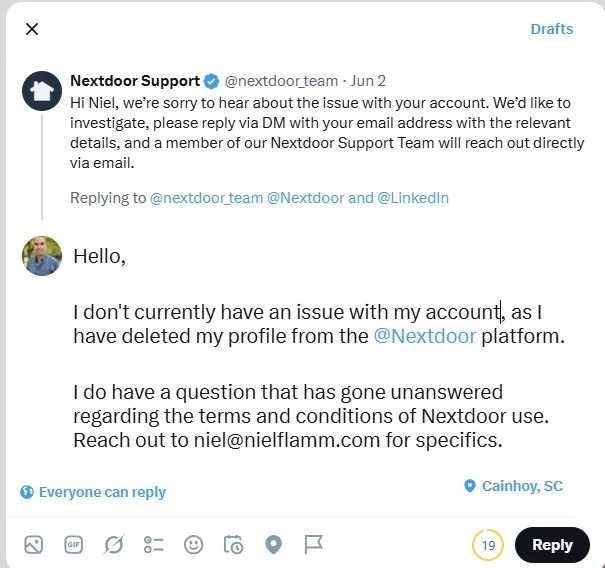
I recently received what appears to be a familiar, canned response from Nextdoor Support after posting on X. The message said they were sorry to hear about my issue and wanted to investigate, asking me to send my email address so someone from the Support Team could reach out directly.
So I replied.
I explained that I no longer have an account, but I have an unanswered question regarding Nextdoor's Terms and Conditions, and I invited them to contact me by email.
Now comes the $1,000,000 question:
Will someone actually follow through?
It's easy to express empathy with a template. It's much harder to demonstrate it through action. The appearance of caring and actually caring are two very different things.
That reminds me of Natalie Beckerman's new book, When Did You Stop Caring?, now available June 23, 2026, through Amazon and Barnes & Noble. I'm also looking forward to her presentation at Customer Contact Week (CCW) in Las Vegas, June 22–25, 2026, where I hope the conference delivers an enormous conversation around empathy, leadership, and customer experience.
The title makes me wonder:
When did Nextdoor stop caring enough to see conversations through to completion?
I'll gladly update everyone if an email arrives.