

Day 137: NXDR Falls to $2.24. Is Nextdoor Losing the Trust It Needs to Grow?

Fifteen years in business. New advertising opportunities. Another earnings report approaching. So why is the stock still sliding?

Day 137 of my Nextdoor case study, and NXDR is now trading at $2.24.
Let's recap.
Nextdoor recently celebrated its fifteenth anniversary by ringing the Nasdaq closing bell. The company has announced an expansion of sponsored search advertising, with new categories expected to include health care, pet care, real estate, telecommunications and financial services beginning in January.
The next quarterly earnings report is approaching, and historically I've seen a pattern where NXDR rises shortly before the earnings presentation, holds some of those gains for a day or two, and then retreats.
That's my observation of historical price behavior, not a guarantee of what will happen next.
But this time, something looks different.
With all these announcements and potential new revenue opportunities, why is NXDR trending downward?
I don't know the specific reason. I don't have access to investor trading decisions, and I won't pretend that one LinkedIn post explains the stock price.
But perhaps we should look beyond the earnings calendar and the revenue announcements.
Perhaps we should look at the experience of the people who actually use Nextdoor.
The LinkedIn Post That Caught My Attention
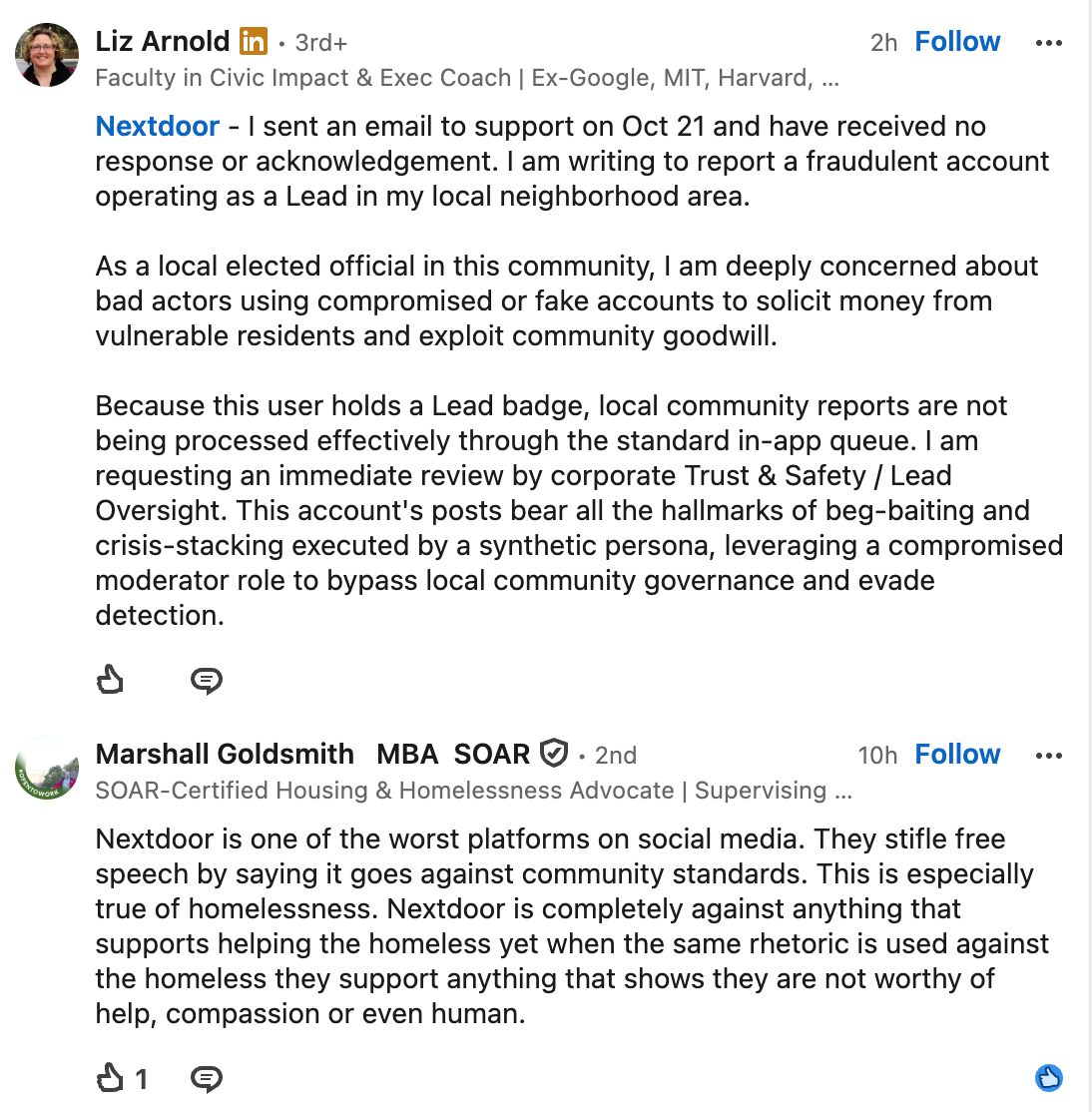
I came across a LinkedIn post by Liz Arnold that deserves attention.
She says she emailed Nextdoor Support on October 21 and received no response or acknowledgment.
Her concern involves an account allegedly operating fraudulently as a Lead in her local neighborhood. She identifies herself as a local elected official and expresses concern that compromised or fake accounts could be used to solicit money from vulnerable residents and exploit community goodwill.
She also raises a particularly important concern: because the account carries a Lead badge, she believes reports about it are not being processed effectively through the standard in-app reporting queue.
She is asking for an immediate review by Nextdoor's corporate Trust and Safety team and the people responsible for Lead oversight.
Let me be clear: these are allegations and concerns expressed in her LinkedIn post. I have not independently verified the account, the alleged fraud, or how her support request was handled.
But the issues she raises are significant.
If an account with a community leadership badge is compromised or being used deceptively, that creates a potential trust and safety problem. If the reporting process isn't working as intended, that creates another.
And if someone reports a potentially fraudulent account and receives no acknowledgment, that creates a customer-service problem.
Those are three issues a platform built around neighborhood trust should want to address.
A Lead Badge Should Come With Responsibility
Nextdoor's Lead program is intended to support community participation and neighborhood governance.
But what happens when a Lead account is compromised, misused, or otherwise becomes part of a dispute?
Is there a separate escalation process for concerns involving Leads?
Does Nextdoor regularly review whether Lead accounts are being used appropriately?
How quickly are reports involving potential fraud investigated?
Can users reach a corporate Trust and Safety team when the standard reporting process isn't working?
Does Nextdoor communicate when a report has been received and reviewed?
A badge creates an expectation.
It signals that the person has a recognized role in the community. If that role is misused, the company needs a reliable way to investigate and respond.
The trust associated with a badge should not make an account immune from scrutiny.
Another Comment Raises Questions About Moderation
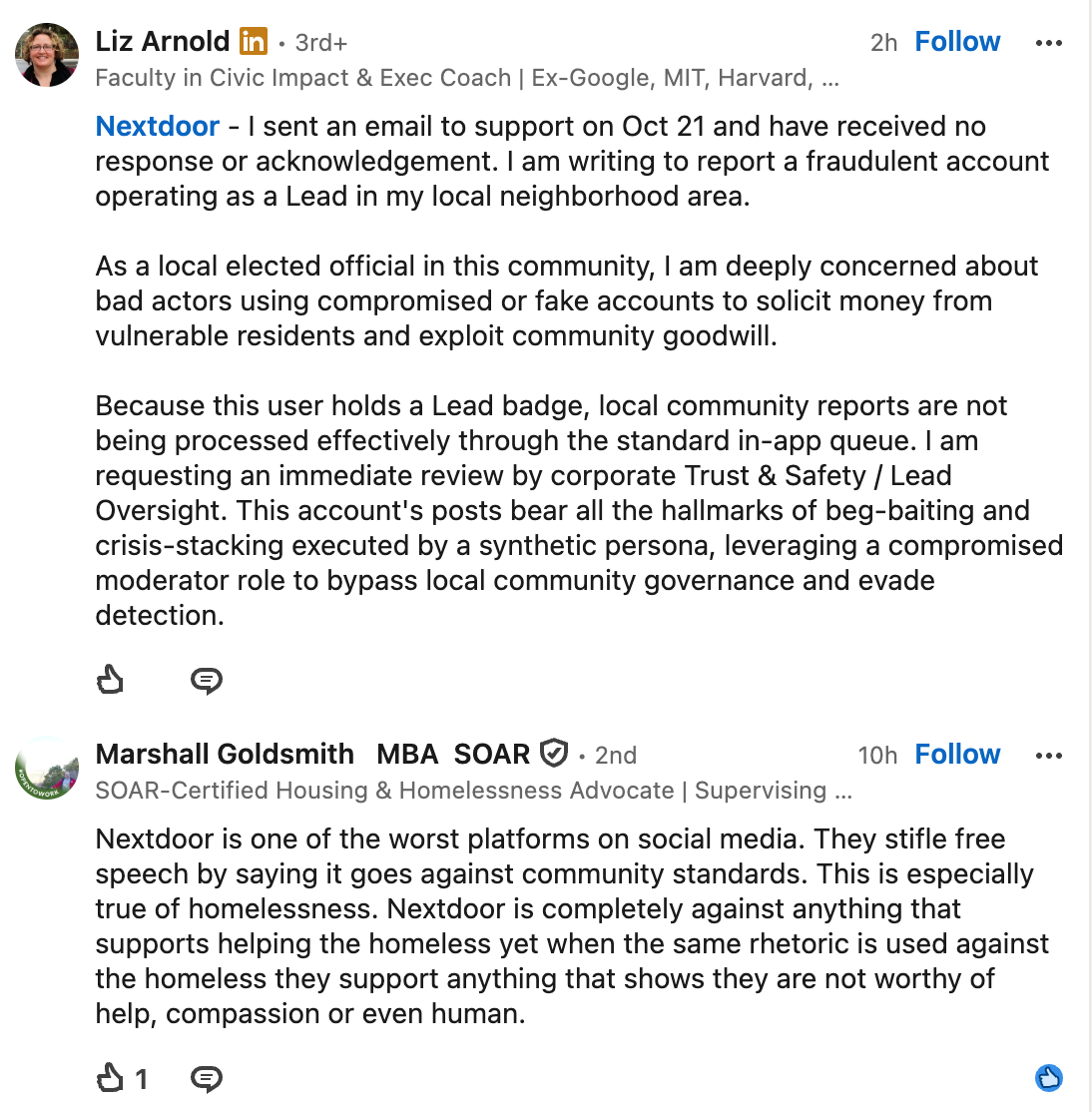
The same screenshot includes a comment from Marshall Goldsmith, who describes his frustration with Nextdoor's moderation of discussions involving homelessness.
He alleges that the platform suppresses discussion supporting homeless people while allowing rhetoric directed against them.
That's his experience and interpretation, not something I can independently establish from the screenshot alone.
But it raises another recurring issue in my case study: consistency.
How does Nextdoor distinguish between a discussion that violates its Community Guidelines and one that expresses an unpopular or controversial opinion?
Are similar comments treated consistently?
Can users understand why content was removed?
And when someone believes moderation has been applied unfairly, is there a meaningful appeal process?
These are not new questions. I've been raising concerns about moderation, communication, and accountability for months.
The company needs more than a set of written rules. It needs consistent enforcement and a way to demonstrate that those rules apply fairly.

Nextdoor Wants More Advertising Revenue. What About the Existing Experience?
Let's return to the new sponsored-search opportunity.
Nextdoor wants to expand advertising into categories such as health care, pet care, real estate, telecommunications, and financial services.
That makes commercial sense. Someone searching for a veterinarian or financial service may have a specific need and be ready to consider a provider.
Advertisers want access to those high-intent moments.
But here's the problem I keep seeing:
Nextdoor is developing new ways to monetize the community while people still question the basic experience of using the platform.
More advertising opportunities don't automatically create more trust.
More revenue categories don't automatically produce better moderation.
And a larger advertising business doesn't automatically mean that users and small businesses are getting a fair value exchange.
The platform needs to get the fundamentals right.
The Gap Between Promise and Execution
Nextdoor's promise centers on connecting neighbors and building stronger communities.
That's a compelling idea.
But the experience has to support the promise.
Consider the issues that keep appearing in my case study:
For users:
Unclear or inconsistent moderation decisions.
Difficulty getting meaningful responses from Support.
Concerns about account security and impersonation.
Questions about how user-generated content is commercialized.
Limited visibility into how complaints are investigated.
For community leaders and moderators:
Questions about training and oversight.
Potential conflicts of interest.
Concerns about the misuse of moderation privileges.
Questions about the protection of nonpublic information.
For small businesses:
Questions about the return on advertising spending.
The growing commercialization of neighborhood recommendations.
Whether businesses of different sizes can access meaningful value.
For investors:
The need for sustainable revenue growth.
The path to consistent profitability.
The ability to retain users and advertisers.
Long-term shareholder value.
These are not all proven failures, and I recognize that Nextdoor has made progress in some areas. But they are recurring questions that deserve answers.

Why Is NXDR at $2.24?
That's the question investors may be asking as earnings approach.
Nextdoor has a new advertising opportunity. It has celebrated fifteen years in business. It has been promoting its neighborhood network and its commercial potential.
Yet the stock is at $2.24.
Multiple factors could explain the decline: broader market conditions, investor expectations, trading activity, company-specific concerns, or something else entirely.
I won't attribute the decline to the LinkedIn post, my case study, or any single issue without evidence.
But I do believe that a company's reputation, user experience, and ability to execute matter to its long-term prospects.
Investors aren't just buying a quarterly revenue number. They're evaluating the business they believe will exist several years from now.
And a business that depends on community trust should take reports of potential fraud, weak support, and inconsistent moderation seriously.
Day 137: Stop Adding New Features Until the Fundamentals Work
Nirav Tolia and the Nextdoor team have spent considerable time promoting new products, advertising opportunities and the company's fifteen-year history.
Those things have their place.
But I would like to see the same energy directed toward fixing the experience that users, community leaders, and small businesses encounter every day.
When someone reports a potentially fraudulent account, acknowledge the report.
When someone raises concerns about a Lead account, make sure the escalation process works.
When people question moderation decisions, provide a meaningful explanation.
When users raise concerns about privacy and nonpublic information, explain the safeguards.
And when people ask legitimate questions about the company, establish a process that brings those questions to resolution.
You cannot build a stronger commercial business on top of a community experience that people don't trust.
Perhaps the market is seeing something that isn't reflected in the anniversary photographs or the latest product announcements.
Perhaps investors want to see execution.
Perhaps users want to see accountability.
Perhaps small businesses want to see measurable value.
I don't know why NXDR is down to $2.24. But I do know that the questions about Nextdoor's underlying experience haven't disappeared.
Fifteen years is a significant milestone.
Now it's time to demonstrate that the company can deliver on the promise.
👉 Follow my continuing Nextdoor case study at NielFlamm.com/blog.