

Day 149: Nextdoor Is Meeting With Wall Street — But What About the People Who Actually Use the Platform?

Today's NXDR update: $2.01. That's down one penny from yesterday's $2.02.
A whole penny. Not exactly the kind of market excitement that gets investors reaching for the champagne.
But Nextdoor has something else on its calendar: another opportunity to meet with the investment community.
And that brings me to a question I've been asking throughout this case study: Who is Nextdoor really listening to?
Nextdoor is heading to the investor conference circuit
Today, Nextdoor announced that its management team will participate in three upcoming investor conferences:
November 18: 15th Annual ROTH Technology Conference — New York
December 2: 30th Annual UBS Global Technology and AI Conference — Scottsdale
December 8: Raymond James TMT and Consumer Conference — New York
According to the announcement, management will host one-on-one investor meetings at each conference.
Here's the announcement:
Nextdoor to Participate in Upcoming Investor Conferences
Now, let's talk about the Raymond James conference.
The investor conference: A room full of people who matter to Wall Street
The Raymond James TMT and Consumer Conference is part of the institutional investment conference world. TMT stands for Technology, Media, and Telecommunications.
These events connect company management with investors, analysts, and other financial professionals. One-on-one meetings give management an opportunity to discuss the business, its strategy, financial performance, and future opportunities.
Let's be clear: these conferences serve a purpose. Public companies need to communicate with the investment community. Institutional investors and analysts have questions, and management needs opportunities to explain the company's direction.
But there's a distinction worth making.
The investment conference circuit isn't the same as listening to the neighbors who use the platform, the small businesses that advertise on it, or the people who share feedback about their experiences.
It can feel like an exclusive club. Management gets scheduled meetings with people who influence investment decisions, while ordinary users are left trying to get a response to a straightforward question.
And yes, I'm speaking from my own experience.
149 days and still waiting
Today is Day 149.
That's how long I've been waiting for the full research study and methodology referenced in a Nextdoor blog post.
I've contacted Jacob Chavis, Senior Manager of Customer Insights, and included Nextdoor leadership in my follow-ups.
I'm not asking for a private investor presentation. I'm not asking for confidential financial information. I'm asking for the underlying research and methodology behind a study Nextdoor publicly discussed.
If you can share it, send it; if you can't, explain why.
It's a pretty straightforward request.
Yet Nextdoor can organize meetings with investors at conferences across the country while my request for research information remains unanswered.
That contrast is difficult to ignore.
What about the feedback?
I've spent considerable time providing feedback about Nextdoor's customer experience, moderation, advertising, research transparency, and communication.
I've also suggested ways the company could improve how it evaluates advertising effectiveness and supports small businesses.
With more than 20 years of experience in learning and development, customer experience, and contact center operations, I tend to look at companies through the lens of process, measurement, quality, and accountability.
Feedback isn't necessarily an attack. It can be an opportunity to identify problems before they become bigger problems.
But feedback only has value when someone is willing to receive it, evaluate it, and decide whether action is warranted.
I haven't seen much evidence of that happening in my own interactions with Nextdoor.
Perhaps the company is listening to other users. I can't speak for every interaction. But my experience has been a long series of unanswered questions.
The stock price tells a different story than the conference announcement
Let's put the numbers in perspective.
Following its November 5 earnings report, Nextdoor reported:
Revenue of approximately $79 million, up 14% year over year.
Platform weekly active users of 24.5 million, up 14%.
A net loss of approximately $659,000, compared with a $12.9 million loss in the same quarter last year.
Adjusted EBITDA of approximately $10.3 million.
Fourth-quarter revenue guidance of $78 million to $80 million.
Those are meaningful improvements in several areas. Nextdoor also reported $382 million in cash, cash equivalents, and marketable securities as of September 30.
But the fourth-quarter outlook and the market's reaction have raised questions about whether the company's growth can translate into sustainable financial performance.
Today, NXDR is at $2.01, down one cent from yesterday's $2.02.
Did the investor conference announcement cause that one-cent decline? I have no evidence of that, and I'm not suggesting it did.
But here's the bigger point: announcing participation in an investor conference doesn't automatically build investor confidence or raise the stock price.
Investors want more than a calendar of meetings. They want to understand the strategy, business model, monetization opportunities, and path to sustainable profitability.
And they want results.
Wall Street gets a meeting. What about everyone else?
This is where I think Nextdoor misses an opportunity.
The company has more than one audience:
Investors want financial performance and a credible business strategy.
Advertisers want measurable results and a reason to keep spending.
Small businesses want support and evidence that advertising on the platform works.
Neighbors want a useful platform where they can participate without feeling that moderation is arbitrary.
Local publishers want their content and community information treated fairly.
Users who provide feedback want to know that someone is listening.
These groups are connected. A platform's value doesn't come exclusively from its stock price or its investor presentations. It also comes from the people and businesses that use it.
If Nextdoor wants to improve monetization, shouldn't it be just as interested in understanding those people’s experiences?
If it wants advertisers to spend more, shouldn't it measure and communicate advertising effectiveness?
If it wants users to stay active, shouldn’t it pay attention to their feedback?
And if it wants to promote research as a differentiator, shouldn't it make the methodology available when it says the research can be requested?
Day 149: I'll keep asking
I understand why Nextdoor wants to meet with institutional investors and financial professionals. That's part of running a publicly traded company.
But I also believe listening shouldn't be reserved for people with a conference badge, a large investment portfolio, or a seat at a private meeting.
The everyday users, small businesses, local publishers, and community members matter, too.
Nextdoor can attend the Raymond James TMT and Consumer Conference on December 8. It can hold one-on-one investor meetings and discuss its strategy.
Meanwhile, I'm still waiting for a response to a research request that is now 149 days old.
Maybe the next investor presentation should include a slide titled: "What Are We Hearing From Our Users — And What Are We Doing About It?"
That might be a useful conversation for everyone.
Day 149. NXDR: $2.01. The request is still outstanding.
👉 Follow the ongoing case study at NielFlamm.com/blog.
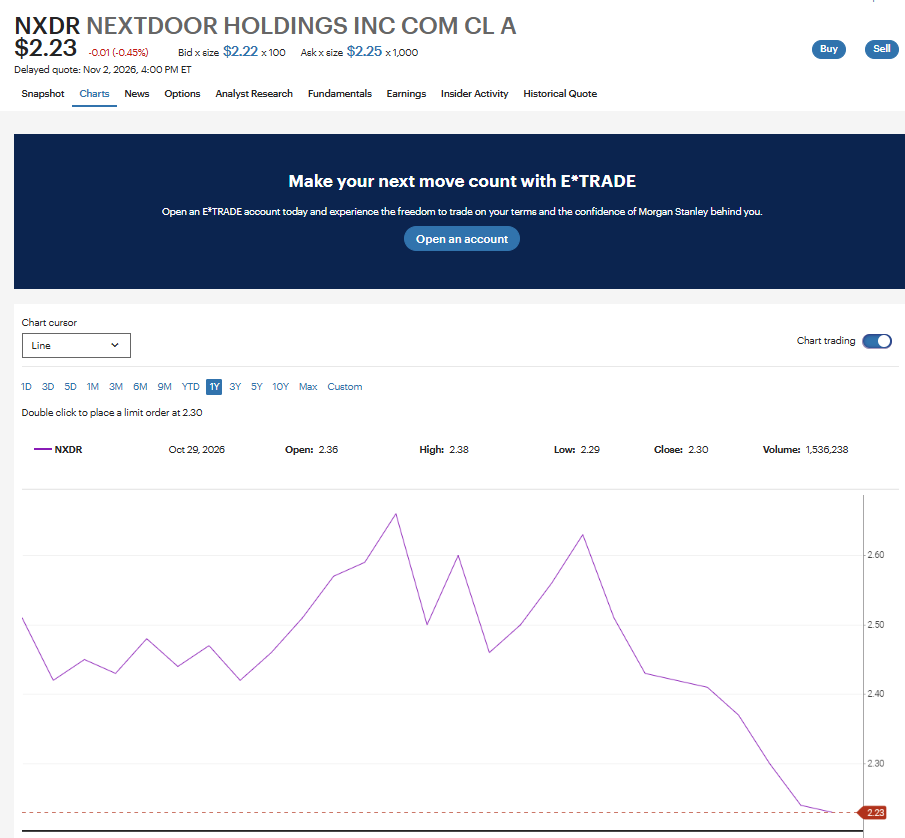
Day 140: NXDR Slides to $2.23 — What Is Driving Nextdoor's Decline?
The slide continues.
Yesterday, NXDR closed at $2.24. Today, it closed at $2.23, down about 0.45%.
One day, another step backward. Not a dramatic drop on its own, but it's part of a trend that's caught my attention.
I've been watching this movement since October 22, 2026, and I'm curious about what's behind it.
Another day in the wrong direction
I've noticed a pattern in previous earnings cycles. NXDR would bump up in the days leading up to an earnings report, only to give back some of those gains shortly afterward.
This time, something looks different.
Instead of the pre-earnings momentum I’ve seen before, the stock has continued to drift downward.
So what's changed?
Is this normal market activity? Are investors waiting for the next earnings announcement? Are there concerns about the company's financial performance, its growth strategy, advertising expansion, or its ability to turn its audience into sustainable revenue?
I don't know the answer, and I'm not going to pretend that I do.
But I would like to hear an explanation.
So I asked The Google: Why do investors think NXDR is sliding?
I asked The Google why investors believe Nextdoor Holdings (NXDR) is declining.
The AI Overview returned several explanations. Some are particularly interesting because they overlap with issues I've been discussing over the past year.
Here's a summary of what The Google identified:
1. Execution and scale concerns
Investors and analysts may be questioning whether Nextdoor has the cost structure and overhead of a much larger technology platform without generating the revenue to support it.
In other words, does the business have the scale to justify its operating structure?
2. Muted guidance and slower growth
The AI Overview pointed to analyst price-target reductions, with targets moving toward the $2.10–$2.20 range, along with expectations for modest revenue growth and adjusted EBITDA margins.
Revenue growth is important, but investors also want to understand how that growth translates into sustainable profitability.
3. Moderation and user friction
This one should sound familiar.
The overview identified concerns about automated moderation, including ordinary neighbor recommendation posts being classified as commercial content and comment threads being closed.
I've spent considerable time discussing moderation, inconsistent enforcement, and the frustration users experience when legitimate neighborhood conversations are restricted.
A platform depends on its users. Make it difficult for them to participate, and you risk damaging the very community that makes the business valuable.
4. Internal culture and leadership questions
The overview also mentioned concerns surrounding employee stock compensation, workplace culture discussions, and leadership changes.
These are areas that deserve careful examination rather than assumptions. However, questions about leadership stability and the ability to execute a strategy can influence investor confidence.
5. A large cash cushion and corporate urgency
Finally, the overview referenced Nextdoor's substantial cash reserves and argued that a significant cash cushion could reduce pressure to make difficult changes.
Having cash is a strength. But cash alone doesn't guarantee a successful business model, profitable growth, or shareholder returns.
These points come from Google's AI Overview, not independently established explanations for today's price movement. They represent potential investor concerns and should be evaluated against company filings, earnings results, analyst research, and other evidence.
Here's what caught my attention
I may not have used the same polished language as Google's AI Overview, but I've raised every one of these issues over the last year or so.
Execution. Revenue growth. Moderation. User experience. Leadership. Company culture. Cash reserves—shareholder value.
I've written about these subjects repeatedly.
I've questioned whether Nextdoor is building a sustainable business or simply adding more advertising opportunities to a platform that still has fundamental user-experience problems.
I've asked whether the company understands the consequences of moderation decisions and how those decisions affect participation and engagement.
I've questioned whether leadership is listening to users and whether the company is doing enough to communicate with investors.
And I've repeatedly asked for answers to specific questions, including the two detailed research reports that remain outstanding.
Apparently, these aren't just questions coming from one neighbor writing a blog.
They're also among the concerns being discussed in the broader investment conversation.
That doesn't mean my commentary caused the stock decline, nor does it prove that every concern in the AI Overview is accurate. But it does reinforce why these subjects deserve attention.
Will management address the decline?
Nextdoor has an earnings report coming up. That creates an opportunity for management to address more than just revenue, user growth, and adjusted EBITDA.
I'd like to hear how leadership views the market's reaction to the company's performance.
Some questions I'd like answered:
What does management believe is driving the recent decline in NXDR?
Is investor confidence changing?
How is Nextdoor measuring the success of its newer advertising and sponsored-search initiatives?
What is the path toward sustainable GAAP profitability?
What is the company doing to create long-term shareholder value?
How does Nextdoor plan to improve trust and engagement among the neighbors who make the platform valuable?
Revenue growth and user numbers are important. But they don't automatically translate into investor confidence or a stronger stock price.
My concern: Will we get any real answers?
Here's where my skepticism comes in.
I expect the earnings report to focus on the usual financial metrics and forward-looking statements. I wonder whether management will address the questions investors are actually asking about the stock's performance.
And that brings me back to a recurring concern throughout this case study: transparency.
I've spent 141 days raising questions about Nextdoor's communication, leadership, moderation, advertising strategy, and accountability.
I've also requested two detailed research reports and am still waiting for a meaningful response.
The company talks about community, connection, and creating value. But those promises need to extend beyond marketing language.
Investors deserve meaningful communication. Users deserve a platform that puts their experience first.
Day 141: The numbers are telling a story. Is anyone listening?
A 0.45% decline in one trading session isn't necessarily a warning sign on its own. I know stock prices move for many reasons, and I don't have enough information to attribute this decline to any one factor.
But the direction since October 22 deserves attention.
Nextdoor has celebrated 15 years, announced new revenue opportunities, and promoted its partnerships. That's great.
Now I'd like to see the company demonstrate how those milestones translate into investor confidence, sustainable growth, and a better experience for its neighbors.
Nirav Tolia and the Nextdoor leadership team: What is driving the slide, and will you address it?
I'll be watching the earnings report.
Day 141. The slide continues. The questions continue. And the wait for answers continues.
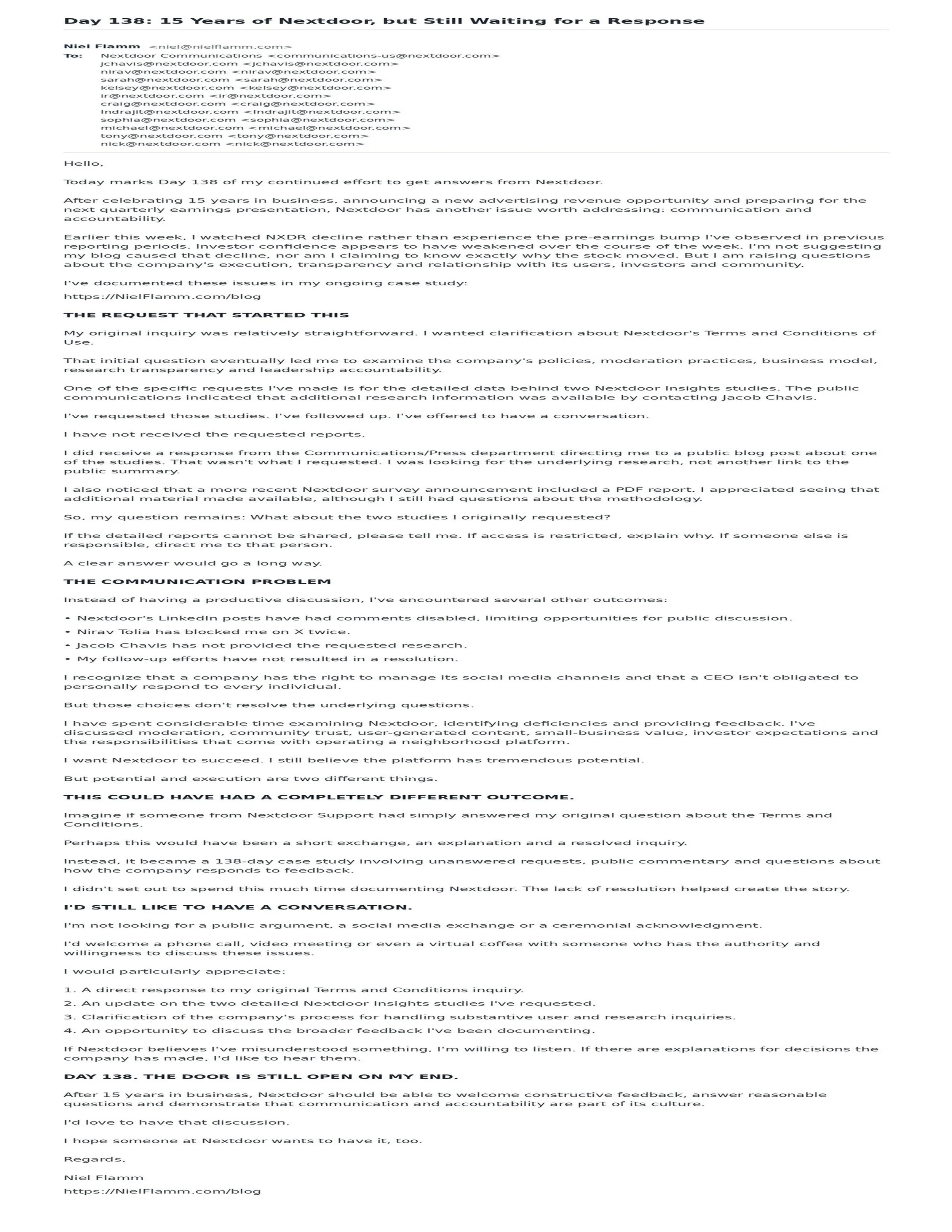
Day 138: I Sent the Email. Now, Will Anyone at Nextdoor Respond?

Day 138. Another day, another attempt to get a response from Nextdoor.
This time, I took a different approach. I put my thoughts, questions, and frustrations into one email and sent it to 12 people at Nextdoor.
Yes, 12.
The recipients included people in Communications, Investor Relations, leadership, and other areas of the company. Some have received emails from me before. Others are being brought into the conversation because, after 138 days, I still don't have the answers I'm looking for.
I'm not expecting 12 individual responses. I'm hoping that at least one person will take ownership and help move this conversation forward.
Fifteen years of Nextdoor, and questions that remain
Nextdoor recently celebrated its 15th anniversary, rang the closing bell at Nasdaq, and announced additional advertising opportunities and revenue initiatives.
Those are milestones worth recognizing. Building a neighborhood platform that reaches millions of people is no small accomplishment.
But anniversaries and announcements don't eliminate the questions that come with running a public company and a platform built around community trust.
This past week, I watched NXDR decline rather than experience the pre-earnings bump I've observed during previous reporting periods. Investor confidence appears to have weakened over the week.
I'm not suggesting my blog caused the decline. I'm also not claiming to know exactly why the stock moved. But I am raising questions about the company's execution, transparency, and relationship with its users, investors, and community.
A company can celebrate 15 years and still have work to do.

The request that started this
My original inquiry was relatively straightforward: I wanted clarification about Nextdoor's Terms and Conditions of Use.
That question eventually led me to examine the company's policies, moderation practices, business model, research transparency, and leadership accountability.
One of my specific requests has been for the detailed data behind two Nextdoor Insights studies. Public communications indicated that additional research information was available by contacting Jacob Chavis.
I've requested those studies, followed up, and offered to have a conversation.
I still haven't received the reports.
Communications/Press responded, but they directed me to a public blog post about one of the studies. That wasn't what I requested. I was looking for the underlying research, not another link to a public summary.
More recently, Nextdoor published a survey announcement that included a PDF report. I appreciated seeing additional material, but I still have questions about the methodology and the two studies I originally requested.
If you can't share the detailed reports, tell me. If access is restricted, explain why. If someone else is responsible, point me in the right direction.
A clear answer would go a long way.
Communication has become part of the case study
Over these 138 days, I've encountered several outcomes that make productive discussion difficult:
Nextdoor's LinkedIn posts have had comments disabled, limiting opportunities for public discussion.
CEO Nirav Tolia has blocked me on X twice.
Jacob Chavis has not provided the requested research.
My follow-up efforts have not resulted in a resolution.
I recognize that a company has the right to manage its social media channels. A CEO isn't obligated to personally respond to every individual. And employees have responsibilities that extend beyond answering my emails.
But those choices don't resolve the underlying questions.
The larger issue is how Nextdoor handles substantive feedback. When someone raises questions about moderation, community trust, user-generated content, small-business value, or the company's research, what happens next?
Is there a process for getting those questions to the right people? Does anyone take ownership? Does the feedback make its way into conversations about product decisions, policies, and strategy?
That's what I'd like to understand.
This could have had a completely different outcome
Imagine if someone from Nextdoor Support had simply answered my original question about the Terms and Conditions.
Perhaps it would have been a short exchange: an explanation and a resolved inquiry.
Instead, it became a 138-day case study involving unanswered requests, public commentary, and questions about how the company responds to feedback.
I didn't set out to spend this much time documenting Nextdoor. The lack of resolution helped create the story.
I've spent considerable time examining the platform, identifying deficiencies, and providing feedback. I've discussed moderation, community trust, user-generated content, small-business value, investor expectations, and the responsibilities that come with operating a neighborhood platform.
I want Nextdoor to succeed. I still believe the platform has tremendous potential.
But potential and execution are different.
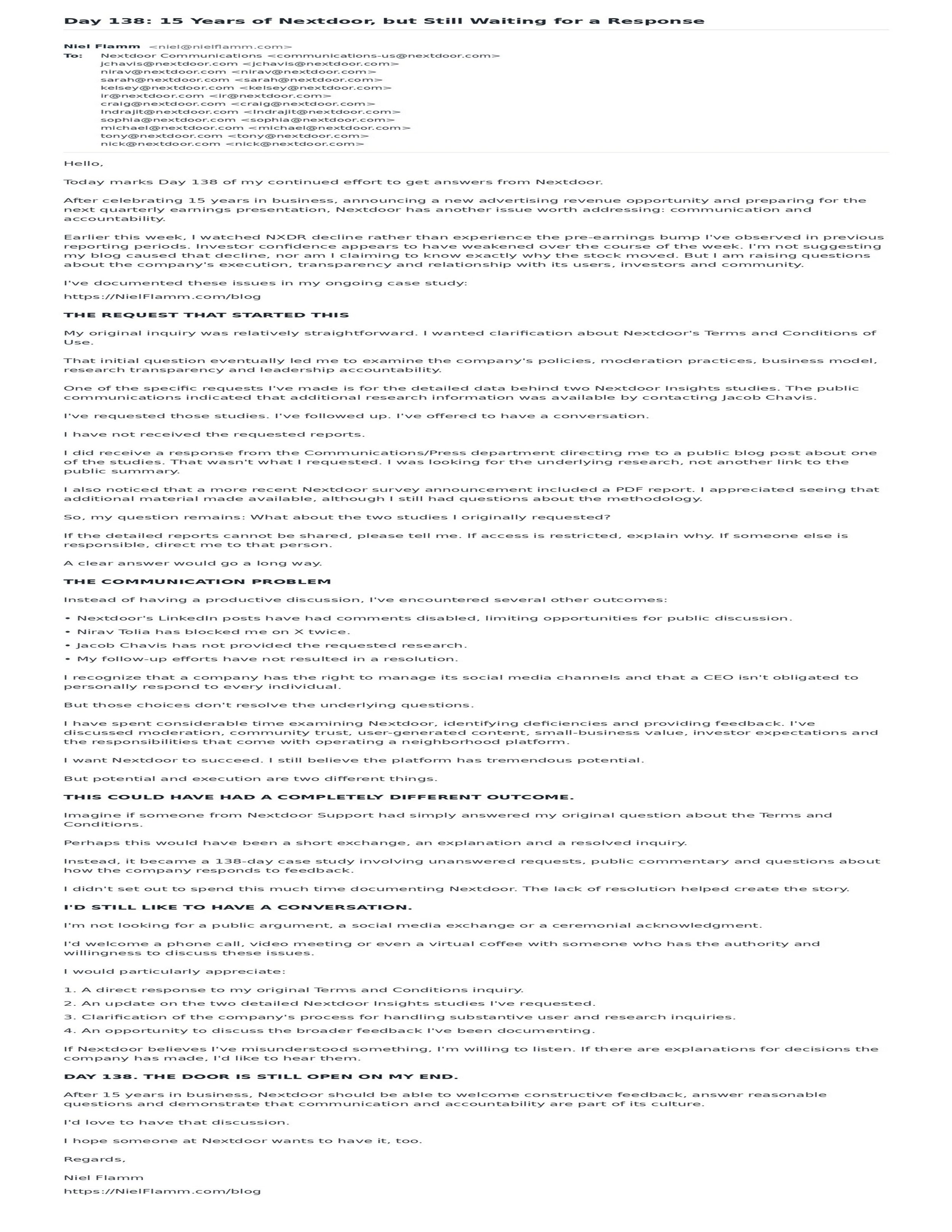
Twelve recipients. One opportunity to respond.
The email I sent isn't a demand for a public apology, a ceremonial acknowledgment, or a social media exchange.
I'm asking for four things:
A direct response to my original Terms and Conditions inquiry.
An update on the two detailed Nextdoor Insights studies I've requested.
Clarification of the company's process for handling substantive user and research inquiries.
An opportunity to discuss the broader feedback I've been documenting.
I'm willing to have a phone call, video meeting, or even a virtual coffee with someone who has the authority and willingness to discuss these issues.
If Nextdoor believes I've misunderstood something, I'm willing to listen. If there are explanations for decisions the company has made, I'd like to hear them.
I'm not asking every recipient to respond individually. I'm asking someone to take responsibility for moving the conversation forward.
Day 138. The door is still open on my end.
After 15 years in business, Nextdoor should welcome constructive feedback, answer reasonable questions, and show that communication and accountability are part of its culture.
The company has celebrated its history. It is pursuing new revenue opportunities. It is preparing to report earnings.
Those are all reasons to look forward.
But the relationship with users, the quality of moderation, the value delivered to small businesses, and investor confidence matter just as much.
I sent the email. I included the people I believe should be aware of the situation. Now I'll wait to see whether anyone decides to engage.
I'm not looking for a fight. I'm looking for a conversation.
Day 138. The door is still open on my end. Is anyone on Nextdoor willing to walk through it?

Day 137: NXDR Falls to $2.24. Is Nextdoor Losing the Trust It Needs to Grow?

Fifteen years in business. New advertising opportunities. Another earnings report approaching. So why is the stock still sliding?

Day 137 of my Nextdoor case study, and NXDR is now trading at $2.24.
Let's recap.
Nextdoor recently celebrated its fifteenth anniversary by ringing the Nasdaq closing bell. The company has announced an expansion of sponsored search advertising, with new categories expected to include health care, pet care, real estate, telecommunications and financial services beginning in January.
The next quarterly earnings report is approaching, and historically I've seen a pattern where NXDR rises shortly before the earnings presentation, holds some of those gains for a day or two, and then retreats.
That's my observation of historical price behavior, not a guarantee of what will happen next.
But this time, something looks different.
With all these announcements and potential new revenue opportunities, why is NXDR trending downward?
I don't know the specific reason. I don't have access to investor trading decisions, and I won't pretend that one LinkedIn post explains the stock price.
But perhaps we should look beyond the earnings calendar and the revenue announcements.
Perhaps we should look at the experience of the people who actually use Nextdoor.
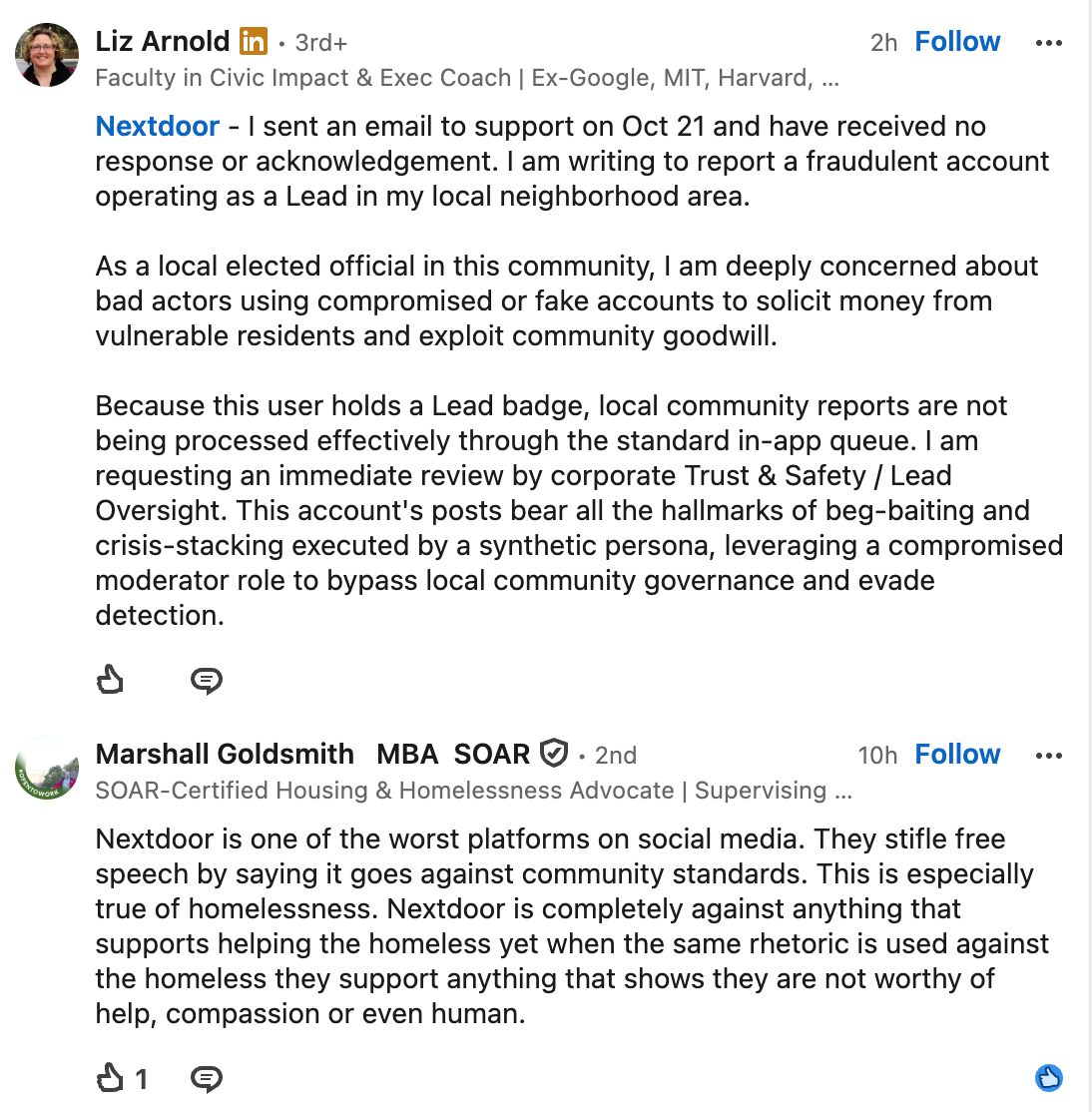
The LinkedIn Post That Caught My Attention
I came across a LinkedIn post by Liz Arnold that deserves attention.
She says she emailed Nextdoor Support on October 21 and received no response or acknowledgment.
Her concern involves an account allegedly operating fraudulently as a Lead in her local neighborhood. She identifies herself as a local elected official and expresses concern that compromised or fake accounts could be used to solicit money from vulnerable residents and exploit community goodwill.
She also raises a particularly important concern: because the account carries a Lead badge, she believes reports about it are not being processed effectively through the standard in-app reporting queue.
She is asking for an immediate review by Nextdoor's corporate Trust and Safety team and the people responsible for Lead oversight.
Let me be clear: these are allegations and concerns expressed in her LinkedIn post. I have not independently verified the account, the alleged fraud, or how her support request was handled.
But the issues she raises are significant.
If an account with a community leadership badge is compromised or being used deceptively, that creates a potential trust and safety problem. If the reporting process isn't working as intended, that creates another.
And if someone reports a potentially fraudulent account and receives no acknowledgment, that creates a customer-service problem.
Those are three issues a platform built around neighborhood trust should want to address.
A Lead Badge Should Come With Responsibility
Nextdoor's Lead program is intended to support community participation and neighborhood governance.
But what happens when a Lead account is compromised, misused, or otherwise becomes part of a dispute?
Is there a separate escalation process for concerns involving Leads?
Does Nextdoor regularly review whether Lead accounts are being used appropriately?
How quickly are reports involving potential fraud investigated?
Can users reach a corporate Trust and Safety team when the standard reporting process isn't working?
Does Nextdoor communicate when a report has been received and reviewed?
A badge creates an expectation.
It signals that the person has a recognized role in the community. If that role is misused, the company needs a reliable way to investigate and respond.
The trust associated with a badge should not make an account immune from scrutiny.
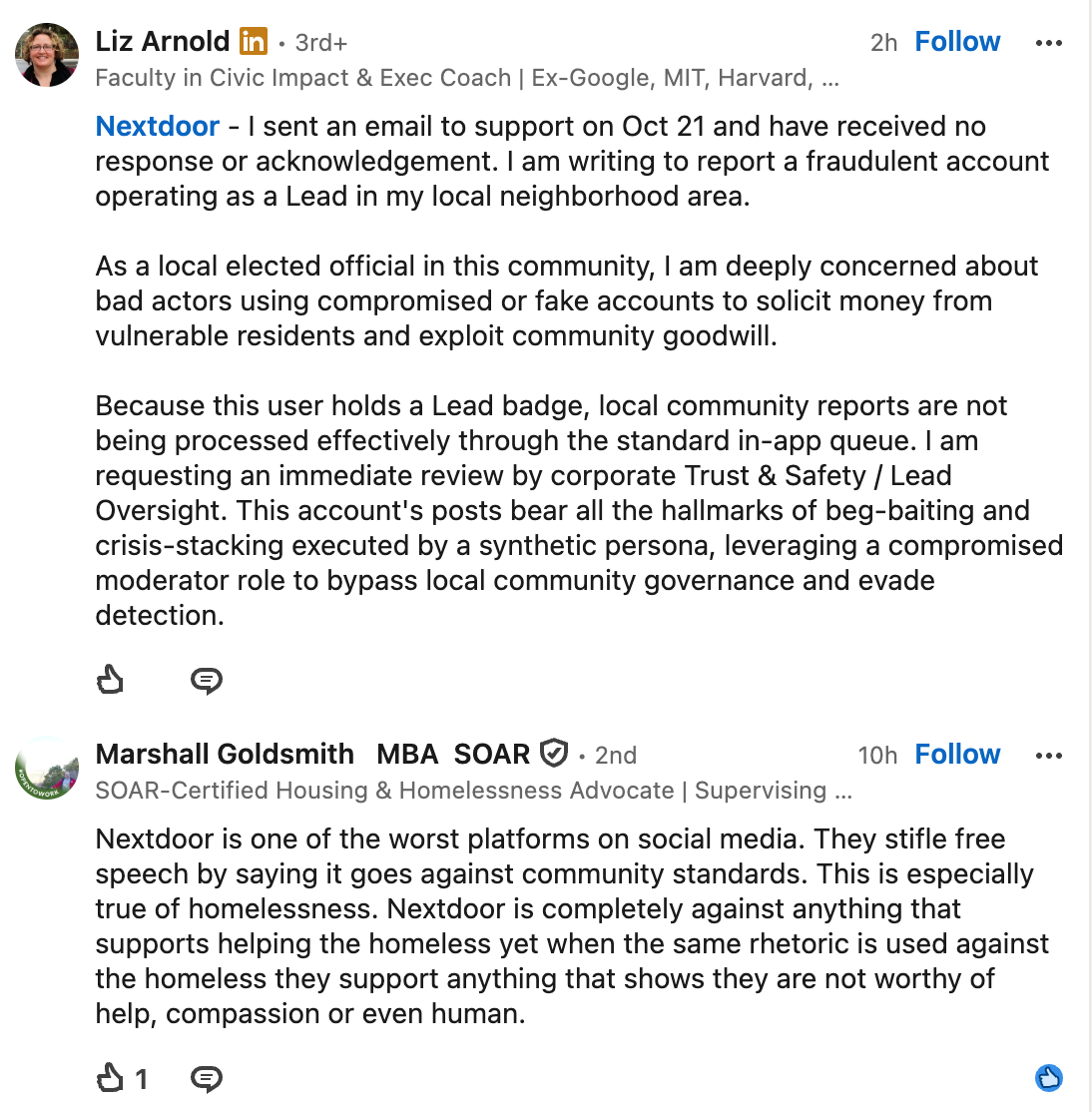
Another Comment Raises Questions About Moderation
The same screenshot includes a comment from Marshall Goldsmith, who describes his frustration with Nextdoor's moderation of discussions involving homelessness.
He alleges that the platform suppresses discussion supporting homeless people while allowing rhetoric directed against them.
That's his experience and interpretation, not something I can independently establish from the screenshot alone.
But it raises another recurring issue in my case study: consistency.
How does Nextdoor distinguish between a discussion that violates its Community Guidelines and one that expresses an unpopular or controversial opinion?
Are similar comments treated consistently?
Can users understand why content was removed?
And when someone believes moderation has been applied unfairly, is there a meaningful appeal process?
These are not new questions. I've been raising concerns about moderation, communication, and accountability for months.
The company needs more than a set of written rules. It needs consistent enforcement and a way to demonstrate that those rules apply fairly.

Nextdoor Wants More Advertising Revenue. What About the Existing Experience?
Let's return to the new sponsored-search opportunity.
Nextdoor wants to expand advertising into categories such as health care, pet care, real estate, telecommunications, and financial services.
That makes commercial sense. Someone searching for a veterinarian or financial service may have a specific need and be ready to consider a provider.
Advertisers want access to those high-intent moments.
But here's the problem I keep seeing:
Nextdoor is developing new ways to monetize the community while people still question the basic experience of using the platform.
More advertising opportunities don't automatically create more trust.
More revenue categories don't automatically produce better moderation.
And a larger advertising business doesn't automatically mean that users and small businesses are getting a fair value exchange.
The platform needs to get the fundamentals right.
The Gap Between Promise and Execution
Nextdoor's promise centers on connecting neighbors and building stronger communities.
That's a compelling idea.
But the experience has to support the promise.
Consider the issues that keep appearing in my case study:
For users:
Unclear or inconsistent moderation decisions.
Difficulty getting meaningful responses from Support.
Concerns about account security and impersonation.
Questions about how user-generated content is commercialized.
Limited visibility into how complaints are investigated.
For community leaders and moderators:
Questions about training and oversight.
Potential conflicts of interest.
Concerns about the misuse of moderation privileges.
Questions about the protection of nonpublic information.
For small businesses:
Questions about the return on advertising spending.
The growing commercialization of neighborhood recommendations.
Whether businesses of different sizes can access meaningful value.
For investors:
The need for sustainable revenue growth.
The path to consistent profitability.
The ability to retain users and advertisers.
Long-term shareholder value.
These are not all proven failures, and I recognize that Nextdoor has made progress in some areas. But they are recurring questions that deserve answers.

Why Is NXDR at $2.24?
That's the question investors may be asking as earnings approach.
Nextdoor has a new advertising opportunity. It has celebrated fifteen years in business. It has been promoting its neighborhood network and its commercial potential.
Yet the stock is at $2.24.
Multiple factors could explain the decline: broader market conditions, investor expectations, trading activity, company-specific concerns, or something else entirely.
I won't attribute the decline to the LinkedIn post, my case study, or any single issue without evidence.
But I do believe that a company's reputation, user experience, and ability to execute matter to its long-term prospects.
Investors aren't just buying a quarterly revenue number. They're evaluating the business they believe will exist several years from now.
And a business that depends on community trust should take reports of potential fraud, weak support, and inconsistent moderation seriously.
Day 137: Stop Adding New Features Until the Fundamentals Work
Nirav Tolia and the Nextdoor team have spent considerable time promoting new products, advertising opportunities and the company's fifteen-year history.
Those things have their place.
But I would like to see the same energy directed toward fixing the experience that users, community leaders, and small businesses encounter every day.
When someone reports a potentially fraudulent account, acknowledge the report.
When someone raises concerns about a Lead account, make sure the escalation process works.
When people question moderation decisions, provide a meaningful explanation.
When users raise concerns about privacy and nonpublic information, explain the safeguards.
And when people ask legitimate questions about the company, establish a process that brings those questions to resolution.
You cannot build a stronger commercial business on top of a community experience that people don't trust.
Perhaps the market is seeing something that isn't reflected in the anniversary photographs or the latest product announcements.
Perhaps investors want to see execution.
Perhaps users want to see accountability.
Perhaps small businesses want to see measurable value.
I don't know why NXDR is down to $2.24. But I do know that the questions about Nextdoor's underlying experience haven't disappeared.
Fifteen years is a significant milestone.
Now it's time to demonstrate that the company can deliver on the promise.
👉 Follow my continuing Nextdoor case study at NielFlamm.com/blog.
The Creators Built the Platform. Why Aren't More of Them Sharing the Revenue?
From Nextdoor to Facebook, social media platforms have a revenue-sharing problem. The people creating the content shouldn't be an afterthought in the business model.
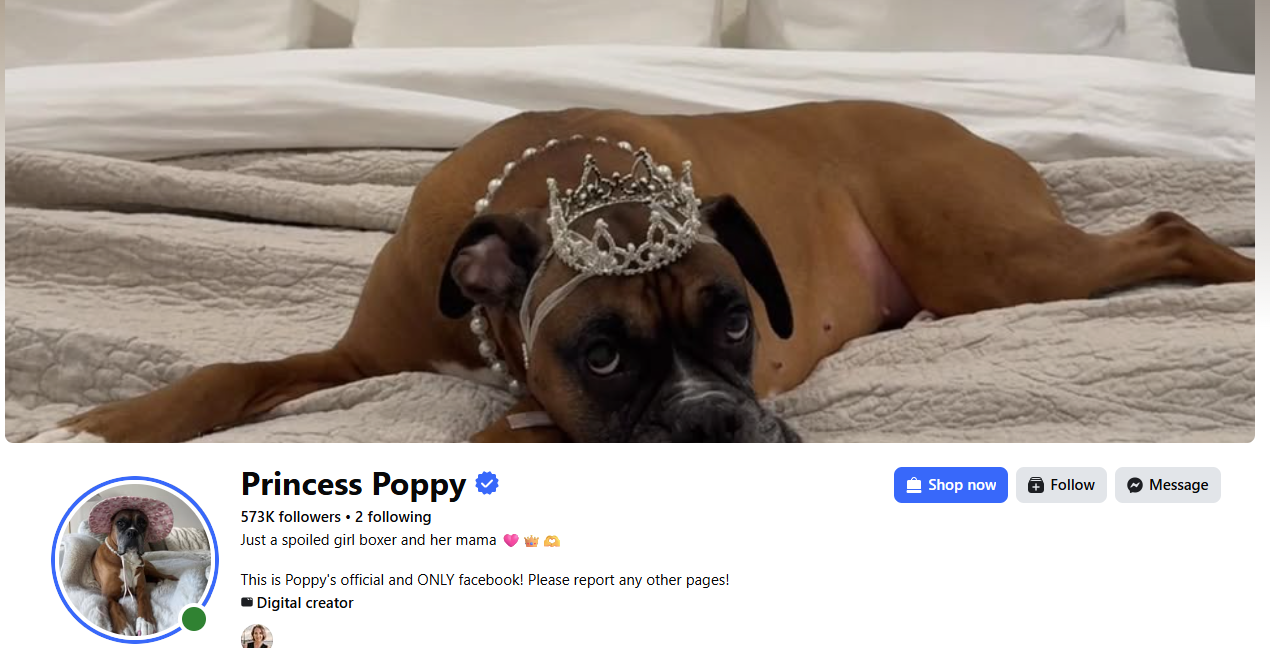
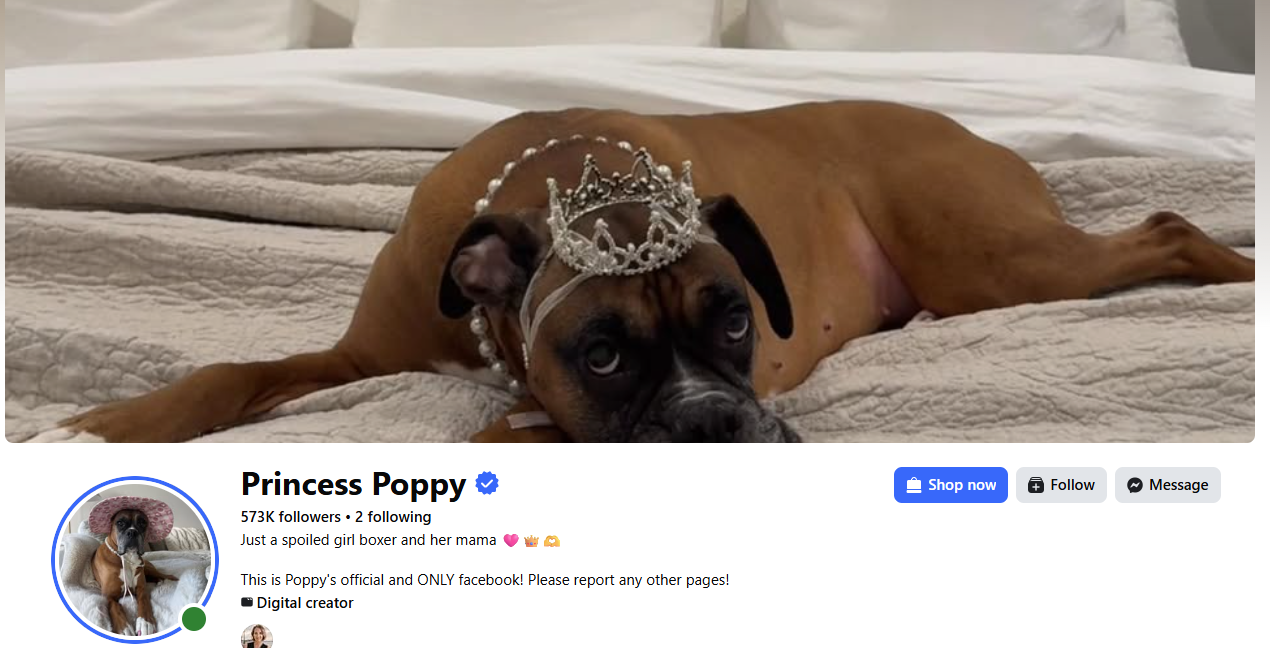
I watched a Facebook Reel featuring Princess Poppy from Poppy Seed Home (https://www.facebook.com/poppyseedhome). The creator discussed money she believes she and Poppy are owed.
I don't know the full backstory, the dispute details, or the circumstances behind the claim. I'm not going to pretend I do.
But something she said resonated with a point I've been making for months while examining Nextdoor and the broader social media business model.
The users create the content. Without the content, what exactly would the platforms have to offer?
Think about that for a moment.
The Platform Provides the Stage. Who Creates the Show?
Facebook, Instagram, TikTok, YouTube, and Nextdoor each offer a different experience. Some focus on entertainment, some on video, some on professional content, and others on neighborhood conversations.
But they share an important characteristic: user contributions help make these platforms valuable.
Creators produce videos, write posts, share photographs, offer recommendations, answer questions, and build communities. Other users watch, read, comment, react, and share.
That activity attracts attention.
Attention creates opportunities for advertising, subscriptions, sponsorships and other commercial products.
The platform provides the technology, distribution, moderation systems, infrastructure and tools. Those things cost money and deserve compensation.
But the people creating the material that attracts the audience also contribute something valuable.
Why should the platform be the only party with a guaranteed business model built around that collective activity?
I'm not arguing that every post should generate a payment. Nor am I saying that anyone who uploads a picture or comments on a neighborhood discussion is automatically entitled to a share of advertising revenue.
I'm asking whether the current arrangements fairly recognize the different kinds of value people contribute.
Yes, Big Creators Make Money. What About Everyone Else?
Let's acknowledge that revenue-sharing programs already exist.
Facebook reported paying content creators nearly $3 billion in 2025, a 35% increase over the previous year. Its monetization programs cover eligible Reels, Stories, photos, and text posts, although access and earnings depend on program rules and content performance.
YouTube also has established advertising and subscription revenue-sharing programs for eligible creators.
Those are meaningful steps. I'm not suggesting that platforms never pay creators.
But here's the issue: not everyone who adds value gets the same opportunities.
Some creators build enormous audiences. They may qualify for monetization, attract sponsorships, and negotiate lucrative brand partnerships.
Then there are smaller creators.
They might have a few hundred followers, a few thousand views, or a modest community that regularly engages with their work. They may never become famous, but their contributions still give people reasons to visit the platform.
Their posts fill feeds. Their videos give people something to watch. Their recommendations help users decide what to watch. Their interactions keep conversations moving.
And when someone opens an app to watch one creator's video, they may also see ads, sponsored posts, and recommendations for other content.
The platform can benefit from that visit even when the original creator receives no direct payment.
I believe that's a part of the business model worth examining more closely.

Small Creators Are Part of the Infrastructure
Imagine a shopping mall.
The mall owner maintains the building, provides security, manages the property, and leases space to businesses. The businesses stock the shelves, serve customers, and give people reasons to visit.
Now imagine the mall became successful because thousands of small businesses attracted shoppers, but only a select group received a share of the revenue that traffic generated.
The comparison isn't perfect. Social media platforms have different economics, and you can't always attribute advertising revenue to a single post or creator.
But the principle is worth considering.
A platform can own the infrastructure without being the sole source of its value.
Small creators are part of the ecosystem. Together, their contributions make a platform feel active, interesting, and worth revisiting.
If platforms want people to keep creating, shouldn't they think about ways to reward more than just the biggest names?
That could mean lower barriers to monetization, transparent bonus programs, small-creator funds, fan-supported payments, or revenue-sharing models that reward qualifying contributions.
The goal doesn't have to be paying everyone equally. It should build a system where meaningful contributions have a realistic path to recognition and compensation.
Nextdoor Has the Same Question to Answer
This is where my ongoing Nextdoor case study comes in.
Nextdoor is different from Facebook or YouTube. Its value comes less from viral entertainment videos. It comes from neighborhood participation.
Neighbors share recommendations for contractors, restaurants, and local services. They discuss community issues, answer questions, post about local events, and exchange information about what's happening nearby.
Businesses can benefit from that activity. Nextdoor can use its audience and neighborhood context to develop advertising products.
The company has also introduced Neighborhood Intelligence, an advertising offering built around neighborhood-level insights.
That raises a question I've asked before:
When neighborhood knowledge becomes part of a commercial product, how should the people contributing that knowledge participate in the value created?
I'm not claiming that every neighborhood post is used in an advertising product, or that every contributor has a legal right to payment. Those are different questions requiring specific evidence and agreements.
I'm asking Nextdoor to consider the broader business relationship.
A neighbor might spend years recommending local businesses, answering questions, and sharing useful information. Those contributions can help make the platform valuable to other users and attractive to advertisers.
What does that neighbor receive in return beyond access to the service?
Perhaps the service itself is the benefit. Some contributors may be satisfied with that arrangement.
But we shouldn’t assume every user sees the exchange the same way.
We should explore additional models that reward people who make sustained, meaningful contributions.

What Would Fairer Revenue Sharing Look Like?
I don't believe one model works for every platform. Different content creates different value, and a system that works for video creators may not work for neighborhood recommendations.
But here are some possibilities worth considering.
1. Lower barriers for smaller creators.
Make it easier for creators with modest audiences to qualify for meaningful monetization, as long as their content meets quality, originality, and safety standards.
2. More transparent earnings.
Give creators understandable information about what qualifies for payment, how earnings are calculated, why views may not count, and how payouts are determined.
3. Rewards for useful community contributions.
Platforms like Nextdoor could explore opt-in programs that reward qualifying contributions to research, local knowledge initiatives, or other commercial projects, with clear terms and privacy protections.
4. Revenue-sharing pools.
Where platforms can't neatly attribute individual advertising revenue to one post, they could explore pools that distribute a portion of eligible revenue among qualifying contributors based on transparent criteria.
5. Better protection against unauthorized reuse.
Creators should have clear ways to report impersonation, unauthorized copying, and misuse of their work, along with understandable processes for resolving disputes.
6. A seat at the table.
Platforms should consult creators of different sizes when designing monetization policies. The needs of someone with millions of followers aren't necessarily the same as those of someone building a small, loyal community.
None of these approaches eliminates the costs of operating a platform. None guarantees that every user will earn money.
But each offers a way to think more seriously about the relationship between contribution and compensation.

The Counterargument: The Platform Takes the Risk
Of course, social media companies have expenses.
They pay for engineering, hosting, security, moderation, customer support, product development, and legal compliance. They also take business risks and invest in systems that help creators reach audiences.
Those investments matter.
And users generally agree to terms that explain how their content may be used when they sign up. For example, TikTok's U.S. terms state that the company can generate revenue and value from use of its services. At the same time, users generally have no right to share in that revenue unless an applicable program or agreement provides otherwise.
That is the commercial arrangement many people accept when they join a platform.
But accepting today's terms doesn't mean the business model can never improve.
Companies regularly revise their products, pricing, and partnerships when they see an opportunity to build a stronger business.
Why shouldn't they also revisit how they share value with the people whose contributions help sustain their platforms?
A fairer model could strengthen loyalty, encourage original content, and give smaller creators more reasons to keep participating.
The challenge is designing a model that rewards meaningful contributions without encouraging spam, artificial engagement, or low-quality content created solely to collect payments.
That's a business problem worth solving—not a reason to avoid the discussion.
Princess Poppy Made Me Think About the Bigger Picture
Returning to the Reel that started this thought: I don't know the full circumstances of the payment issue involving Princess Poppy and her creator. I need more information before I can conclude what happened or what anyone is owed.
But I don't need every detail of that dispute to recognize the larger question it raised.
Creators invest time, effort, and creativity in producing material that other people enjoy. Some build businesses around their work. Others contribute because they love what they do.
The platform benefits when people keep coming back for that content.
When disputes arise over payment, attribution, or the use of creative work, the underlying relationship deserves scrutiny.
The question isn't whether a platform should make money. Of course it should have a sustainable business model.
The question is whether the people contributing to that model have fair opportunities to share in the value they help create.
The Future Shouldn't Belong Only to the Platforms
Social media companies have built enormously valuable businesses by connecting people and distributing content at scale.
Their technology matters. Their employees matter. Their advertisers matter. Their investors matter.
And their users matter.
The next stage of social media monetization should recognize that an ecosystem creates value, not just the company that owns the app.
That doesn't mean everyone gets a check every month. It means platforms should be willing to experiment with fairer, more transparent ways to reward meaningful contributions.
For Facebook, that means continuing to examine how monetization can reach beyond established stars.
For YouTube and TikTok, it means keeping eligibility rules and revenue-sharing programs understandable and accessible to creators with different-sized audiences.
For Nextdoor, it means asking whether neighbors who contribute useful local knowledge should have additional opportunities to participate when that knowledge supports commercial products.
And for all of them, it means remembering that a platform without interesting contributions has a much harder time attracting and retaining an audience.
The platforms built the tools. The creators and communities helped give those tools value. Isn't it time we had a bigger conversation about sharing the returns?
👉 Read more of my ongoing Nextdoor case study and other commentary at NielFlamm.com/blog.