
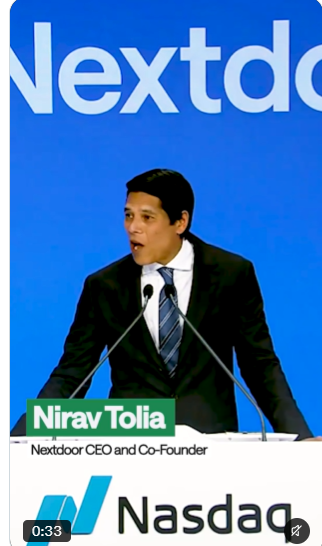
Day 151: The Nasdaq Closing Bell — A Celebration, a New Beginning, or Just a Change of Address?
Apparently, I wasn't finished writing about today's activities.
Around 9 AM Eastern, after publishing my 4:44 AM post, I hopped onto X and came across another post from Nirav Tolia.
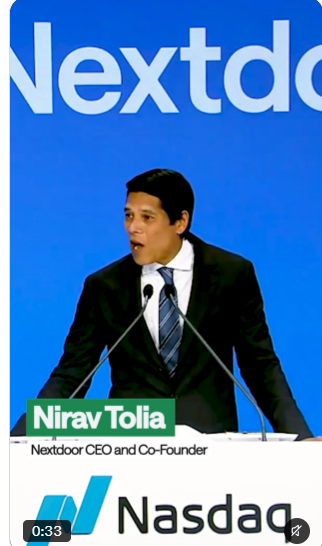
This time, he was reflecting on ringing the Nasdaq Closing Bell a couple of weeks earlier.
Here's what he wrote:
A couple of weeks on, what I remember most about ringing the @NasdaqExchange Closing Bell is who was in the room. It took a lot of people to get @Nextdoor to that podium, and fifteen years is a long time to build anything. I'm lucky to do it with this team and these neighbors. Thank you, Nasdaq, for having us. It meant a lot to celebrate our move and join some of the most innovative public tech companies.
A nice celebration. A milestone. Fifteen years of building a company.
But I started wondering something.
What does moving from the New York Stock Exchange to Nasdaq actually accomplish?
So, I asked The Google.
And the answers were interesting.
Why would a company move from the NYSE to Nasdaq?
There are several legitimate reasons a publicly traded company might decide to transfer its stock listing.
Here are some of the benefits The Google identified.
1. Brand alignment and perceived innovation
Nasdaq has built a reputation around technology, innovation, and growth-oriented companies.
For a consumer technology or software company, being listed alongside other technology businesses may create a stronger association with the industry it wants to represent.
Nasdaq's branding, events, and promotional opportunities also bring visibility.
Let's face it: ringing the Closing Bell makes for a great photograph and a nice social media post.
2. Access to indices, including the Nasdaq-100
This one caught my attention.
The Nasdaq-100 is a well-known index that tracks 100 of the largest non-financial companies listed on the Nasdaq Stock Market.
Being listed on Nasdaq can create an opportunity to meet the exchange's eligibility requirements for certain indices.
But there's a distinction: moving to Nasdaq does not automatically qualify a company for the Nasdaq-100.
Index inclusion depends on specific eligibility requirements and selection criteria.
Still, the possibility of becoming eligible for additional index exposure can be attractive.
3. Lower costs and different fee structures
Exchanges have different listing fee structures and services.
A company may find that transferring to Nasdaq offers a more attractive overall cost structure, depending on its circumstances and the services it uses.
Those costs can matter, particularly for companies looking to manage operating expenses.
4. Market quality and trading metrics
Nasdaq has published research suggesting that companies transferring from the NYSE can experience improvements in certain trading measures, including bid-ask spreads and liquidity.
Of course, those are market-wide observations, not a guarantee that every company will experience the same results.
A change of exchange doesn't automatically make a stock more attractive to investors.
The company's financial performance, growth prospects, investor confidence, and fundamentals still matter.
Nasdaq outlines its reasons for attracting companies here:
https://www.nasdaq.com/products/listings/transfer-to-nasdaq
Now, the other question: Could a company be hiding something?
This is where I asked The Google a second question.
What might a company be hiding by moving from one exchange to another?
The response included several potential red flags.
I want to emphasize something: these are general possibilities to investigate, not accusations about any particular company. A transfer by itself is not evidence of wrongdoing or financial trouble.
But investors should understand what to look for.
1. Avoiding an imminent NYSE delisting
If a company is struggling to meet an exchange's continued listing requirements, investors should investigate.
Listing requirements can involve share price, market capitalization, financial standards, and other criteria.
A company that receives a deficiency notice may have a period to regain compliance.
But simply moving to another exchange doesn't erase the need to disclose relevant listing problems or satisfy the new exchange's requirements.
2. Distracting from operational or financial problems
A major corporate announcement can create positive publicity.
A Closing Bell ceremony, photographs with executives, a new exchange listing, and a message about innovation can all generate attention.
But investors should not confuse publicity with financial performance.
A company can celebrate a move to Nasdaq while still facing challenges involving revenue growth, profitability, customer retention, or monetization.
The two things can exist simultaneously.
3. Governance and oversight
Investors should also look at corporate governance.
Are the board and management accountable? Are executive incentives aligned with long-term shareholder value? Are disclosures clear? Are investors receiving meaningful information about the company's performance?
These questions don't disappear because a company changes exchanges.
4. Financial restatements or structural changes
Evaluate a company making a major listing change alongside its financial reporting history.
Have there been financial restatements? Changes in auditors? Material weaknesses in internal controls? Significant changes in corporate structure?
Those issues deserve attention regardless of which exchange displays the ticker symbol.
And a transfer doesn't provide a hiding place for required disclosures.

The Google bonus: How investors can spot red flags
This was probably the most useful part of the response.
The Google suggested that investors examine three areas:
1. SEC Form 8-K filings
In particular, look at Item 3.01, which covers notices of delisting or failure to satisfy continued listing standards, as well as listing transfers.
The SEC explains what investors should look for in its guide:
https://www.sec.gov/investor/pubs/readan8k.pdf
A company may have to disclose a notice of noncompliance, a delisting action, or its decision to withdraw its listing from an exchange.
2. Which Nasdaq market tier?
Nasdaq has different listing tiers, including:
Nasdaq Global Select Market
Nasdaq Global Market
Nasdaq Capital Market
These markets have different listing and continued-listing standards.
Investors should understand which market a company is joining rather than assuming that every Nasdaq listing carries the same requirements.
3. Reverse stock splits
A reverse stock split is another item worth reviewing.
Companies sometimes use reverse splits to increase their share price and address minimum bid-price requirements.
A reverse split isn't automatically bad, and it doesn't necessarily mean a company is in financial trouble.
But if a reverse split, listing deficiency, and exchange transfer occur around the same time, investors may want to investigate the circumstances.
The point is to look at the entire picture rather than one announcement.
A Closing Bell is a celebration. What happens after the ceremony?
I can appreciate the significance of ringing the Nasdaq Closing Bell.
Fifteen years is a long time to build a company. Reaching the point where a business is publicly traded and participates in an exchange ceremony is a milestone.
And the people who helped build the business deserve recognition.
But there's another side.
Investors don't buy a stock because the CEO got to ring a bell.
They invest because they believe the company has a business model that can produce future value.
A new exchange listing can improve visibility, create opportunities, and potentially offer other advantages.
But it doesn't automatically solve the underlying business challenges.
It doesn't guarantee revenue growth.
It doesn't guarantee profitability.
It doesn't guarantee a higher stock price.
And it certainly doesn't guarantee that investors will suddenly become more confident.
Day 151: New exchange, same questions
I'm interested in watching what happens next.
Will the move to Nasdaq improve visibility? Will it help attract new investors? Will it create additional opportunities for index eligibility? Will the company benefit from different trading dynamics?
Those are all reasonable questions.
But I also want to see the fundamentals.
Revenue growth. Sustainable profitability. Strong customer retention. Advertiser value. Transparent research. Better communication. And a business that earns the confidence of its users and investors.
A new exchange can be a fresh chapter.
But changing the sign outside the building doesn't necessarily change what's happening inside.
The Closing Bell is one moment. Delivering shareholder value is the long game.
That's my two cents.
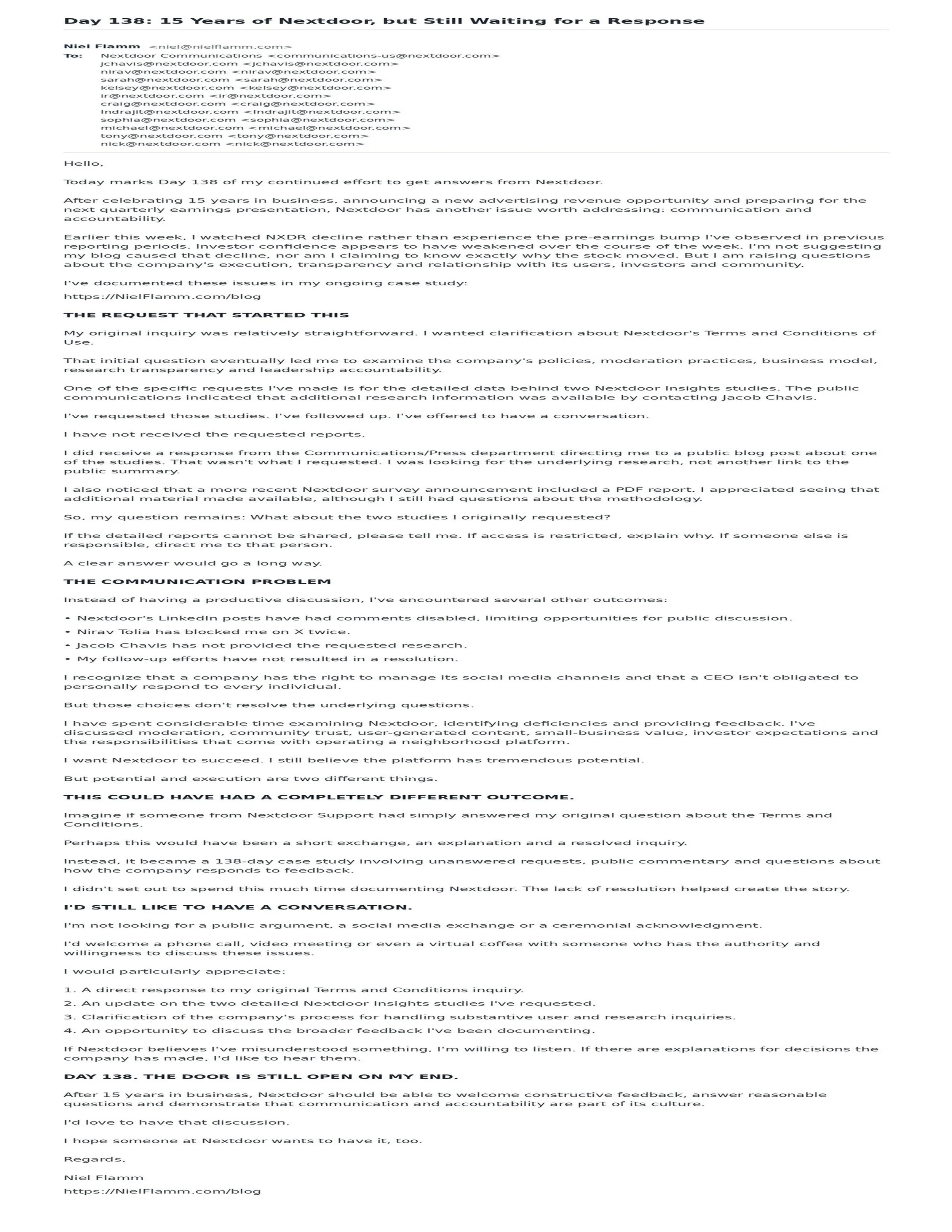
Day 138: I Sent the Email. Now, Will Anyone at Nextdoor Respond?

Day 138. Another day, another attempt to get a response from Nextdoor.
This time, I took a different approach. I put my thoughts, questions, and frustrations into one email and sent it to 12 people at Nextdoor.
Yes, 12.
The recipients included people in Communications, Investor Relations, leadership, and other areas of the company. Some have received emails from me before. Others are being brought into the conversation because, after 138 days, I still don't have the answers I'm looking for.
I'm not expecting 12 individual responses. I'm hoping that at least one person will take ownership and help move this conversation forward.
Fifteen years of Nextdoor, and questions that remain
Nextdoor recently celebrated its 15th anniversary, rang the closing bell at Nasdaq, and announced additional advertising opportunities and revenue initiatives.
Those are milestones worth recognizing. Building a neighborhood platform that reaches millions of people is no small accomplishment.
But anniversaries and announcements don't eliminate the questions that come with running a public company and a platform built around community trust.
This past week, I watched NXDR decline rather than experience the pre-earnings bump I've observed during previous reporting periods. Investor confidence appears to have weakened over the week.
I'm not suggesting my blog caused the decline. I'm also not claiming to know exactly why the stock moved. But I am raising questions about the company's execution, transparency, and relationship with its users, investors, and community.
A company can celebrate 15 years and still have work to do.

The request that started this
My original inquiry was relatively straightforward: I wanted clarification about Nextdoor's Terms and Conditions of Use.
That question eventually led me to examine the company's policies, moderation practices, business model, research transparency, and leadership accountability.
One of my specific requests has been for the detailed data behind two Nextdoor Insights studies. Public communications indicated that additional research information was available by contacting Jacob Chavis.
I've requested those studies, followed up, and offered to have a conversation.
I still haven't received the reports.
Communications/Press responded, but they directed me to a public blog post about one of the studies. That wasn't what I requested. I was looking for the underlying research, not another link to a public summary.
More recently, Nextdoor published a survey announcement that included a PDF report. I appreciated seeing additional material, but I still have questions about the methodology and the two studies I originally requested.
If you can't share the detailed reports, tell me. If access is restricted, explain why. If someone else is responsible, point me in the right direction.
A clear answer would go a long way.
Communication has become part of the case study
Over these 138 days, I've encountered several outcomes that make productive discussion difficult:
Nextdoor's LinkedIn posts have had comments disabled, limiting opportunities for public discussion.
CEO Nirav Tolia has blocked me on X twice.
Jacob Chavis has not provided the requested research.
My follow-up efforts have not resulted in a resolution.
I recognize that a company has the right to manage its social media channels. A CEO isn't obligated to personally respond to every individual. And employees have responsibilities that extend beyond answering my emails.
But those choices don't resolve the underlying questions.
The larger issue is how Nextdoor handles substantive feedback. When someone raises questions about moderation, community trust, user-generated content, small-business value, or the company's research, what happens next?
Is there a process for getting those questions to the right people? Does anyone take ownership? Does the feedback make its way into conversations about product decisions, policies, and strategy?
That's what I'd like to understand.
This could have had a completely different outcome
Imagine if someone from Nextdoor Support had simply answered my original question about the Terms and Conditions.
Perhaps it would have been a short exchange: an explanation and a resolved inquiry.
Instead, it became a 138-day case study involving unanswered requests, public commentary, and questions about how the company responds to feedback.
I didn't set out to spend this much time documenting Nextdoor. The lack of resolution helped create the story.
I've spent considerable time examining the platform, identifying deficiencies, and providing feedback. I've discussed moderation, community trust, user-generated content, small-business value, investor expectations, and the responsibilities that come with operating a neighborhood platform.
I want Nextdoor to succeed. I still believe the platform has tremendous potential.
But potential and execution are different.
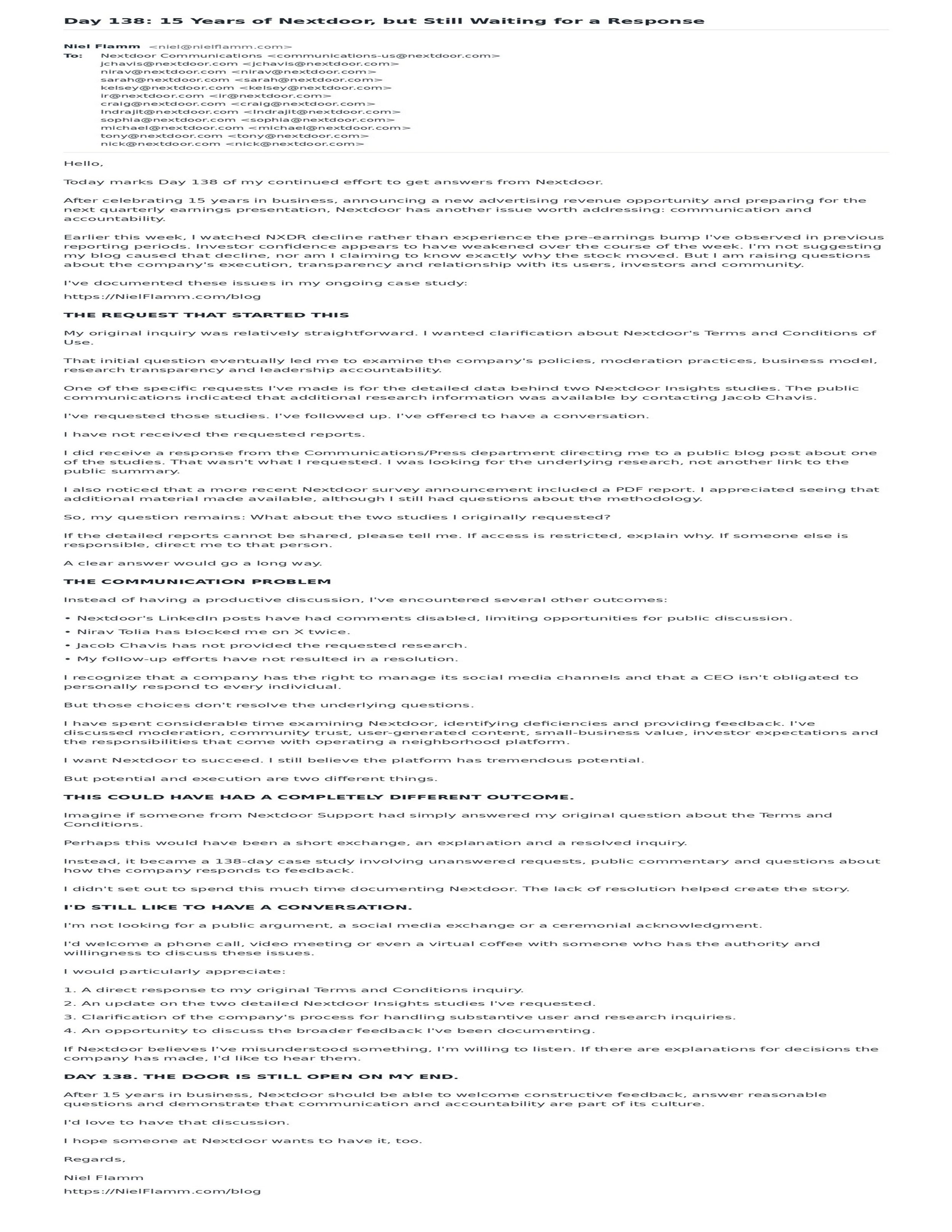
Twelve recipients. One opportunity to respond.
The email I sent isn't a demand for a public apology, a ceremonial acknowledgment, or a social media exchange.
I'm asking for four things:
A direct response to my original Terms and Conditions inquiry.
An update on the two detailed Nextdoor Insights studies I've requested.
Clarification of the company's process for handling substantive user and research inquiries.
An opportunity to discuss the broader feedback I've been documenting.
I'm willing to have a phone call, video meeting, or even a virtual coffee with someone who has the authority and willingness to discuss these issues.
If Nextdoor believes I've misunderstood something, I'm willing to listen. If there are explanations for decisions the company has made, I'd like to hear them.
I'm not asking every recipient to respond individually. I'm asking someone to take responsibility for moving the conversation forward.
Day 138. The door is still open on my end.
After 15 years in business, Nextdoor should welcome constructive feedback, answer reasonable questions, and show that communication and accountability are part of its culture.
The company has celebrated its history. It is pursuing new revenue opportunities. It is preparing to report earnings.
Those are all reasons to look forward.
But the relationship with users, the quality of moderation, the value delivered to small businesses, and investor confidence matter just as much.
I sent the email. I included the people I believe should be aware of the situation. Now I'll wait to see whether anyone decides to engage.
I'm not looking for a fight. I'm looking for a conversation.
Day 138. The door is still open on my end. Is anyone on Nextdoor willing to walk through it?