

My Eyes Weren’t Playing Tricks—That Is Not a Parking Space
After dialysis, I made the 30-minute drive to Retina Consultants of South Carolina in Ladson for my eye appointment.
Apparently, the parking lot decided to test my vision before the doctor could.
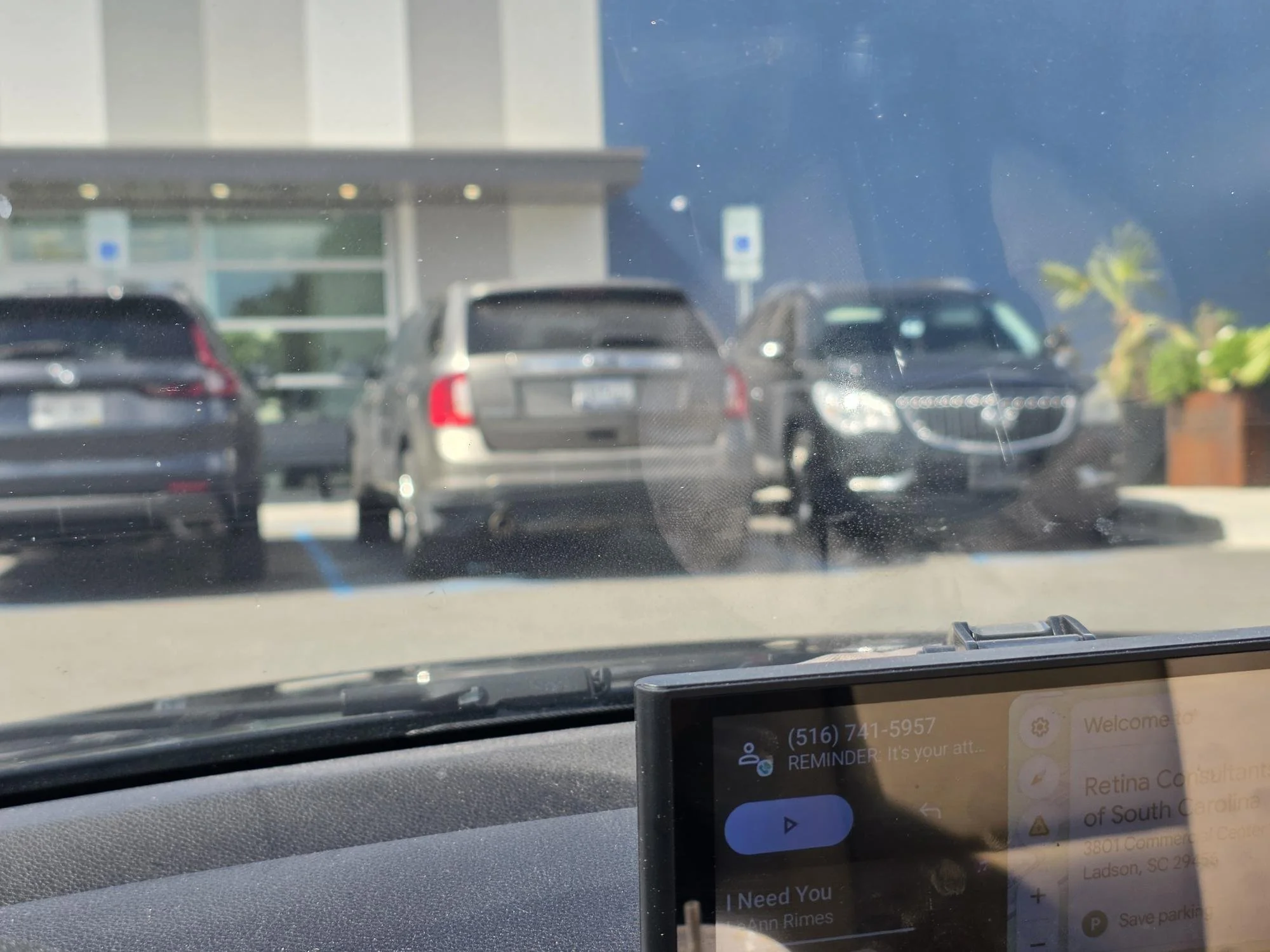
I saw a vehicle parked in a spot that was not actually a parking space, squeezed unbelievably close to the cars beside it. I am not sure the pictures fully capture just how little room was left between the vehicles.
Maybe this was part of my eye exam:
“Niel, can you identify the illegally parked vehicle?”
Yes. Yes, I can.
The scene reminded me of something that happened many years ago after a business trip. At the time, I was neither physically nor emotionally sober.
I returned to the long-term parking lot at O’Hare, exited the train, and walked down the stairs. My car was parked nearby, which should have been a pleasant surprise after traveling.
Instead, someone had parked beside me in a space that did not exist. Their car was so close to mine that I could not open the driver’s door.
I had to climb into my car through the passenger side—all 350 pounds of me, at least—and maneuver myself across the center console into the driver’s seat.
But before I did that, I gave the illegal parker a reason to get a new paint job.
That was not my proudest moment.
Let me be clear: damaging someone’s vehicle was wrong. Their terrible parking did not justify my response. That story is not advice or something I am celebrating. It is simply an honest example of who I was at the time and how poorly I handled anger and frustration.
Today, I respond differently.
I take a picture. I write a blog post. I point out the problem without creating a bigger one—and without adding an appointment at the body shop to someone’s calendar.
Still, parking in a space that does not exist and leaving barely enough room for other drivers to enter their vehicles is selfish. You do not know whether the person beside you has limited mobility, uses a wheelchair or prosthetic, or physically cannot climb through the passenger side.
And no one—especially after dialysis and on the way to a retina appointment—should have to perform parking-lot gymnastics because you decided the painted lines were merely suggestions.
My eyes may be recovering, but even I could see that was not a parking space.
Be better, people. Be better.
Springhill Suites - Long Island City Review. Great Staff and Spacious Room, With a Few Accessibility and Noise Issues
I was in town for just one day to attend an “old guys” fraternity gathering in a backyard in Astoria/Long Island City. My flight arrived at LaGuardia shortly before 9:00 a.m., and I reached the SpringHill Suites around 9:30. I politely asked whether an early check-in might be possible because I was hoping to take a nap before the party—I’m old! They accommodated me immediately. SCORE!
Since Saturday breakfast ran until 10:30, I grabbed a plate of bacon and found a seat. At 9:30, the first-floor breakfast area was packed, with guests cutting in front of one another as if it were the apocalypse and the world had run out of toilet paper again. Through it all, the breakfast staff worked incredibly hard to keep the area clean, replenish food, and answer questions.
My room on the 12th floor was spacious by New York City standards. As an above-the-knee amputee, I had requested an accessible room with a roll-in shower. Like many Marriott-family hotels I’ve visited, the room seemed to meet the basic ADA requirements: grab bars, a handheld showerhead, and anchored bottles of shampoo, conditioner, and body wash.
However, the shower did not have a built-in bench, which I usually find in roll-in showers. The staff quickly provided a shower chair, so that was an easy fix. A few practical improvements would make the room much more usable for actual ADA guests. The shower tray should be closer to the mounted toiletries so guests can also place their own soaps within reach. The towels were left on the sink, forcing me to scoot the shower chair over to retrieve them because I do not shower while wearing my prosthetic leg. Placing towels within reach of the shower would make a meaningful difference.
The hotel has three elevators, but they are small considering the number of guest rooms. A line frequently formed in the lobby. The elevators are fast—unless yours turns into the local train and stops on every floor.
The hotel is in a very industrial area, although new residential buildings are being constructed or converted nearby. There is a bodega at the end of one block and a DoubleTree at the other. There is also a street-cart guy nearby, and I got a combo over rice from him at an awesome price by any standard—especially for New York City.
Rideshare vehicles can reach the hotel, but street parking narrows the remaining roadway. Since I move slowly, the cars behind my rideshare had to wait while I got out.
The first-floor gym, which I did not use, is about the size of a large Manhattan studio apartment. There are also three universally accessible restrooms near the gym. The hotel market uses a self-checkout system: select an item, scan it, and pay by card—no cash. Security is stationed at the entrance, which has become fairly typical at New York City hotels.
Noise was the biggest drawback. I could have sworn I smelled cigarette smoke coming from another room on my floor. Doors slammed throughout the night and into the morning, and some younger guests near my room seemed to be having a party in the hallway. I understand that people want to ensure their doors are securely closed, but the constant slamming was disruptive. Having security periodically patrol the guest floors—using the type of scan system commonly used in hospitals and office buildings—could help address smoking, hallway gatherings, and excessive noise.
Despite those concerns, the staff was absolutely awesome. Their friendliness, hard work, and willingness to help made the overall experience a good one. The early check-in alone was greatly appreciated, and the staff truly made this hotel shine.