
Day #9: Silence Is Still a Response
Today marks Day #9 since I requested the full Home Insurance Insights study from Jacob Chavis.
No study.
No acknowledgment.
No “we’re working on it.”
No response at all.
At this point, I have to assume that if I were a business, user, or investor with an issue, I should expect a similar experience from the company.
And that’s concerning.
Leadership sets culture. Culture drives behavior.
Which brings me to CEO Nirav Tolia.
Nirav, you’re allowing a team you lead to simply not respond. I don’t understand why. According to the original post, the study exists and is available. This should be a simple interaction:
“Thanks for reaching out.”
Attach study.
Or:
“Here’s the link.”
Done.
The entire exchange could probably be completed in less time than it took to read this post.
In fact, if AI is truly the transformational force that Nextdoor leadership frequently discusses, perhaps an AI-powered chatbot could respond with the study automatically.
Instead, we’re on Day #9.
When companies don’t respond to questions, people start wondering whether the issue is process, priorities, or culture.
Either way, silence doesn’t build trust.
It erodes it.
As always, if the study arrives tomorrow, I’ll happily update everyone.
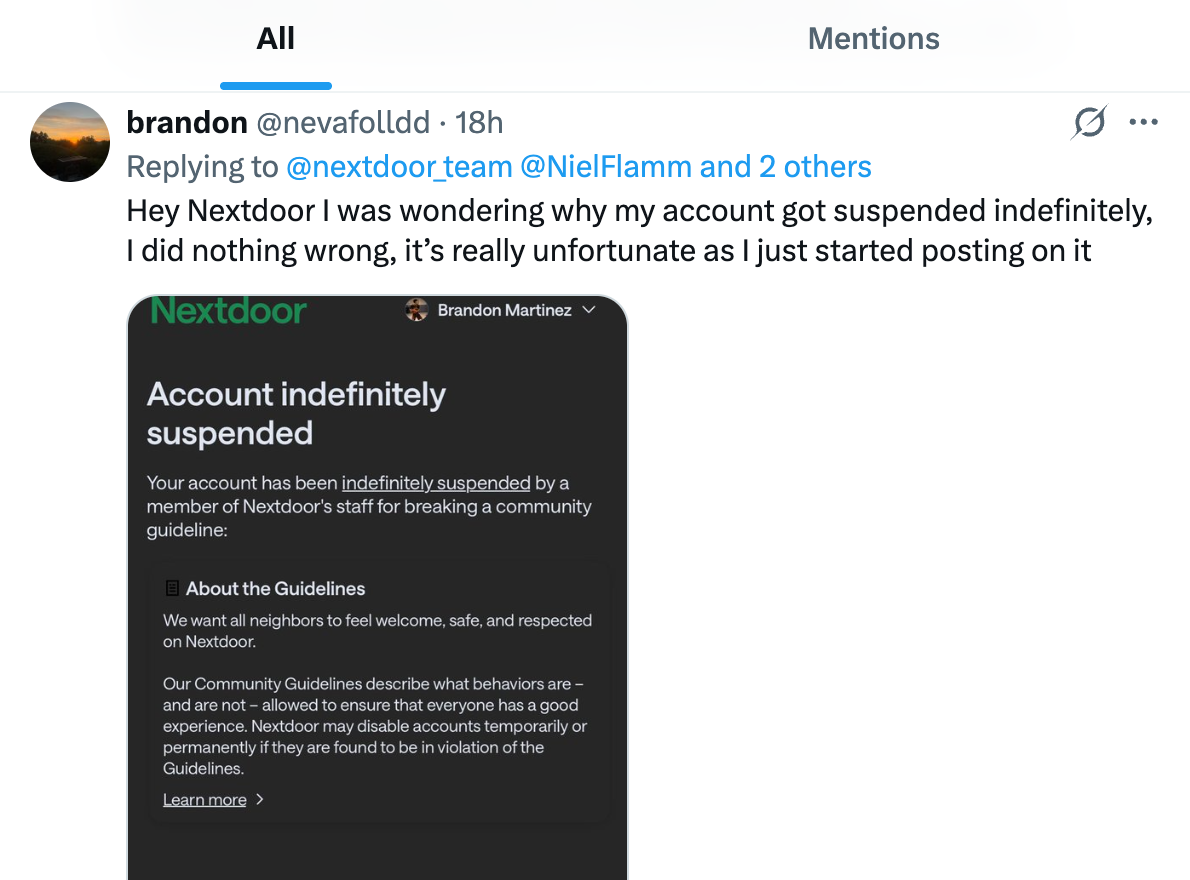
The Suspensions Nextdoor Doesn’t Study
Late Saturday, Brandon shared that his Nextdoor account had been indefinitely suspended shortly after he started posting.
This is the part of Nextdoor that doesn’t show up in the surveys, research reports, or LinkedIn articles.
It’s also the part that raises questions about transparency.
When users are suspended, what exactly is the appeal process? How are decisions reviewed? What standards are being applied? Why are the Community Guidelines often written broadly enough that interpretation seems to favor the platform?
I’ve asked these questions before and have yet to receive meaningful answers.
What makes this even more interesting is that suspended users don’t necessarily disappear from the ecosystem immediately. Their accounts, data, and history remain part of the platform. Yet discussions about transparency surrounding suspensions, appeals, and user rights rarely seem to receive the same attention as discussions about Weekly Active Users, advertising opportunities, or engagement metrics.
For many users, it can feel as though simply asking difficult questions, disagreeing with the prevailing narrative, or refusing to become “another brick in the wall” creates risk.
Whether that’s perception or reality, it is a perception that leadership should take seriously.
This isn’t a study about FIFA.
This isn’t a study about home insurance.
This isn’t a study about pharmaceutical advertising.
This is about real users who believe they’ve been silenced and want to understand why.
And that’s a study I’d be interested in reading.
Triage, Transformation & The Missing Turnaround at Nextdoor
When #NiravTolia returned as CEO of Nextdoor in March 2024, the mandate was straightforward: stabilize the business, restore confidence, and create durable shareholder value.
Turnarounds follow a predictable playbook. Triage before transformation. That means:
- Shedding or restructuring underperforming segments
- Reallocating capital toward profitable, scalable initiatives
- Streamlining operations and clarifying accountability
- Consistently meeting financial expectations
- Communicating transparently with investors and employees
- Tying executive compensation to measurable outcomes
More than two years in, the question that deserves a serious answer is: Where is the evidence of transformation?
What has largely filled that void is AI.
That's not inherently a problem. AI is a legitimate strategic lever. But AI is a capability, not a strategy. Wrapping operational drift in the language of innovation does not fix the underlying business. And dismissing outside criticism doesn't change what the metrics show — it simply signals that the gap between narrative and reality hasn't closed.
The numbers are no longer forgiving. The stock's all-time high was $13.50 in November 2021. It now trades around $1.50 — a collapse of nearly 90% from its peak. Market cap has fallen to roughly $630 million. Weekly active users grew just 1% year-over-year in Q1 2026, even as the company posted an $11 million net loss.
This raises a question that can no longer be deferred: What are the fiduciaries doing?
The board includes Bill Gurley of Benchmark, David S. of Greylock, and directors Dana Evan, Robert Hohman, Jason Pressman, Niraj Shah, Elisa Steele, and Chris Varelas. BlackRock holds a 5%-or-greater institutional stake. These are not passive observers — they are experienced investors who know what a real turnaround looks like.
At what point does continued patience become complicity? Gurley built his reputation by holding management accountable. Sze backed LinkedIn, Facebook, and Pandora — he knows what genuine growth inflection looks like. BlackRock's fiduciary obligation to its own investors is explicit.
Two-plus years in, with the stock near historic lows and user growth nearly flat, the board's silence is itself a signal.
Outcomes measure leadership. The board is measured by whether it demands them.
At some point, loyalty to a founder and accountability to shareholders become mutually exclusive. That point may already have passed.
Subscribe to NielFlamm.com
#Nextdoor #NXDR #Leadership #InvestorRelations #CorporateStrategy #TurnaroundManagement #BoardAccountability #TechIndustry #CEO #Benchmark #Greylock #BlackRock