

Day 90: What If Nextdoor Is Trying to Serve Too Many Customers at Once?

Day 90.
Ninety consecutive days of looking at Nextdoor from different angles.
Yesterday, NXDR closed at $2.27. That's up from the $2.23 close I discussed on Day 88, but I'm not going to spend Day 90 dissecting four cents.
Instead, I want to ask a completely different question:
Who exactly is Nextdoor's customer?
Sounds simple.
I'm not sure it is.
Meet the Nextdoor Family
Think about all the different people Nextdoor is trying to satisfy.
There's the neighbor who wants to know why three police cars just went down the street.
There's the small-business owner who wants customers.
There's the advertiser who wants access to those neighbors.
There's the moderator trying to keep everyone from digitally strangling each other over political signs and dog poop.
There's the researcher or marketer interested in Nextdoor's Insights.
There's the shareholder—hello!—who wants the company to create sustainable value.
And then there's Nextdoor itself, which has to somehow turn this entire neighborhood block party into a profitable business.
That's a lot of people sitting at one table.
And they don't necessarily want the same meal.
The Neighbor Doesn't Wake Up Thinking About Monetization
I doubt many people roll out of bed thinking:
“I hope Nextdoor improves its advertising yield today.”
Neighbors want utility.
What's happening?
Who can fix my air conditioner?
Did somebody find my dog?
Why is the power out?
Is that restaurant any good?
What's being built down the street?
And, naturally:
“Did anyone else hear that boom?”
That's the product from the neighbor's perspective.
But there's a problem.
The neighbor may be the person using the product...
without being the person primarily paying for it.
That's where things get interesting.
The Advertiser Wants Something Completely Different
The advertiser doesn't necessarily care whether Karen and Steve finally resolve their six-day dispute over Steve's garbage cans.
The advertiser wants:
Attention.
Preferably local attention.
And preferably attention from people likely to buy something.
That creates a balancing act.
Nextdoor needs enough people using the platform to make the audience valuable to advertisers.
But if monetizing that audience makes the experience less useful, those people may use Nextdoor less.
And then the audience becomes less valuable.
Welcome to the social-media hamster wheel.
Then Along Comes the Small Business
This is where Nextdoor has another interesting relationship.
The local business can simultaneously be:
Content creator.
Advertiser.
Community participant.
Recommended business.
Potential paying customer.
That's a lot of hats.
Nextdoor wants neighbors to recommend local businesses organically because those recommendations build trust and create useful content.
But Nextdoor also needs to make money from businesses.
That's not inherently wrong.
Nextdoor is a public company, not a neighborhood charity.
The interesting question is where the line sits between:
Helping local businesses participate
and
Monetizing their need to reach neighbors.
That's a strategic question worth watching.
And Then There Are Shareholders
This is the group I belong to.
I don't need Nextdoor to be free of advertising.
I want revenue growth.
I want profitability.
I want innovation.
I want management making intelligent investments.
And yes...
I want NXDR worth more than $2.27.
But here's the catch.
If Nextdoor squeezes too much money out of the platform and damages the neighbor experience, that isn't necessarily good for shareholders long-term.
If Nextdoor focuses exclusively on making neighbors happy but can't build a profitable business around them, that's not particularly helpful either.
The interests are connected.
Maybe Nextdoor Isn't One Product
This is the thought that really interests me on Day 90.
Maybe we're evaluating Nextdoor incorrectly by thinking of it as one product.
It may actually be several products sharing the same neighborhood.
To the neighbor, Nextdoor sells connection and information.
To the local business, it sells visibility and potential customers.
To the advertiser, it sells access and attention.
To researchers and marketers, it offers neighborhood insights.
And to shareholders, management is ultimately selling something else:
The promise that all of those pieces can become a valuable business.
That's a difficult puzzle.
Imagine Trying to Run This Restaurant
Imagine opening a restaurant where one customer wants steak.
Another wants vegan.
Another wants breakfast.
Another wants cocktails.
Another wants everything free.
And there's a shareholder standing near the kitchen asking why the margins aren't better.
Hi. I'm the guy near the kitchen.
Meanwhile, the chef is doing podcasts explaining the future of restaurants.
At some point somebody has to decide:
What's our signature dish?
That's what I'm asking about Nextdoor.
What Is the One Thing Nextdoor Must Be Exceptional At?
Not 17 things.
One.
Is Nextdoor primarily:
The place to discover what's happening nearby?
The place to connect with neighbors?
The place to discover trusted local businesses?
A hyperlocal advertising platform?
A neighborhood recommendation engine?
A source of uniquely valuable local data?
Maybe it can eventually be all of those things.
But companies usually become indispensable because they're exceptionally good at something.
Then they expand.
And That Brings Me Back to $2.27
NXDR closed yesterday at $2.27.
Four cents higher than the $2.23 close I discussed earlier this week.
Good.
As a shareholder, I'll happily take the four cents.
But Day 90 isn't about whether the stock moved four cents.
It's about what eventually moves it forty cents, a dollar, or several dollars—and keeps it there.
That requires more than announcements.
It requires a business people understand.
A product neighbors value.
An ecosystem businesses value.
An audience advertisers value.
And a strategy shareholders believe will eventually create sustainable returns.
That's a lot of customers to keep happy.
Day 90: Who Gets the Best Seat at the Table?
So after 90 days, here's today's question:
When the interests of neighbors, businesses, advertisers, and shareholders collide, who comes first?
Because saying everyone comes first sounds wonderful.
Until two of them want completely different things.
That's when corporate strategy stops being a mission statement and becomes a decision.
And those decisions may ultimately tell us far more about Nextdoor's future than whether NXDR closed yesterday at $2.27 or $2.23.
Ninety days down.
And somehow, I still haven't run out of doors to open.
Follow my continuing Nextdoor case study at NielFlamm.com/blog.

Day 76: Maybe I’ve Been Asking the Wrong Question

For 76 days, I've been asking some version of the same question:
Where is the detailed data?
Today, I'm changing the question.
Why advertise something as available if you're not prepared to provide it?
That's a much more interesting question.
Nextdoor published Insights articles that don't simply say, “Here's our research. Hope you enjoyed it.”
They specifically invite readers who want more to reach out.
The language is pretty clear: if you want “detailed data, additional audience segments, and strategic recommendations,” contact the person Nextdoor identifies.
So I did.
And here we are.
Day 76.
Imagine This Anywhere Else
A restaurant puts this on the menu:
“Ask your server about today's desserts.”
You ask.
The server hands you the dinner menu again.
You explain:
“No, I already read this. I'm asking about the desserts you told me to ask about.”
They hand you the dinner menu again.
You clarify exactly what you're requesting.
You point to the sentence telling you to ask.
You eventually send them a picture of the sentence.
And then...
Nothing.
At some point, you're no longer wondering what's for dessert.
You're wondering why the restaurant put the sentence on the menu.
That's essentially where I am with Nextdoor.
This Isn't Really About a Report Anymore
The research is almost secondary now.
What fascinates me is the disconnect between invitation and execution.
If an organization publicly tells people:
Contact us for X
there should probably be a process for what happens when someone actually...
contacts you for X.
Who qualifies?
What gets sent?
Is there a sales requirement?
Is it only available to advertisers?
Is there a minimum advertising spend?
Is it proprietary and unavailable to the general public?
Is there an NDA?
Is it simply not something Nextdoor wants to provide to me?
Any of those answers would at least be an answer.
And if there are conditions attached to receiving the information, why not disclose those conditions when inviting people to request it?
Maybe There's a Bigger Marketing Lesson Here
Calls to action are promises.
Download the guide.
Request a demo.
Contact us for more information.
Reach out for detailed data.
Every one of those statements creates an expectation.
Marketing gets someone through the door.
Operations determines what happens after they walk through it.
And when those two things don't connect, the customer discovers the gap.
This has become much more interesting than my original request.
I didn't have to uncover some hidden Nextdoor process.
I followed Nextdoor's own call to action.
So Day 76 Has a New Question
I'm not asking Nextdoor where the detailed data is today.
I've asked that plenty.
Instead:
Nextdoor, what is supposed to happen when someone does exactly what your marketing tells them to do?
Because I did.
And 76 days later, I'm still trying to figure it out.
Maybe the most important data I've collected during this experiment isn't contained in the reports at all.
Maybe it's the 76 days of customer experience generated while trying to obtain them.
That's becoming quite a dataset in its own right.
Day 76.
The research request continues.
But apparently, so does the research on Nextdoor.
My LinkedIn posts are the condensed version. The full continuing Nextdoor case study is at NielFlamm.com/blog.
And subscribe at NielFlamm.com to follow along.

Day 62: What Do Nextdoor’s Partners Think?

It's Day 62.
I'm not surprised.
And somehow, I'm still surprised.
Sixty-two days since I requested a study from Jacob Chavis without receiving the study—or a response.
62 days. Unbelievable.
Yesterday I wrote about Nextdoor reposting content from Groundworks Commercial. Since Jacob seems to have vanished from the Insights landscape—perhaps abducted by aliens 👽—I've started watching what Nextdoor is publishing.
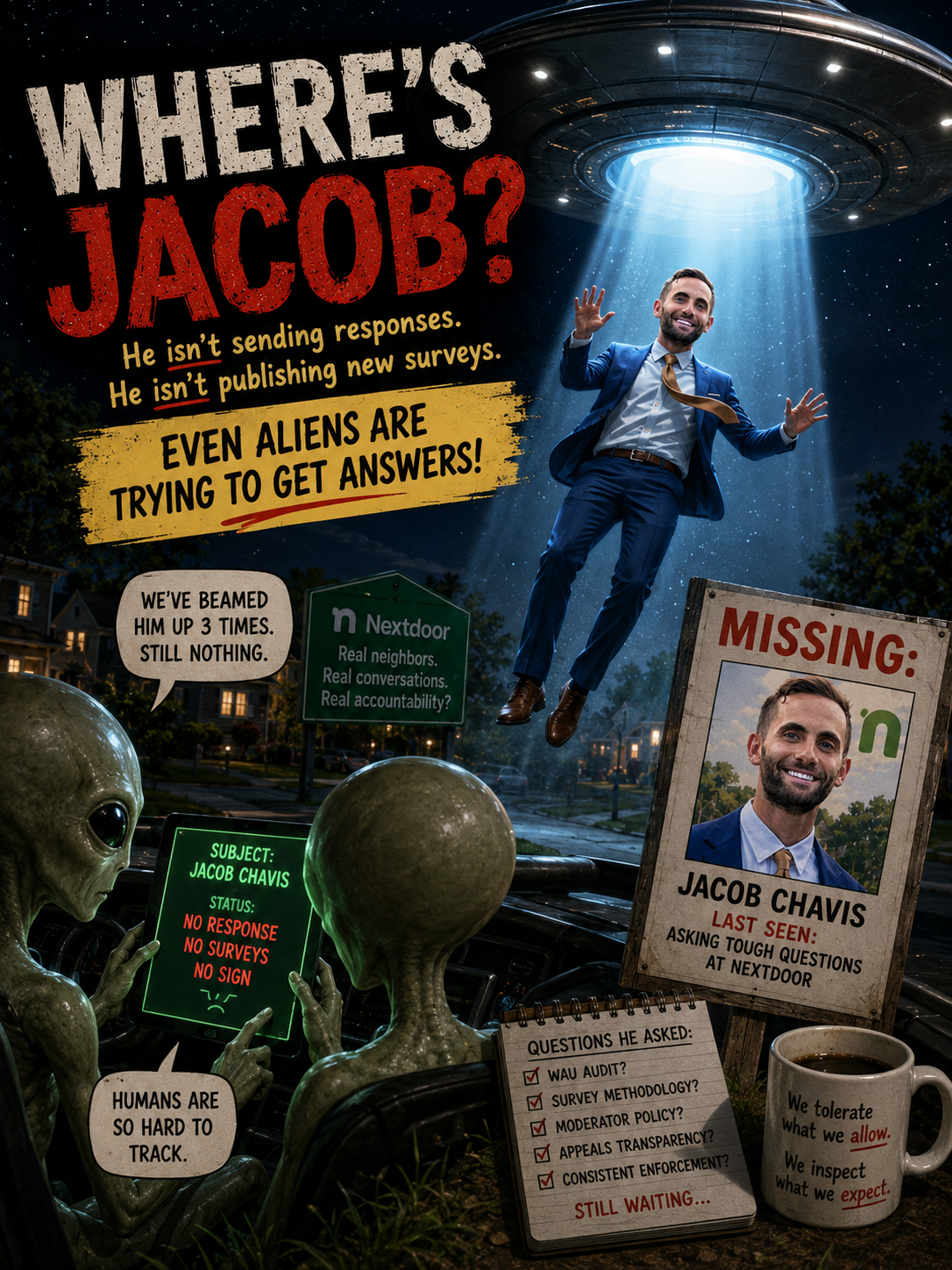
Something is interesting about reposts.
When Nextdoor publishes its own LinkedIn content, comments are typically disabled.
When Nextdoor reposts someone else's content, the original post's comments may remain available.
And, well...
I do what I do.
I commented on the Groundworks Commercial post about my experience with Nextdoor.
Then last night, I noticed Josh Jones from Groundworks Commercial viewed my LinkedIn profile.
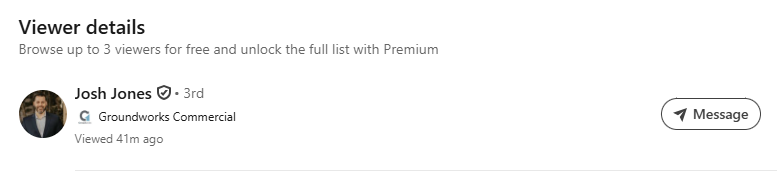
Hello, Josh. 👋
I'm genuinely curious:
What do you think about all of this?
Not just Josh, either.
That has me thinking about Nextdoor's broader network of partners.
Nextdoor works with businesses, advertisers, local organizations, news outlets, government agencies, and other companies.
Those organizations lend something besides money or content.
They lend their names.
So what are decision-makers at these organizations seeing?
Do they look only at Nextdoor's WAU, advertising opportunities and neighborhood reach?
Do they examine the moderation controversies?
Do they look at how critical feedback is handled?
Do they notice comments are disabled on corporate posts?
Do they examine how small businesses experience the platform?
Do they care how shareholders are treated?
And does corporate culture factor into deciding whether another organization wants its brand associated with Nextdoor?
I'm not suggesting Groundworks Commercial—or any Nextdoor partner—agrees with my views.
I have no idea what Josh thinks.
That's why I'm asking.
But partnerships work both ways.
When two brands associate publicly, each company's reputation becomes part of the other's equation.
I've spent 62 days asking questions on Nextdoor.
Maybe there's another group worth asking:
What do Nextdoor's partners think?
Local news organizations.
Small businesses.
Advertisers.
Corporate partners.
Public agencies.
What are their experiences behind the scenes?
After 62 days, I'm increasingly interested not only in what Nextdoor says about itself...
but what organizations doing business with Nextdoor say about Nextdoor.
Josh, since you stopped by my profile, I'd welcome your perspective.
And if anyone from another Nextdoor partner is reading this, yours too.
Day 62. The conversation keeps getting bigger, even if Nextdoor isn't participating.
Join the discussion at NielFlamm.com/blog.
Leave some feedback—I'd love to hear your perspective.

Day 61: A Rising Stock Doesn't Erase the Questions

It's Day 61.
While NXDR is up for the week, as I'm writing this it's down approximately $0.02 today.
Perhaps some short-term players are taking profits. Perhaps it's ordinary market movement. I don't pretend to know why someone else presses sell.
But I'm watching.
While I've been bearish on Nextdoor, I'm also a shareholder. I benefit when NXDR rises. I'd rather be writing about a company delivering undeniable value than explaining why I continue questioning its direction.
My concerns aren't based on one red trading day—or one unanswered email.
They're cumulative.
From my perspective, several leadership decisions under CEO Nirav Tolia deserve scrutiny.
I've questioned the investment in an elaborate new Dallas headquarters while the company continues reporting a GAAP net loss.
I've questioned a strategy that appears to ask some small businesses to pay additional money to respond to potential customer leads.
I've questioned a moderation model dependent on unpaid neighbors while seeing examples that make me wonder about consistency and quality control.
I've questioned a platform built around community and conversation while Nextdoor's corporate LinkedIn presence doesn't permit comments and Nirav has blocked me on LinkedIn.
I've tested Nextdoor's identity/address verification myself and raised questions about whether reality matches the rhetoric surrounding "trust."
And, of course...
It's Day 61 since I requested a study from Jacob Chavis.
No study.
No explanation.
No acknowledgment.
That has become less about Jacob and more about leadership.
I've contacted Nirav Tolia, Sarah Leary, Investor Relations, Communications, and others.
At some point, accountability travels upward.
A CEO doesn't personally answer every email, moderate every neighborhood, or respond to every shareholder.
I understand that.
But a CEO does own the culture and direction of the organization.
That's the distinction.
I don't know what's happening internally at Nextdoor, and I won't pretend I do.
I'm documenting what I can observe and asking whether these decisions create sustainable value.
NXDR can rise 5%, fall 2%, or trade sideways tomorrow.
The ticker tells us what the market thinks the company is worth at a particular moment.
It doesn't tell us whether today's leadership decisions are right for the next five years.
That's the conversation I'm interested in.
I'm watching leadership, execution, culture, communication, moderation, monetization, and shareholder value much more closely than today's ticker.
Day 61. Still watching. Still asking.
Join the discussion at NielFlamm.com/blog.
Leave some feedback—I'd genuinely like to hear what you think.
Is Nextdoor Building a Pay-to-Participate Community?
Something dawned on me shortly after publishing my Day 55 posts.
Maybe Nextdoor's latest business pricing strategy shouldn't surprise me.
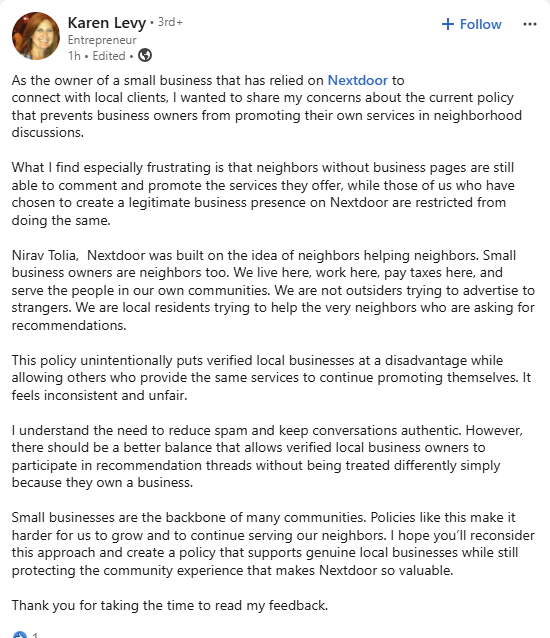
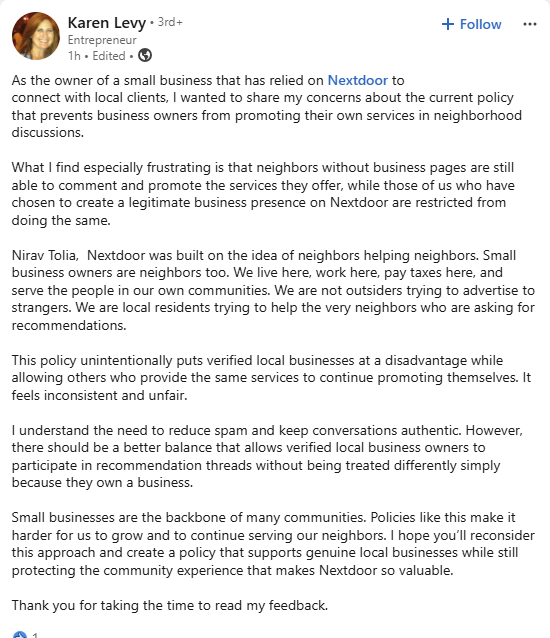
I recently saw a LinkedIn post from Karen Levy discussing Nextdoor's new pay-to-play system for businesses. Business accounts are reporting that they must pay an additional fee to respond to certain neighbor posts as potential sales leads.
That got me thinking:
What does this potentially do to WAU among businesses?
Nextdoor reports Platform Weekly Active Users (WAU) as an important metric. If participating in valuable conversations becomes more expensive—particularly for small businesses with limited marketing budgets—what happens to engagement?
Do they pay?
Or decide:
This isn't worth it anymore?
That's interesting because, from my perspective, Nextdoor has increasingly created an environment where conversation feels restricted.
Nextdoor doesn't allow comments on its blog.
Nextdoor Communications doesn't allow comments on its LinkedIn posts.
CEO Nirav Tolia blocked me on LinkedIn.
And now, according to business owners, participating in certain conversations with potential customers comes with another price tag.
Are these separate decisions—or examples of the same philosophy?
Control the conversation. Monetize the conversation. But how much are you actually encouraging the conversation?
I also want to be transparent.
I understand the "buck stops with me" approach to leadership.
Someone has to make decisions.
On a ridiculously smaller scale, I organize a lottery pool for my fraternity chapter brothers. My rules for today's pool were simple:
$20. Cash option when we obviously win—payment through Zelle by 2:00 p.m. EDT on 8/8/26.
Those are my rules.
I'm unapologetic about them.
But here's the difference:
I communicated them.
If someone asks why, I answer.
I don't pretend the question wasn't asked.
That's what keeps bringing me back to Nextdoor.
I'm on Day 55 and haven't received the study or a response.
I've continued emailing, posting, and commenting publicly on X. I've also seen multiple Nextdoor employees viewing my LinkedIn profile.
Yet nobody will answer.
I previously received a read receipt from John T. Williams in Investor Relations. I haven't received one from Nirav, but after 55 days and numerous attempts at communication, the silence raises questions.
So, Nirav:
The buck stops somewhere. You're the CEO. What gives?
You don't have to agree with me.
You don't have to like my posts.
You don't even have to send me the study.
But after 55 days, why can't someone communicate the answer?
Join the discussion at NielFlamm.com/blog. I'd genuinely like your perspective.