

I Feel Like I'm in the Movie Hackers — Cedar Knolls, We've Got a Situation!

I feel like I'm living in the movie Hackers.
Not familiar with it? Let me take you back to 1995, when the interwebs were taking shape, and the idea of a computer hacker was becoming part of pop culture.
The movie starred Angelina Jolie, Jesse Bradford, Matthew Lillard, Marc Anthony, and Lorraine Bracco. The story follows a group of New York high school hackers who get caught up in a conspiracy after being framed for something they didn't do.

I remember the movie for its soundtrack, a young Angelina Jolie with her pouty looks, and that wonderfully dystopian, futuristic atmosphere. It had a very particular 1990s vision of what the digital world might become.
Well, here I am, decades later, and I'm starting to feel like I've wandered into my own low-budget version of Hackers.
Only my story involves NielFlamm.com, website analytics, suspicious traffic, and a mysterious location in New Jersey.
Previously on NielFlamm.com: Cedar Knolls
If you missed my previous post, I noticed an unusual amount of traffic coming from Cedar Knolls, New Jersey.
At first, it was a few visits here and there. Nothing that immediately raised alarms.
Then the numbers started climbing.
And climbing.
And climbing.
Eventually, I discovered more than 17,000 hits associated with Cedar Knolls. A much more technical question quickly replaced my initial excitement about suddenly becoming an internet sensation:
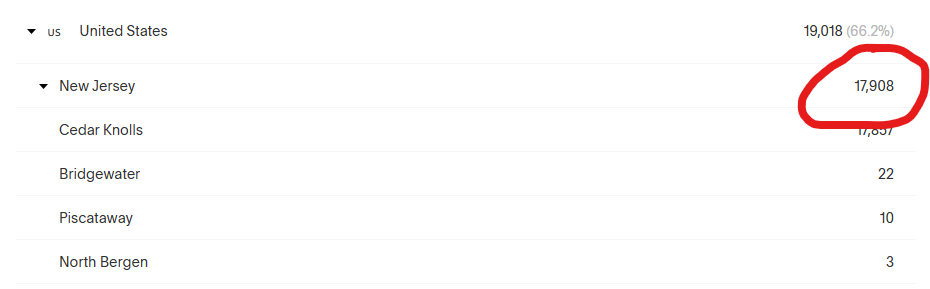
Who—or what—is hammering my website?
So I started digging.
Enter Akamai Connected Cloud (Linode)
Here's what my research turned up.
Akamai Connected Cloud, formerly known as Linode, is a cloud computing platform that rents virtual servers, storage, and networking infrastructure to businesses and developers.
Linode was founded in 2003, and Akamai Technologies acquired it in 2022.
In simpler terms, people can rent virtual computers to run websites, applications, databases, and automated services.
Think of it as renting a computer in the cloud without buying the physical machine.
And that's where things get interesting.
According to the information I found, traffic associated with Akamai/Linode infrastructure can come from several sources:
Web scrapers and crawlers: Automated programs collecting information from websites.
VPNs and proxies: People or organizations routing internet traffic through servers to mask their original IP addresses.
Monitoring services: Automated systems checking whether websites are online and functioning.
Spam and security bots: Programs scanning websites for login pages, contact forms, and possible vulnerabilities.
In other words, not every visitor showing up in my analytics is necessarily a person sitting at a computer reading my latest movie review.
Some visitors may be machines.
And apparently, some machines are very enthusiastic about visiting my website.
So, who is behind it?
That's the million-dollar question.
Akamai/Linode infrastructure is available to customers who rent virtual servers. That means the IP address alone doesn't tell me who is operating the system or what their intentions are.
It could be a legitimate service, an automated crawler, someone using a proxy, or something less friendly.
It could be someone in Nigeria, China, Russia, the United States, Mars, or even Alpha Centauri.
Okay, maybe not Mars. Although at this point, I wouldn't completely rule it out.
Could it be someone I've annoyed? Someone who decided my little website needed a little extra attention?
Possibly.
But I don't have evidence identifying the person or organization responsible, and I'm not going to pretend that I do.
What I do know is that the traffic pattern was unusual enough to prompt an investigation.
Time to put another layer of protection in place
One thing I've been learning is how to use website security tools to distinguish legitimate visitors from suspicious automated traffic.
For example, Cloudflare offers interactive challenges that can help screen traffic from certain networks. One option is to apply a challenge to traffic associated with a particular network, such as Linode's AS63949, rather than automatically blocking everyone.
The idea is simple: legitimate visitors can complete a quick challenge, while automated traffic may not get through.
Of course, no security measure is perfect. Challenges can occasionally inconvenience legitimate visitors, and not all traffic from a cloud provider is malicious.
But I'm learning, adjusting, and adding protection where it makes sense.
Touche, Cedar Knolls. Touche.
Here's the funny part.
The traffic started slowly. I didn't notice what was happening right away. Over the last week, the activity increased, and today it reached a point where I couldn't ignore it anymore.
It took me a little while to connect the dots, research the infrastructure, and figure out what might be going on.
But I got there.
I'm a 54-year-old Gen-Xer who has spent more time than I ever expected learning about website analytics, SEO, DNS, IP addresses, cloud infrastructure, firewalls, and security settings.
Who knew that running a personal blog would eventually make me feel like I was auditioning for a sequel to Hackers?

And for the record, I'm smarter than my medical history might suggest. It just took me a little time to get there.
So, whoever—or whatever—is behind the activity from Cedar Knolls, I see you.
I may not know your identity, your intentions, or whether you're even human.
But I know enough to start protecting my little corner of the internet.
Touche, Cedar Knolls. Touche.
And if Angelina Jolie happens to be reading this, I wouldn't mind a cameo in the sequel.
Stay tuned. The investigation continues.
Technical note: An IP address associated with a cloud hosting provider does not identify a specific person or prove malicious activity. The traffic may be automated, routed through a proxy, or generated by a legitimate service. I'm describing what I observed and the steps I'm taking to investigate and protect the website.
Who Are You, Cedar Knolls, NJ? And What Are You Doing on My Website?
I woke up once again because nature called. After letting nature take care of what it needed to, guess what I did?
That's right. I checked the analytics for NielFlamm.com.
Apparently, I have developed a new nighttime hobby. Some people count sheep. I check website traffic.
Before letting the Sandman take over, my analytics showed about 26,000 visits. I wake up a little later for another appointment with nature, check the numbers again, and suddenly I'm looking at 28,000.
Okay, what in the world is going on?
Did my website suddenly become the hottest destination on the internet? Did some celebrity mention me? Did my movie reviews go viral? Did the world finally discover my little corner of the internet?
Well, not exactly.
Enter Cedar Knolls, New Jersey
I checked the activity log, and a large number of visits were coming from one specific location, arriving at a rather fast-and-furious rate.
Cedar Knolls, NJ, USA.
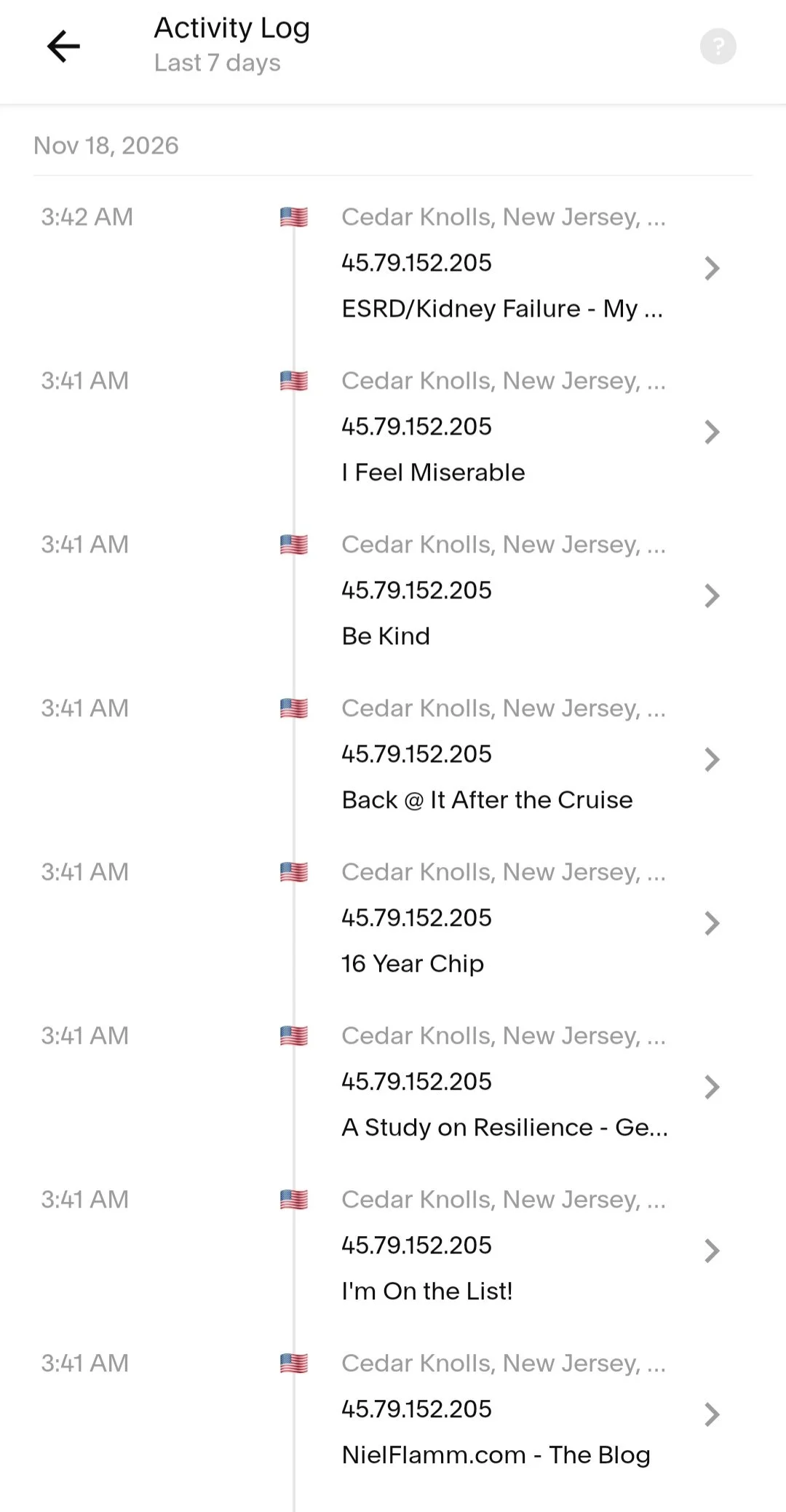
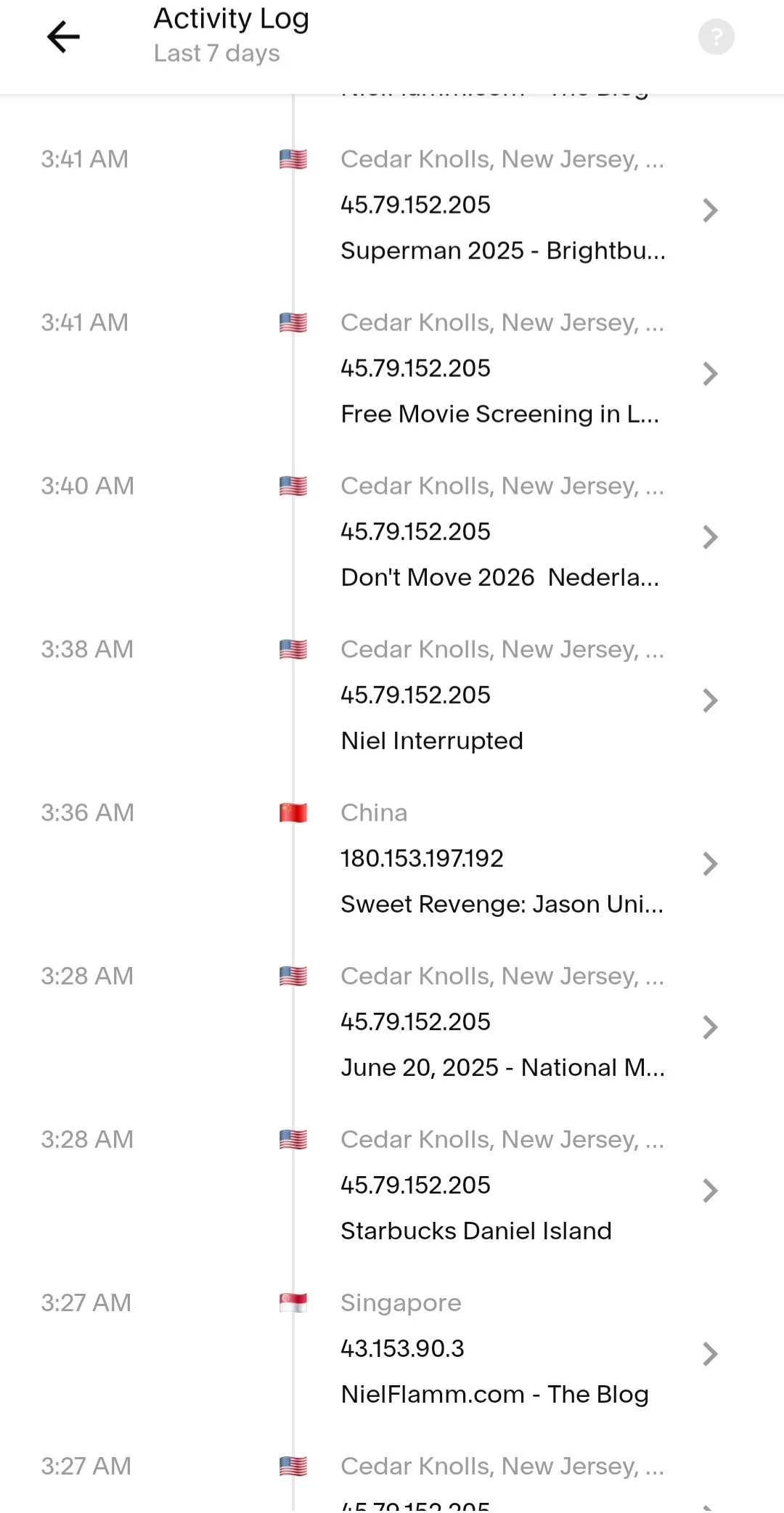
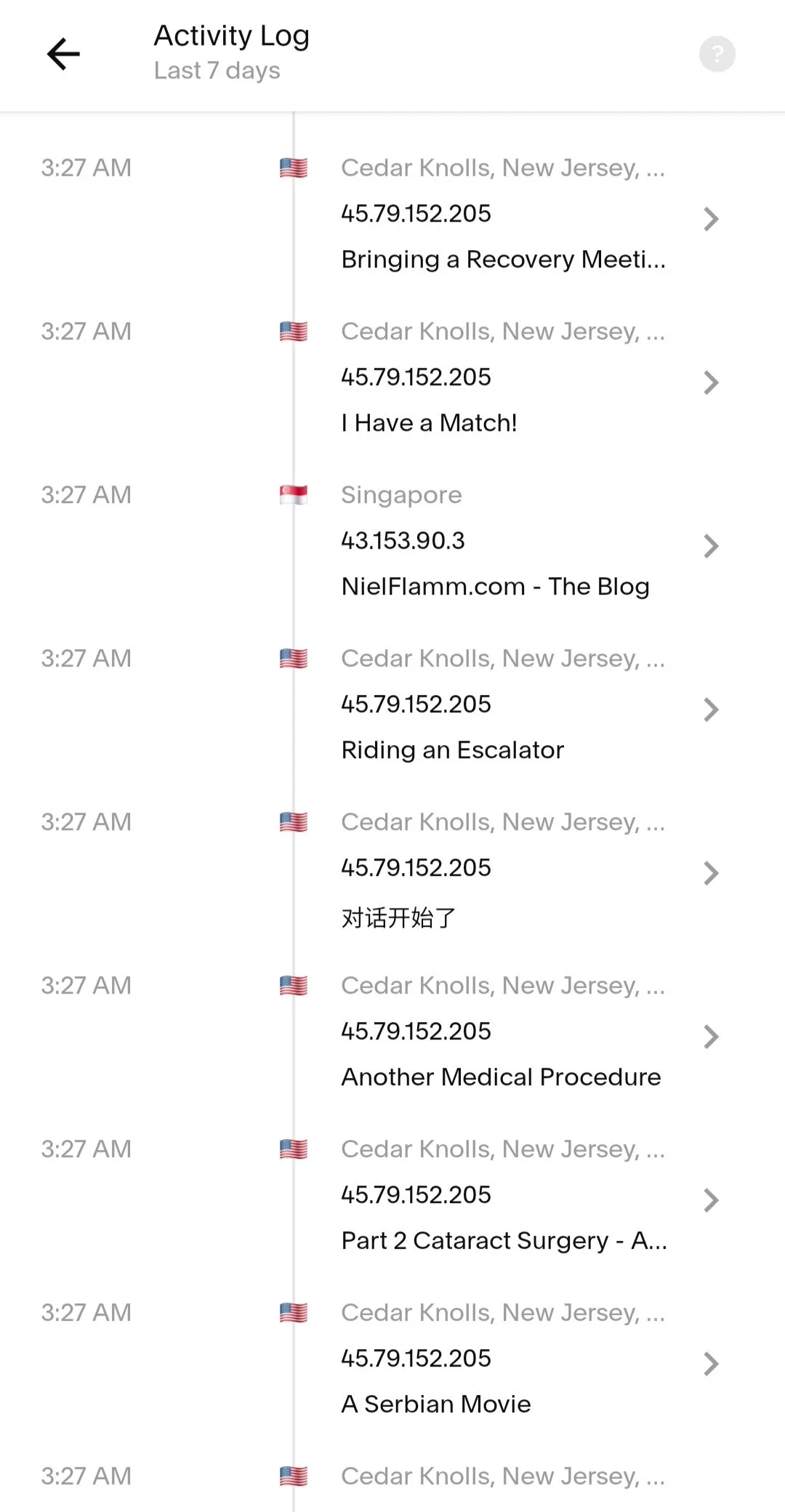
I've noticed activity from Cedar Knolls before, but nothing anywhere near this volume. This wasn't a few curious visitors stopping by to read a blog post. This was more like a digital invasion.
So, naturally, I started investigating.
Where exactly is Cedar Knolls?
It's approximately 21 miles from Newark, New Jersey, and about 41 miles from Manhattan. Based on what I found, Cedar Knolls is a small community near Morristown, New Jersey, with a history dating back to 1913.
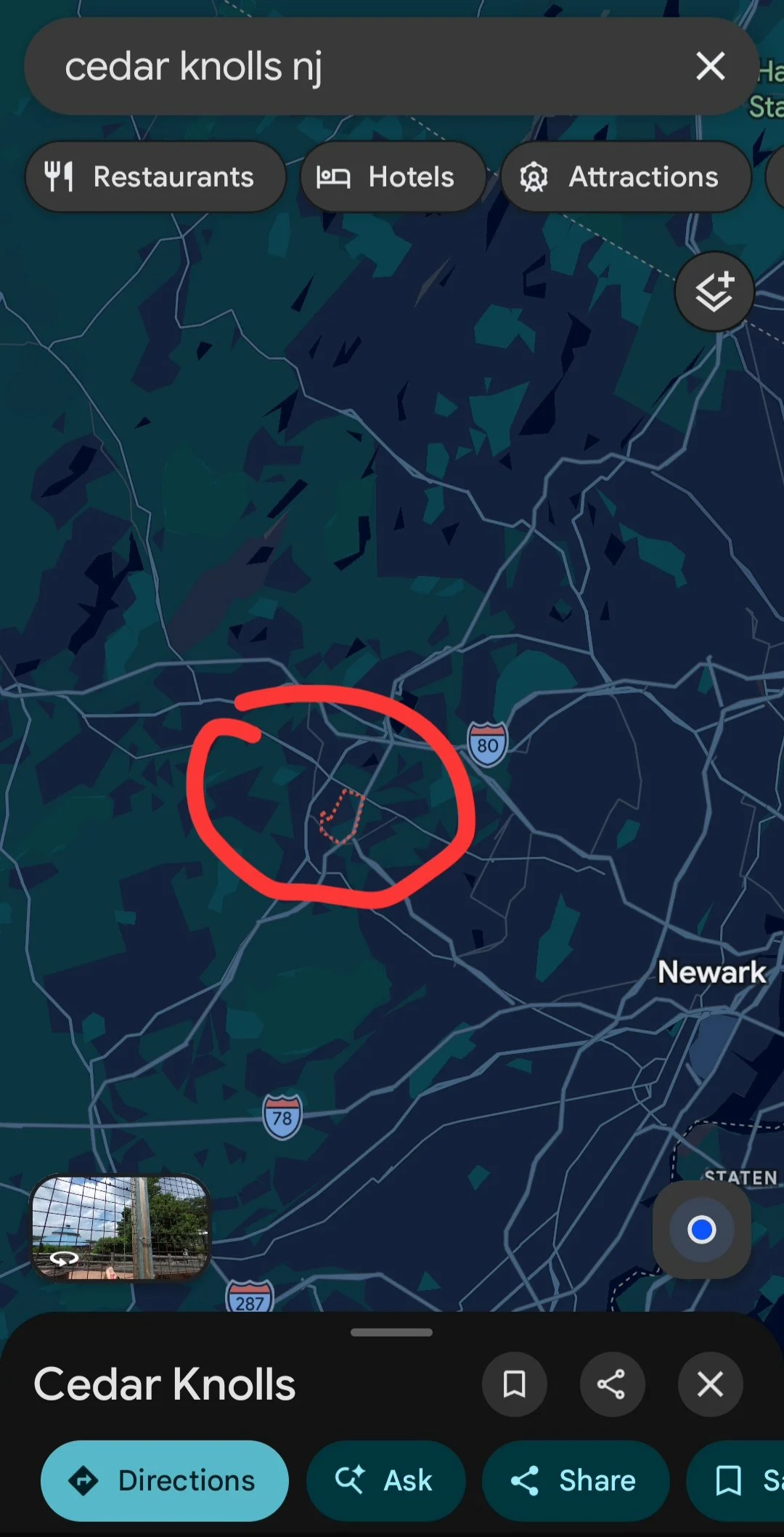
A quiet, family-friendly area. Not exactly what I would expect to be the center of a massive overnight traffic event on my website.
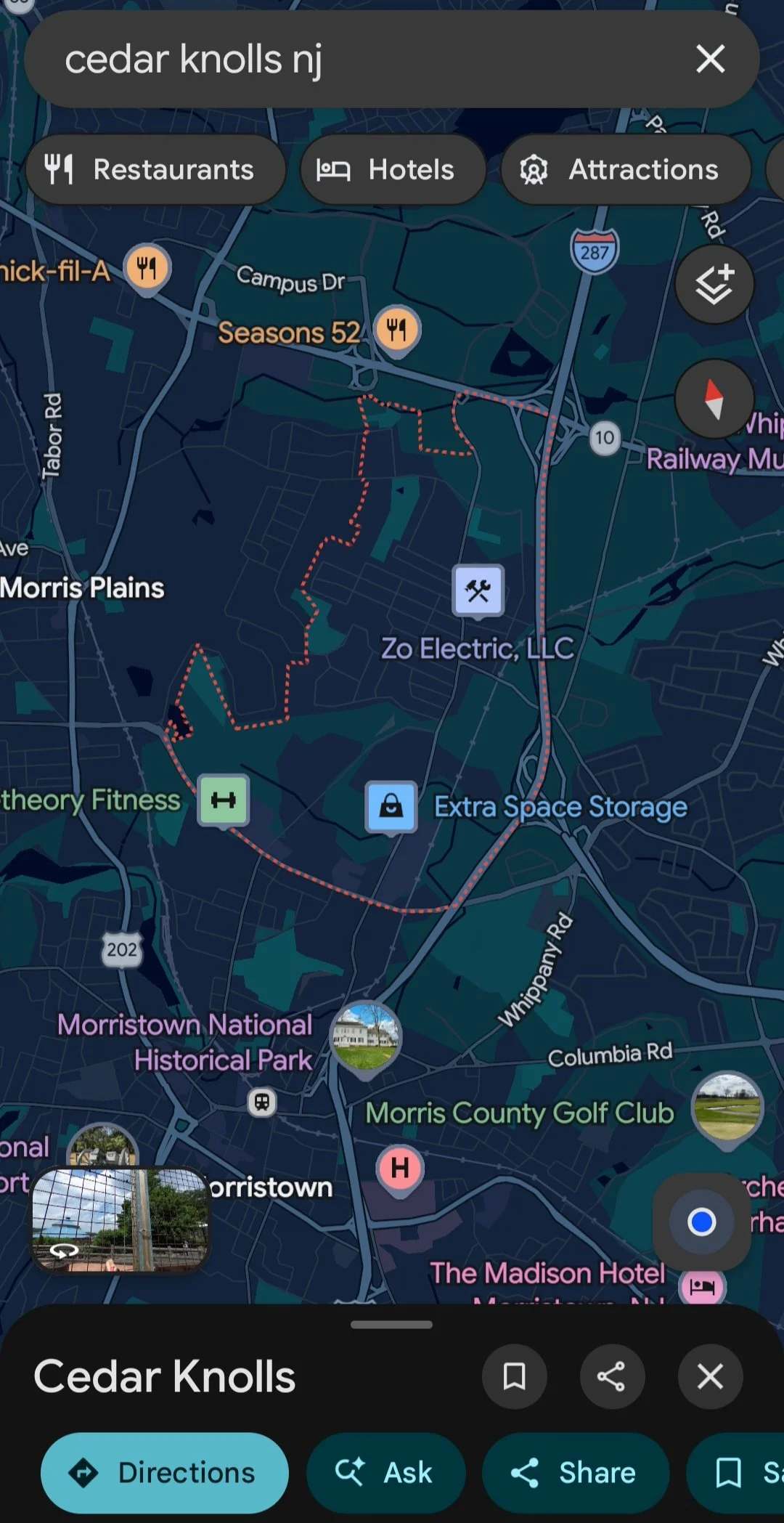
And then I looked a little closer.
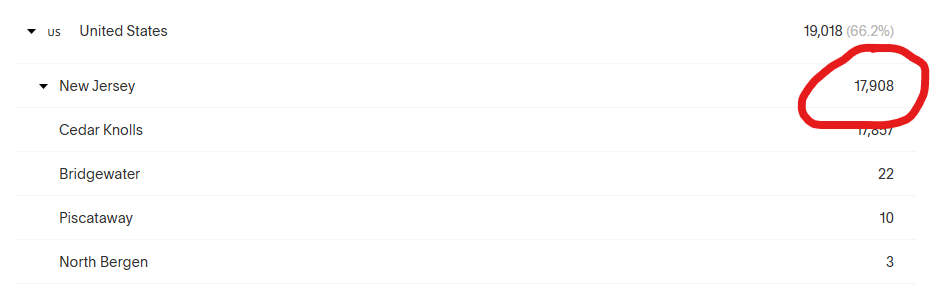
More than 17,000 hits. Seriously?
The activity log showed more than 17,000 hits from Cedar Knolls, NJ.
Seventeen thousand!
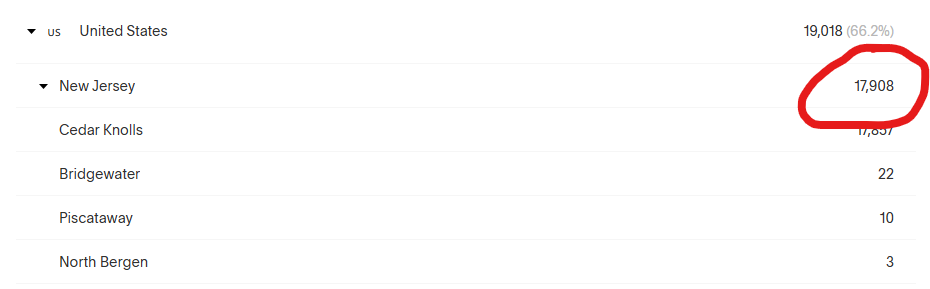
Just when I thought NielFlamm.com had finally taken off with the mainstream, reality brought me back down to earth. Quickly.
I was imagining thousands of people discovering my blog, reading about my adventures, checking out my movie reviews, and following along with my life.
Instead, I may have a traffic problem.
I don't know who's behind the activity. It could be automated traffic, a bot, a proxy, a data center, or something else entirely. Website geolocation isn't precise enough to identify an individual or establish who's actually responsible.
But the volume and speed were enough to get my attention.
So, I added another layer of protection.
One thing I've learned from running a website is that you don't just publish content and hope for the best.
There's SEO optimization, analytics, website security, domains, traffic monitoring, and a whole collection of technical details that I never expected to spend this much time learning.
I've learned more about websites and all the stuff that goes on behind the scenes than I probably needed to as a 54-year-old Gen'Xer.
But here's the thing: Never stop learning.
I added another layer of protection to my website because I don't intend to sit back and let unexplained traffic overwhelm it.
I want people to visit NielFlamm.com because they're interested in what I'm writing, not because some automated system has decided to make my website its new playground.
A question for Cedar Knolls
So, if you're the person—or whatever automated visitor is responsible—for all this activity from Cedar Knolls, New Jersey, I have a few questions.
Who are you?
What are you attempting to do?
And, perhaps most importantly...
How can I help you?
I mean, if you're going to visit my website more than 17,000 times, the least you could do is leave a comment.
Just don't crash the place.
And to everyone else who visits NielFlamm.com because you actually want to read something, thank you. I appreciate every real visitor.
As for Cedar Knolls?
I'm watching my analytics.
Apparently, I have a new neighbor. And they're very, very busy.
Stay tuned. This could get interesting.
One important note: A location shown in website analytics doesn't necessarily identify the person or organization generating the traffic. IP geolocation can point to a proxy, hosting provider, or other intermediary. I'm investigating the activity, not accusing Cedar Knolls residents of anything.