

Day 70: Nextdoor Is Becoming a White Paper on How Not to Communicate
At this point, my ongoing experience on Nextdoor could become a white paper on corporate communications.
Unfortunately for Nextdoor, it would largely be about what not to do.
There are two names that naturally come up in this conversation: Kelsey Grady, who leads Communications, and Nirav Tolia, because he's ultimately the CEO.
But for a moment, let's forget that today is Day 70 without receiving the detailed research I've requested.
Let's even forget that Communications finally responded by sending me links to the same blog posts I've been referencing—essentially answering a question I didn't ask.
I want to look at something bigger.
How Do You Communicate a Change Your Customers Aren't Going to Like?
Nextdoor has changed how businesses can participate in conversations.
As I've previously discussed, when a neighbor asks for recommendations for a service, businesses may encounter Nextdoor's new pay-to-comment model to respond as a business.
Think about who this affects.
The plumber.
The landscaper.
The handyman.
The house cleaner.
The dog walker.
The locally owned restaurant.
The contractor who has spent years building a reputation among neighbors.
These are precisely the kinds of small businesses that helped make Nextdoor useful in the first place.
And I've seen business owners who are not happy about the change.
Here's where my Learning & Development brain kicks in.
My first question isn't:
"Why are people complaining?"
It's:
"How was the change managed?"
Because when you're introducing a change that affects how people operate—and potentially their wallets—the communication strategy matters almost as much as the change itself.
Where Was the Buy-In?
I'm genuinely curious about what happened before rollout.
Was there a focus group of small-business users?
Was there a beta program?
Were businesses shown different pricing or participation models?
Was feedback collected?
Were objections identified before launch?
Did Nextdoor explain the business problem it was trying to solve?
Were longtime business users prepared for the change before suddenly encountering it?
And perhaps most importantly:
Did anyone ask the small businesses what they thought before asking them for more money?
I don't know the answers.
Maybe Nextdoor did extensive research.
If so, show us.
That's communication too.
Because good change management isn't simply:
"Here's the new policy. Good luck."
It's creating awareness, explaining the reason, gathering feedback, building understanding, addressing resistance and giving stakeholders an opportunity to participate in the change.
Will everybody agree?
Of course not.
You aren't getting 100% buy-in on a change that asks people to pay for something they previously did differently.
But there's a significant difference between:
"I don't like this change, but I understand how and why we got here."
and
"Wait...you're charging me for WHAT now?"
That's where communication earns its keep.
Kelsey and Nirav: This Is the Bigger Question
This is why my criticism goes beyond one unanswered research request.
Kelsey leads Communications.
Nirav leads the company.
So I'm increasingly interested in understanding the philosophy behind Nextdoor's communication strategy.
When people criticize the company, comments are often unavailable.
When I requested research, I spent weeks without an answer.
When Communications finally contacted me, I believe they answered something different from what I requested.
And now small businesses are publicly questioning a monetization change that directly affects how they participate on the platform.
These may look like separate issues.
I don't think they are.
They all raise the same fundamental question:
Is Nextdoor communicating with its stakeholders—or communicating at them?
That's a distinction worthy of a white paper.
Nextdoor talks extensively about community.
But community requires dialogue.
Businesses aren't just revenue opportunities.
Shareholders aren't just ticker symbols.
Users aren't just WAU.
They're stakeholders.
And stakeholder communication isn't measured by how many announcements you publish.
It's measured by whether people understand the message, have an opportunity to respond, and believe someone is actually listening.
Maybe Nextdoor's new business model ultimately proves successful.
Maybe businesses eventually embrace it.
But if the rollout creates unnecessary anger because the people affected weren't properly prepared, consulted or given a compelling reason to buy in, that's not simply a pricing issue.
That's a change-management and communications issue.
Day 70.

At this point, I'm not merely studying Nextdoor anymore.
Nextdoor is providing the case study.
Follow the continuing experiment and full timeline at NielFlamm.com/blog.
When a Communication Strategy Becomes a Communication Problem
I've spent 61 days documenting what I see as a fundamental communication failure at Nextdoor.
At this point, it's no longer one unanswered request.
Look at the pattern I've experienced:
Nirav Tolia blocked me on LinkedIn.
Comments are routinely turned off on Nextdoor's LinkedIn posts.
I've sent direct emails to Jacob Chavis, Nirav Tolia, Sarah Leary, Communications, and Investor Relations, but have not received a substantive response to my request.
And now there's another example involving Sarah Leary.
I had been commenting on an older X post she reposted about a Massachusetts community—if I remember correctly, Beacon Hill—preparing for significant snowfall and other neighborhood happenings.
The post eventually accumulated approximately 180 comments.
I'd estimate at least 75% were mine, documenting my ongoing Nextdoor experience.
Then the post disappeared.
To be clear: I don't know why it was deleted or whether my comments had anything to do with the decision.
But it got me thinking.
Yes, there may have been steam coming from my ears. 💨
If Nextdoor had an effective communication strategy for handling critical feedback, would any of this be happening?
That's when I started thinking about Kelsey Grady, Executive Vice President of Communications at Nextdoor.
I looked at the typical responsibilities associated with an executive communications role. At that level, we're talking about responsibility for an organization's internal and external messaging, brand reputation, public relations, crisis response, and advising executive leadership on communication strategy.
Which raises some fascinating questions.
Is ignoring my emails an intentional communications strategy?
Was blocking me on LinkedIn part of a strategy?
Is routinely disabling comments part of it?
Did anyone advise Sarah to remove that X post?
Or are executives individually deciding how—or whether—to engage?
I don't know.
I'm deliberately asking rather than pretending I know what happens inside Nextdoor.
But that's precisely why communication matters.
A coordinated communications strategy shouldn't leave outsiders spending 61 days trying to determine whether there even is a strategy.
And ultimately, responsibility travels upward.
Kelsey Grady may oversee Communications, but Nirav Tolia is CEO.
The buck eventually stops there.
One of the most important responsibilities of executive communications is crisis management.
Now, I'm certainly not suggesting one small shareholder asking for a study constitutes a corporate crisis.
But something that could have been resolved with a simple email has now generated 61 consecutive days of public commentary about Nextdoor's leadership, moderation, culture, investor relations, verification, business strategy and communication.
That's the part I find remarkable.
My grade for handling this particular situation?
Crisis Management: F.
Not because Nextdoor hasn't given me the answer I want.
Because after 61 days, Nextdoor still hasn't given me an answer.
Perhaps the most useful question isn't "Why does this shareholder keep posting?"
Maybe it's:
"How did we allow a simple request to become a 61-day public case study in communication?"
I'd genuinely like to hear Kelsey Grady's perspective on that one.
Join the discussion at NielFlamm.com/blog. Leave some feedback—I'd love to hear your perspective.

Day 53: Is the Market Celebrating Improvement or Ignoring the Questions?
As I write this, NXDR is up.
The market is clearly reacting positively to Nextdoor's latest earnings report.
I understand why.
The company reported a smaller loss than in previous quarters, along with revenue growth and improved operating metrics.
As a shareholder, I'm glad to see progress.
But I also see it differently.
To me, it's a bit like a marathon where you've consistently finished last and this year you finish second-to-last.
That's an improvement.
It deserves acknowledgment.
But you still didn't win the race.
Nextdoor is still reporting a GAAP net loss.
The company has now been operating for approximately 15 years, and while CEO Nirav Tolia described this as the company's best quarter, I believe it's also fair for shareholders to ask what "best" should ultimately look like.
For me, financial performance is only part of the equation.
Today also marks Day 53 since I requested a study from Jacob Chavis.
Fifty-three days later:

No study.
No acknowledgment.
No explanation.
No response.
I've also noticed that the last Nextdoor Insights article appears to have been published on July 6, 2026.
As a shareholder, I naturally wonder:
Are new studies still being produced?
Has the research strategy changed?
Is the Insights program on pause?
I don't know.
That's exactly why I've continued asking.
This isn't about criticizing improvement.
It's about asking whether improving financial results should also be accompanied by improvements in communication, transparency, and accountability.
Potential alone doesn't create long-term shareholder value.
Execution does.
Communication does.
Culture does.
One quarter doesn't define a company, just as one stock move doesn't define its future.
I'll continue recognizing progress when I see it, and I'll continue asking questions when I believe they're warranted.
That's what engaged shareholders should do.
Join the discussion at NielFlamm.com/blog. Leave some feedback—I'd love to hear from you.

Day 20: Still No Report. Still No Response.

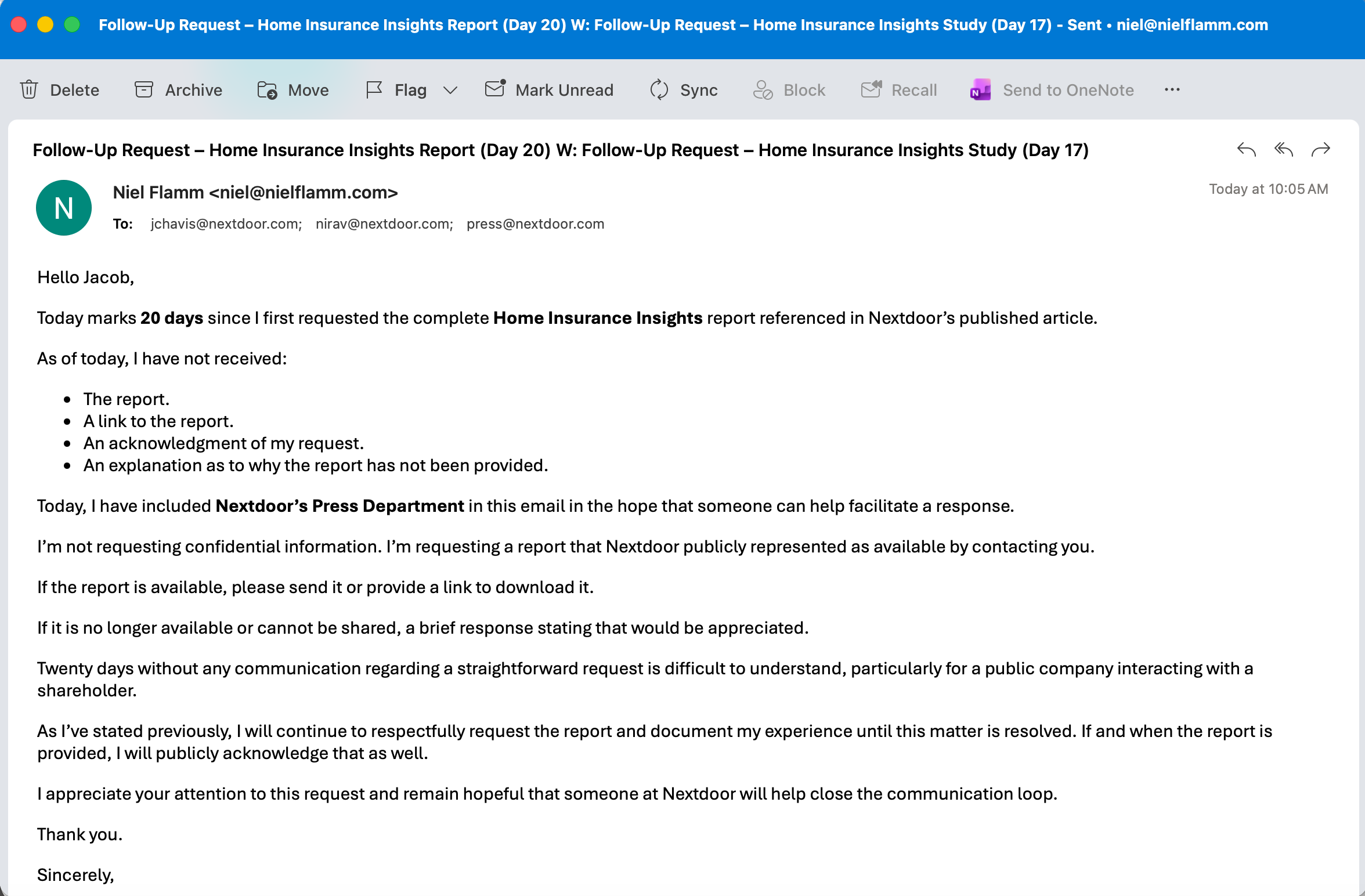
Today marks Day 20 since I requested the Home Insurance Insights report that Nextdoor publicly stated was available upon request.
This time, I included Nextdoor’s press email on my latest request. Perhaps the Communications team can help get the mouse wheel turning.
Frankly, I don’t have much faith that it will.
I also recognize that CEOs rarely manage every email themselves. It’s entirely possible that Nirav Tolia has an Executive Assistant who prioritizes correspondence, manages his calendar, coordinates speaking engagements, and keeps the day-to-day operations moving.
If that’s the case:
Executive Assistant, if you’re reading this, please flag this issue as important.
Twenty days without a response to a straightforward request from a shareholder is more than a missed email—it reflects on the organization’s communication culture.
Jacob Chavis, once again, I’m tagging you because the article identifies you as the contact for obtaining the report. My posts have simply documented a factual timeline: I requested the report, and 20 days later, I still have not received it or any acknowledgment.
That leaves me with one question.
If this isn’t your final professional role, how would you explain this situation in a future interview when discussing customer experience, responsiveness, or performance?
As I’ve said from the beginning, I’m not asking for special treatment.
I’m asking for the report Nextdoor said was available.
Join the discussion on NielFlamm.com.