
Day 109: Nextdoor Honored Five Great Neighbors. Only One Story Really Needed Nextdoor.
Day 109.
I'm still asking Nextdoor for the detailed data behind the original two Insights studies I requested.
But before getting into today's observation, let me give Nextdoor some credit.
You're welcome. 😂
I've spent 109 days publicly asking for the research Nextdoor said readers could request.
And recently, Nextdoor published a new study on neighborhood trust with substantially more methodology and research information than I've been asking to see.
I liked it.
I said so.
So, Nextdoor, you're welcome for the free accountability service.
Please let me know where the first two detailed reports I originally requested are.
I'm not asking for another summary.
Could you share the underlying research that started this 109-day project?
Now, About Those Good Neighbors
Nextdoor recently published its 2026 Good Neighbor Day honoree roll call.
And I genuinely like these stories.
They selected five honorees from more than 1,300 nominations, representing five regions of the country.
These are people doing exactly what good neighbors should do.
They're feeding people.
Helping someone recovering from a hospital stay.
Taking out trash cans.
Plowing driveways.
Maintaining neighborhoods.
Helping people when they need it.
Bravo.
But while reading Nextdoor's own descriptions of the five honorees, something jumped out at me.
Of the five individual stories, only one explicitly describes Nextdoor as part of how the actual good-neighbor work operates.
That would be Dorea in Raleigh, North Carolina.
Nextdoor says Dorea cooks free dinners for roughly 100 neighbors every Wednesday and that the operation “runs on Nextdoor.” By late September, the project had served more than 2,800 meals.
That's fantastic.
And that, to me, is exactly where Nextdoor makes sense.
A neighbor has a need.
Another neighbor wants to help.
Nextdoor becomes the conduit connecting them.
Simple.
Useful.
Local.
Neighborly.
Then I Read the Other Four Stories
The other four honorees are equally deserving.
But something is different.
Bhagwat Gupta spent years helping rebuild and improve his Texas neighborhood.
Dan Schaefer organized meals and continued helping a neighbor recovering alone.
Dan Brinsky plowed a neighbor's driveway throughout the winter so she could visit her husband in the hospital.
Karl and Debbie Word helped neighbors during a medical emergency and kept up their property while they dealt with it.
Wonderful stories.
But in Nextdoor's descriptions of those four acts, Nextdoor isn't presented as the mechanism that made the help happen.
The neighbors are the story.
Which got me thinking again about something I've been saying for months.
What Exactly Is Nextdoor?
Is Nextdoor a social-media platform?
Is it a neighborhood communication platform?
Is it a recommendation platform?
Is it a business-review platform?
Is it an advertising platform?
Is it a local-services marketplace?
Is it a research and consumer-insights company?
Is it a lead-generation platform for businesses?
Is it all of them?
Because maybe that's part of the problem.
Too many lanes.
I've questioned whether Nextdoor is trying to be so many things that its clearest value proposition gets buried underneath everything else.
And ironically, Nextdoor's own Good Neighbor stories may illustrate the question better than I ever could.

Dorea's Story Shows Me the Nextdoor I Understand
Dorea's story is incredibly easy for me to understand.
Someone cooks meals.
Other people need meals.
Neighbors volunteer.
People donate.
People help deliver.
Nextdoor helps connect them.
Boom.
There's the product.
There's the value.
That’s the reason the platform exists.
Nextdoor doesn't have to be the hero.
Dorea is the hero.
Nextdoor helps the hero find the people who need her—and helps other neighbors find a way to participate.
That's a powerful role.
In fact, I think it's more powerful than trying to make Nextdoor the center of every story.
Maybe the Best Version of Nextdoor Is the Conduit
This is where I keep coming back.
Nextdoor doesn't necessarily need to be the neighborhood.
The neighbors already are the neighborhood.
It doesn't need to create neighborliness.
People were helping the person next door long before there was an app for it.
Technology can make those connections easier.
Someone needs help.
Someone else can provide it.
Someone needs a recommendation.
Someone nearby has experience.
Someone lost a dog.
Someone three streets away just saw it.
Someone needs a plumber.
Someone nearby knows one.
Someone has extra food.
Someone else needs dinner.
Connect them.
That's a value proposition I can understand immediately.
But Then Come All the Other Lanes
Reviews.
Recommendations.
Advertising.
Business Pages.
Paid opportunities.
Consumer research.
Insights reports.
Social feeds.
Local discussions.
Business discovery.
Content.
AI.
And somewhere inside all of that is the original idea:
Neighbors connecting with neighbors.
Maybe all of those other businesses ultimately support that mission.
That's certainly a possible strategy.
But I think Nextdoor's own Good Neighbor post raises a worthwhile strategic question:
Has Nextdoor added so many lanes that the simplest reason for using Nextdoor has become harder to see?
The Good Neighbor stories don't prove the answer is yes.
But they certainly made me ask the question again.

Five Honorees. One Particularly Clear Platform Story.
That's what stood out to me.
Not because the other four honorees somehow matter less.
Quite the opposite.
Their actions are the entire point.
But Dorea's story gives me something the others don't:
A crystal-clear example of what Nextdoor itself contributed.
Nextdoor connected people.
That's it.
And that's enough.
Maybe Nextdoor doesn't need another lane.
Maybe it needs to become exceptionally good at the lane its own name has been describing all along.
Next. Door.
Neighbors helping neighbors.
Technology making the connection easier.
The people do the rest.
And now, back to Day 109
I gave Nextdoor credit for the latest research report.
I gave Nextdoor credit for recognizing these five neighbors.
And I'll continue giving the company credit when I think it gets something right.
Now let's finish some unfinished business.
Where are the detailed reports from the first two studies I requested?
It's Day 109.
You showed with the latest research that greater transparency is possible.
Great.
Now let's close the loop on the first two.
Then we'll be square.
Read Nextdoor's 2026 Good Neighbor Day honorees here:
Announcing Nextdoor's 2026 Good Neighbor Day honorees
👉 NielFlamm.com/blog
Nextdoor’s Good Neighbor Awards Get the Spirit Right. I Still Have Questions About the Selection Process.
Nextdoor is highlighting the honorees from its 2026 Good Neighbor Day program, and I want to start somewhere that may surprise people who have followed my ongoing Nextdoor posts:
Bravo. Seriously.
Nextdoor says it received more than 1,300 nominations and ultimately selected five honorees from different regions of the country. The stories are exactly the kinds of things I think deserve recognition: cooking meals for neighbors, helping someone recover after hospitalization, maintaining a neighbor's property during a difficult time, and years of service to a community. Nextdoor Blog
I love this stuff.
Being of Service Matters to Me
Being of service is an important part of my own recovery program.
Help somebody.
Extend my hand.
Be available when somebody needs me.
Do something for another person without constantly calculating what I'll get in return.
That's why I genuinely enjoy reading about these neighbors.
And I'll give Nextdoor additional credit for something else: the stories largely allow the neighbors' actions to stand on their own.
They're not simply commercials screaming, LOOK WHAT NEXTDOOR DID!
The people did these things.
The people deserve the recognition.
That's how it should be.
But Here Comes Niel With Another Question
I know. Shocking. 😂
Nextdoor has provided more information about the process than it did when I first started asking about the program.
The original nomination announcement said a committee of Nextdoor employees would select winners, with one winner per region. It said a panel would review the strongest nominations and score them based on how specific, sustained, and impactful the stories were. Nextdoor Blog
The final announcement provides a little more detail. Nextdoor says it scored nominations using a consistent rubric and reviewed them with Nextdoor employees. They selected the five honorees based on how specific and lasting the acts were and the difference they made. Nextdoor Blog
That's useful information.
But I still have questions.
Who was on the committee?
What roles did they hold at Nextdoor?
How were committee members selected?
What qualifications or experience did they bring to evaluating the nominations?
What did the scoring rubric actually look like?
Were nominations scored independently by multiple people?
Were scores averaged?
Did committee members discuss finalists and reach consensus?
Could someone recuse themselves if they knew a nominee?
Were there conflict-of-interest rules?
How did Nextdoor get from 1,300+ nominations to five people?
Those aren't accusations.
They're questions about process.
Even Reality Television Shows Us the Judges
Think about it.
American Idol doesn't tell viewers, “A committee listened to everybody. Trust us.”
We know who the judges are.
Dancing With the Stars doesn't hide the judging panel behind the ballroom curtain.
We see the judges. We see scores. We understand that there is a process.
Even competition programs built primarily for entertainment recognize that when people are being evaluated, the credibility of the process matters alongside the outcome.
I'm not suggesting Nextdoor needs Ryan Seacrest standing next to a giant scoreboard while an employee holds up a 9.5 for snow shoveling.
Although I'd probably watch that. 😂
I'm saying transparency makes recognition more credible.
Who Judges the Judges?
Here's the uncomfortable hypothetical.
Suppose someone selecting recipients of a community-service award had previously been convicted of embezzling money from a charity or employer.
Would that automatically mean that person couldn't recognize a good deed?
No.
But wouldn't people reasonably want to know who was making the decision?
I'd certainly want to know.
That's why an awards committee's identities, relevant qualifications, and conflict-of-interest standards can matter.
I'm not suggesting anyone on Nextdoor's committee has that kind of history. I don't know who the committee members were—that's precisely the point.
If Nextdoor wants people to trust a selection process, giving people enough information to understand that process would strengthen it.
Nextdoor Is Actually Close Here
This may be one of the stranger conclusions in my continuing Nextdoor case study:
I think Nextdoor got a lot right.
More than 1,300 neighbors apparently took the time to recognize someone else. Nextdoor Blog
Nextdoor established criteria.
It divided recognition geographically.
It published descriptions of how the honorees helped others.
It disclosed that employees participated in the selection.
And, most importantly to me, it largely kept the spotlight on the people actually doing the work.
That's good.
My issue is that Nextdoor stops just short of the transparency I'd like to see.
It tells us there was a committee.
Great. Who was on it?
It tells us there was a rubric.
Great. Show us the rubric.
It tells us nominations were scored.
Great. Explain how.
It tells us five people emerged from more than 1,300 nominations.
Great. Show us how the process got from Point A to Point B.
This Is Becoming a Familiar Theme
That question fits rather neatly into what I've been writing about Nextdoor under CEO Nirav Tolia for months.
Research methodology.
Detailed Insights data.
Communication.
Moderation.
Metrics.
Awards.
Again and again, I find myself arriving at essentially the same place:
Show us the process.
That's where I think Nextdoor's leadership continues to leave an opportunity on the table.
Transparency doesn't diminish these awards.
It could make them stronger.
Publish the committee.
Publish the rubric.
Explain the scoring and consensus process.
Explain conflict-of-interest safeguards.
Then get out of the way and let these neighbors enjoy the recognition they've earned.
Because on the most important part of this story, I have no complaints at all.
People helping other people deserve a spotlight.
As someone whose own recovery reminds me of the importance of extending a hand and serving others, I celebrate every one of them.
Bravo to the neighbors.
Now, Nextdoor, show us how you chose them.
👉 Read my continuing Nextdoor case study at NielFlamm.com/blog
Day 105: “The Power of We” Sounds Great. I’m Still Waiting for the “We.”
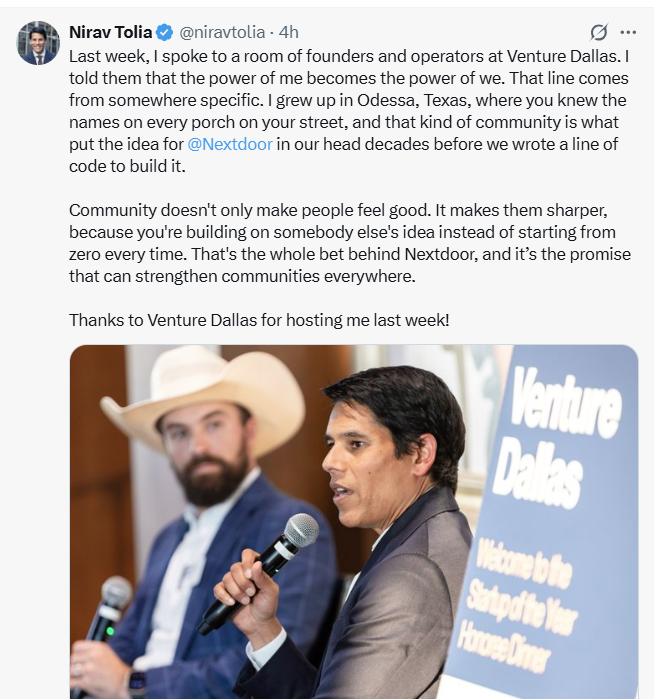
Today, Nextdoor CEO Nirav Tolia posted about speaking to a room of founders and operators at Venture Dallas.
One line immediately caught my attention:
“The power of me becomes the power of we.”
That's a pretty good line.
Actually, it fits remarkably well with what I've been writing about for the past 105 days.
Nirav went on to describe growing up in Odessa, Texas, where knowing the names of people on the street helped shape the idea behind Nextdoor. He wrote that community makes people sharper because they're building on other people's ideas instead of constantly starting from zero.
Then came another line that caught my attention:
“That's the whole bet behind Nextdoor.”
Venture Dallas itself describes its mission in similar terms: connecting innovators and investors while building collaboration and a stronger entrepreneurial community.
Great.
So let's talk about the “we.”
I've Been Trying to Join the Conversation for 105 Days
For 105 days, I've been asking Nextdoor about detailed data referenced in two of its Insights posts.
This hasn't been 105 days of demanding that somebody agree with me.
It hasn't been 105 days of demanding that Nextdoor change its business because one small shareholder has an opinion.
I've asked a question.
I've provided feedback.
I've emailed.
I've followed up.
I've publicly documented the experience.
Communications eventually responded, and I acknowledged that response. I didn't receive the complete, detailed material I requested.
Yesterday, I expanded the email to Nextdoor's Executive Team.
Those emails did not bounce.
I also attempted to CC members of the Board of Directors. Every one of those attempted Board addresses came back undeliverable.
I’m waiting to see if anyone on the Executive Team responds.
My prediction is still that nobody will.
I would love to be wrong.
“Building on Somebody Else's Idea”
This is where Nirav's post gets especially interesting to me.
He talks about the value of building on somebody else's idea.
That's exactly what feedback can be.
Sometimes feedback is wrong.
Sometimes it's annoying.
Sometimes the person providing it has misunderstood something.
Sometimes it's brilliant.
Sometimes it's somewhere in between.
But an organization doesn't figure out which it is by ignoring it.
My Learning & Development brain immediately goes to the difference between hearing and listening.
Hearing is receiving the message.
Listening requires doing something with it—even if the eventual response is:
“We heard you. We disagree, and here's why.”
That's still communication.
What Does “We” Mean When Someone Disagrees?
The “power of we” is easy when everyone in the room is nodding.
It's harder when somebody keeps raising his hand.
For 105 days.
😂
That's where community becomes much more interesting.
If Nextdoor believes communities become stronger by building upon the knowledge and ideas of other people, shouldn't that philosophy apply when the ideas are uncomfortable?
Shouldn't it include shareholders asking questions?
Small businesses providing feedback?
Neighbors questioning policies?
People challenging research methodology?
People asking how their contributions are being monetized?
People saying, “I think there's a better way to do this”?
I'm not suggesting every piece of feedback deserves implementation.
That would be ridiculous.
But feedback can at least deserve consideration and, when appropriate, an answer.
And Then There's the Other “We”
There's another reason the phrase jumped out at me.
I've recently been writing about the economic value of the information neighbors contribute to Nextdoor.
Recommendations.
Reviews.
Local experiences.
Business information.
Questions.
Answers.
Years of neighborhood knowledge.
Nextdoor provides the technology, infrastructure, and distribution.
Neighbors provide most of what's inside it.
That's a pretty literal example of “me” becoming “we.”
And if that collective knowledge becomes increasingly valuable—particularly as AI makes it easier to organize, search, and commercialize enormous amounts of information—I think there's a legitimate conversation about whether the people supplying that knowledge should share in some of the value it creates.
That's why I started my petition calling for a Neighbor Value-Sharing model.
It currently has one signature.
Mine.
I'm apparently dominating the polling. 😂
But I'm still asking the question.
Community Can't Just Be a Stage Message
I like what Nirav wrote.
I genuinely do.
Community can make ideas better. Collaboration can create things an individual never could. Venture Dallas itself is built around connecting entrepreneurs, investors, and innovators.
But that's also why I'm going to keep comparing the message with the experience.
“The power of me becomes the power of we.”
Okay.
I'm here.
I've been here for 105 days.
I've provided feedback, asked questions, and repeatedly offered to connect—phone, video, or virtual coffee, whatever works.
Yesterday, my email appears to have successfully reached the addresses for members of Nextdoor's Executive Team.
So perhaps Day 105 is the perfect day to test the philosophy.
Does the “we” include people who ask uncomfortable questions?
I hope so.
Because if community really is the whole bet behind Nextdoor, then listening to the community shouldn't be the difficult part.
Day 105.
Now I wait.
👉 Read the continuing case study at NielFlamm.com/blog
Coffee Chats with Donna: I Should Have Brought a Notebook
Today’s coffee delivery was a small Dutch Bros Americano with vanilla and cream.
And I have an update: my friend has a name.
Donna Woods.
She’s the woman I’ve been getting to know while visiting my mother at the skilled nursing facility. Our previous conversations have covered burgers, sweet tea, prosthetics, and enough pets to require a separate address book.
Today, the conversation continued. My ability to keep up did not.
I learned that her husband was a trash collector and later built a Toys “R” Us. Before I could get all the details, we had moved on to pecan ice cream, a strawberry shake, coffee and donuts, and Pensacola, Florida.
I believe that was the order. There may have been a connecting flight I missed.
I was still mentally standing in Toys “R” Us while Donna was already ordering dessert.
She had to be talking 200 words a minute. That’s my unofficial estimate. I didn’t have the equipment—or the processing speed—to verify it.
But I was enjoying myself.
I’m learning that I don’t need to capture every detail to enjoy a conversation with Donna. I can listen, follow what I can, and accept that I may leave with questions about how we got from trash collection to a strawberry shake.
Then Donna had things to do.
The 11 a.m. Coffee Chats were coming up, and she was rounding up people. She was meeting new residents, saying hello to nurses, and making sure people knew there was somewhere to go and someone to talk to.
I don’t know whether she has an official role in organizing any of this. From what I saw, she wasn’t waiting for a title.
Donna was working the room.
Watching her, I got to see another side of the friend I’ve been writing about. I’ve talked about the importance of stopping to listen and making time for people. Today, I watched Donna doing her own version of showing up: greeting people, introducing herself, and inviting them into a conversation.
She had a full social schedule, and she appeared ready to help everyone else acquire one.
I came into the facility because my mother is there. Along the way, I’ve found myself looking forward to these conversations, too. Each visit, I learn a little more about Donna—and see a little more of the community around Mom.
Today, that community included an enthusiastic recruiter and an 11 a.m. coffee appointment.
Next time, I may bring a notebook.
Although at Donna’s pace, I should probably learn shorthand first.
Day 101: Nextdoor Said It. The Person Behind the Post Is Doing the Work.
I missed yesterday on LinkedIn, although I posted almost everywhere else.
So, welcome to Day 101.
NXDR closed today at $2.38, down 4.8%.
But something Nextdoor posted on LinkedIn caught my attention even more.
Read Nextdoor's LinkedIn post.
It highlights Jessica Spann, a Charlotte educator whose work supporting students ultimately caught the attention of The Drew Barrymore Show.
Then I got to Nextdoor's final sentence:
“Local posts have a way of traveling when the person behind them is doing the work.”
ABSOLUTELY!
That's my point.
Jessica did the work.
Jessica made the impact.
Jessica created something worth talking about.
Nextdoor provided the platform that helped amplify it.
That's valuable too.
But if Nextdoor recognizes that the person behind the post is doing the work, why shouldn't we also talk about that person participating in the value their contributions help create?
Think of Nextdoor as the funnel.
The funnel helps direct the gasoline.
But the gasoline makes the engine run.
Neighbors provide the stories, reviews, recommendations, conversations, and local knowledge that keep the platform interesting.
That's why I started the Neighbor Value-Sharing Petition.
And, for transparency, I remain its sole signer. 😂
I need signature No. 2.
If you believe neighbors should participate in the value their contributions help create, sign it. Then share it.
Sign the Neighbor Value-Sharing Petition
Nextdoor said it, not me: the person behind the post is doing the work.
Now let's talk about sharing the value created by that work.
👉 Full Day 101 post: NielFlamm.com/blog